 info@bamchocolate.com
  Login
Login 

 en
en 
 BAM Cake converter
  Login
Login Urša R.
Ustvarjalka vsebin


 Reading time:
3 minutes
Reading time:
3 minutes 
Although cocoa was brought to European courts by European colonisers in the 17th century, it was originally used as it was by South American peoples: as an accompaniment to cooked dishes and as a beverage. Contrary to popular belief, the Aztecs and Mayans did not make chocolate from cocoa - something we have come up with in Europe. Chocolate production was originally boutique. In the back of the chocolate shops, chocolates were prepared by hand from cocoa and other ingredients, poured into moulds and filled with fillings, and then each chocolate praline was hand-decorated and placed in a glass case in the shop. The tiny chocolates were expensive and had to be eaten as quickly as possible.
Be grateful - someone has just told you, without words, exactly what you wanted to hear!
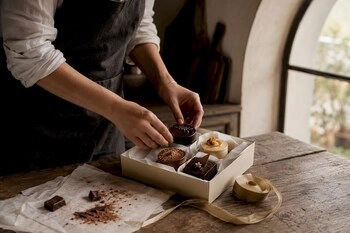
The first candy box, i.e. a box of different chocolates, is said to have been created in 1854, and the reasons were purely practical: when a lady bought a large number of pralines, she had to make sure that they were packaged accordingly. The box had to be of a nice appearance to reflect the value of the contents, as chocolates were often given as a token of affection even then. And to make sure that the visit to the chocolatier did not take too long and that the choice was not too difficult (imagine impatient men), the makers prepared bonboniers - neat boxes already filled with the delicious snacks. In 1868, heart-shaped boxes were made for the first time to give to women on the occasion of courtship, and are now used mainly on Valentine''s Day. In 1899, Queen Victoria made the bonboniere not just a token of love, but also of gratitude and respect. She sent chocolates in metal boxes to the soldiers fighting the Boer War in South Africa to help them enter the year 1900.
Do you want to know why chocolates were such a special gift? Let''s convert the numbers. Back in 1933, a British Black Magic cost a hundred shillings. That compares to around 250 euros! The owners of this brand (now part of Nestle) decided to adapt production and make chocolates more affordable. And they revolutionised the price: their candy bar with ten pralines reached a price of just over two shillings, or five euros for us. The company was a huge success and the brand has endured to the present day, with chocolates becoming a commonplace way of expressing affection. As a point of interest, Rowntree, which produced the first sweets ''for the masses'', also produced the well-known Kit Kat chocolate in the same decade.
We humans are strange creatures who often find it quite difficult to express our feelings. We put a lot of weight on words, which makes it hard to get them off the tongue, and we are also afraid of expressing ourselves awkwardly. Do you often repeat words in your mind that need to be said at the right moment, in the right way, and especially to the person who is important to you? Perhaps psychologists consider the inability to verbally thank, apologise or express love to be a sign of an immature and, above all, insecure personality, but we have to admit that humans are not made according to the ideals of psychology. If you can''t find your way around the simple phrase "I love you" because it makes your knees weak, if you can''t find the right words to express your regret, and if a whole novel would be insufficient to describe your gratitude, help yourself in a very simple way: give a candy bar!
Just as in the past, a box of chocolates is an expression of affection (despite its much lower and affordable price). It is chocolate in the form of a gift, not usually bought for oneself, but always for the person of one''s choice. To help us define our feelings in even greater detail, the manufacturers have done an excellent job by providing different shapes and designs for the boxes, as well as different forms of chocolates. For example, the box often says ''thank you'' or ''I love you'', and imaginative boutique manufacturers even add verses from songs, quotes and their own creative writing to the boxes, similar to the writing on greeting cards. That way you can always find a box that''s just right!


 Confectionery tips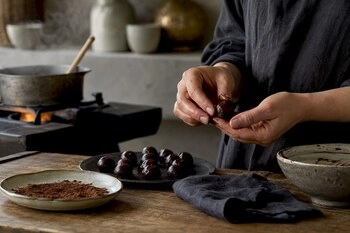


 Slovenščina
 Hrvatski
 Deutsch
 Italiano
 Česky
Česky
 Polski
 Magyar
 Français
 Slovák
 Nederlands
 Español