 info@bamchocolate.com
 Login


 en

 BAM Cake converter
 Login
Claudia
Avtorica vsebin


 Reading time:
9 minutes
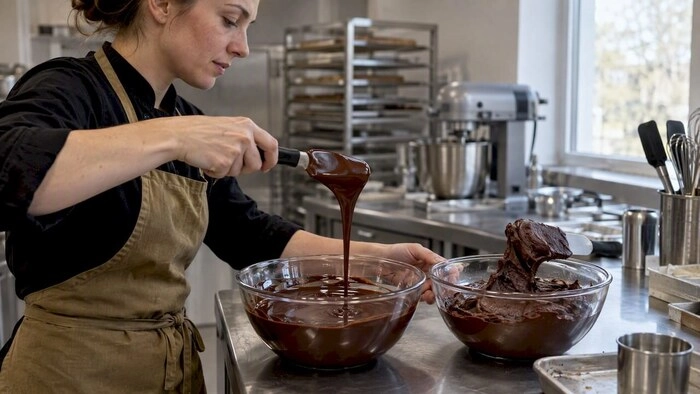
Compare chocolate glaze and ganache by texture and use. Learn how ratios shape the finish, fix common problems, and find baking supplies at BAM.
Ganache is a chocolate-and-cream emulsion that gives a thicker, creamier finish; a chocolate glaze is a thinner, shinier coating made using chocolate or cocoa plus a liquid and fat. Choose ganache when you want richness, structure or a filling that holds its shape. Choose glaze when you want shine, a thin coat and minimal fuss, as on a donut or a quick Bundt.
Ganache starts simply: chocolate melted into hot cream, sometimes with butter, sugar or flavourings stirred in afterwards. The ratio of chocolate to cream decides almost everything about the final texture, from a thin pourable sauce to a stiff piping paste.
One well-cited review found that chocolate ganache behaves as an oil-in-water emulsion while hot, then shifts into a bicontinuous fat-and-water network as it cools, which is why the same recipe can look glossy at 35°C and set firm by the next morning. This matters practically: the chocolate’s cocoa solids and fat content, not just the cream quantity, determine how hard the finished ganache goes, according to research on ganache formulation.
Cooling speed also plays a role. A ganache cooled slowly at room temperature tends to form a more even, stable structure than one shocked in the fridge, which can affect how smoothly it pipes or spreads later. For home baking, this means resisting the urge to rush a ganache into the freezer when you need it to set for piping: a gentler cool gives a more predictable result.
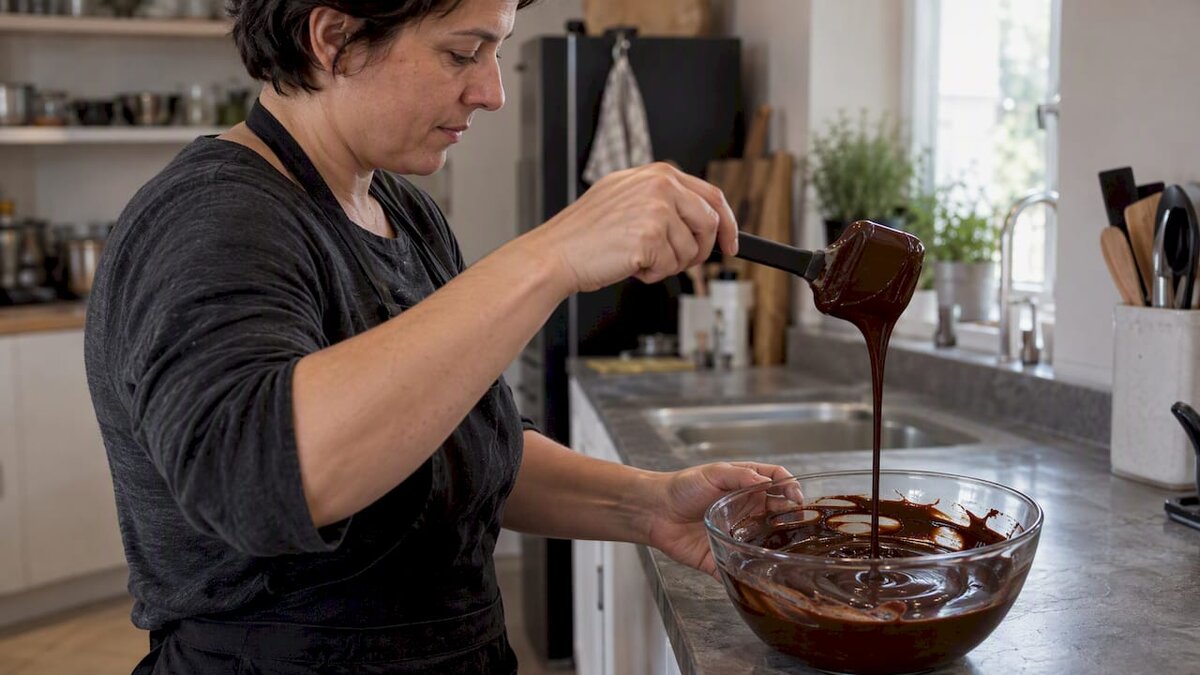
A glaze is built for shine and thinness rather than body. Most home-baking glazes fall into a few recognisable types, and each behaves differently once it hits the cake or pastry.
Butter or oil glazes combine melted chocolate or cocoa powder with butter, oil or a splash of milk, poured warm for a thin, glossy coat that firms lightly but stays soft to the bite.
Quick cocoa glazes mix cocoa powder, sugar, a liquid such as milk or water, and a little fat, useful when there is no bar chocolate on hand.
Mirror glazes add a gelling agent, usually gelatin or a plant-based alternative, along with glucose syrup for an intensely glossy, almost lacquered finish that sets with a defined skin.
Glaze shine comes largely from fat and sugar content rather than from the emulsion structure that defines ganache. A butter glaze stays soft enough to cut through cleanly, while a gelatin-set mirror glaze firms into a thin, glass-like layer that holds crisp edges when poured over a chilled cake. Home bakers generally reach for a simple glaze on donuts, bundt cakes or a quick finish over a loaf, saving the more involved mirror glaze for cakes meant to look polished with minimal piping work.
Lined up side by side, the practical differences become easy to act on.
| Feature | Ganache | Chocolate glaze |
|---|---|---|
| Core ingredients | Chocolate and cream (plus optional butter) | Chocolate or cocoa, a liquid, and fat (plus gelatin or glucose for mirror styles) |
| Typical ratios | 1:1 pourable, 2:1 firm, up to 3:1 pipeable | No fixed ratio; thinner liquid-to-fat balance throughout |
| Final texture/finish | Creamy, dense, matte to semi-gloss | Thin, glossy to mirror-like sheen |
| Best uses | Filling, truffles, piping, drip cakes | Donuts, bundt cakes, quick cake toppings |
| Setting behaviour | Firms as fat crystallises on cooling | Sets soft (butter glaze) or firm-skinned (gelatin mirror glaze) |
| Ease of preparation | Simple but ratio-sensitive | Generally quicker, fewer failure points |
These five methods cover the ganache textures and glaze styles most home bakers need, scaled for a standard 20cm cake or roughly 20 to 24 truffles.
Pro Tip: Keep a digital thermometer nearby when working with mirror glaze: pouring a few degrees too hot or too cool is the most common reason the shine falls flat.
Scaling any of these recipes up or down keeps the ratio fixed, so doubling a 1:1 ganache simply means doubling both chocolate and cream. Milk or white chocolate can replace dark chocolate in most recipes, but expect a softer set, so reduce the cream slightly or increase the chocolate-to-cream ratio to compensate for the lower cocoa solids.
Most ganache and glaze problems trace back to temperature or ratio, and most are fixable without starting again.
Hot ganache behaves as an oil-in-water emulsion that reorganises into a bicontinuous fat-and-water structure as it cools, which is why the same mixture can pour smoothly one moment and set firm the next.
Food-science reviews describe ganache in exactly these terms: an emulsion whose stability depends on the balance between its aqueous and fat phases, as detailed in a 2017 study on ganache structure. Separate experimental work measuring ganache texture found that altering a chocolate’s solid fat content changed hardness, spreadability and melting behaviour, according to research on ganache microstructure, which explains why swapping dark chocolate for milk chocolate in the same recipe rarely gives the same result. These findings line up with the ratios above: more cocoa solids and fat push ganache toward the firmer end, so matching chocolate type to ratio, rather than following a ratio blindly, gives the most reliable outcome. We stock the couverture and dark chocolate referenced in these ratios through our BAM Chocolate range, chosen for consistent cocoa solid content batch to batch.
A rule of thumb: richness and structure call for ganache, speed and shine call for glaze. For a birthday cake where texture matters, a 2:1 ganache is recommended; for a quick weeknight bundt, a butter glaze does the job in minutes. Try both on the same cake before deciding which one you prefer.
— Andraz
Getting the ratios above right starts with chocolate that behaves consistently, which is why we built BAM Chocolate around premium, carefully sourced cocoa content for ganache and glaze alike. Our baking accessories range covers the thermometers, bowls and spatulas these methods call for, so one order sets you up for both techniques.
A butter or oil-based glaze firms lightly but stays soft to the bite, while a gelatin-set mirror glaze sets with a defined, firmer skin. Neither hardens as densely as a chilled ganache, since glazes carry less fat and chocolate relative to liquid.
Melt chocolate or cocoa powder with butter or oil and a small amount of liquid such as milk, stirring until smooth and glossy, then pour it warm over a cooled dessert. Mirror glaze adds glucose syrup and gelatin for a reflective, high-shine finish.
Chocolate on its own is a solid confection made from cocoa solids, cocoa butter and sugar, while ganache is chocolate melted together with cream to form an emulsion. That emulsion is what gives ganache its soft, spreadable texture rather than the firm snap of plain chocolate.
Yes, a firmer 2:1 or 2.5:1 ganache spreads well as icing and holds clean edges once set, and a whipped ganache gives a lighter, frosting-like texture for piping. A 1:1 pourable ganache works better as a glaze-style topping than as a structured icing.


 Confectionery tips



 Slovenščina
 Hrvatski
 Deutsch
 Italiano
 Česky
 Polski
 Magyar
 Français
 Slovák
 Nederlands
 Español