 info@bamchocolate.com
 Login


 en

 BAM Cake converter
 Login
Claudia
Avtorica vsebin


 Reading time:
11 minutes
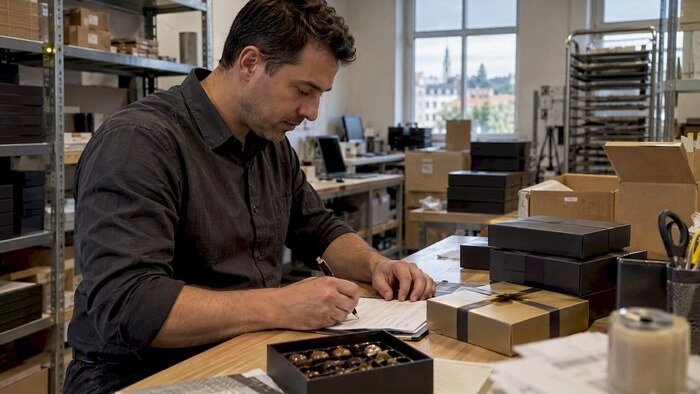
Plan corporate gifts in Slovenia with production times, courier expectations, workback deadlines, peak season advice, and two worked timeline examples.
Allow several weeks from order to in-hand delivery for most corporate gifts, and expect a longer window for bespoke kitted sets or large quantities. The variable that moves this window most is production complexity: custom branding, engraving and multi-component kits all add days that courier speed cannot claw back. Approvals and peak season matter too, but production is where plans usually slip.
Production time depends on what the gift is, not just how many you need. Custom apparel and printed materials carry setup costs before the first unit even starts: screen printing or embroidery needs tooling, proofing adds a review cycle, and many suppliers hold minimum order quantities that affect how a run is scheduled. A straightforward reorder with existing artwork moves faster than a first-time design.
Gourmet food and curated gift boxes bring a different set of constraints. Ingredient sourcing can be seasonal, some confectionery items are made in batches tied to availability, and anything perishable needs a shelf-life check before it ships, particularly when the gift will sit in transit or storage for several days. Food gifts also need packaging that protects both the product and the brand presentation, which is a separate production step from making the item itself.
Personalised and engraved items add a per-piece time cost that scales with volume in a way bulk-printed goods do not. Engraving a name, a laser-etched message or a monogram takes a fixed number of seconds or minutes per unit, so a 500-piece order with individual names takes meaningfully longer than 500 identical units. Build this into your estimate rather than assuming personalisation is a flat add-on.
Kitted gifts, meaning boxes that combine several separate items into one package, depend on component availability as much as assembly. If every component is in stock, assembly is mostly a packing and quality-check exercise. If one component needs its own production run, the kit’s lead time is set by the slowest part, not the average.
The simplest distinction to keep in mind when comparing quotes is local stock versus bespoke sourcing. A gift built from items already warehoused and ready to pack can often ship within days. A gift that requires custom tooling, imported components or made-to-order food items needs weeks, and the gap between those two scenarios is usually the single biggest planning error corporate buyers make.
A few practical markers worth noting:
Once a gift is produced and packed, transit time depends on the lane and the service level chosen. Domestic deliveries within the same country are typically next business day. Within Europe, standard transit tends to run one to three business days. Outside Europe, expect three to seven business days or longer, depending on customs processing and the destination country’s own clearance speed.
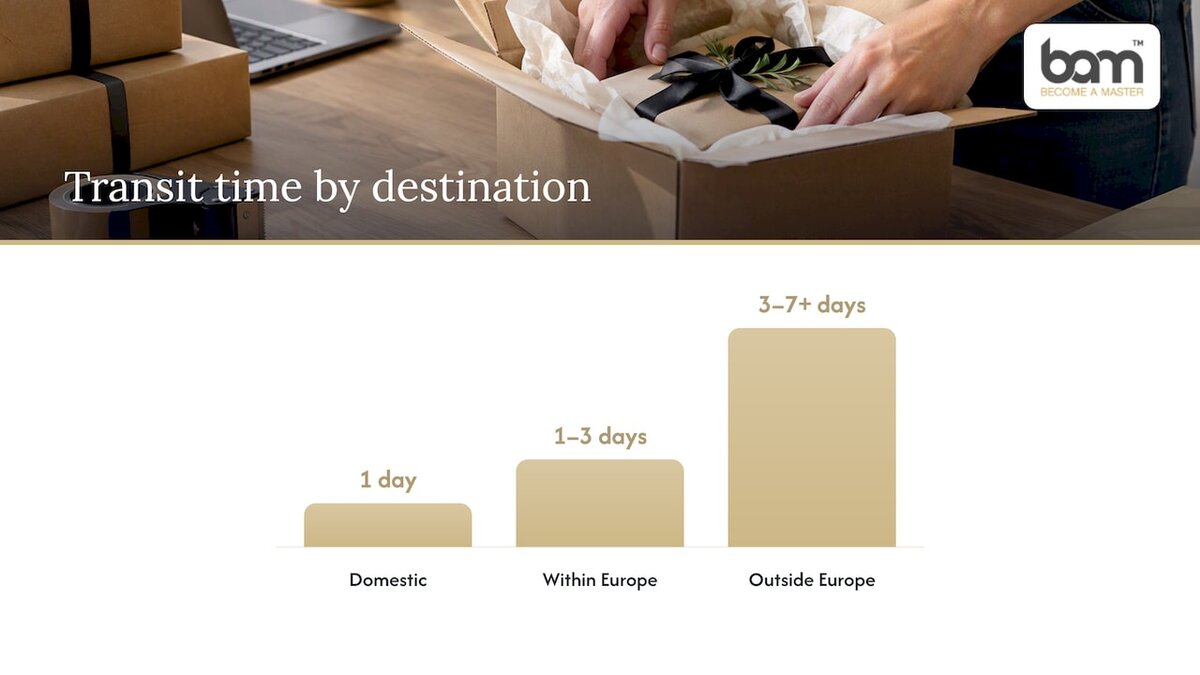
Domestic parcels typically arrive the next working day, with 24 to 48 hours to neighbouring European countries and 72 to 120 hours for many further destinations, according to GLS delivery service descriptions for Slovenia. These bands are a reasonable planning anchor for most corporate orders, though actual transit can run faster or slower depending on the specific courier and route.
Time-definite and guaranteed services exist for situations where a standard window will not do. DHL Express’s service and rate guide lists premium options such as delivery by 9:00 or by 12:00 on many European lanes, alongside next- or second-business-day standard express services. These guaranteed slots carry optional service charges on top of standard freight, so they are worth reserving for genuinely time-critical shipments rather than building into every order by default.
Cut-off times change which day a parcel actually leaves. GLS pick-up rules state that orders placed by 4pm are generally collected the next working day, while parcels dropped at a locker before 10:00 may be dispatched the same day. Missing a cut-off by even an hour can cost a full day of transit, so it is worth confirming the courier’s daily pick-up schedule rather than assuming same-day collection.
A few points worth checking before you commit to a delivery date:
The most reliable way to set an order-by date is to work backwards from the day the gift needs to be in the recipient’s hands, not forwards from today. Each stage subtracts a block of time from that fixed point until you reach the date you need to place the order.
Approval time is the stage most planners underestimate. A single round of sign-off might take two or three working days when one person owns the decision, but committee-based approval, where multiple stakeholders each need to weigh in, routinely stretches that to a week or more, simply because feedback arrives at different times and often conflicts.
Pro Tip: Name one person as the single approval owner before the project starts: it collapses a multi-round sign-off cycle into a single pass and is one of the most reliable ways to protect a tight deadline.
Running the workback method on paper, even as a simple worksheet, turns a vague “we need this soon” into a specific order-by date that you can defend to a client or an internal budget holder. It also makes clear, early, whether the requested in-hand date is realistic for the gift type chosen, which is a far easier conversation to have at the start of a project than two weeks before an event.
The fourth quarter is the hardest stretch of the year to secure fast turnaround on corporate gifts. Holiday orders, year-end client appreciation gifts and conference season all land in the same few weeks, which stretches both production slots and courier capacity at once. Bespoke kitted orders are hit hardest, since suppliers can usually add a shift for standard printed goods but cannot easily expand hand-assembly capacity on short notice.
Event lead-ins carry a similar risk on a smaller scale. A conference, product launch or awards dinner compresses the whole workback schedule into a fixed window, and any slip in approvals or production eats directly into the delivery buffer.
A few tactics reduce this risk without requiring a larger budget:
Phased delivery is worth accepting rather than fighting when a full on-time batch genuinely is not achievable. Communicating a staggered arrival clearly, both internally and to recipients where appropriate, is far less damaging than a late, rushed, all-at-once delivery that arrives after the event it was meant to mark.
We built our Gifts collection and BAMBox™ format specifically to cut the approval friction that stretches corporate gifting timelines. Working with one supplier for curated boxes, rather than coordinating separate vendors for chocolate, packaging and branding, removes a round of back-and-forth from the schedule.
When ordering a corporate package, we work on quantity, packaging, and any corporate branding requirements, and can set up account arrangements for invoicing as needed.
A few things that help us pack and dispatch your order faster:
Most corporate gifting delays trace back to one habit: treating the order-by date as a feeling rather than a calculation. The planners who hit deadlines reliably are not the ones with bigger budgets. They are the ones who run the workback arithmetic before they fall in love with a bespoke idea, and who accept early that a fixed event date sometimes means a simpler gift, not a late one.
The conventional advice to “order as early as you can” is true but useless on its own, because it gives no number. A planner needs a date, not a sentiment.
Example A, a quick off-the-shelf order of 50 standard gift boxes with no personalisation, needs roughly two weeks: a few days for approval, under a week for production from stock, and a short transit window with a modest buffer.
Example B, a bespoke kitted order of 1,000 personalised boxes, needs eight to ten weeks: approval, custom sourcing, per-unit personalisation and assembly each add their own block, with a larger delivery buffer because more components mean more points of possible delay.
The buffer in each example scales with the number of moving parts, not with the order’s importance.
— Andraz
Choosing a single supplier for the full corporate gift, rather than assembling it from separate vendors, can reduce approval rounds and simplify order management. Our Gifts collection offers curated, ready-to-send options, and our BAMBox™ format gives you a pre-curated box that can be branded for corporate orders without starting the design process from scratch.
If you are planning a corporate gift and want a straightforward route to an in-hand date you can rely on, get in touch to request a quote or set up a corporate account with us.
Corporate gifting is a B2B activity: a business buys and sends gifts to clients, partners, employees or prospects, rather than a consumer buying for personal use. The same gift items can sometimes exist in a consumer catalogue, but the ordering process, invoicing and bulk quantities are what make it a B2B transaction.
Corporate gifting is shifting towards fewer, higher-quality curated gifts rather than multiple smaller items, a shift some planners describe as a move from a “three gift” approach to one standout gift. This aligns with broader interest in sustainability and recipient feedback, since a single well-chosen item tends to land better than several minor ones.
A corporate gift is a legitimate, standard business practice when it comes from a known supplier with clear invoicing, product descriptions and delivery terms. Checking a supplier’s product pages, order process and account options before committing to a large order is a reasonable way to confirm legitimacy.
The “3 gift rule” refers to an older corporate gifting approach of sending a small bundle of multiple modest items rather than one larger gift. Current practice is moving away from this towards a single, higher-quality curated gift, which tends to be easier to personalise and ship within a predictable lead time.



 Confectionery tips




 Slovenščina
 Hrvatski
 Deutsch
 Italiano
 Česky
 Polski
 Magyar
 Français
 Slovák
 Nederlands
 Español