 info@bamchocolate.com
  Login
Login 

 en
en 
 BAM Cake converter
  Login
Login Claudia
Avtorica vsebin


 Reading time:
8 minutes
Reading time:
8 minutes 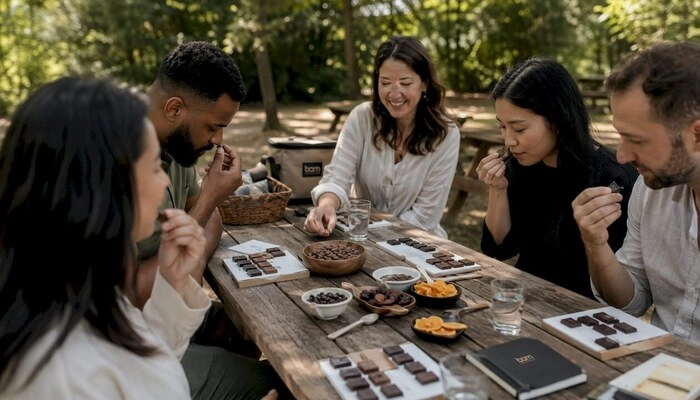
Master the art of tasting chocolate as we explain chocolate flavor notes, from aromas to textures. Discover your favorite profiles today!
Chocolate flavor notes are the distinct tastes, aromas, and textures you detect when tasting chocolate. They reflect everything from the cacao bean’s origin and genetics to the roasting and conching decisions made during production. The core taste components are sweetness, bitterness, sourness, acidity, and astringency. Aroma categories span cocoa, fruity, floral, nutty, vegetal, and spicy. Mouthfeel descriptors cover creamy, melting, astringent, and snap. Together, these elements form a complete chocolate flavor profile:
The IICCT flavor profile map and Barry Callebaut’s Consumer Chocolate Sensory Wheel both use this three-part structure to give tasters a uniform sensory language. For dark chocolate, you need nine descriptors (sweetness, sourness, bitterness, cocoa, roasted, fruity, creamy, melting, astringent) to fully characterise a single chocolate’s taste experience; white chocolate requires seven.
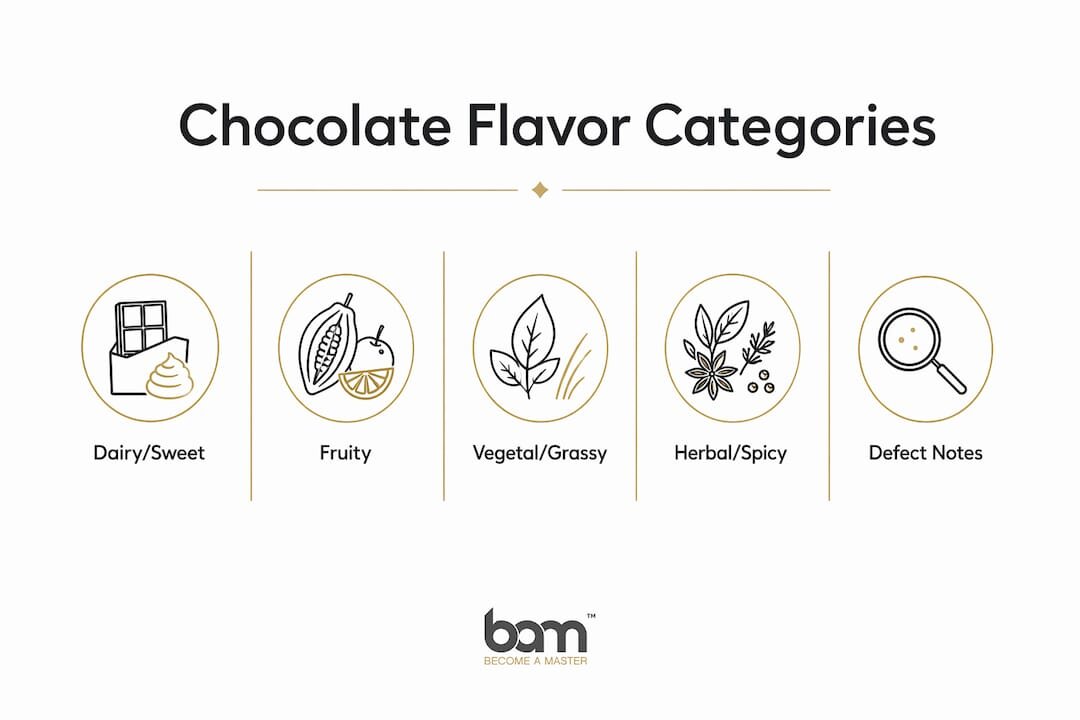
The International Institute of Chocolate & Cacao Tasting (IICCT) organises positive flavor notes into four main categories. Each one covers a distinct family of aromas, and knowing them helps you place what you are tasting quickly.
| Category | Example notes |
|---|---|
| Dairy/Sweet | Butter, cream, caramel, toffee, dark sugars, honey, maple syrup |
| Fruity | Citrus, red berry, dried fruit, stone fruit, tropical, wine-adjacent |
| Vegetal/Grassy | Cut grass, hay, chlorophyll, green leaves, loam |
| Herbal/Spicy/Woody/Nutty | Cinnamon, hazelnut, walnut, jasmine, cedar, capsicum, rum, coffee |
Alongside these positive categories, the IICCT defect categories cover Chemical, Medicinal, Earthy/Organic, and Savory/Mineral faults. Detecting a solvent-like or medicinal note signals a problem with the beans or the fermentation process, not a stylistic choice.
Sensory wheels and flavor profile maps organise all these notes visually, moving from broad families in the inner ring to specific descriptors on the outer edge. For dark chocolate, the full tasting picture requires nine descriptors: sweetness, sourness, and bitterness for taste; cocoa, roasted, and fruity for aroma; creamy, melting, and astringent for mouthfeel. White chocolate needs only seven, with no bitterness or sourness in the profile.
Key positive note families to know:
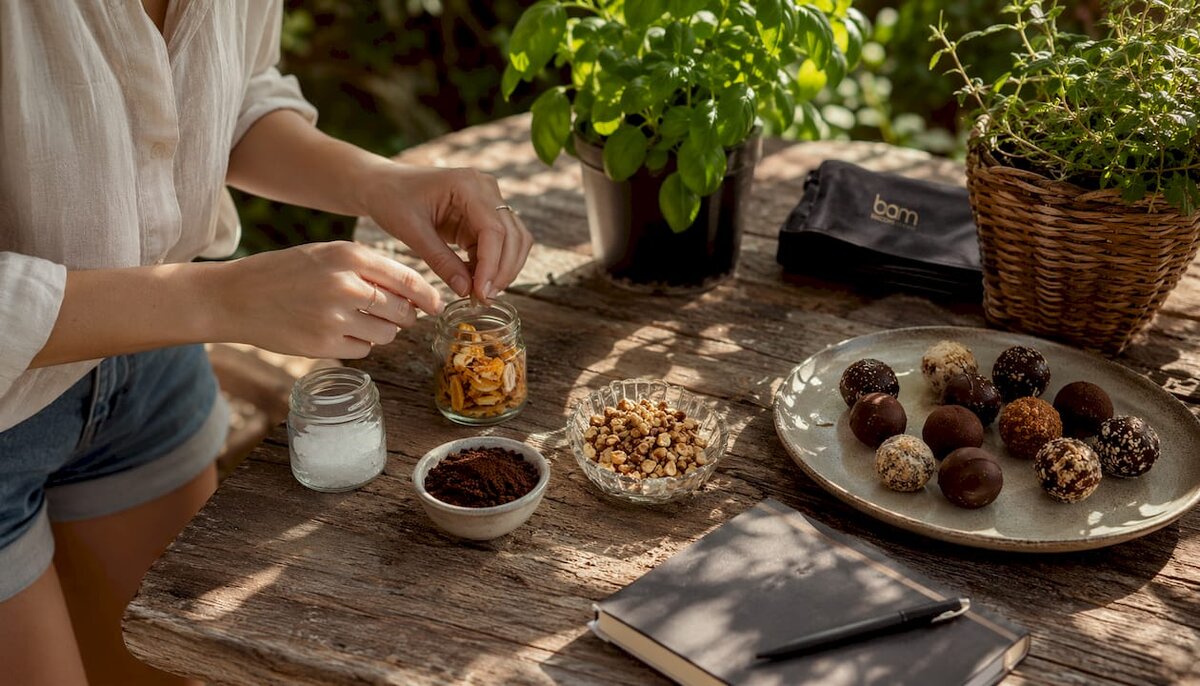
The sequence in which you engage your senses determines how much you actually detect. Rushing past the smell stage means losing a large portion of the flavor information before the chocolate even reaches your tongue.
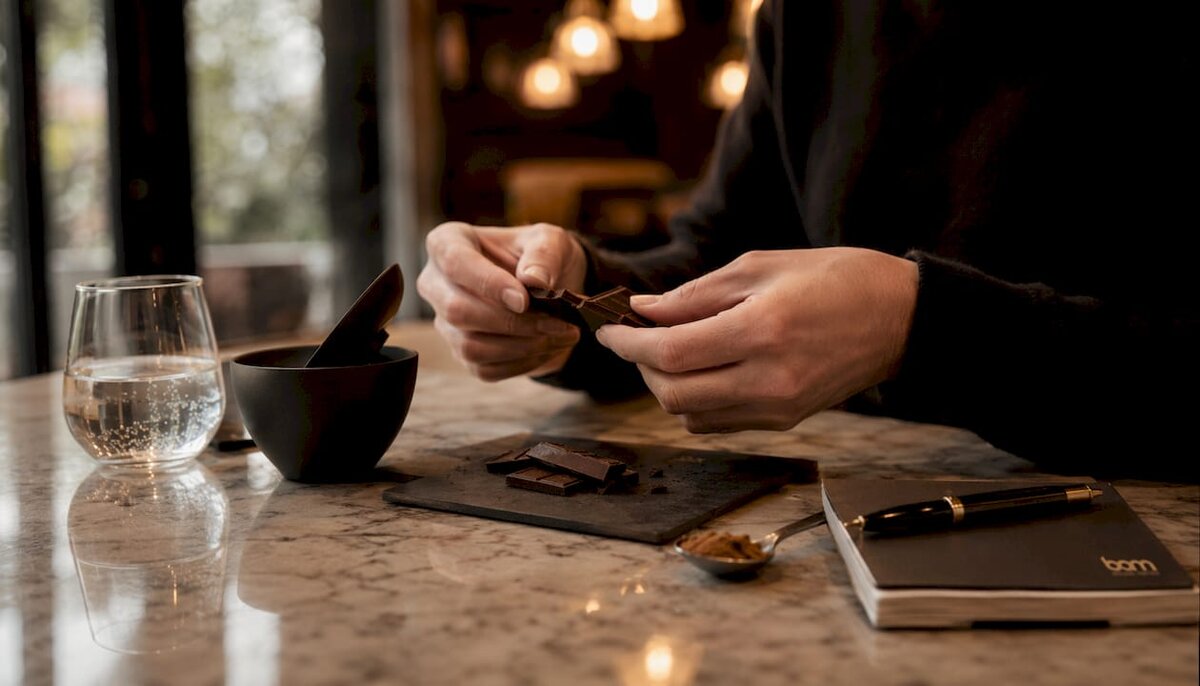
Start by breaking the chocolate and smelling the fresh edge. The surface of a bar may have absorbed ambient aromas from packaging or air, but the broken edge gives you a cleaner read. Warm the piece briefly between your fingers; cocoa butter softens just below body temperature, releasing volatile aroma compounds that would otherwise stay locked in the fat matrix.
Next, identify the broad aroma family before reaching for a specific descriptor. Start with direction: is it roasty, fruity, floral, or earthy? A bar that smells like dried cherry and molasses can begin as “dark fruit.” The exact word comes later. Separating structural sensations (sweetness, bitterness, acidity) from aroma and texture prevents sensory overload and keeps your notes precise.
When tasting, let the chocolate melt on your tongue rather than chewing. Pay attention to three stages: the opening notes in the first 15–30 seconds, the mid-palate from 30 seconds to one minute, and the finish from one to three minutes. Citrus and berry notes tend to appear early; roasted and nutty notes define the mid-palate; astringency and woody notes linger in the finish.
Tasting bars side by side at the same cocoa percentage is the fastest way to learn origin character. Three 70% bars from different regions will teach you more than reading a hundred tasting notes.
Pro Tip: Keep a tasting journal. Record the maker, origin, percentage, date, and your notes in plain sentences. Over months, patterns emerge and your vocabulary becomes genuinely personal rather than borrowed from a label.
The flavor compounds in chocolate are formed primarily during processing. 3-methylbutanal is the strongest predictor of classic cocoa-chocolate flavor in GC-MS analysis, while linalool indicates specific heirloom genetics and terroir. These compounds do not appear by accident; they are the result of fermentation, drying, and roasting acting on the bean’s genetic material.
Regional flavor signatures are consistent enough to use as reference points. Ecuador tends towards floral and honey notes, linked to the Nacional heirloom variety and its distinctive terroir. Madagascar produces bright red berry and citrus, driven by high acidity and specific fermentation conditions. Tanzania often shows melon and honey, with a softer, rounder profile. Tasting these origins side by side makes these differences obvious rather than theoretical.
Processing decisions shape the final profile as much as origin does. Roasting develops pyrazines, the compounds behind roasted and nutty notes, while also reducing acidity. Conching affects mouthfeel and can mellow harsh or astringent notes over time. The role of processing in flavor development is why two bars made from the same bean can taste entirely different.
Common flavor notes by category:
Flavor chemistry note: Floral and astringent notes in fine chocolate are linked to high concentrations of (−)-epicatechin, procyanidin B2, and 2-phenylethan-1-ol, according to molecular analysis published in the Journal of Agricultural and Food Chemistry. These compounds are markers of fine flavor cacao, not defects.
Just as bean origin shapes espresso flavor, terroir and genetics leave a measurable chemical fingerprint in chocolate that no amount of processing can fully erase.
Balance is the clearest indicator of quality in chocolate. A well-made bar does not eliminate bitterness or astringency; it holds them in proportion with sweetness and acidity so that no single sensation dominates. Expert sensory analysis consistently identifies balanced bitterness and astringency, alongside delicate fruity, floral, or nutty notes, as the hallmark of desirable chocolate.
The finish tells you the most. Quality chocolate shows a long finish lasting up to five minutes, with complexity that evolves rather than fades. Lipids and polyphenols contribute to this persistence. A finish that disappears in seconds, or one dominated by harsh bitterness, points to poor fermentation, over-roasting, or inferior beans.
Temper and melt rate also affect how flavor is experienced over time. Properly tempered chocolate melts slowly, spreading flavor across the palate in measured stages. Untempered chocolate melts quickly, delivering all its flavor at once in a way that can feel flat or overwhelming. The snap of a bar signals correct cocoa butter crystallisation; a dull or crumbly break suggests the opposite.
Signs of poor flavor balance:
For guidance on choosing quality chocolate by sensory indicators, the principles above apply whether you are buying a single bar or sourcing ingredients for baking.
Bamchocolate stocks a curated range of premium chocolate and confectionery products for home bakers and enthusiasts. Explore the baking accessories range to find everything you need to put your tasting knowledge into practice.
Chocolate flavor notes span taste, aroma, and mouthfeel, and for dark chocolate, you need nine descriptors (sweetness, sourness, bitterness, cocoa, roasted, fruity, creamy, melting, astringent) to fully characterise a single bar’s profile; white chocolate requires seven.
| Point | Details |
|---|---|
| Three-part structure | Every chocolate profile covers taste, aroma, and mouthfeel — all three are needed for an accurate description. |
| IICCT four categories | Positive notes fall into Dairy/Sweet, Fruity, Vegetal/Grassy, and Herbal/Spicy/Woody/Nutty families. |
| 3-methylbutanal as key compound | This compound is the strongest predictor of classic cocoa-chocolate flavor in scientific analysis. |
| Origin drives regional character | Ecuador shows floral and honey; Madagascar shows red berry and citrus; Tanzania shows melon and honey. |
| Finish signals quality | Quality chocolate shows a long, evolving finish lasting up to five minutes; a short finish indicates inferior beans or processing. |
Describe chocolate flavor across three dimensions: taste (sweetness, sourness, bitterness), aroma (cocoa, roasted, fruity), and mouthfeel (creamy, melting, astringent). Using nine descriptors for dark chocolate, or seven for white chocolate, from these categories gives a complete picture of any bar’s profile.
A flavor note is a specific taste or aroma detected during tasting, such as raspberry, caramel, or jasmine. These notes reflect the cacao bean’s origin, genetics, fermentation, and roasting, not added ingredients.
The IICCT groups positive chocolate flavors into four categories: Dairy/Sweet, Fruity, Vegetal/Grassy, and Herbal/Spicy/Woody/Nutty. Defect categories include Chemical, Medicinal, Earthy/Organic, and Savory/Mineral, which signal faults in the beans or process.
Smell the broken edge of the bar rather than the surface, then warm the piece briefly to release volatile aroma compounds. Start with a broad family (roasty, fruity, floral) before narrowing to a specific note such as dried cherry or hazelnut.
Terroir, heirloom genetics, and local fermentation practices all leave a chemical fingerprint in the finished bar. Linalool, for example, is a marker of specific heirloom genetics and terroir, and its presence or absence measurably shifts the aroma profile of the chocolate.



 Confectionery tips



 Slovenščina
 Hrvatski
 Deutsch
 Italiano
 Česky
Česky
 Polski
 Magyar
 Français
 Slovák
 Nederlands
 Español