 info@bamchocolate.com
 Login


 en

 BAM Cake converter
 Login
Claudia
Avtorica vsebin


 Reading time:
8 minutes
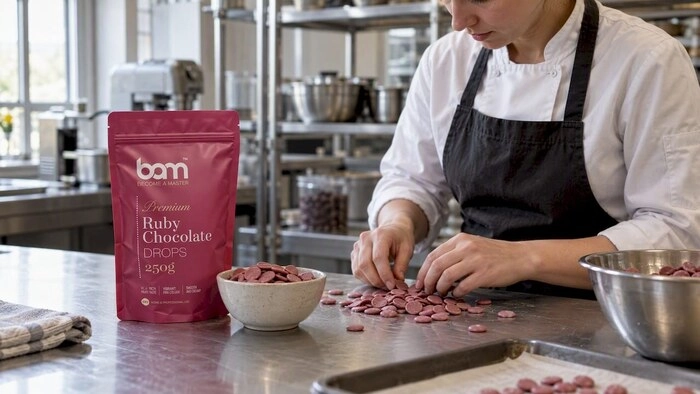
See where ruby chocolate works best, from bonbons and ganache to cold desserts, with handling advice to protect its color and tart flavor from heat and...
Ruby chocolate performs best in moulded confectionery, fat-based ganaches, cold mousses, decorations and specialised ice-cream coatings. The one rule that protects every application: keep it away from baking and water-rich processing, because heat and moisture dull both its colour and its tart flavour. We stock couverture and accessories suited to these uses at BAM - Become A Master, alongside recipe guidance for getting the most from it.
Manufacturers market ruby as a fourth style of chocolate, alongside dark, milk and white, though the claim describes a processing innovation rather than a new category recognised by food science bodies. Barry Callebaut developed and patented the processing steps behind the cocoa-derived material, launching it commercially in 2017 and 2018.
On the palate, ruby reads as:
A compositional analysis found that ruby chocolate carries a distinct set of polyphenols and methylxanthines, with characteristic A-type proanthocyanidins that set it apart from dark chocolate even where overall phytochemical levels run lower. That compositional difference is part of what gives ruby its distinct acidity rather than the roasted bitterness we associate with dark cocoa.
Ruby rewards kitchens that treat it as a finishing ingredient rather than a baking ingredient. Each application below plays to its fluidity, colour and acidity while sidestepping its weak points.
Manufacturer technical guidance points to the same shortlist: confectionery, cold desserts, coatings and fat-based fillings, with shelf-life testing recommended in the actual packaging a product will ship in.
Pro Tip: Treat ruby as a topping, not a structural ingredient; add it after baking or freezing rather than before.

Ruby’s acidity and berry note give it an unusually wide pairing range, provided nothing drowns it out.
Manufacturer case notes describe spices, herbs, cheeses and rosé wine as reliable partners, which lines up with what pastry teams report in practice. Chefs working with ruby advise using it as ‘pure’ as possible, letting the acidic berry note lead rather than burying it under heavier flavours. The practical rule: add sweetness in small increments and let ruby’s acidity stay the loudest voice on the plate.
Ruby is more fragile than dark or milk chocolate, and most quality problems trace back to moisture, heat or light rather than the ingredient itself.
Pro Tip: Check colour and aroma after every melt and reset cycle; both fade faster in ruby than in dark or milk chocolate.
These are starting ratios to test and adjust, not fixed recipes.
Beyond the base templates, a few assembly ideas worth testing on a seasonal menu:
We’ve spent years sourcing and testing couverture and confectionery ingredients for home bakers and professional kitchens alike, and ruby chocolate is one of the trickiest to get right outside manufacturer-controlled conditions. We curate chocolate lines, recipe support, a rotating product of the month and BAMBox™ selections with exactly this kind of handling in mind, so chefs working with delicate ingredients have both the product and the guidance to use it well. We hear regularly from customers testing ruby in confectionery and cold desserts, and we fold that feedback back into the recipe notes we share.
Most advice on ruby chocolate focuses on what to add to it: fruit, spice, cheese, wine. The more useful lesson is what to leave out. Ruby’s acidity does most of the work on its own, and the biggest mistake we see is treating it like a blank canvas that needs rescuing with extra sweetness or heavy flavour layering.
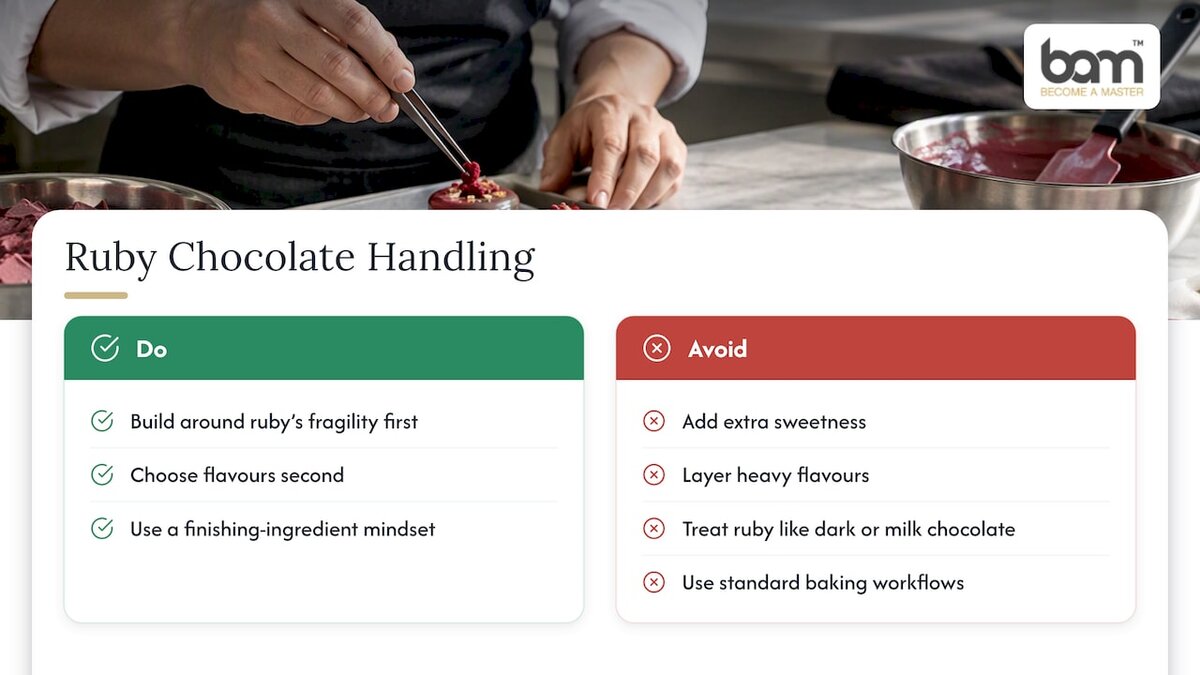
The second mistake is treating it like dark or milk chocolate with a different colour. It isn’t. Its sensitivity to heat and moisture means standard baking workflows simply don’t apply, and chefs who skip the finishing-ingredient mindset end up with a dull, brownish result that defeats the point of using ruby at all.
If you take one thing from this: build the recipe around ruby’s fragility first, then choose flavours second. The pairing list is long and forgiving. The handling window is not.
— Andraz
Sourcing the right couverture matters more with ruby than with any other chocolate type, since quality and freshness show up directly in colour and flavour. Our BAM Chocolate range covers baking and coating-grade chocolate for confectionery and finishing work, and our baking accessories line includes thermometers, moulds and transfer sheets for the kind of temperature control ruby demands. For fat-based fillings or blended bases, our 100% BAM Spreads work well alongside ruby in ganaches and sauces.
Single orders and bulk or corporate orders both run through the same shop, and a BAMBox™ is a practical way to trial a small batch of ruby-compatible items with recipe guidance before committing to a larger run. Browse the full range and place an order at Bamchocolate.
Yes. Ruby is made from cocoa through a patented processing method, and Barry Callebaut developed and launched it commercially as a distinct product rather than a flavoured or coloured variant of white chocolate. Whether it counts as a fully separate “fourth type” alongside dark, milk and white is a marketing framing rather than a settled scientific classification.
The established types are dark, milk and white chocolate, with ruby marketed by its originator as a newer, fourth style built on a different processing method. Ruby chocolate’s commercial launch in 2017 and 2018 introduced it as a naturally pink, tart alternative to the three traditional types.
Dark chocolate with a high cocoa content is generally considered the better option among mainstream chocolate types, owing to its higher cocoa solids and lower sugar content. Ruby chocolate’s own compositional profile shows measurable antioxidant capacity and methylxanthine content, though levels of some phytochemicals run lower than in dark chocolate.
Yes, in small amounts. Analytical studies show ruby chocolate contains methylxanthines, including both theobromine and caffeine, generally at levels lower than dark chocolate but variable depending on the formulation.



 Tales of chocolate



 Slovenščina
 Hrvatski
 Deutsch
 Italiano
 Česky
 Polski
 Magyar
 Français
 Slovák
 Nederlands
 Español