 info@bamchocolate.com
 Login


 en

 BAM Cake converter
 Login
Claudia
Avtorica vsebin


 Reading time:
14 minutes
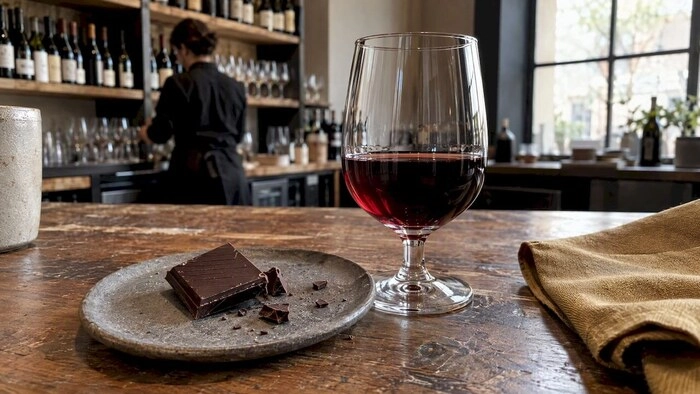
Match chocolate with wine by sweetness, tannin, and texture. Try 12 practical pairings, use a quick tasting method, and find gift ideas for any occasion.
A sweet fortified wine with milk or dark chocolate is the most reliable starting point for any chocolate pairing with wine. Sweetness needs to match or beat the chocolate, and body needs to hold its own against cocoa. Try a ruby Port with high-cocoa dark chocolate tonight: it is close to a fail-safe combination, and it takes two minutes to set up.
Four factors decide whether a chocolate and wine pairing works: sweetness, tannin, acidity and texture.
Wine sweetness has to meet or exceed the chocolate’s sweetness. A dry red next to a sweet milk chocolate will taste thin and sour, because the sugar in the chocolate makes the wine’s own fruit disappear. Tannin is the next hurdle. Le Cordon Bleu warns that high cocoa percentages increase bitterness, and that bitterness clashes badly with the tannin in a young, full-bodied red, producing a metallic or overly dry sensation on the palate. Acidity, by contrast, is useful: a touch of fresh acidity cuts through richness and keeps a creamy ganache or a thick praline from feeling heavy. Texture matters just as much as flavour. Decanter notes that a wine’s body should not fight a very creamy filling: a thin wine next to a dense ganache feels like a mismatch even when the flavours agree.
Inclusions change the equation again. Nuts, dried fruit and caramel each pull the pairing in their own direction, which the next section covers in detail.
Three quick rules cover most situations:
Pro Tip: Taste the chocolate alone first and note whether it is bitter, sweet or creamy before choosing the bottle.
Each chocolate type behaves differently on the palate, so the wine needs to shift with it.
Serve dark and filled chocolates slightly below room temperature so the cocoa fat does not mute the wine, and let milk or white chocolate sit a minute longer to soften before tasting.
A handful of wine categories cover almost every chocolate scenario, so stocking a few bottles from each makes future pairings easy.
A bottle from each category, kept on hand, means a pairing is never more than an open drawer away.
Each of these pairs a chocolate style with a wine style and a reason it works, with one-line serving notes.
Serve wine slightly chilled for whites and sparkling, closer to room temperature for Ports, and let the chocolate melt on the tongue before the first sip, in small portions, so neither element overwhelms the other.
A short, consistent method makes it easy to tell a good pairing from a poor one.
A controlled sip-melt-sip protocol with small samples helps new tasters quickly identify which pairings they prefer, as outlined in sensory research on sparkling wine and chocolate. Watch for three signs: tannin that turns metallic signals a mismatch, a wine that tastes thin or sour means it was not sweet enough, and a refreshing, lifted finish usually means the acidity is doing its job. Jot a quick note after each pairing so preferences build into a personal shortlist over time.
A handful of pairings have become standard reference points because they consistently balance sweetness, body and texture.
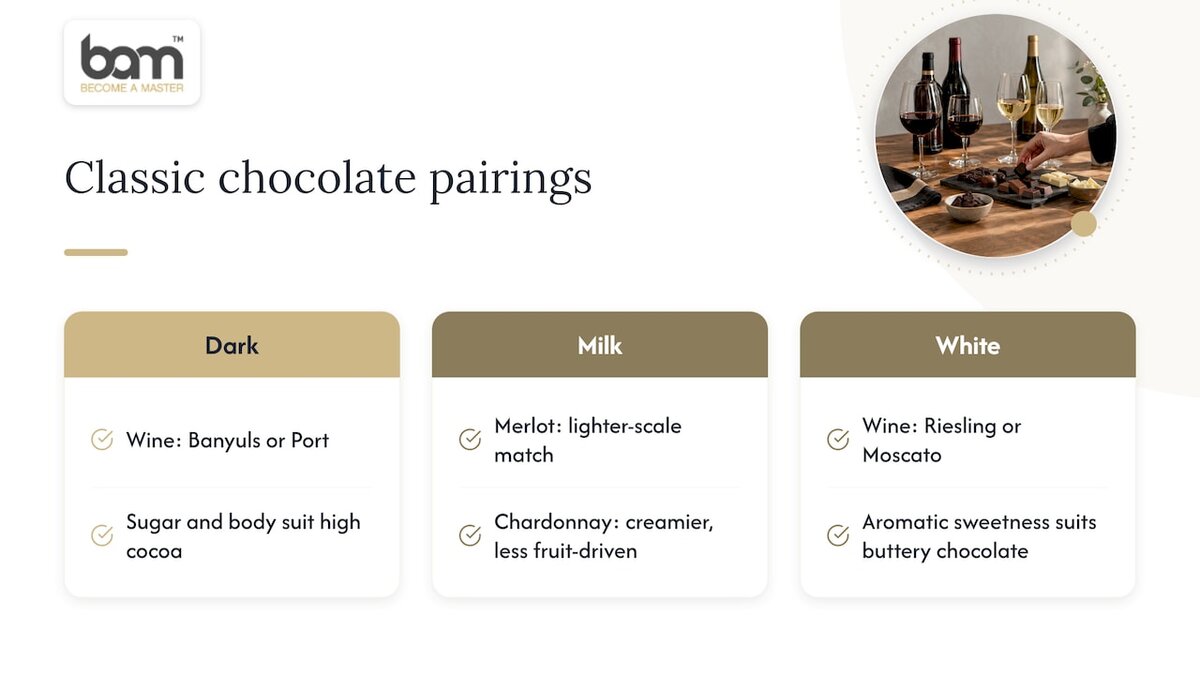
Dark chocolate with Banyuls or Port is the most frequently cited pairing, and for good reason: both wines carry enough sugar and body to stand up to high cocoa content without the tannin problems a dry red brings. Milk chocolate with Merlot works on the same logic at a lighter scale, while milk chocolate with an off-dry Chardonnay offers a creamier, less fruit-driven alternative for those who prefer white wine. White chocolate with Riesling or Moscato rounds out the trio: the wine’s aromatic sweetness gives the chocolate’s buttery, low-cocoa profile something to play against, which a dry wine simply cannot do.
These three combinations are a dependable shortlist for a gift note, a dinner party or a first attempt at pairing. None of them demands rare or expensive bottles: a modestly priced ruby Port, a fruit-forward Merlot and an off-dry Riesling cover the three most common chocolate styles between them. Once these feel familiar, branching into sparkling wines or Sherries for filled and specialty chocolates becomes a natural next step rather than a guess.
Chocolate and wine pairings make an easy, memorable gift because the giver does the tasting work in advance.
For a birthday or anniversary, a small selection of dark chocolate squares alongside a half-bottle of Port reads as thoughtful without needing an explanation. For a dinner party, serving two or three chocolate styles with a matching wine for each turns dessert into a short tasting rather than a single plate. For a corporate gift, a boxed set that pairs milk and dark chocolate with tasting notes signals more care than a generic hamper, and works well for clients or colleagues who may not know wine well.
Serving is straightforward: pour a small measure, about 50 to 75 millilitres, so the wine does not overpower the chocolate, and offer two or three chocolate pieces per guest rather than a whole bar. Keep red wines at a cool room temperature and whites or sparkling wines chilled, and set the chocolate out ten minutes before serving so it is not too firm to melt properly on the tongue. A simple printed card naming each pairing adds polish to a gift box without extra cost, and helps the recipient know where to start.
Good pairings start with ingredients that have been looked after, since both chocolate and wine lose character quickly when stored badly.
Chocolate should be kept in a cool, dark place, ideally between 15 and 18 degrees Celsius, away from strong odours that cocoa butter absorbs easily. Avoid the refrigerator unless the room is genuinely too warm, since condensation on the surface dulls both texture and flavour. When buying chocolate for a pairing session, choose bars with a clear cocoa percentage on the label so the matching wine can be chosen with confidence, and check filled chocolates for their dominant flavour, nut, fruit or caramel, before deciding on a bottle.
Wine needs steadier conditions: store bottles on their side in a cool, dark spot away from vibration, and avoid temperature swings that push corks in and out. Fortified wines such as Port and Sherry hold up well once opened, often for several weeks in a cool spot, while a sparkling or dessert wine is best finished within a few days of opening. Buying smaller or half-bottles of dessert and fortified wines makes sense for pairing sessions, since a little goes a long way against the chocolate and a half-finished bottle still deteriorates over time.
A tasting evening works best with a simple structure rather than an elaborate setup.
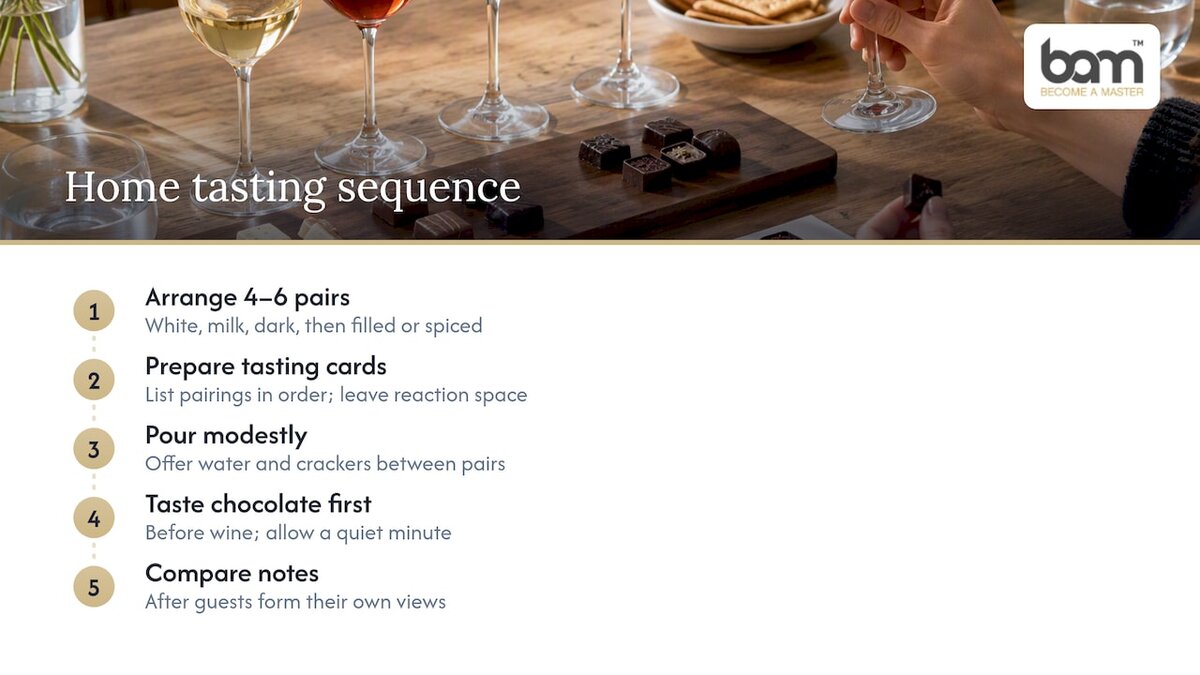
Arrange four to six chocolate and wine pairs on a single table, moving from lighter to richer: white chocolate first, then milk, then dark, finishing with filled or spiced pieces. Give each guest a small tasting card listing the pairings in order, with space to jot a quick reaction. Pour modest measures, provide plain water and crackers between pairings to reset the palate, and allow a minute or two of quiet tasting before conversation starts, so first impressions are not lost to chatter.
Etiquette is simple: taste the chocolate before the wine, never the reverse, and let each guest reach their own view before comparing notes, since personal preference plays a real part in how a pairing lands. Keep the room at a comfortable, cool temperature so the chocolate does not soften too fast, and have a spare plate for anyone who wants to set a piece aside rather than finish it. A tasting works just as well for four people around a kitchen table as it does for a larger gathering, and the format scales without needing extra equipment beyond glasses, small plates and the pairings themselves.
Knowing the texture and intensity of the chocolate on hand makes choosing a wine far less of a guess.
A dark chocolate bar with a high cocoa percentage tends to carry a firm snap, a dry, slightly bitter finish and little sweetness, which is exactly why a fortified wine’s sugar is needed to balance it. A milk chocolate bar is softer underfoot, with a rounder, dairy-forward sweetness that calls for a wine with its own fruit or gentle sweetness rather than dry tannin. Spreads built on a chocolate base, such as our 100% BAM Spreads, carry a smoother, more concentrated chocolate character than a solid bar, which makes them a good match for the same fortified or off-dry wines used with milk or dark chocolate, served on bread or fruit as part of a tasting plate. A protein-forward or sugar-reduced bar from our BAM FIT products line tends to taste slightly less sweet than a standard bar, so pairing it with a wine on the sweeter end of the scale, rather than a dry one, keeps the balance right. Checking the cocoa percentage and texture on the pack before pouring the wine takes the guesswork out of the evening.
Choosing chocolate for pairing is part of what we do every day: cocoa percentage, texture and filling all decide which wine suits a bar, and we select our range with those factors in mind. Our gift boxes and spreads are built to be easy to pair, not just to eat on their own. If a pairing from this guide works for you, our curated collections are a straightforward way to try the next one.
— Andraz
We stock the chocolate side of every pairing in this guide, from high-cocoa dark bars to milk chocolate and spreads suited to a tasting plate. Our BAM Chocolate range covers the cocoa percentages that decide which wine style to reach for, and our BAMBox™ curated sets group pairing-friendly chocolates together, ready to give or open at a tasting evening without needing to source each piece separately. For a gift that needs no further assembly, our Gifts selection includes options built around sharing and tasting rather than a single bar. Browse our chocolate range to put tonight’s pairing together.
Chocolate itself pairs best with a wine whose sweetness matches or exceeds its own, so dark chocolate suits a fortified wine like Port, while milk and white chocolate work well with an off-dry white or demi-sec sparkling wine. Small plain biscuits or dried fruit on the side can round out a tasting without competing with either element.
A dry, high-tannin red next to a high-cocoa dark chocolate is a common mismatch, since the tannin and cocoa bitterness combine into a harsh or metallic taste, as Le Cordon Bleu notes. In general, a dry wine with little sweetness struggles against any sweet or creamy chocolate.
This is not a recognised wine or food pairing principle, and no authoritative source on chocolate and wine pairing refers to it. Letting a wine breathe for a short period before serving can soften tannin, but there is no fixed rule tying this specifically to a fixed time window for chocolate pairings.
There is no single best wine for every chocolate, since the right choice depends on the chocolate’s cocoa percentage, sweetness and filling. Decanter notes that matching intensity, sweetness and texture matters more than following one fixed recommendation, though a fortified wine like Port is a reliable starting point for most dark and milk chocolates.


 Confectionery tips


 Slovenščina
 Hrvatski
 Deutsch
 Italiano
 Česky
 Polski
 Magyar
 Français
 Slovák
 Nederlands
 Español