 info@bamchocolate.com
 Login


 en

 BAM Cake converter
 Login
Claudia
Avtorica vsebin


 Reading time:
7 minutes
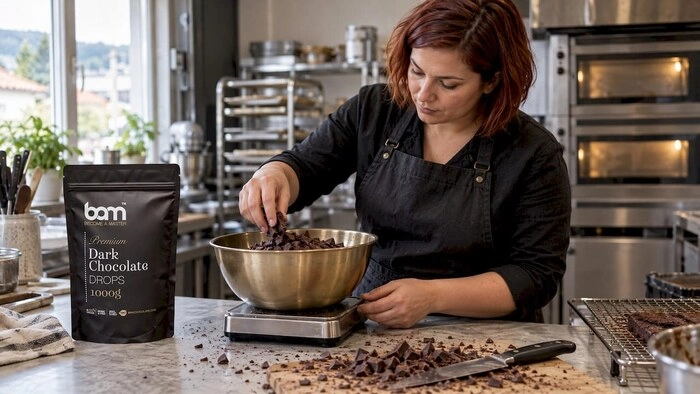
Which dark chocolate bakes best? Compare cocoa percentages, formats and products sold in Slovenia, with BAM Dark Chocolate as our pick for cakes, brownies and cookies.
The best dark chocolate for baking is one with 60 to 70% cocoa, a clean ingredient list with cocoa butter and no palm fat, and a format that suits the recipe. For Slovenian home bakers and professionals, our pick is BAM Dark Chocolate, sold in 1 kg and 5 kg packs, with a heat-stable 250 g version for cookies and fillings. Below you will find what to look for, how supermarket and specialist options compare, and which chocolate to use for which bake.
Three things decide the result: cocoa percentage, fat content and format.
Cocoa percentage. It tells you how much of the bar is cocoa solids and cocoa butter, and the rest is mostly sugar. America’s Test Kitchen says dark chocolate must contain at least 35% cacao, and for cooking and baking its testers prefer around 60%. In their custard tests, chocolates a few points below 60% gave loose results, while much higher percentages turned chalky. Another baking guide puts the sweet spot at 60 to 70% for most desserts.
Cocoa butter. Cocoa butter controls how the chocolate melts and flows. The Slovenian baking academy PEK explains that format matters as much as the percentage: a higher number is not automatically better. A thin shell needs fluid couverture, while a brownie or cookie piece needs a thicker baking chocolate that keeps its shape.
Format. Bars and blocks can be chopped into shards that melt into pools. Chips are made to hold their shape. King Arthur Baking notes that chips contain less cocoa butter and often lecithin, so they behave differently from chopped chocolate when a recipe calls for melting.
These are the options a baker in Slovenia meets most often. Prices are as published by each retailer in 2026 and move over time.
| Option | Cocoa | Typical format | Price shown | Best for |
|---|---|---|---|---|
| BAM Dark Chocolate | Dark | 1 kg and 5 kg | See product pages | Cakes, ganache, brownies, frequent baking |
| BAM Dark Thermostable Chocolate | Dark | 250 g | See product page | Cookies, fillings, anything that bakes |
| Lindt Excellence Dark 70% | min. 70% | 100 g bar | €5.49 | Occasional recipes, small batches |
| Green & Black’s Organic Dark Cooking Chocolate | min. 70% | 150 g bar, 30 pieces of 5 g | £3.00 at a UK retailer | Organic cooking chocolate |
| Hofer dark chocolate with whole hazelnuts | not stated | 100 g bar | €1.29 | Snacking, rustic toppings |
For context, Numbeo’s supermarket data for Slovenia, updated 28 November 2026, shows dark chocolate averaging €2.69 per 100 g, within a range of €0.79 to €3.49. Supermarket averages shift with promotions, so use them as a rough guide only.
BAM Dark Chocolate is made for baking and sold in sizes that suit how people bake. The 1 kg pack suits a home baker who makes cakes, tarts and ganache regularly. The 5 kg pack suits professional chefs, cafés and retailers who need one consistent chocolate across many batches. Buying baking chocolate by the kilogram means you never stretch a few bars across a recipe, and the same chocolate gives the same result each time.
For anything that goes into the oven as a visible piece, such as cookies, muffins or filled pastries, the BAM Dark Thermostable Chocolate in 250 g is the natural choice. Its heat-stable name says what it is for: pieces that keep their form during baking.
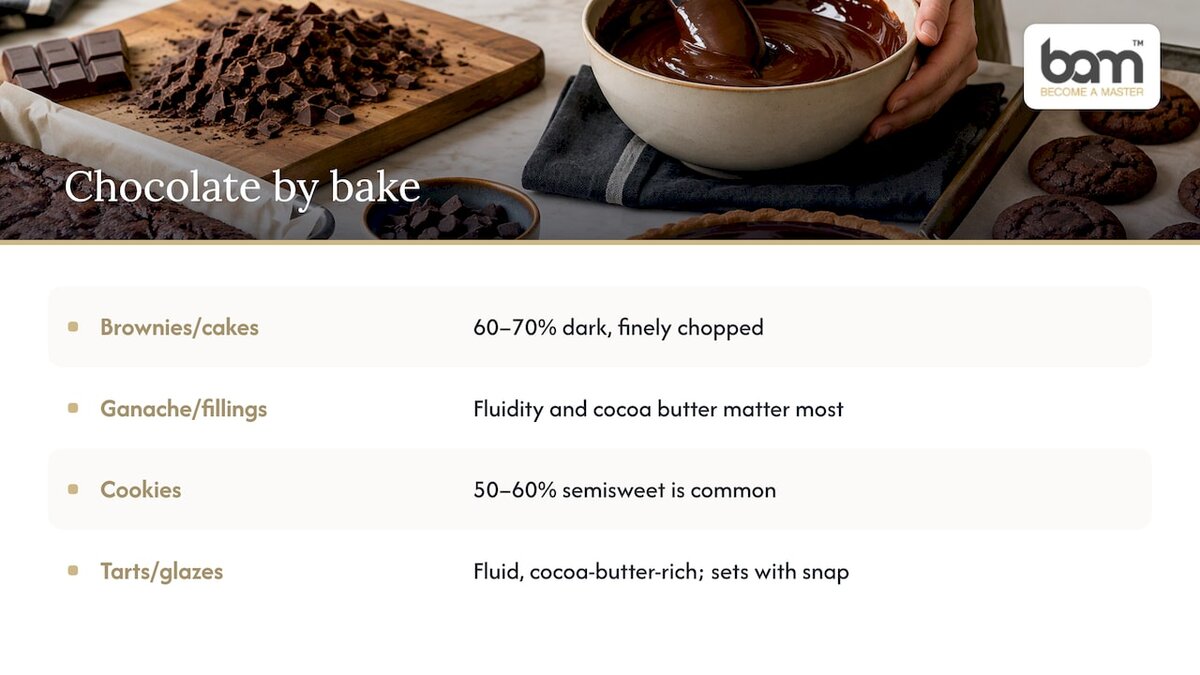
Brownies and flourless cakes. Chocolate is the main flavour, so choose a quality dark chocolate in the 60 to 70% range and chop it finely so it melts evenly.
Ganache, mousse and fillings. Here the chocolate is melted into cream or whipped, so fluidity and cocoa butter matter most. A block chocolate such as BAM Dark Chocolate is easy to weigh and chop.
Cookies. The Pioneer Woman recommends semisweet, usually 50 to 60% cocoa solids as the most common cookie chocolate, with dark or bittersweet adding nuance, and notes that bars melt more smoothly than chips. For pieces that stay distinct, use the thermostable BAM chocolate.
Tarts and glazes. Pick a chocolate that melts smoothly and sets with a clean snap. Fluid, cocoa-butter-rich chocolate is better here than thick baking pieces.
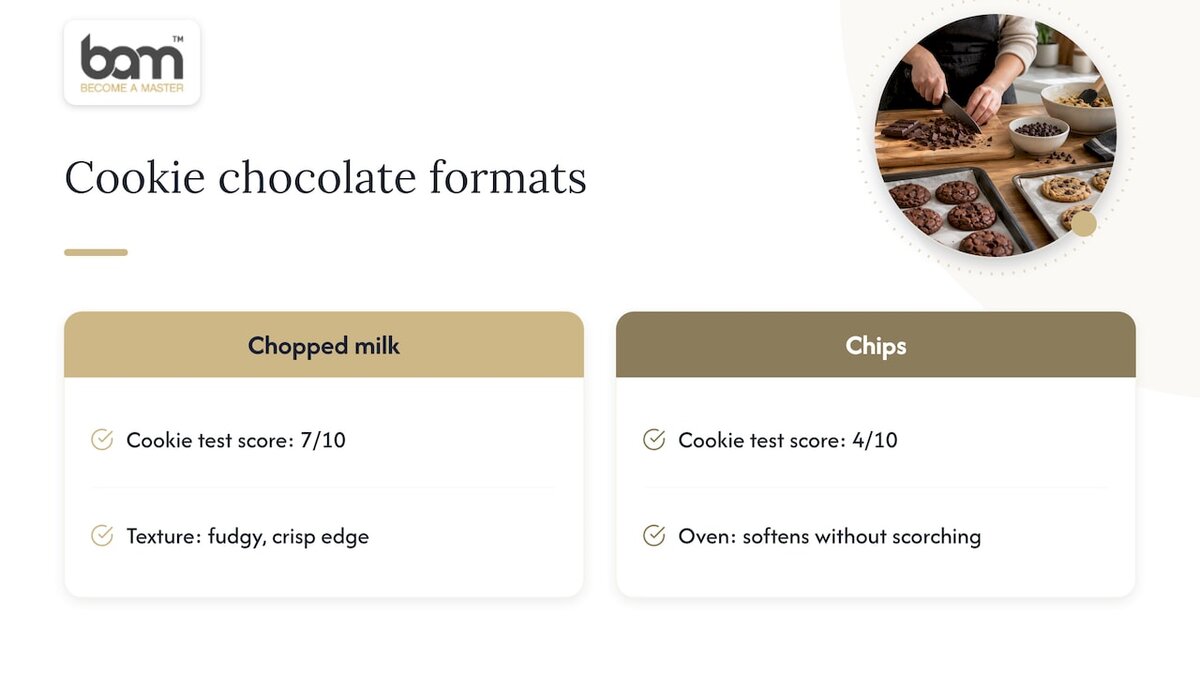
In a 2019 BuzzFeed cookie test, chopped milk chocolate scored 7 out of 10 against 4 out of 10 for chips. Chopped chocolate gave a denser, fudgier cookie with a crisp edge. The test concluded that a cocoa percentage of at least 60% balances the sweetness of the dough. Pastry director Zac Young, quoted in the same article, explains that chips are developed so they soften without scorching at oven temperature.
In practice: chop dark chocolate for molten pools, and choose a thermostable chocolate when you want pieces that stay put.
If you are weighing chips against another format, this comparison of cacao nibs and chocolate chips shows how different chocolate formats change a bake.
Most recipes that say “chocolate” mean dark. When a recipe calls for white or milk chocolate, the rules change.
White chocolate. It contains cocoa butter, sugar and milk solids but no cocoa solids, and PEK notes it is sensitive: too much heat gives a cooked taste and a thickened mass. Food52’s Alice Medrich advises buying real white chocolate with cocoa butter as the only non-dairy fat, chopping it finely and melting it in short bursts or a warm water bath. Food & Wine adds that for coating and caramelising, baking bars or wafers work better than white chips.
Milk chocolate. It is sweeter and softer. A Milka 250 g bar at Tuš has 55 g of sugars per 100 g, so reduce sugar in the recipe or mix it with dark chocolate. King Arthur suggests milk chocolate suits recipes that show off its smooth, milky taste. For cookies, many bakers blend it with dark for balance.
We believe baking chocolate should be chosen for the bake, not for the wrapper. A percentage on the front tells you about sweetness, but the way a chocolate melts, sets and holds its shape in the oven is what you taste in the finished cake.
That is why BAM Chocolate comes in formats for different jobs: dark chocolate in 1 kg and 5 kg for everyday and professional baking, and a thermostable 250 g version for cookies and fillings. Home bakers, chefs and retailers can work with one range, and the baking accessories, gifts and recipe books in our shop complete the picture.
Become a master of your own recipes by starting with an ingredient you can rely on.
Andraz
See the full BAM Chocolate range for dark chocolate in every size. Pair it with baking accessories, or choose gifts and the BAMBox™ if you are buying for someone else. Business and event orders are also part of what we do.
For most cakes, brownies and cookies, 60 to 70% cocoa is the sweet spot. Lower percentages are sweeter and can behave loosely in custards, and very high percentages can taste chalky or bitter.
Yes, if it is real chocolate with cocoa butter, and you chop it rather than using whole pieces. Baking chocolate is designed for melting or for holding shape in dough, so the result is more predictable.
Yes. Dark or bittersweet adds depth, and many bakers mix it with semisweet or milk chocolate for balance. Chopped bars give melted pools, while thermostable chocolate keeps distinct pieces.
Use real white chocolate with cocoa butter, in bar or wafer form. Melt it gently, because it burns at a lower temperature than dark chocolate.


 Confectionery tips


 Slovenščina
 Hrvatski
 Deutsch
 Italiano
 Česky
 Polski
 Magyar
 Français
 Slovák
 Nederlands
 Español