 info@bamchocolate.com
 Login


 en

 BAM Cake converter
 Login
Claudia
Avtorica vsebin


 Reading time:
9 minutes
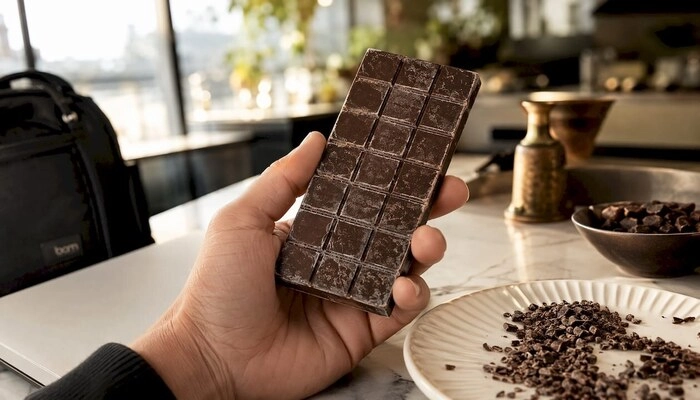
Wondering what is chocolate bloom? Discover its causes, impacts, and how to fix it. Explore safe, delicious chocolate today!
Chocolate bloom is a harmless, whitish or greyish coating that forms on the surface of chocolate when fat or sugar recrystallises. It is not mould, not spoilage, and not a sign the chocolate is old. Solid chocolate with bloom is safe to eat. There are two distinct types: fat bloom, caused by cocoa butter migrating to the surface, and sugar bloom, caused by moisture dissolving surface sugar that then recrystallises. Fat bloom tends to affect texture and snap; sugar bloom primarily affects surface appearance and mouthfeel.
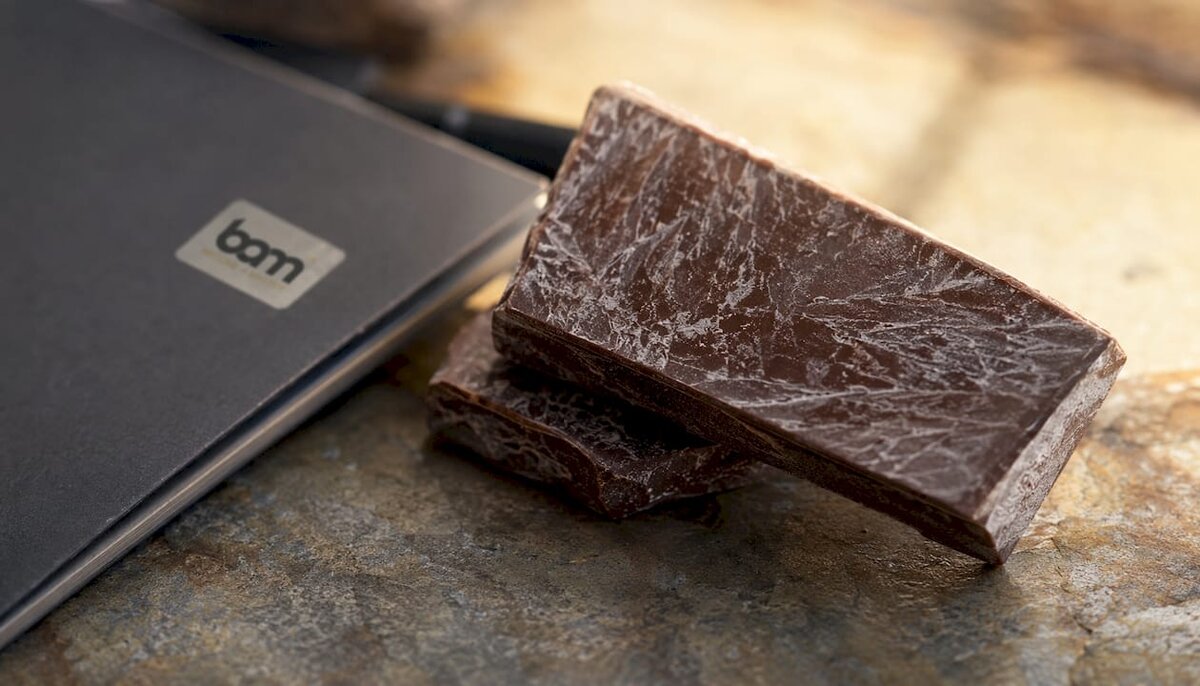
Fat bloom happens when cocoa butter melts, migrates through the chocolate, and recrystallises into less stable polymorphs, disrupting the Form V crystal structure that gives well-tempered chocolate its gloss and clean snap. The result is a streaky, greyish or waxy sheen on the surface.
Common triggers:
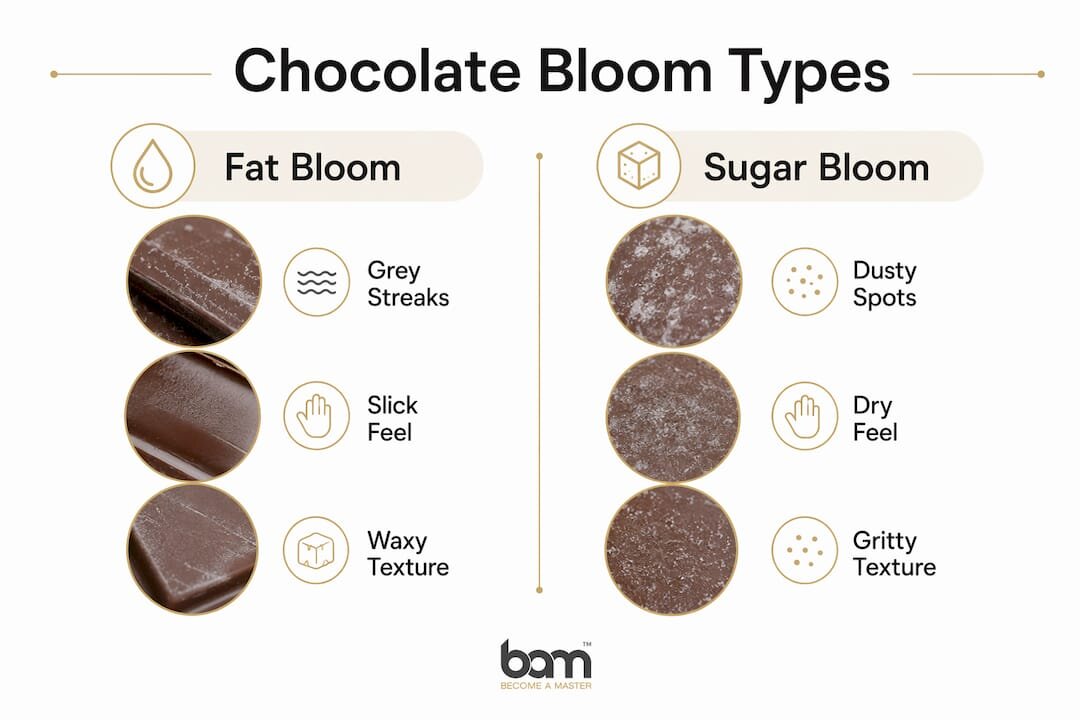
How to spot it: Fat bloom looks streaky or marbled, often grey-white. Run a finger across the surface and it feels slick or slightly oily. The chocolate may have lost its sharp snap and feel softer than usual.
Pro Tip: If your chocolate bar has been sitting in a warm kitchen and develops a grey sheen, do not discard it. Seal it in an airtight bag and move it to a cooler spot. The bloom will not reverse, but the chocolate is perfectly usable for baking.
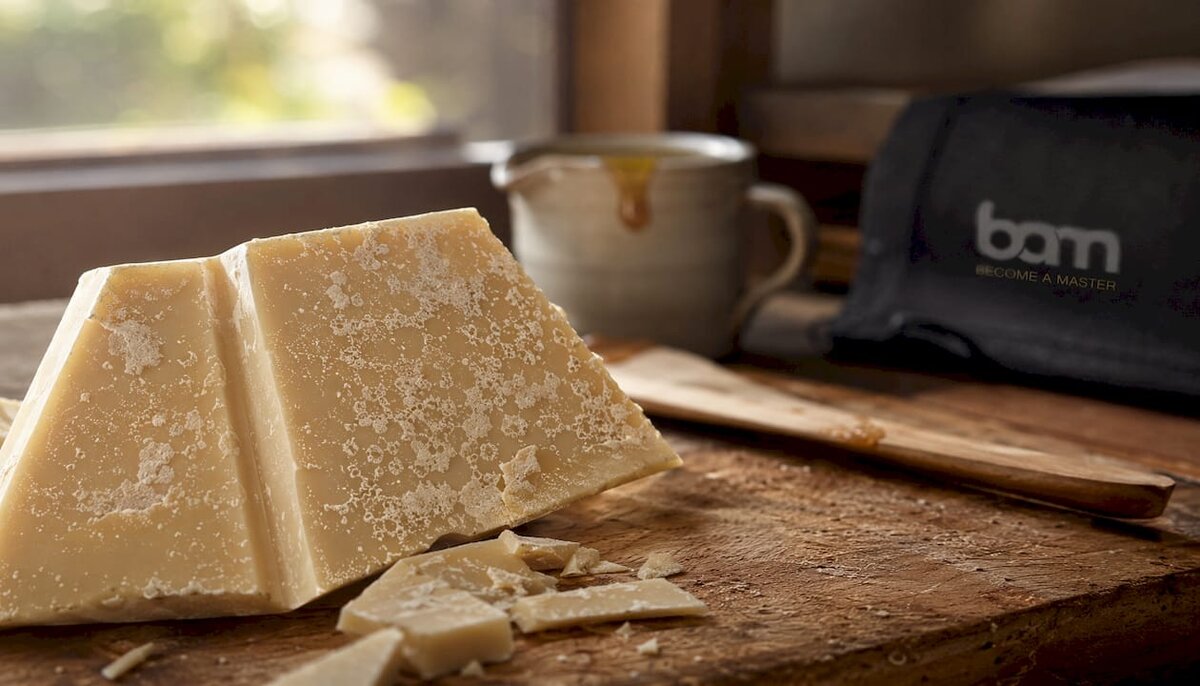
White chocolate is particularly prone to fat migration because of its high cocoa butter content. See the Bamchocolate guide on handling white chocolate for specific advice.
Sugar bloom has a different mechanism entirely. When cold chocolate is brought into a warm, humid room, condensation forms on the surface. That moisture dissolves the surface sugar, and as it evaporates, larger sugar crystals are left behind. The result is a dusty, spotted, or powdery white coating.
Common scenarios:
How to spot it: Sugar bloom looks dusty or grainy, often spotted rather than streaked. Touch it and it feels dry and sandy, not slick. Unlike fat bloom, it does not disappear when you warm the chocolate gently with your hand. That single test separates the two types reliably.
The sensory difference matters in practice. Fat bloom gives a waxy mouthfeel; sugar bloom produces a chalky, gritty texture. Neither is dangerous, but both reduce the pleasure of eating the chocolate as a snack.
Three quick tests let you diagnose the surface issue without any equipment.
When to discard: If you see fuzzy or hairy growth, that is mould. Discard immediately. Also discard if the chocolate smells sour, fermented, or off, or if the packaging was damaged and allowed moisture or contamination in. Filled chocolates (truffles, pralines) have a shorter shelf life than solid bars and should be treated with more caution.
Decision guide:
Bloom is cosmetic, not a food-safety issue. Solid chocolate has high sugar content and very low water activity, which makes it effectively non-perishable. Bloom does not shorten shelf life on its own.
The practical concern is sensory, not safety. Fat bloom produces a waxy mouthfeel and muted flavour because the cocoa butter structure has changed. Sugar bloom introduces a chalky, grainy texture. Neither makes the chocolate harmful, but both make it less enjoyable to eat straight from the wrapper.
The best use for bloomed chocolate is in recipes where melting resets everything. Ganache, brownies, chocolate sauces, and bark all tolerate bloom completely. The texture defects disappear the moment the chocolate melts. This is also a straightforward way to reduce waste in confectionery rather than discarding a bar that is structurally fine.
Storage is the most common cause of bloom in domestic settings. Callebaut’s guidance recommends a stable, cool, dark environment at moderate temperature with low humidity. Most UK homes in winter sit comfortably in that range; summer is where problems start.
Storage rules:
Transport and gifting tips: Use an insulated cool bag for warm-weather deliveries. Do not leave chocolate in a parked car. If buying online in summer, choose a seller who ships with appropriate packaging.
For a full breakdown of domestic storage conditions, the Bamchocolate guide on how and where to store chocolate covers the detail.
Bloomed chocolate is not wasted chocolate. Two routes are available depending on what you want to do with it.
Route 1: Melt and repurpose (baking)
For ganache, brownies, sauces, or bark, simply melt the chocolate. Bloom vanishes. No special technique needed.
Route 2: Re-temper (moulding, coating, snacking)
Re-tempering restores Form V crystal structure and gives the chocolate back its gloss and snap.
| Chocolate type | Working temperature |
|---|---|
| Dark | 30–31°C |
| Milk | 29–30°C |
| White | 28–29°C |
A kitchen thermometer is the most reliable tool here. If you do not have one, the Bamchocolate guide on tempering without a thermometer offers practical alternatives.
Form V cocoa butter crystals are the foundation of good chocolate. They give a glossy surface, a clean snap, and resistance to fat migration. When tempering goes wrong, or when finished chocolate is stored poorly, those crystals destabilise and bloom follows.
Three practical tips for home bakers:
Pro Tip: Break a small piece of your tempered chocolate and warm it briefly with your breath. If it blooms within 30 seconds, the temper is unstable. If it stays glossy, you are set. Bamchocolate’s step-by-step tempering guide walks through the full process.
Chocolate bloom is a physical, not biological, change: it is safe to eat, fixable by melting, and preventable with proper storage at 15–18°C in a dry, airtight container.
| Point | Details |
|---|---|
| Bloom is safe | Both fat and sugar bloom are cosmetic; solid chocolate remains safe to eat. |
| Two types, two tests | Slick feel = fat bloom; grainy feel = sugar bloom. Warm gently to confirm. |
| Storage prevents it | Store at 15–18°C, dry and airtight; avoid the fridge and temperature swings. |
| Melting fixes it | Repurpose bloomed chocolate in ganache, brownies or sauces; bloom disappears on melting. |
| Re-tempering restores it | Melt fully, cool to 27–28°C, rewarm to working temperature (28–31°C by type). |
Chocolate bloom is one of those things that looks alarming and turns out to be nothing. The grey streaks, the dusty white patches — they signal a storage or tempering issue, not spoilage. Every bar that gets discarded because of bloom is a bar that could have gone into a ganache or a batch of brownies.
The practical takeaway is simple: learn to recognise which type you are looking at, decide whether to eat it as-is or melt it down, and adjust your storage going forward. Bamchocolate’s baking accessories range includes the thermometers and tools that make tempering and bloom prevention straightforward, and the BAM Basic pastry package is a good starting point for anyone who wants to work with chocolate more confidently at home.
Yes. Chocolate bloom is harmless and does not affect food safety. Solid chocolate with bloom is safe to eat; the change is physical, not biological.
Melting bloomed chocolate fully resets the crystal structure and removes all visible bloom. For moulding or coating, re-temper by cooling to 27–28°C then rewarming to the correct working temperature for your chocolate type (28–31°C depending on dark, milk or white).
Rub the surface with a fingertip: fat bloom feels slick; sugar bloom feels dry and grainy. Warming the chocolate gently confirms it: fat bloom softens and fades, sugar bloom stays unchanged.
No. Bloom is a sign of a storage or tempering issue, not spoilage. Discard chocolate only if you see fuzzy mould growth, smell something sour or fermented, or if filled chocolates have been stored poorly for an extended period.



 Confectionery tips




 Slovenščina
 Hrvatski
 Deutsch
 Italiano
 Česky
 Polski
 Magyar
 Français
 Slovák
 Nederlands
 Español