 info@bamchocolate.com
 Login


 en

 BAM Cake converter
 Login
Claudia
Avtorica vsebin


 Reading time:
11 minutes
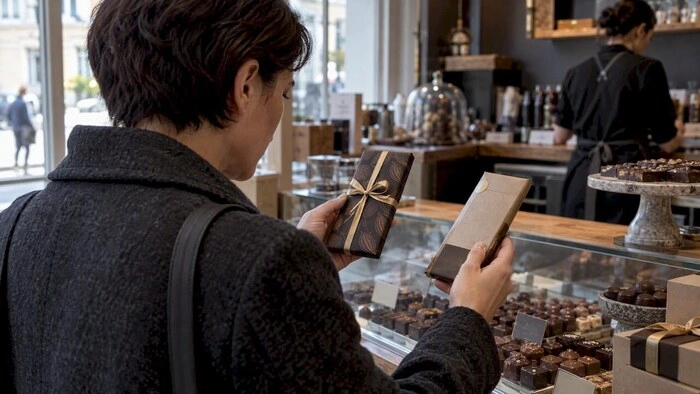
Choose sustainable chocolate gifts by checking cocoa origin, sourcing claims, and packaging under EU rules. Find organic options at BAM - Become A Master.
Choose certified, traceable chocolate with low-impact packaging, and buy from a seller who can show origin, to make a genuinely sustainable chocolate gift. Look for organic or Fairtrade marks, a clear country or farm source, and recyclable or compostable wrapping. We stock organic, gift-ready chocolate at BAM - Become A Master built around exactly these checks.
The right gift depends on who receives it, not just what certification sits on the box. A few concepts cover most occasions:
Whichever concept you pick, check the same four things on the product page before buying: an organic or Fairtrade logo, a named origin rather than a vague “cocoa blend”, a statement on packaging recyclability or compostability, and whether the seller discloses a supplier or farm relationship rather than just a certification badge.
Portion size and price should track the occasion. A short list to keep in mind:
Price tends to rise with origin specificity and packaging quality rather than with size alone. A single-origin bar with full traceability documentation generally costs more than an unlabelled blend of the same weight, and that premium is often the clearest signal that the seller has done the sourcing work.
A chocolate gift touches four separate impact areas, and a seller rarely covers all four with the same strength. Deforestation and legality concern whether the cocoa was grown on land cleared illegally or recently. Organic farming concerns pesticide and fertiliser use on the farm. Social sourcing concerns whether farmers were paid fairly, which is what Fairtrade and similar schemes attempt to verify. Packaging concerns what happens to the wrapper after the gift is unwrapped. A bar can be organic and still have no deforestation documentation, or Fairtrade-certified and wrapped in packaging that cannot be recycled locally. Treat each claim on its own merits rather than assuming one badge covers the rest.
Before buying, it is worth asking a seller for:
The EU’s deforestation-free products regulation brings cocoa and chocolate into scope, requiring operators to show products are deforestation-free and legally produced, with application dates set for large and medium operators by 30 December 2026 and for micro and small operators by 30 June 2027. Buying from a seller who already references this standard, rather than waiting for the deadline, is a reasonable proxy for a serious traceability programme.
Packaging is where good intentions most often go wrong, because “paper” and “compostable” are not single, interchangeable claims. Recyclable paper with a verified barrier coating can protect chocolate from moisture while staying recyclable in standard fibre streams, but only when the coating itself is recyclable or removable. Compostable films need a certification mark and, in most cases, industrial composting conditions rather than a home compost bin. Seed-paper wrappers and reusable boxes add a post-use purpose but depend on the recipient’s willingness to use them as intended.
A few presentation choices keep a gift memorable without adding waste:
Pro Tip: When a packaging claim feels vague, choose the reusable or minimal option instead, and always include a plain-language disposal line on the box or card.
Local recycling streams vary, and a wrapper that is technically recyclable may not be accepted by every collection scheme. Including disposal instructions on the gift itself removes that guesswork for the person receiving it.
Two sources set useful expectations for anyone buying chocolate gifts in the EU market right now. First, the regulation on deforestation-free products requires operators to demonstrate legality and deforestation-free sourcing for cocoa, with the compliance dates noted above; this is the clearest signal that traceability claims will need documentation behind them, not just a logo.
Second, packaging innovation is moving in a useful direction but with caveats. Amcor reported paper-based chocolate packaging redesigns that cut pack weight substantially for specific 200 g packs, while noting that recyclability holds only where paper recycling streams exist to accept the material.
A lighter pack is not automatically a greener one if the barrier layer cannot be separated or recycled locally.
The practical takeaway for buyers: ask whether a “paper” wrapper has been tested for recyclability in a standard fibre stream, and treat a weight reduction claim and a recyclability claim as two separate questions.
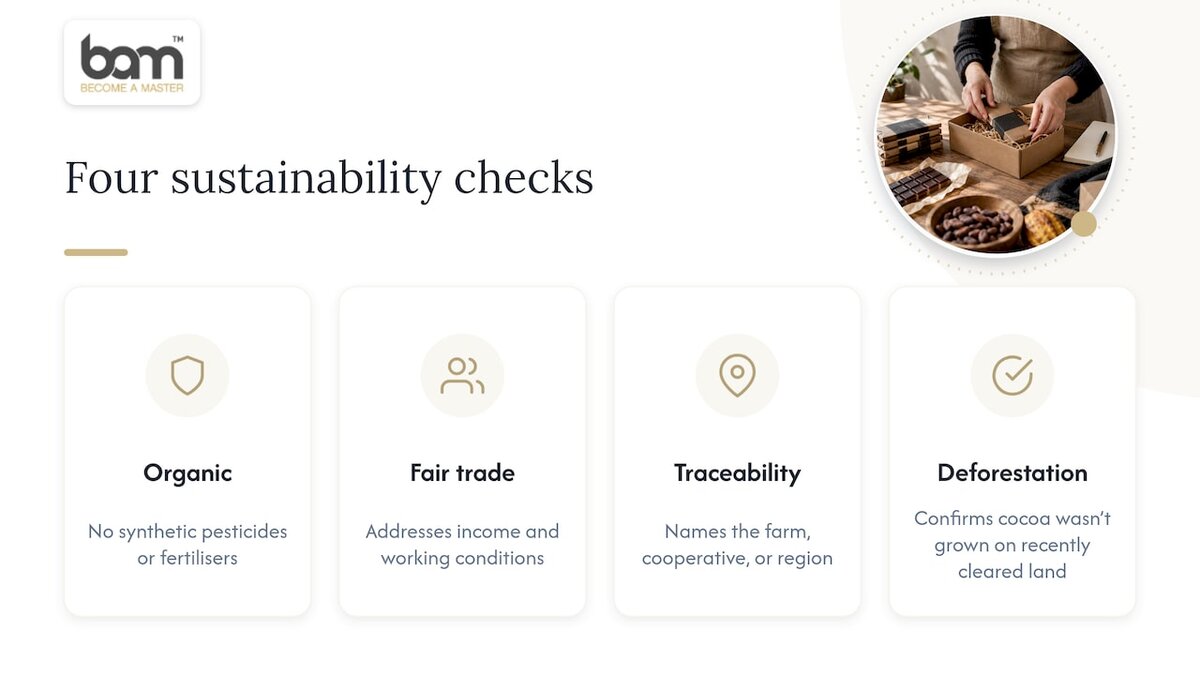
Four factors combine to make a chocolate gift genuinely sustainable, and a strong gift usually covers at least three of them. Organic certification confirms the cocoa was grown without synthetic pesticides or fertilisers, which addresses farm-level environmental impact but says nothing about who was paid what. Fair trade or equivalent schemes address farmer income and working conditions, filling the gap organic certification leaves open. Traceability, meaning a seller can name the farm, cooperative or region the cocoa came from, is what makes any other claim checkable rather than assumed. Deforestation-free sourcing, now a legal requirement under the EU’s regulation referenced above, confirms the cocoa was not grown on recently cleared land.
None of these four replace the others. A bar can be organic and still lack deforestation documentation; a bar can be traceable to a named farm and still not be certified organic. The strongest sustainable chocolate gifts combine certification with a named origin and a packaging answer, rather than leaning on a single badge to carry the whole claim. When a product page states all four clearly, that transparency itself is a reasonable proxy for a seller who has done the underlying sourcing work.
Certified, traceable chocolate generally costs more than an uncertified equivalent of the same weight, because certification audits, traceability systems and better packaging all add cost somewhere in the chain. A single bar with full origin disclosure and recyclable packaging sits above a supermarket own-brand bar of the same size, and a curated gift box costs more again once presentation and assembly are added.
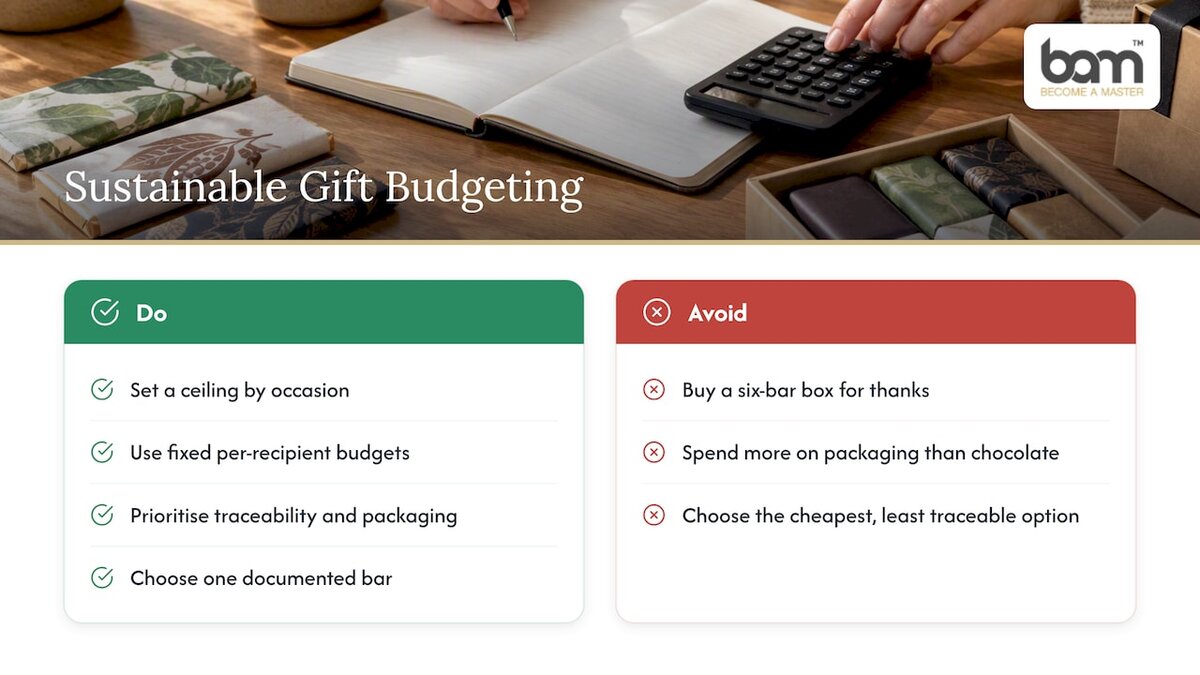
Budgeting for a sustainable chocolate gift works best when you decide the occasion first and let that set the ceiling. A quick thank-you gift does not need a six-bar tasting box, and spending more on packaging than on the chocolate itself rarely improves the experience for the recipient. For corporate gifting at volume, a fixed per-recipient budget applied consistently across a hamper or box range keeps costs predictable without pushing you toward the cheapest, least traceable option available.
Where budget is tight, prioritise traceability and packaging over quantity: a single well-documented bar with a clear origin story and a recyclable wrapper usually makes a stronger impression than a larger assortment of unlabelled chocolate. Price is one of the more reliable signals that a seller has invested in sourcing and packaging rather than just a certification logo on the front.
Start with what the recipient actually eats before thinking about certification. A vegan recipient needs a dairy-free assortment, not a mixed box with a few compliant bars buried inside it. Someone managing sugar intake benefits more from a sugar-free or lower-sugar option than from a standard bar with an organic label, since the two claims address entirely different concerns.
Flavour preference matters as much as dietary fit. A recipient who prefers mild, milky chocolate will not enjoy a high-percentage single-origin dark bar regardless of how well-documented its origin is, so match intensity to known taste before matching certification. For recipients you know less well, a small tasting box spreads the risk across several styles rather than committing to one bar that might miss.
Finally, confirm allergen handling where it matters: nut-free, gluten-free or dairy-free claims should be stated clearly on the packaging, not inferred from the product name. A gift that fits the recipient’s dietary needs and taste will land better than one chosen purely for its sustainability credentials, however strong those credentials are.
We carry chocolate products built for gifting occasions like those covered above, with sourcing transparency buyers benefit from seeing clearly on the product page. Our BAM Chocolate line sits at the centre of our range, alongside a curated Gifts selection and our BAMBox™ for anyone who wants a ready-assembled or personalised box without building one from scratch.
Ordering is simple either way:
For corporate gifting, the range extends to spreads and baking accessories that pair well with chocolate in a hamper, so a single order can cover diverse recipient preferences. Start with our Gifts page, or go straight to BAMBox™ to put a box together for the occasion in front of you.
I run a short checklist before buying any chocolate gift: certification first, then a named origin, then a packaging answer, then whether it actually fits the recipient’s taste or diet. Skipping the last step is the most common mistake I see, because a perfectly sustainable bar that nobody wants to eat is not a good gift. The order matters less than covering all four, every time, rather than stopping at the first badge on the box.
— Andraz
Look for organic certification, Fairtrade or an equivalent fair trade mark, and a named origin or supplier statement rather than a generic “cocoa blend” label. No single certification covers every impact area, so a product that lists two or three of these alongside packaging information is a stronger choice than one with just a logo.
It depends on the barrier layer and local collection rules rather than the word “paper” alone. Amcor’s redesigned paper-based packaging cut pack weight by up to 61% for some 200 g packs, but recyclability held only where fibre recycling streams accepted that specific material.
Yes. Under the EU’s deforestation-free products regulation, cocoa and chocolate fall within scope, and operators must show products are deforestation-free and legally produced, with large and medium operators required to comply by 30 December 2026 and micro and small operators by 30 June 2027.
Choose a dedicated vegan assortment made with dairy-free dark chocolate rather than a mixed box that happens to include a few compliant bars. Checking the allergen and ingredient statement on the packaging confirms the claim rather than relying on the word “vegan” on the front of the box.
Certified, traceable chocolate costs more than an uncertified equivalent of the same weight, and a curated gift box adds further cost for presentation and assembly. Set a budget based on the occasion first, and prioritise traceability and packaging over sheer quantity when funds are limited.



 Tales of chocolate



 Slovenščina
 Hrvatski
 Deutsch
 Italiano
 Česky
 Polski
 Magyar
 Français
 Slovák
 Nederlands
 Español