 info@bamchocolate.com
 Login


 en

 BAM Cake converter
 Login
Claudia
Avtorica vsebin


 Reading time:
10 minutes

Want to know what is chocolate percentage? Learn how it affects flavor and quality in your favorite chocolate bars. Get tips for shopping!
TL;DR:
- Chocolate percentage indicates the proportion of cocoa-derived ingredients in a bar, reflecting its intensity but not quality. It mainly measures cocoa solids, cocoa butter, and cocoa powder, with the rest made up of sugar and dairy, affecting taste and texture. A higher percentage reveals more intense cocoa flavors but requires better processing and bean origin for quality.
The chocolate percentage on a wrapper tells you one thing precisely: what proportion by weight of the finished bar comes from the cocoa bean. That includes cocoa mass (also called cocoa liquor), any added cocoa butter, and cocoa powder where present. Everything else, mainly sugar and dairy, makes up the rest. A 70% bar therefore contains roughly 30% sugar and other non-cocoa ingredients. Use that number as an intensity guide when shopping, not as a quality stamp.
Pro Tip: When tasting an unfamiliar bar, check the percentage first. It tells you how bitter and dry to expect the chocolate to be before you even unwrap it.
The cocoa percentage is a proportion by weight of all cocoa-derived ingredients in the finished product. The formula is straightforward:
(Weight of cocoa-derived ingredients ÷ Total weight of bar) × 100 = Cocoa percentage
Worked example: a 100g bar containing 70g of cocoa components (cocoa mass plus added cocoa butter) has a cocoa percentage of 70%.
The terms “cocoa” and “cacao” appear interchangeably on UK labels. Both refer to the same bean; “cacao” is simply the less-processed form of the word, often used by craft producers to signal minimal intervention. Legally, UK chocolate regulations define minimum cocoa-solid thresholds for each chocolate type, and the percentage declaration on the front of pack must reflect total cocoa-derived content.
Statistic callout: A bar with a cocoa percentage around 70% typically contains a roughly proportional amount of sugar to balance the composition. Labels give a quick sense of relative sweetness, but precise sugar grams only appear in the nutritional panel.
Ingredient order matters too. Cocoa mass listed first signals a higher proportion of cocoa than sugar. If sugar appears first, the bar leans sweet regardless of the percentage printed on the front.
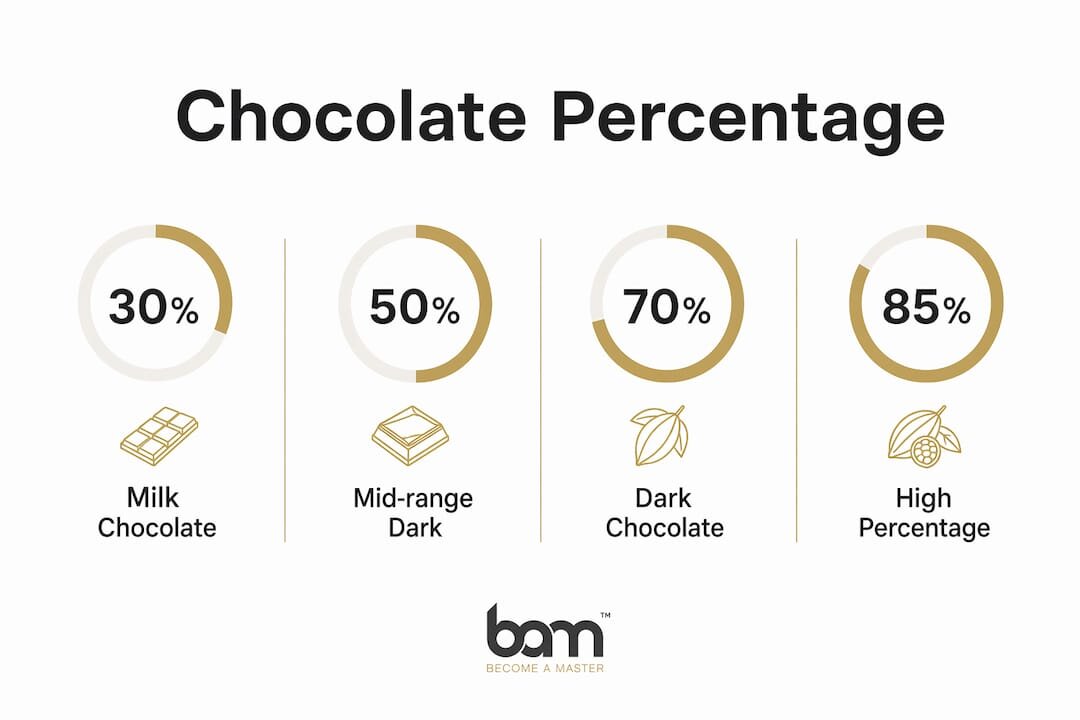
As the cocoa proportion rises, something else has to fall. For most bars, that “something else” breaks down as follows:
White chocolate sits outside this framework entirely. It contains no cocoa solids at all, only cocoa butter, milk solids, and sugar. Under EU Directive 2000/36/EC, white chocolate must contain a minimum of 20% cocoa butter, but you will rarely see a percentage printed on the front of pack because there are no cocoa solids to declare.
Inclusions such as nuts, dried fruit, or caramel do not change the cocoa percentage. They dilute the overall bar composition but are not counted within the cocoa-content figure.
Cocoa butter and cocoa solids both count toward the percentage, but they affect your experience differently. Cocoa solids deliver bitterness, astringency, and aroma. Cocoa butter delivers the smooth melt and creamy mouthfeel. A bar heavy in solids relative to butter will taste drier and more intense; one heavy in butter will feel silkier even at the same declared percentage.

Sugar and milk mask acidity and bitterness. As their proportion falls with rising cocoa content, the bar’s natural flavour compounds become more exposed. Tannins, fruit notes, and earthy tones that sit quietly in a 50% bar become prominent at 80%.
Pro Tip: Taste progressively. Start with a 50% bar, then move to 70%, then 85%. Let each piece melt fully on the tongue before forming an opinion. The difference in bitterness and dryness between 70% and 85% is more pronounced than between 50% and 70%.
Mouthfeel also shifts. Higher-percentage bars tend to snap more cleanly and melt more slowly because there is less fat relative to solids. Lower-percentage bars, especially milk chocolate, melt almost immediately from body heat.
| Percentage band | Sweetness / bitterness | Best for |
|---|---|---|
| Below 30% | Very sweet, milky | White and confectionery chocolate; dessert sauces |
| 30–40% | Sweet, creamy, mild cocoa | Milk chocolate snacking; mousses; ganache for beginners |
| 50–70% | Balanced; moderate bitterness | Everyday dark chocolate; brownies; chocolate chip biscuits |
| 70–85% | Noticeably bitter; complex | Intense snacking; truffles; dark ganache; pairing with red wine |
| 85%+ | Very bitter; dry; aromatic | Specialty baking; sugar-reduced recipes; experienced tasters |
Milk chocolate typically sits in the 30–40% band; 38–40% is considered high for milk chocolate and signals a less sweet, more distinctly chocolatey bar. Most UK supermarkets stock dark chocolate starting from a moderate cocoa percentage upward, with bars around the low seventies cocoa percentage being common dark options on standard shelves.
For baking, the 50–70% band is the most versatile. It melts predictably, balances well with added sugar in recipes, and suits everything from brownies to tempering work. Above 70%, you get deeper flavour but need to adjust sweetness in the recipe accordingly. For guidance on choosing chocolate for baking, the percentage band is the first decision to make.
No. Percentage measures composition by weight, not craftsmanship. Two bars at 70% can taste completely different because the label does not show the ratio of cocoa solids to cocoa butter, the bean variety, or how the beans were processed.
What actually determines quality:
A practical quality checklist for reading a wrapper:
Higher-percentage bars above 85% expose flaws more readily because there is less sugar to mask off-notes. That is why very high-percentage chocolate demands superior beans and careful processing. For more on identifying quality in dark chocolate, the ingredient list and origin declaration are more reliable guides than the percentage alone.
Start with three questions: How sweet do you want it? What are you making or doing with it? How experienced is your palate with dark chocolate?
For eating: If you are new to dark chocolate, begin at 50–60%. Move to 70% once that feels comfortable. Reserve 85%+ for when you want complexity over sweetness.
For baking: The 50–70% band is the safest starting point. When substituting a higher-percentage bar for a lower one in a recipe, reduce added sugar slightly and consider adding a small amount of cream or extra cocoa butter to maintain texture. Bakers adapting recipes across percentage bands need to account for the lower fat and sugar content in higher-percentage chocolate.
For pairing: Percentage guides the match.
A simple tasting plan: buy three bars at 50%, 70%, and 85%. Taste them in order, palate-cleansing with water between each. Note where bitterness becomes pleasant complexity rather than unpleasant harshness. That threshold is your personal preference point.
Percentage is a useful label, but it is not a substitute for origin and process information. The same figure on two bars can represent entirely different flavour experiences depending on how the beans were grown, fermented, and roasted.
Fermentation is the step most consumers never see, yet it shapes more of a bar’s final flavour than the percentage does. Poorly fermented beans produce flat, astringent chocolate regardless of how high the cocoa content is declared. Roasting then either develops or destroys the flavour compounds that fermentation created. Conching, the prolonged mixing stage, smooths texture and drives off volatile acids.
The actionable takeaway: when buying chocolate, look for the bean origin declaration alongside the percentage. Single-origin bars that name a country or region give you more information than a percentage alone. A short ingredient list paired with a declared origin is the clearest signal of a producer who cares about what is in the bar. For a deeper look at how processing shapes flavour, the journey from cocoa seed to finished bar explains why two identical percentages can taste so different.
Chocolate percentage measures the proportion by weight of cocoa-derived ingredients in a bar, making it a reliable intensity signal but not a measure of quality or craftsmanship.
| Point | Details |
|---|---|
| Percentage = intensity, not quality | The number shows cocoa content by weight; bean origin and processing determine actual flavour quality. |
| The remainder is mainly sugar | A 70% bar contains roughly 30% sugar and other non-cocoa ingredients such as milk solids or emulsifiers. |
| Choose by use and palate | Use 50–70% for everyday baking and balanced eating; 70–85% for intense flavour; 85%+ for specialist baking. |
| Check the ingredient list too | Cocoa mass listed first, a short ingredient list, and a declared bean origin are stronger quality signals than percentage alone. |
| Bamchocolate range | Bamchocolate stocks curated baking and confectionery ranges across percentage bands, suited to both tasting and recipe work. |
At Bamchocolate, percentage is where every product conversation starts. When sourcing baking chocolate and confectionery ingredients, the cocoa content tells us the intensity level a recipe needs. But it is the origin, fermentation quality, and processing behind that number that determine whether the final result is genuinely good.
The Bamchocolate range is built around giving home bakers and enthusiasts access to chocolate across the full spectrum of cocoa percentages, from approachable milk-chocolate blends through to high-percentage baking specialities. Curated bundles make it straightforward to sample different intensities side by side, which is the fastest way to understand what percentage actually means for your palate and your recipes. If you want to go further, the Bamchocolate online training covers how to work with different percentages in confectionery and baking.
The BAM Basic Pastry Package is a practical starting point for anyone who wants to taste and bake across cocoa percentage bands. It brings together a curated selection of Bamchocolate’s baking chocolates and confectionery ingredients, giving you the range you need to compare intensities in real recipes rather than just on paper.
For bakers who want to go further, the baking accessories range at Bamchocolate covers the tools and additives that make working with high-percentage chocolate more predictable. Browse the full selection and find the percentage that fits your next recipe.
It shows the proportion by weight of all ingredients derived from the cocoa bean, including cocoa mass and added cocoa butter. A 70% bar contains roughly 30% sugar and other non-cocoa ingredients.
Not necessarily. Higher percentage means more intense and less sweet, but quality depends on bean origin, fermentation, and processing. An 85%+ bar exposes flaws more readily, so it requires better beans and technique to taste good.
A 40% bar sits in the upper range for milk chocolate, meaning it is less sweet and more distinctly chocolatey than a standard milk bar, while still containing milk solids and a significant proportion of sugar.
Milk chocolate typically ranges from 30–40% cocoa content; standard dark chocolate on UK supermarket shelves is most commonly around 70%. White chocolate contains no cocoa solids and rarely carries a cocoa percentage on the front of pack.
Higher cocoa content generally means lower sugar per serving and a greater proportion of cocoa-derived compounds, but overall health impact depends on portion size and total calorie content shown on the nutritional panel.



 Confectionery tips




 Slovenščina
 Hrvatski
 Deutsch
 Italiano
 Česky
 Polski
 Magyar
 Français
 Slovák
 Nederlands
 Español