 info@bamchocolate.com
 Login


 en

 BAM Cake converter
 Login
Claudia
Avtorica vsebin


 Reading time:
10 minutes

Choose couverture or ready-to-use fountain chocolate for smooth flow. Get buying, melting, portioning, and dipping advice, plus BAM - Become A Master.
Couverture or purpose-made fountain chocolate is the best choice for a chocolate fountain. Its higher cocoa-butter content keeps the melted chocolate thin enough to flow in a continuous waterfall rather than seizing or running grainy. Some fountain products are formulated with extra cocoa butter already in the mix, so they run smoothly without added oil.
Not every chocolate behaves the same way once it melts, and that difference decides whether a fountain runs or clogs. Four categories turn up most often on shop shelves and online listings.
Couverture is a professional-grade chocolate with a higher percentage of cocoa butter than standard bars, which is exactly what gives it the fluid, glossy melt a fountain depends on. Fondue and fountain blends are formulated specifically for this use, usually with cocoa butter already added so no extra oil is needed. Candy melts are a compound coating made with vegetable fat instead of cocoa butter: they melt easily but tend to set thicker and lack the same sheen. Ordinary eating chocolate, the kind meant for snacking, usually has too little fat to flow well on its own and often needs thinning before it will run.
Shape matters as much as type when buying. Options include:
Milk, dark and white fountain blends behave differently once melted. Milk chocolate tends to flow most easily thanks to its added milk fat and sugar content, making it a forgiving choice for first-time hosts. Dark chocolate has a more intense flavour but can run slightly thicker, so it benefits from a formulation with extra cocoa butter. White chocolate flows well but scorches more easily, so gentle, closely watched melting matters more than with milk or dark varieties.
The reason couverture outperforms standard chocolate in a fountain comes down to simple physics. Cocoa butter is naturally fluid when warm, and the more of it a chocolate contains, the lower its viscosity once melted. That lower viscosity is what lets the chocolate cascade over the fountain’s tiers in a smooth, even sheet instead of dripping unevenly or stalling partway down.
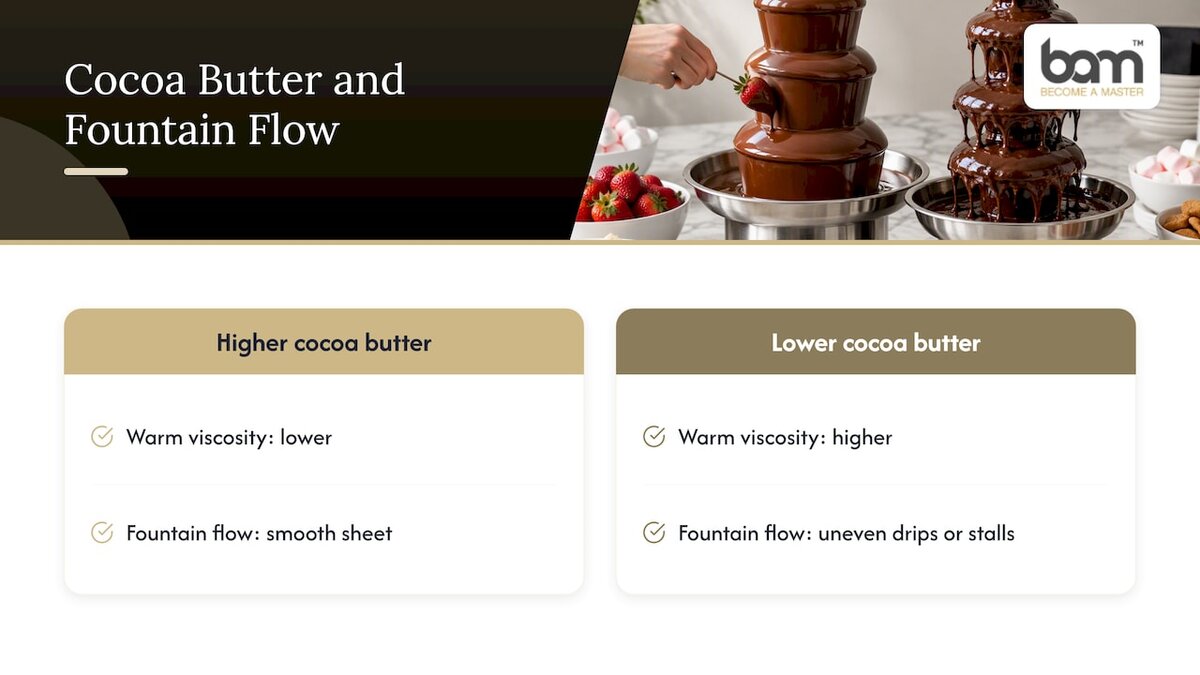
Shine follows the same logic. A higher cocoa-butter content produces a glossier, more appealing finish on dippers, which is part of why couverture is the standard choice in professional kitchens as well as for fountains.
Emulsifiers such as lecithin also play a role. They help keep the cocoa solids, sugar and fat evenly suspended through the melt, preventing the mixture from separating or turning grainy as it circulates through the pump and over the tiers repeatedly.
Temperature changes viscosity more than most hosts expect. According to the overview on Wikipedia, chocolate fountains rely on melting chocolate with higher cocoa-butter or added fats so the liquid stays fluid and forms a continuous waterfall rather than seizing or running grainy. The same source notes that experienced operators watch flow visually and favour a formulation with slightly higher fat, since even a 2 to 3°C shift in temperature can noticeably thicken or thin the mixture. A chocolate already formulated with extra cocoa butter gives a wider working window before thickening becomes a problem, which is exactly why purpose-made fountain blends reduce the guesswork around thinning.
A quick checklist at the shop or online saves a lot of frustration once the fountain is running. Buying the right product the first time means fewer last-minute fixes during an event.
Pro Tip: Buy a little more chocolate than your estimate calls for: it is easier to store leftovers than to run out mid-event.
Fountain-specific products exist precisely to remove a step from preparation. When a chocolate already contains the cocoa butter needed for flow, there is no need to measure out oil, test small batches or guess at ratios under time pressure before guests arrive. For hosts without catering experience, that difference between a product that works straight from the bag and one that needs adjusting on the day is often the deciding factor.
Getting the chocolate to the right consistency before it goes into the fountain is the single most important step in avoiding a clogged or uneven flow.
A fountain’s flow depends on temperature stability as much as on the chocolate itself. A difference of only 2 to 3°C can shift the mixture from a smooth cascade to a sluggish, uneven one, which is why checking the flow visually before guests arrive matters more than relying on a single thermostat setting.
Fountain size and guest count decide how much chocolate to buy, and getting this wrong in either direction causes problems: too little and the fountain runs dry mid-event, too much and you are left storing a large block of melted chocolate.
The right dippers make a fountain feel like an occasion rather than a novelty. Fruit with a slight acidity, such as strawberries, orange segments or pineapple chunks, cuts through the sweetness of melted chocolate and holds up well on a skewer. Bakery items like marshmallows, pretzel sticks and shortbread add texture contrast, since their dry, slightly crisp surface grips the chocolate rather than letting it slide straight off.
A few flavour tweaks can lift a simple milk or dark fountain:
For dietary-friendly options, offer dairy-free fruit alongside gluten-free biscuits or rice cakes, and keep nut-based dippers on a separate tray if allergies are a concern among guests. Arranging dippers by colour or type on tiered stands around the fountain also makes the display feel considered rather than thrown together, which matters as much for a home party as for a corporate event.
Spend enough time around chocolate fountains and a pattern becomes obvious: most flow problems trace back to the chocolate, not the machine. Hosts tend to blame the motor or the temperature dial when the real issue is a bar that never had enough cocoa butter to begin with.
Some manufacturers add extra cocoa butter at the production stage rather than leaving hosts to guess at ratios with oil on the night of an event. A purpose-made product removes a step that trips up a lot of first-time hosts, and it means the difference between a smooth, glossy waterfall and a sluggish, clumping one is decided before the chocolate ever reaches the fountain.
— Andraz
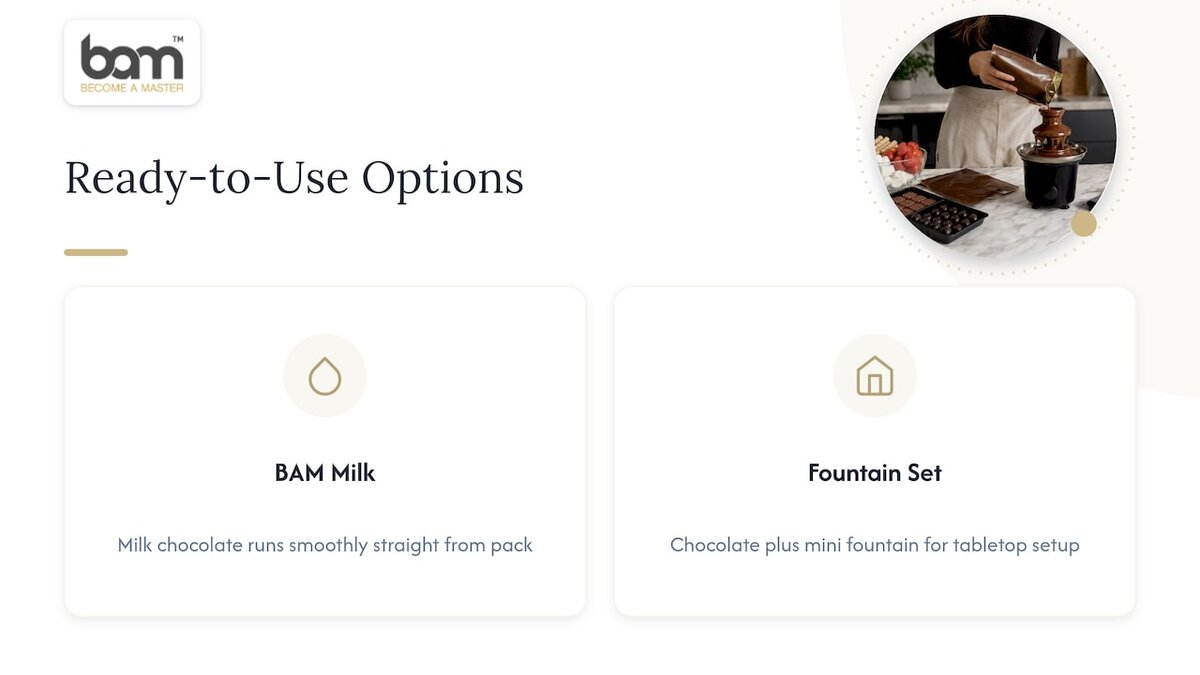
For hosts who want the result described above without testing ratios on the day, our BAM Chocolate range includes a milk chocolate formulated specifically for fountains, with added cocoa butter so it runs smoothly straight from the pack. We also put together a Chocolate Fountain Set that pairs the fountain chocolate with a mini fountain, giving home hosts everything needed for a tabletop setup without separate sourcing.
Both are built around the same idea: less preparation, more reliable flow. There is no oil to measure, no test batch to melt first, and no need to adjust consistency part-way through service. Browse the full BAM Chocolate selection to find the pack size that suits your event, whether that is a small family gathering or a larger celebration.
Couverture or purpose-made fountain chocolate is the best option, since its higher cocoa-butter content keeps it fluid enough to flow continuously. Standard eating chocolate can work but usually needs thinning with cocoa butter first to reach the same consistency.
Milk, dark and white chocolate can all work in a fountain as long as they contain enough fat to stay fluid once melted. Milk chocolate tends to flow most easily thanks to its milk fat and sugar content, making it a reliable starting point for first-time hosts.
Not reliably. Chocolate with too little cocoa butter, such as some everyday snacking bars, tends to seize or run thick and grainy, so it either needs thinning with cocoa butter or swapping for a couverture or fountain-specific blend.
The same principle applies to fondue as to fountains: a chocolate with a higher cocoa-butter content gives a smoother, glossier dip. Couverture is the standard choice among professional kitchens for exactly this reason.


 Confectionery tips


 Slovenščina
 Hrvatski
 Deutsch
 Italiano
 Česky
 Polski
 Magyar
 Français
 Slovák
 Nederlands
 Español