 info@bamchocolate.com
 Login


 en

 BAM Cake converter
 Login
Claudia
Avtorica vsebin


 Reading time:
8 minutes
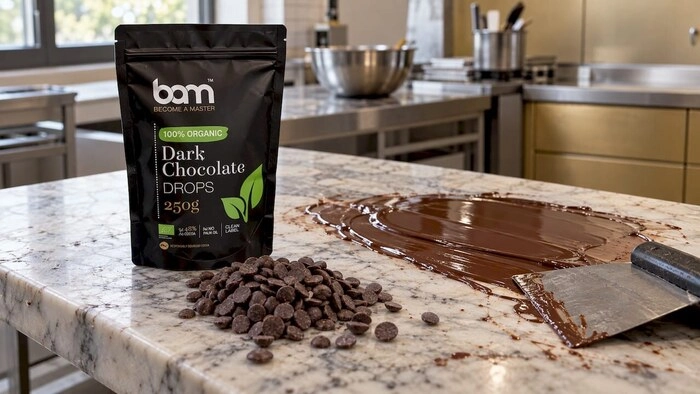
Why palm oil ends up in some chocolate, what it does to taste and texture, how to read the label, and what to look for if you prefer to avoid it.
Palm oil is not an ingredient of real chocolate. Real chocolate gets its snap, shine and quick melt from cocoa butter. Palm oil turns up in fillings, spreads, coatings and cheaper bars, where a manufacturer wants a firm, creamy texture at a lower cost. The label tells you which kind you are holding, and at BAM - Become A Master we point bakers and chocolate lovers to chocolate whose ingredient list you can read in ten seconds, such as BAM Chocolate.
This guide explains why palm oil is used, what the EU rules say, how to read a label, and what changes when you bake or eat without it.
Fat decides how a chocolate product feels. The Institute of Food Science and Technology (IFST), a UK professional body, explains that confectionery fats are chosen for melting point, crystallisation, storage stability and nutrition. Palm oil scores well on several of these at once.
Three reasons come up again and again:
These are manufacturers’ own explanations of their own recipes. They show what palm oil is for, not that every product containing it is made the same way.
In a bar of proper chocolate, cocoa butter is the fat that matters. IFST says it lets chocolate stay solid at room temperature yet melt quickly in the mouth. Tempering, the controlled heating and cooling of melted chocolate, sets its crystals in the right form and helps prevent softness and fat bloom, the pale streaks on old chocolate.
That is why bakers who temper chocolate care about the fat in it. Cocoa butter behaves predictably when tempered. A product built on other fats does not follow the same rules.
In the EU, chocolate may contain a limited amount of certain non-cocoa vegetable fats. IFST says palm-oil middle fractions and shea-butter stearin are among the fats that can serve as cocoa-butter equivalents. Products whose fat is not cocoa butter at all, such as confectionery coatings, cannot legally be called chocolate under the rules IFST describes.
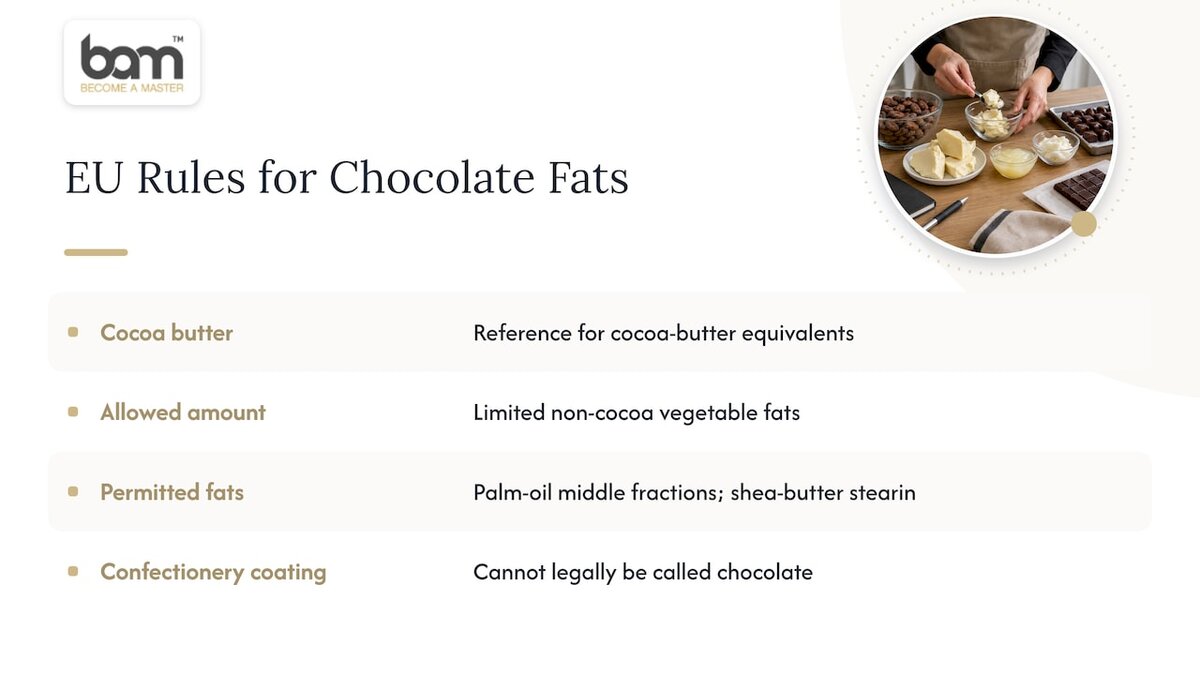
So a bar sold as chocolate can contain some palm-derived fat, while a coating made mostly with palm fat is a different product with a different name. If you want to compare how fats differ nutritionally, a food database such as butter calories and macros shows how much a single tablespoon of a pure fat contributes.
EU food law, Regulation (EU) No 1169/2011, requires the ingredient list to name ingredients in descending order by weight, using specific names where they apply. The regulation is also available in Slovenian, so shop labels in Slovenia follow the same text.
A quick routine:
Position on the list matters. An ingredient near the end is present in a small amount, one near the front is a main component.
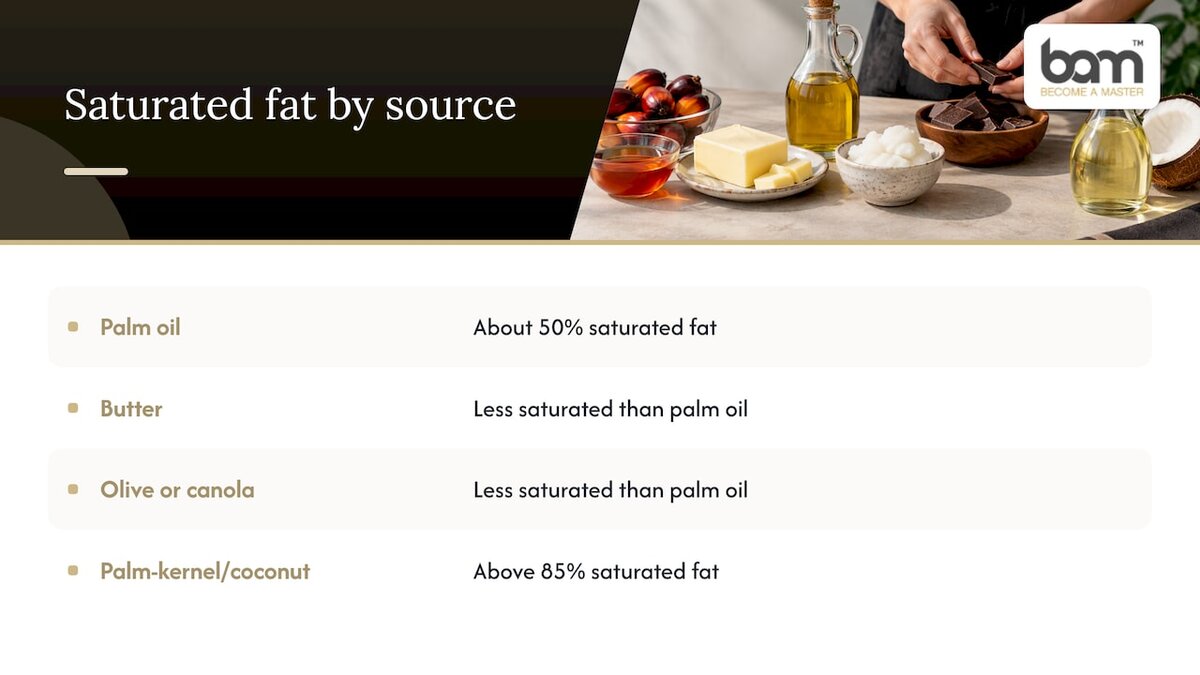
Palm oil is a fat, and it sits in the middle of the range. Harvard Health says it is about 50% saturated fat, less than butter but more than liquid oils such as olive or canola, which it recommends as preferable. Palm-kernel and coconut oils are above 85% saturated.
The British Heart Foundation explains that excess saturated fat can raise non-HDL cholesterol and advises swapping some saturated fat for unsaturated fat; it lists chocolate among foods that may contain saturated fat.
The research on palm oil itself is not dramatic either way. A 2019 meta-analysis found no significant differences in total cholesterol, LDL or triglycerides against unsaturated comparators, while calling for larger human trials. In a small 2-week trial of 20 healthy adults, a chocolate spread made with olive oil was linked to better insulin-sensitivity markers than one with palm oil. These are narrow results, so treat them as pointers for choosing a spread, not as rules.
If you manage cholesterol, diabetes or heart disease, ask your doctor or a dietitian how much saturated fat suits you.
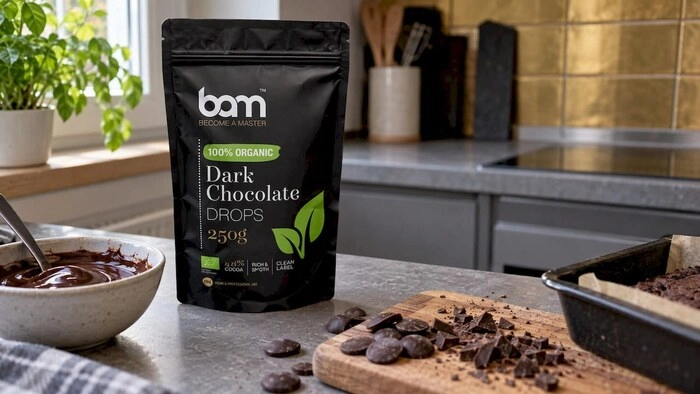
Good chocolate needs no replacement, because cocoa butter already does the job. The question arises for fillings, spreads and coatings.
A 2016 review of commercial alternatives lists liquid oils, fully hydrogenated fats and specialty fats such as shea and sal. Fully hydrogenated fats can have melting points that are too high and may need blending to get a pleasant texture. The 2025 Foods study found that sunflower-oil alternatives did not compromise overall flavour in its tests. Alternative fats worked well in dark-chocolate fillings, while light-chocolate fillings lost firmness at higher inclusion rates.
For a baker this means:
The 2025 Foods study names tropical deforestation and the draining and burning of peatland as concerns linked to meeting extra palm-oil demand. The picture is not simple, though. The 2016 review notes that palm has a high yield per hectare compared with other oil crops, so swapping it is not automatically better for the environment, and specialty fats carry cost and availability limits. The practical step is the same as with nutrition: know what is in the product and choose deliberately.
We built BAM - Become A Master around ingredients people can judge for themselves. A baker who tempers chocolate wants cocoa butter doing the work, and a gift buyer wants a bar whose ingredient list is short and clear.
That is why our range is organised by what you want to make or give: chocolate for baking and eating, spreads and dressings, products without added sugar, protein-rich BAM FIT products, and organic options. Reading the label is the best habit a chocolate lover can build, and we design the range so the habit pays off.
Whether you bake at home, cook professionally, stock a specialty shop or buy gifts for a company, the same rule applies: start with the ingredient list, then choose the texture and flavour you want.
Andraz
For everyday eating and baking, start with BAM Chocolate. If you want organic dark chocolate, see BAM BIO Dark Chocolate. For lower sugar, we offer dark chocolate with no added sugar and milk chocolate without added sugar. For spreads, see 100% BAM Spreads, and for gifts, our gift selection and the BAMBox™.
No. Classic dark chocolate is made from cocoa mass, cocoa butter and sugar. Palm-derived fat is more common in fillings, spreads, coatings and some milk or white chocolate, so the ingredient list is the only reliable guide.
Manufacturers say it gives a creamy texture, stable shelf life and a neutral taste, and it is cost-effective. Its semi-solid state at room temperature suits fillings in particular.
Read the ingredient list for palm oil, palm fat or palm kernel fat. Be careful with the general term vegetable fats, which can include palm among other oils. A product named chocolate coating is not chocolate under EU rules.
Harvard Health puts palm oil at about 50% saturated fat, which is less than butter. It still prefers liquid unsaturated oils such as olive or canola for regular use.


 Confectionery tips


 Slovenščina
 Hrvatski
 Deutsch
 Italiano
 Česky
 Polski
 Magyar
 Français
 Slovák
 Nederlands
 Español