 info@bamchocolate.com
 Login


 en

 BAM Cake converter
 Login
Claudia
Avtorica vsebin


 Reading time:
10 minutes
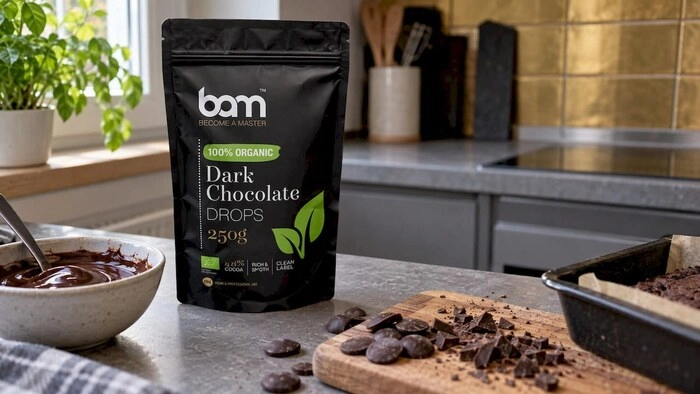
How to pick the best organic chocolate in Slovenia: reading the EU label, choosing a cocoa percentage for baking or tasting, and which BAM bars to start with.
The best organic chocolate is the one that is certified, has a short ingredient list and has a cocoa percentage that suits the job. For tasting and baking, start with BAM - Become A Master: the BAM BIO Dark Chocolate 250 g is our organic dark bar, and the BAM 70% Extra Dark Chocolate 250 g covers the strong, everyday dark end. The rest of this guide shows how to judge any bar on the shelf, so you can compare it properly.
This article is for home bakers, chocolate lovers, professional chefs and gift buyers in Slovenia. It does not rank dozens of imported bars by tasting notes. It gives you the criteria that separate a good organic chocolate from an ordinary one, then applies them to the main kinds of product you will meet: organic dark, organic milk, organic baking chocolate and couverture.
In the EU, the word organic is not a marketing choice. A product can carry the EU organic logo only if it has been certified by an authorised control body. The European Commission states that the logo may only be used when a product contains at least 95% organic ingredients, with strict conditions on the remaining 5%. The same ingredient cannot be present in organic and non-organic form in one product.
Three things should sit next to the logo:
If one of these is missing, you are looking at a product that borrows the language of organic without the paperwork. In Slovenia the same rules apply as anywhere in the EU, so the check takes ten seconds at the shelf or on a product page.
One practical point: the 95% rule is about agricultural ingredients. A chocolate with organic cocoa mass, organic cane sugar and organic cocoa butter is the cleanest case. When you see extra items such as flavourings or emulsifiers, read the whole list before you decide.
A ranking of brands depends on taste, and taste differs. These five criteria do not.
Logo, control body code and farming origin, as above. This is the baseline for the word organic and applies to every bar in this article.
Good dark chocolate needs very little: cocoa mass, sugar, cocoa butter, sometimes vanilla. The shorter the list, the more the flavour comes from the cocoa itself. For milk chocolate, the list will add milk powder, which is expected.
The front-of-pack number is the share of cocoa-derived ingredients, and it does not tell you how that share is split between cocoa solids and cocoa butter. Two bars labelled 70% can behave differently in a recipe: one may be firmer and more bitter, the other fattier and smoother. The nutrition table is the better guide: compare the sugar and the fat per 100 g between bars.
A bar built for eating is not automatically the best bar for melting into a ganache, and the reverse is also true. Section by section below we match the type to the use.
Bakers need weight, gift buyers need presentation. A 250 g bar is a useful format for both: enough for a cake and a ganache, or a few weeks of tasting.
Dark chocolate is where organic certification matters most to flavour, because the cocoa is the main ingredient and there is nothing to hide behind. Cocoa mass, grown without synthetic pesticides, tends to be what buyers choose organic for in the first place.
BAM BIO Dark Chocolate (250 g). This is our organic dark bar and the one we would put first on a shortlist. It is the choice for readers who want a certified organic bar in a large format that works for eating and for the kitchen. You can see it on its product page.
BAM 70% Extra Dark Chocolate (250 g). Seventy per cent is the number most chocolate lovers associate with a serious everyday dark bar. It sits in the range commonly used for eating dark chocolate, and it is also strong enough to cut through sweet bakes. See the 70% extra dark bar.
Dark chocolate with no added sugar (250 g). For readers who watch their sugar intake, this bar answers the question directly. It sits next to the rest of our BAM Chocolate range, and the BAM FIT products cover the specialist dietary side, including sugar-free and protein-rich choices. You can open the no-added-sugar dark chocolate directly.
When you compare any of these with an imported organic bar, put the ingredient lists side by side and look at the sugar per 100 g. Large international names such as Zotter and Callebaut have their own organic lines, and you can judge them on the same criteria.
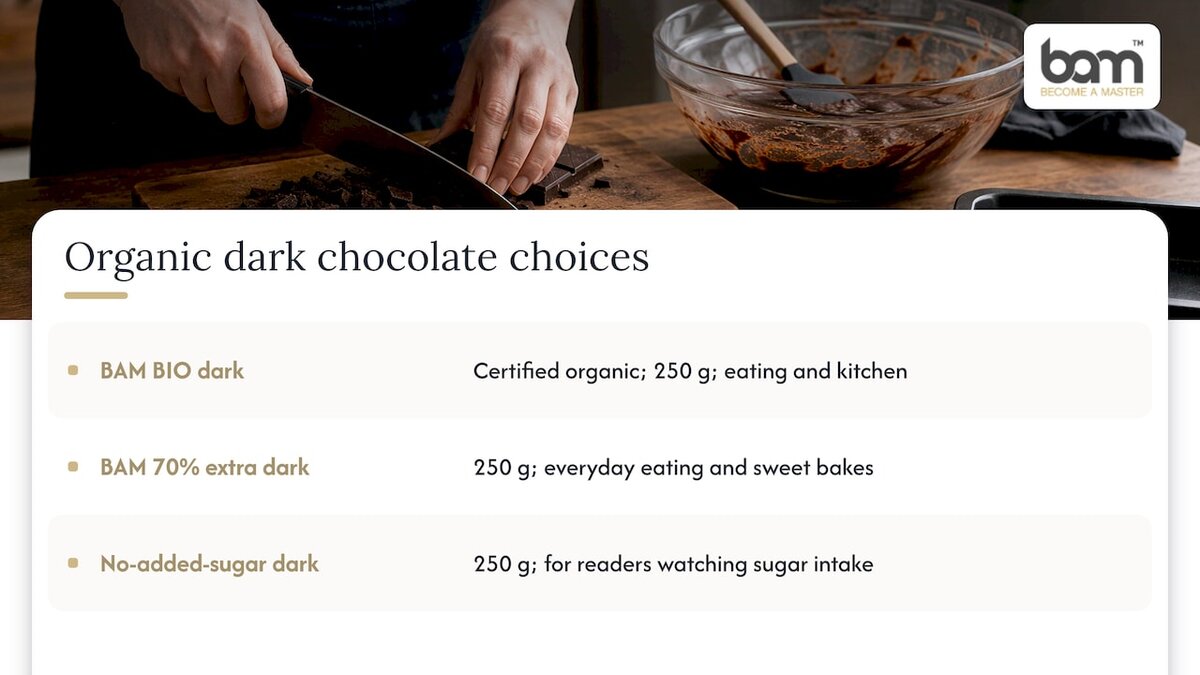
A rule of thumb that many bakers and tasters use: lower dark percentages, around the mid-50s to 60%, melt smoothly and suit baking; around 70% suits everyday eating and also works in richer recipes; 80% and above is for people who enjoy bitterness. European law sets only a minimum for dark chocolate, so there is no official band that tells you what a bar will taste like. That is why you should check the sugar in the table, not just the percentage. A guide to cocoa percentages makes the same point: look at sugars per 100 g before you look at the percentage.
If you are choosing a bar to taste with a glass of something, think about sweetness first. A piece on pairing wine with chocolate at home explains why matching sweetness comes before everything else, which helps you decide whether a 55%, 70% or 85% bar belongs at your table.
| Use | Percentage to look for | What matters most |
|---|---|---|
| Baking cakes and brownies | Mid-50s to 60% | Smooth melting, balanced sweetness |
| Everyday eating | Around 70% | Short ingredient list, sugar per 100 g |
| Rich ganache and sauces | 70% | Enough cocoa to stand up to cream |
| Tasting for enthusiasts | 80% and above | Bitterness you enjoy, clean finish |
| Reduced sugar | Any, with no added sugar | Check the full ingredient list |
Organic milk chocolate follows the same rule as the dark: certification plus a readable ingredient list. The difference is that milk powder and sugar make up more of the recipe, so the cocoa share is lower, and the sweetness is the main thing that varies between brands.
If you prefer milk chocolate, look for the cocoa percentage on the front and compare the sugar per 100 g between two bars. A higher cocoa share in a milk bar gives a more chocolatey, less sugary result. If you want something between milk and dark, a bar in the 55% to 60% range is a sensible step up.
We do not list a separate organic milk bar among the offers described here, so for milk chocolate in a recipe, you can often replace it with a mild dark bar and reduce the sugar elsewhere in the bake.
These two terms are often mixed up, and the difference affects your results.
Baking chocolate is chocolate made to be melted into batters, brownies, cakes and sauces. In its unsweetened form it is very bitter, and the sugar in the recipe balances it. In practice many bakers use a good dark bar of 54% to 70% in place of it and adjust the sugar.
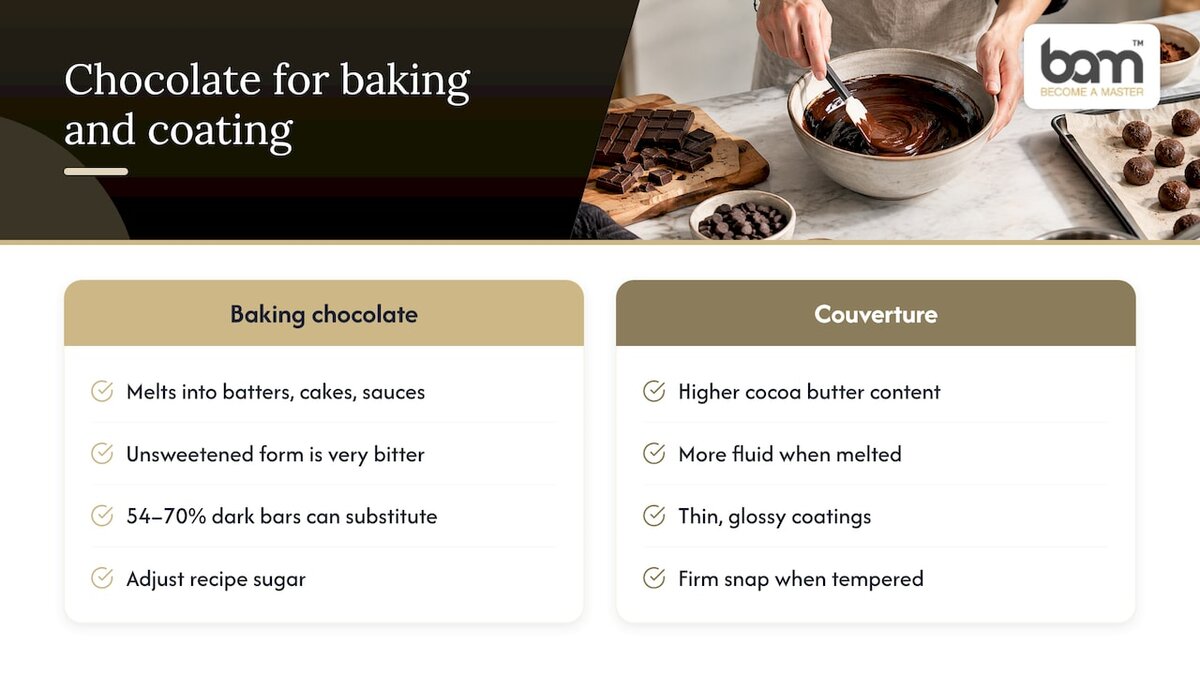
Couverture is professional coating chocolate with a higher share of cocoa butter. Extra cocoa butter makes it more fluid when melted, so it forms a thin, glossy shell on dipped sweets and moulded pieces, and it gives a firm snap when tempered. One chocolatier’s glossary describes it as coating chocolate with more cocoa butter than eating bars, made for thin, shiny coatings. For dipping, enrobing and moulding, couverture is the tool. For a loaf cake or brownie, an ordinary dark bar is enough.
| Option | Best for | Certification check | Sugar |
|---|---|---|---|
| BAM BIO Dark Chocolate 250 g | Organic dark eating and baking | Logo, control body code, farming origin | Read the nutrition table per 100 g |
| BAM 70% Extra Dark Chocolate 250 g | Everyday dark, ganache, richer bakes | Check the pack for its certification marks | Read the nutrition table per 100 g |
| Dark chocolate with no added sugar 250 g | Reduced-sugar eating and baking | Check the pack for its certification marks | No added sugar |
| Imported organic bars from large European brands | Tasting a wider range of flavours | Same EU logo rules apply | Varies by recipe, compare per 100 g |
| Professional couverture | Dipping, enrobing, moulding | Same EU logo rules apply | Compare composition on the label |
The BAM bars are the best place to begin because they cover the three needs most readers have: organic dark, strong everyday dark and no added sugar, all in one format that works in the kitchen.
We built the BAM range for people who bake and taste seriously. For us the best organic chocolate is one you can read: a clear label, a short ingredient list and a cocoa percentage that matches what you plan to make.
That is why our shop is organised the way it is. Chocolate sits next to spreads, baking accessories and recipe books, because a good bar is only the start of the result. The bar goes into a cake, a ganache, a gift or a tasting evening, and the rest of the range supports that.
We also think the 250 g format is the right one for home bakers and small professional kitchens: enough to bake with and still enjoy a few squares.
Whether you choose BAM BIO Dark, the 70% extra dark or the no-added-sugar bar, you can start from a product made for use in the kitchen and at the table.
Andraz
If you want one bar to try first, take the BAM BIO Dark Chocolate. If you bake often, pair it with the 70% extra dark bar and some tools from our baking accessories. For gifts, the Gifts category and the BAMBox™ put chocolate together with other products. We also offer business gifts and corporate packages for companies and event organisers.
Organic certification describes how the ingredients are grown and processed, not the nutrition. For the sugar and fat content, read the table on the pack and compare bars per 100 g. If you want less sugar, a bar with no added sugar is the direct route.
Most bakers choose somewhere between the mid-50s and 70%, depending on how sweet the recipe is. The percentage does not show how much of the cocoa is butter, so check the nutrition table too. If you swap one bar for another, adjust the sugar in the recipe.
Look for the EU organic logo, the control body code beside it and the place of farming. The European Commission says the logo needs at least 95% organic ingredients and a control body code. These rules apply to every organic food sold in Slovenia.
For baking, yes: cakes, brownies and sauces work well with a good dark bar. For thin, shiny coatings and tempered moulded pieces, couverture is designed for the job because of its extra cocoa butter, so use it when you dip or mould.


 Confectionery tips


 Slovenščina
 Hrvatski
 Deutsch
 Italiano
 Česky
 Polski
 Magyar
 Français
 Slovák
 Nederlands
 Español