 info@bamchocolate.com
 Login


 en

 BAM Cake converter
 Login
Claudia
Avtorica vsebin


 Reading time:
9 minutes
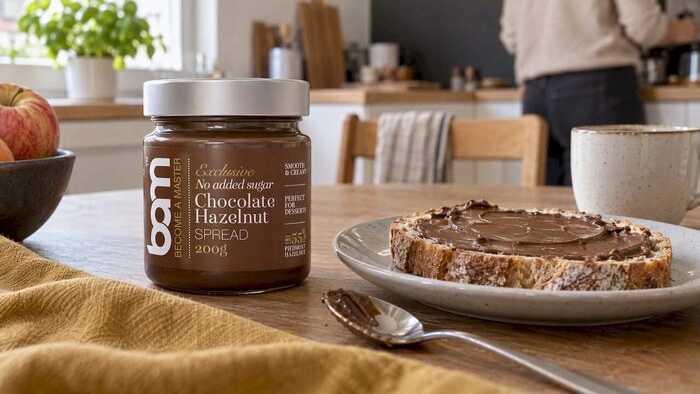
Compare the main Nutella alternatives by ingredients, sugar, vegan and nut-free options, and see which chocolate hazelnut spread suits your toast, baking or gifts.
The best Nutella alternative depends on what you want to change. If it is the sugar, look at a spread with no added sugar. If it is the milk, look at a vegan formula. If it is the nutrition, look at a protein spread. And if you want full control over the ingredients, you can make your own. At BAM - Become A Master we sell three spreads for the first and third cases: a sugar-free hazelnut spread with cocoa and two protein spreads. This guide compares them with the other options, so you can pick on facts and not on the front of the jar.
A fair comparison starts with the reference. By the manufacturer’s own Slovenian label, classic Nutella has seven ingredients: sugar, palm oil, hazelnuts (13%), skimmed milk powder (8.7%), fat-reduced cocoa (7.4%), soya lecithin and vanillin. Per 100 g it lists 539 kcal, 30.9 g fat, 57.5 g carbohydrate, 56.3 g sugars and 6.3 g protein. Its recommended portion is 15 g, about one teaspoon, at 80 kcal.
Two numbers matter most. Sugar is the first ingredient, and sugars make up more than half the jar by weight. Hazelnuts are 13%, which the maker says is about 97 nuts in a 750 g jar. So when people ask for an alternative, they usually want one of four things:
A fifth group wants no nuts at all, which is a safety question and gets its own section below.
In a Slovenian supermarket or online shop, the realistic options fall into five groups. The table compares them on what readers ask about most. Nutella’s figures are the manufacturer’s own label values.
| Option | Sweetened with | Milk | Best for | Watch for |
|---|---|---|---|---|
| Classic Nutella | Sugar (56.3 g per 100 g) | Skimmed milk powder | Familiar taste, toast, crêpes | High sugar and energy per 100 g |
| Nutella Plant-Based | Sugar and rice syrup (45.4 g sugars per 100 g) | None, uses chickpea flour and rice syrup | Vegan and lactose-free diets | Made in a factory that uses milk |
| BAM hazelnut spread with cocoa, no added sugar | Sweeteners, no added sugar | See the product label | Cutting sugar, everyday spreading | Read the label for your diet |
| BAM hazelnut and chocolate protein spreads | See each product label | See each product label | Breakfast, snacks, training days | Check the label for allergens |
| Homemade hazelnut spread | Whatever you add | Your choice | Full control, small batches | Short shelf life, you do the work |
The rest of this article explains each row and where it fits.
Sugar is the most common reason to look for an alternative. A 15 g portion of classic Nutella carries about 8.4 g of sugar, going by the label figure of 56.3 g per 100 g. That is fine as an occasional treat. It adds up when a spread goes on bread every morning and into the children’s lunchboxes too.
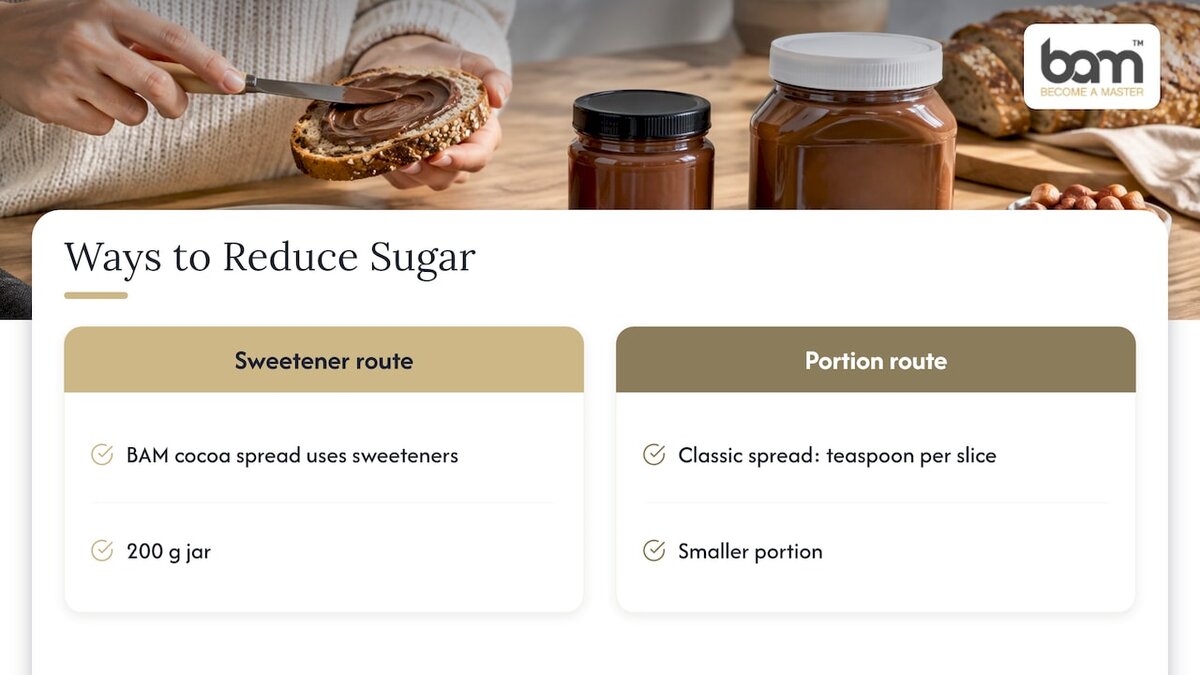
There are two routes to less sugar. The first is a spread sweetened with sweeteners instead of sugar. Our BAM hazelnut spread with cocoa, sugar-free is made this way and comes in a 200 g jar. The second is a smaller portion of a classic spread. A teaspoon on a slice behaves differently from a thick layer, whichever jar you open.
If you want sweet things beyond chocolate spreads, you can cut sugar elsewhere too. These sugar-free jam methods show how chia seeds or pectin set a fruit spread without added sugar. It pairs well with a hazelnut spread on one slice.
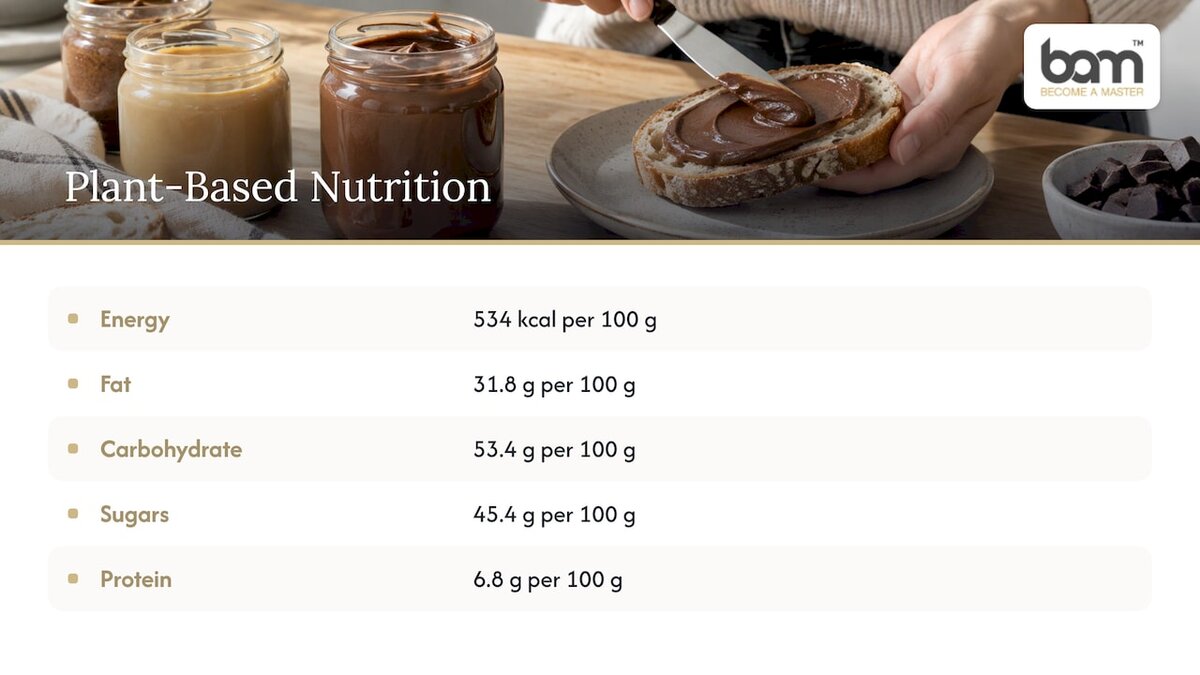
Classic Nutella contains skimmed milk powder, so it is not vegan. The brand’s answer is Nutella Plant-Based. It replaces milk with rice syrup and chickpea flour, and the maker says it is certified vegan by the Vegetarian Society. By its label it has 534 kcal per 100 g, 31.8 g fat, 53.4 g carbohydrate, 45.4 g sugars and 6.8 g protein. The maker also says it is suitable for people with lactose intolerance, but not for milk-protein allergy, because it is made in a factory that uses milk.
That last point applies to every spread. A vegan recipe is not the same as an allergen-free product. If you or a guest has a milk allergy, the factory statement on the jar decides, not the word vegan.
If you cook for a vegan household, a homemade spread (below) is the most flexible route, because you choose every ingredient. For hosting and gifts, our spreads and dressings category lets you compare the jars side by side.
Some people want a spread that does more than sweeten toast. We make two for this: a hazelnut protein spread and a chocolate protein spread, each in a 200 g jar. They belong to the BAM FIT range, which is built for bakers and athletes who track what goes on the plate. You can see the whole range under BAM FIT products.
How to use them:
Because the recipe differs from Nutella, expect a different texture and sweetness. If you are used to a very sweet, very smooth spread, try a thin layer first and adjust.
Making your own is the most hands-on alternative. A Croatian nutritionist quoted by Ordinacija in 2021 suggested 250 g of hazelnuts, 250 g of dark chocolate and 3 tablespoons of coconut oil. The method is simple:
Where it goes wrong: the nuts must be ground long enough to release their oil, and the chocolate must be good. A poor chocolate gives a grainy, bitter spread. Baking chocolate is the key ingredient here, and our BAM Chocolate range was made for this kind of use. A good scale, a spatula and clean jars also help, and you will find them in baking accessories.
Homemade spread has no preservatives, so make small batches. It also costs more time than buying a jar, which is why many bakers keep a ready-made spread for weekdays and make their own for special bakes.
A nut-free alternative to Nutella is a different problem. Hazelnut is a tree nut, so any hazelnut spread is out. Spreads based on seeds, such as sunflower, are the usual substitute, and a few chocolate spreads are made without nuts altogether.
For anyone with a nut allergy, the label is the only thing that counts:
For meals around a nut-free spread, these nut-free meal ideas offer safe swaps for the rest of the table. We do not present our hazelnut spreads as suitable for nut allergy.
Peanut butter is not similar to Nutella, though both are spreads based on ground nuts. Peanut butter is savoury or lightly salted, higher in protein and usually has no cocoa. A chocolate hazelnut spread is sweet and soft, with a dessert character.
Use it like this:
Whatever you choose, judge by the label, not by the word healthy. Compare sugars, fat and portion per 100 g and per serving, since a 15 g serving is far smaller than what most people spread.
Most people who write to us about Nutella do not want to give it up. They want the same moment at breakfast without the sugar load.
That is why we put sugar-free and protein spreads in the BAM range. A spread is not only a topping. It goes into pancakes, fillings and gift boxes, so the quality of what is in the jar matters more than the label on the front.
Our 200 g jars are sized for real use: one for the kitchen, one for a gift. Add good baking chocolate, and you can cover toast, baking and presents from one shop.
Andraz
You can order the whole range online. Start with 100% BAM Spreads for the spreads themselves. If you are buying for someone else, the gift selection and the BAMBox™ put several products in one parcel. Businesses can ask us about corporate packages and business gifts, and retailers and specialty shops can contact us about the range.
You can use a sugar-free hazelnut and cocoa spread, a protein spread, a vegan chocolate spread or a homemade mix of roasted hazelnuts, dark chocolate and oil. Choose by what you want to change: sugar, milk, protein or ingredients.
A spread with no added sugar lowers the sugar per portion, and a protein spread suits sports breakfasts. Portion size matters as much as the jar, since the manufacturer’s own serving of classic Nutella is 15 g. Compare the label values per 100 g and per serving.
Yes. Nutella Plant-Based uses chickpea flour and rice syrup instead of milk powder, and the maker says it is certified vegan. It is made in a factory that uses milk, so it does not suit a milk-protein allergy. A homemade spread gives you full control.
Hazelnut spreads always contain nuts, so a nut-free choice has to be a different type of spread, such as one made from seeds. Check the ingredient list and the factory statement on every jar. If someone has a nut allergy, ask their allergist first.


 Confectionery tips




 Slovenščina
 Hrvatski
 Deutsch
 Italiano
 Česky
 Polski
 Magyar
 Français
 Slovák
 Nederlands
 Español