 info@bamchocolate.com
 Login


 en

 BAM Cake converter
 Login
Claudia
Avtorica vsebin


 Reading time:
8 minutes
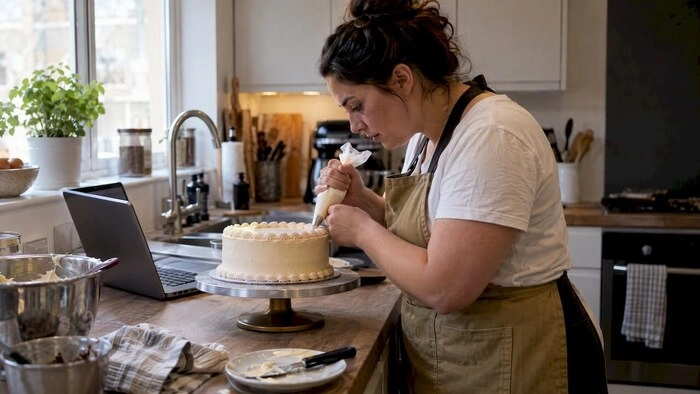
Compare live feedback with recorded baking lessons, choose a course for your skill level, and see how BAM pairs training with premium ingredients.
The best route for most home bakers mixes two formats: live, interactive workshops to learn technique with real-time correction, and on-demand video masterclasses to repeat and practise afterwards. We built our confectionery training and ingredient range around exactly that combination. The sections below cover formats, course levels, selection criteria and how to get the most from either option.
A genuinely live class puts an instructor in front of a small group in real time, watching how you shape dough, temper chocolate or pipe a border, then correcting you on the spot. On-demand masterclasses are pre-recorded lessons you watch and rebake at your own pace, with no live feedback loop. A third model sits between the two: sessions billed as “live” that are mostly pre-recorded video with a scheduled Q&A bolted on.
Interactive, instructor-led courses show completion rates of 75 to 85%, compared to roughly 15 to 25% for passive video libraries, according to EdSurge. That gap matters most for manual skills: dough handling, shaping, chocolate tempering. Real-time correction speeds up competence in a way that watching a video a second time rarely does.
Signs a course is truly live and interactive rather than live-streamed in name only:
For most home bakers, the practical answer is to book a live session for a technique that needs correcting, such as laminated pastry or chocolate tempering, then use an on-demand masterclass to repeat the same recipe two or three times until it is automatic.
Online baking and pastry courses tend to sit in three broad tiers: beginner (basic methods, simple bakes), intermediate (laminated dough, celebration cakes, entremets) and advanced (competition-style technique, professional chocolate work). Within those tiers, the common topic areas are bread, pastry, celebration cakes and chocolate, each with its own skill curve.
A well-structured lesson usually includes a live or recorded demo, a bake-along section where you follow in your own kitchen, a troubleshooting segment, and a written recipe with an ingredient list you can shop against. Alison’s free Baking and Desserts for Beginners course is a useful example: it runs 4 to 5 hours of video covering basic methods, which makes it a reasonable way to test interest before committing to a longer paid programme.
Access models vary by provider:
Certificates or completion badges are common on marketplace platforms, but for a home baker they mainly confirm attendance rather than certify a professional qualification, so weigh them as a nice extra rather than a deciding factor.
Before paying for a course, run it against a short set of criteria: instructor experience, how interactive the sessions actually are, class size, what resources come with the course, whether subtitles or language options are offered, the price against your budget, the refund policy, and the total time commitment relative to your schedule.
A compact checklist to work through while comparing options:
Pro tip: Book one live session first to judge how much real feedback you actually get, then fill in repeat practice with a cheaper on-demand masterclass covering the same technique.
We built our training platform around the idea that a course only teaches you as much as your ingredients let you reproduce. Good instruction paired with inconsistent couverture or vague recipe measurements leaves you guessing at exactly the stage where a class should be building confidence.
Our product range is designed to close that gap:
For readers ready to stock a kitchen before their next lesson, our chocolate and baking accessories pages are a reasonable starting point.
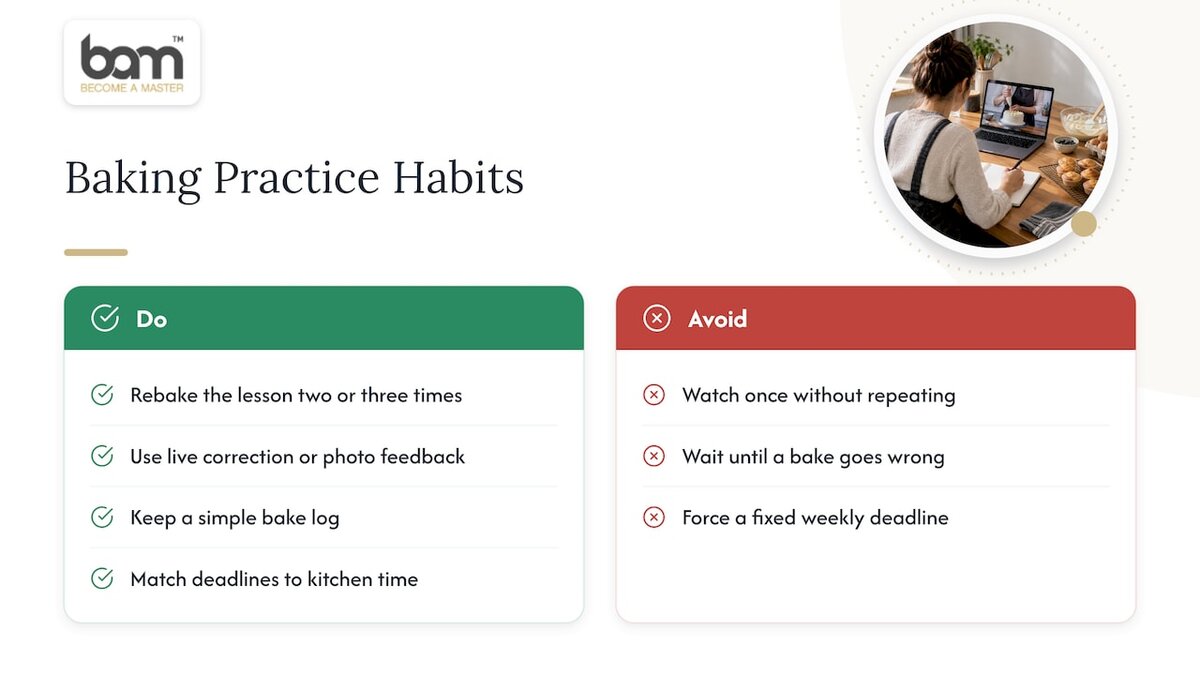
A course only improves your baking if you actually repeat the recipe, not just watch it once. Rebaking the same lesson two or three times, ideally within a week, is what turns a demonstration into a skill you can do without checking notes.
Feedback matters as much as repetition. If your course offers a live correction slot or a submission channel for photos, use it every time rather than only when something has gone visibly wrong, since small corrections (how you’re holding a piping bag, how warm your butter is) compound over several bakes. Community features such as class forums or shared photo threads are worth checking in on too: seeing how other students solved the same problem often answers a question faster than waiting for the next live session.
Keep a simple bake log: date, recipe, what went wrong, what you changed next time. It sounds basic, but it is the difference between learning a recipe and learning a technique you can apply to a different one.
Finally, pace yourself against your actual kitchen time rather than the course schedule. A cohort class with a fixed weekly deadline is only useful if you can realistically hit it; otherwise, an on-demand masterclass with no deadline will teach you the same technique with less pressure.
I have found the live and on-demand mix works better than committing fully to either. A live chocolate tempering session showed me, within one correction, that my workspace was simply too warm, something no video had ever flagged. Rewatching an on-demand masterclass of the same lesson afterwards is what actually fixed my habit.
My practical advice: invest in a few good tools before you start rather than mid-course, set one fixed bake session a week rather than “whenever I have time”, and pick a single focused course to finish before adding another to your list. Run any course you’re considering against the checklist above first.
— Andraz
Once you’ve picked a course, the next decision is what you bake with. A well-stocked range of ingredients and tools helps ensure you’re not improvising substitutions mid-lesson.
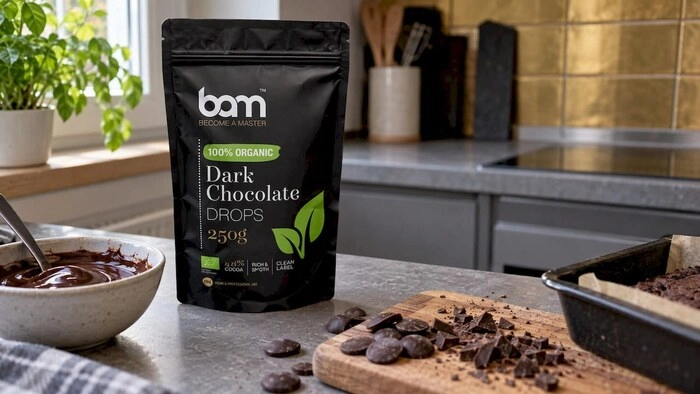
Our BAM Chocolate range gives you consistent couverture for tempering practice, our baking accessories cover the scales, moulds and piping tools most pastry and chocolate lessons call for, and our BAMBox™ kits bundle several of those items together when a recipe needs more than one specialty ingredient at once. If you’re buying for someone else taking a course, our gifts range covers that too.
Browse the full range at BAM - Become A Master and have your kitchen stocked before your next lesson starts.
The strongest options combine course marketplaces, which list a wide range of one-off workshops and cohort classes, with free short courses for testing interest before paying. Course marketplaces such as CourseHorse catalogue both formats alongside gift-card options, while Alison offers free beginner video courses with no upfront cost.
For bread and bakery technique, look for a course that includes live, hands-on correction rather than only video demonstration, since shaping and proofing are hard to self-diagnose from a screen. Intermediate and advanced tiers covering laminated dough or celebration cakes typically build on a beginner bread foundation first.
Most beginner courses assume a kitchen scale, mixing bowls, a stand mixer or hand whisk, basic baking tins and an oven thermometer. Pastry and chocolate lessons add specific items such as piping tips, acetate sheets or chocolate moulds, which reputable course listings typically specify in advance.
Definitions vary across schools, but a common version covers: mise en place, mixing, fermenting or resting, shaping, proofing, baking, and cooling or finishing. Course curricula sometimes compress or expand these stages depending on whether the focus is bread, pastry or confectionery.


 Confectionery tips


 Slovenščina
 Hrvatski
 Deutsch
 Italiano
 Česky
 Polski
 Magyar
 Français
 Slovák
 Nederlands
 Español