 info@bamchocolate.com
 Login


 en

 BAM Cake converter
 Login
Claudia
Avtorica vsebin


 Reading time:
12 minutes
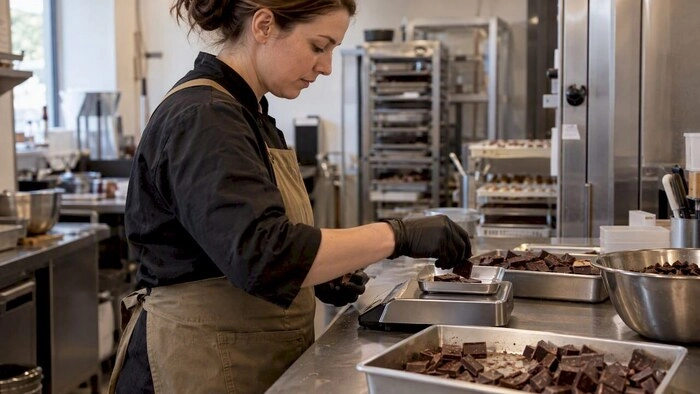
Plan event chocolate with per guest portions, an order calculation, and packaging tips that reduce waste. BAM - Become A Master offers bulk chocolate.
Plan on 40 to 60 grams or three to five bite-size pieces per guest for a reception, closer to 80 to 100 grams when chocolate is part of a dessert course, and one 20 to 40 gram favour pack per person for take-home gifts. Bulk chocolate, favour packs and corporate gift boxes are available for exactly this kind of order.
The right figure depends on whether chocolate is a passing snack, a dessert component or a gift to take home. Each format carries a different expectation of how much a guest will actually eat or keep.
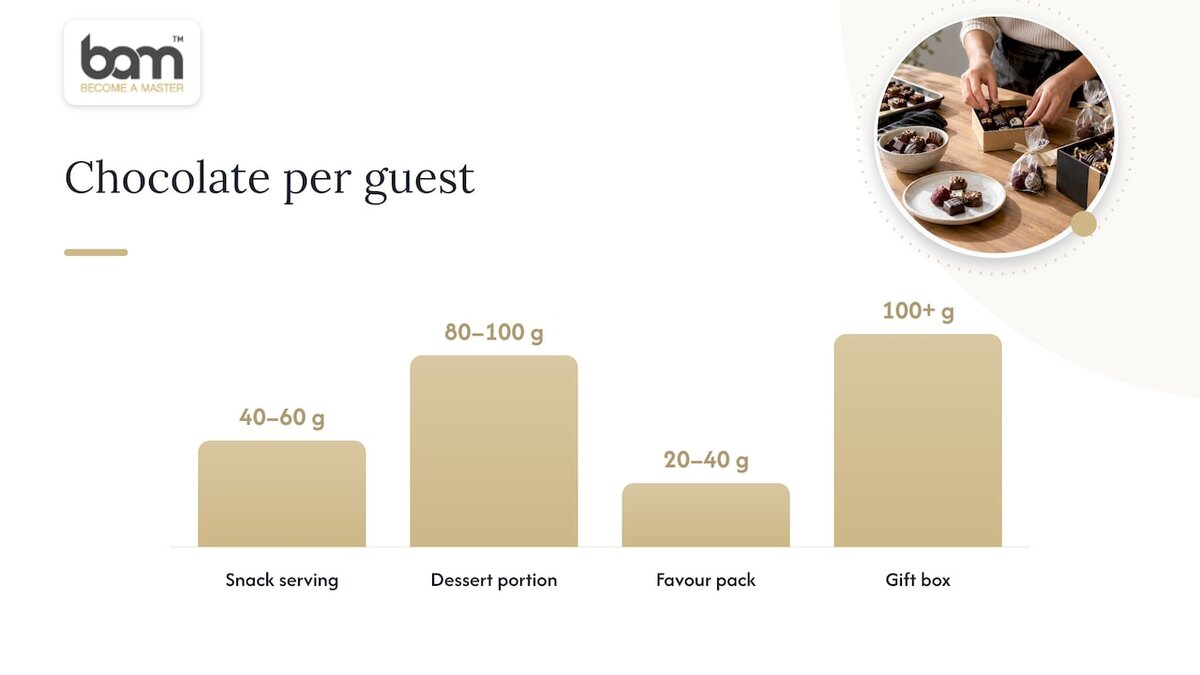
For a cocktail reception or networking event, guests tend to graze. A snack-style serving of three to five bite-size pieces, or roughly 40 to 60 grams per person, covers casual sampling without leaving excess on the table. For a dessert-table buffet or a plated dessert where chocolate sits alongside cake or fruit, raise that to 80 to 100 grams per guest, since this portion is meant to satisfy rather than merely tempt.
Favour packs work on a different logic: perceived value matters more than raw weight. A pack in the 20 to 40 gram range, holding four to six small pieces, reads as generous without becoming a second dessert. Corporate gift boxes sit at the top end, typically built around one or two full bars or a curated assortment weighing 100 grams or more, reserved for VIP guests, key clients or senior staff rather than every attendee.
Mixing formats at a single event is common. A corporate reception might offer a light snack serving at the bar while reserving a boxed gift for departing guests, so it helps to calculate each format separately before adding the totals together.
Once you know which format applies, converting it into an order is three steps.
A modest buffer on top of the base calculation covers variables such as no-shows turning into walk-ins, second helpings, and breakage during transport or service.
Worked example A, a private party of moderate size: with an estimated per-guest portion for a reception-style serving, multiply to find the base need and add a buffer, then round up to a bulk order size.
Worked example B, a larger corporate reception: similarly, multiply an estimated per-guest portion for a dessert-table addition by the guest count, add a buffer, and round up to a bulk order size, which may be split across cases.
How chocolate is packaged affects both guest experience and how much you need to order. A favour bag or box with four to six pieces reads as a complete gift, while anything fewer can look sparse even at the same total weight.
Pro Tip: Combine an open display tray for visual impact with individually wrapped pieces for actual service: guests take fewer unwrapped pieces when wrapped options sit beside them.
Stocked items such as standard bars or pre-packed favours can usually move quickly, but anything custom, including bespoke-wrapped favours or handmade truffle assortments, needs more notice to allow for production and packaging.
A simple budgeting example: if a 2.5 kilogram bulk order covers 40 guests at a cost you have already quoted per kilogram, dividing that total by 40 gives you a clean per-guest cost to carry into your overall event budget.
We run BAM - Become A Master as an e-commerce platform specialising in high-quality baking ingredients, confectionery and gourmet chocolate, including organic and sophisticated flavours.
A one-hour cocktail reception and a three-hour seated dinner call for different totals even with the same guest count. Shorter, standing events see guests circulate past a chocolate station once or twice, so the lighter 40 to 60 gram snack range usually holds.
Longer seated events change the maths. A dinner that runs several hours, with chocolate appearing as a dessert course or alongside coffee service, pushes consumption toward the 80 to 100 gram dessert-level portion, since guests are seated and have time to finish a full serving rather than graze.
Duration matters as much as format. A reception that runs past two hours effectively becomes two serving windows, so either plan for a second light pass of 20 to 30 grams per guest or budget the full dessert-level amount from the start. A seated dinner with multiple courses, by contrast, often needs only one chocolate moment, which keeps the per-guest figure closer to the standard dessert range rather than stacking a snack portion on top.
The safest approach is to map your event’s timeline first: count how many distinct moments chocolate will appear, then apply the relevant per-guest figure to each one rather than guessing a single blended number for the whole event.
Guest appetite for chocolate shifts with the season and the occasion’s theme. Winter events, particularly those running close to colder months, tend to see slightly higher per-guest consumption, as richer, denser flavours feel more fitting and guests linger longer at dessert and gift tables.
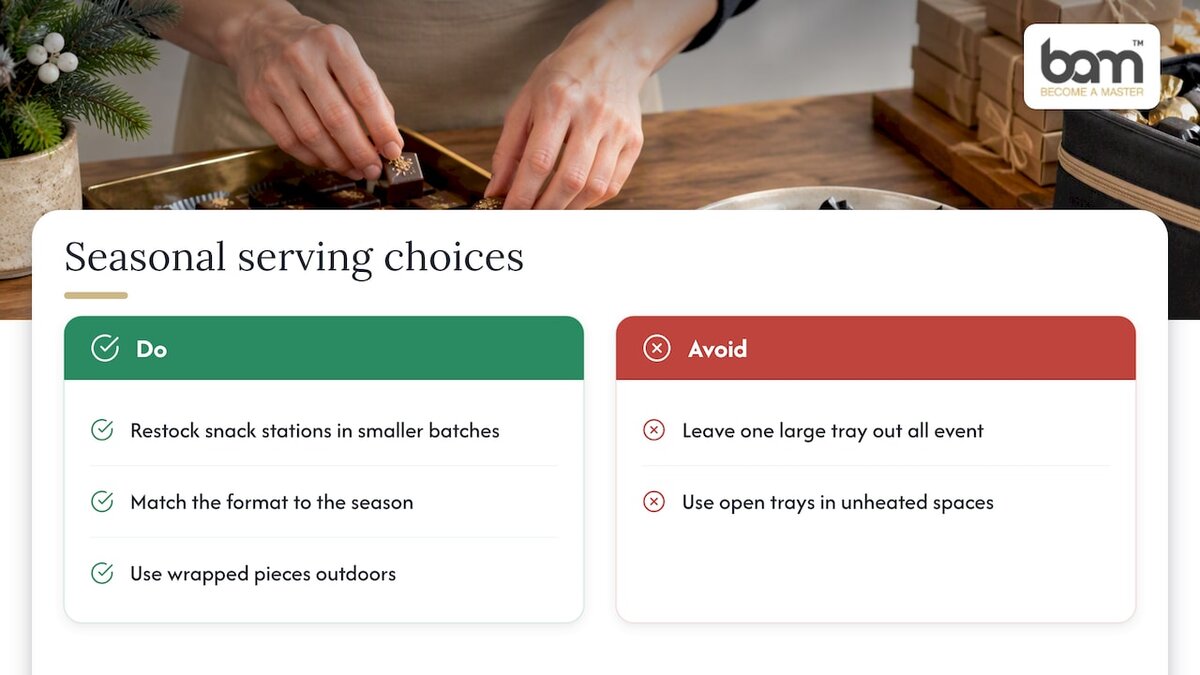
Warmer-weather events often call for lighter handling: chocolate pieces spend less time out on display before softening, so smaller, more frequent restocking of a snack station can work better than one large tray set out for the full event.
Themed events add another layer. A dessert-forward or chocolate-themed event naturally justifies the higher end of the dessert-table range, since chocolate is the centrepiece rather than one option among several. A gifting-focused occasion, such as a client appreciation event or a holiday corporate gathering, shifts weight toward favour packs and boxed gifts rather than snack-station totals, since the chocolate is meant to travel home with the guest.
When in doubt, match the format to the season rather than the calendar date alone: a chilled venue in summer can still support a generous display, while an unheated outdoor space in any season favours wrapped, individually packed pieces over an open tray.
Chocolate ordered in bulk needs to hold its texture and appearance from delivery through to service, and temperature is the main variable to manage. Store boxes in a cool, dry space away from direct sunlight and ideally below 20°C, since warmer conditions can cause the surface to dull or soften before the event even starts.
Avoid storing chocolate near strong-smelling foods or cleaning products, since it absorbs odours easily through its packaging. Keep original boxes sealed until the day of the event rather than unwrapping everything in advance, which limits exposure to air and humidity.
On the day itself, bring chocolate out of cold storage gradually rather than placing it directly under warm lighting or near a heat source, which can cause visible bloom, a dulling or whitening of the surface that affects appearance more than taste. Setting up display trays as close to service time as practical keeps pieces looking their best for photographs and first impressions.
For multi-day events, rotate stock so that the oldest boxes are used first, and keep any dietary-specific or custom-wrapped batches clearly separated to avoid mix-ups during a busy service window.
When chocolate shares the table with cake, pastries or other sweets, the per-guest chocolate figure should drop rather than stack on top of a full dessert-level portion. If chocolate is one of three or four sweet options, a lighter 30 to 50 gram allocation per guest usually balances the table without excess.
Think in terms of total sweet consumption per guest rather than treating each dessert category as a separate full portion. A guest who takes a slice of cake and a few chocolate pieces is unlikely to also finish a full favour pack, so dessert-table and favour-pack totals can overlap in practice even though they are planned separately.
Where chocolate is the headline dessert and other sweets are supporting options, such as petit fours or a small pastry selection, keep chocolate at the full 80 to 100 gram dessert range and treat the other items as lighter accents at 20 to 30 grams each. This keeps the overall sweet course generous without over-ordering across every category.
Favour packs sit outside this calculation, since they are taken home rather than eaten on site, so they should be planned at their standard 20 to 40 gram range regardless of how many other desserts appear on the night.
Guest demographics shift the numbers meaningfully, and an event with a significant proportion of children benefits from planning two separate figures rather than one blended average. Children typically take smaller, more frequent portions and often prefer simpler pieces over darker or more intense flavours.
For a reception or snack-style serving aimed at children, a smaller portion per child is usually sufficient, since smaller portions and shorter attention spans mean less gets eaten per visit to a station. Favour packs for children can follow the same 20 to 40 gram range as adults, since the take-home element carries similar value regardless of age.
For mixed-age events such as family celebrations or community gatherings, calculate the adult and child totals separately using your actual headcount split, then combine them for the final order rather than applying one average figure across every guest. This avoids both over-ordering for an event with many children and under-ordering for one skewed toward adults.
Dietary variation also tends to be higher among adult corporate guests, so leaving a slightly larger allergen-labelled and sugar-free allocation within the adult total is a practical adjustment worth making before finalising numbers.
Most advice on this topic treats the per-guest gram figure as the whole answer, but the number that causes problems on the day is almost never the base calculation. It is the buffer, or the lack of one, that leaves hosts short when a reception runs long or a guest list grows by ten names the week before.
The conventional advice also tends to treat every event as one serving moment, when duration and format are what actually move the figure. A two-hour reception is not one calculation; it is two or three, and the mistake planners make most often is applying a single blended number across a timeline that clearly has distinct phases.
If you take one thing from this guide, make it the buffer and the timeline mapping, not the base gram figure. Get those two right and the per-guest number becomes almost mechanical to apply.
— Andraz
Once you have your numbers, ordering is straightforward. We stock bulk-ready BAM Chocolate for reception and dessert-table formats, curated Gifts and BAMBox™ for corporate and VIP favours, and BAM FIT products for sugar-free or protein-rich guest packs. Get in touch for a bulk quote, bespoke packaging or a sample pack ahead of your event, and allow extra lead time for custom-wrapped batches.
A standing wedding reception typically needs 40 to 60 grams or three to five bite-size pieces per guest, rising to 80 to 100 grams if chocolate also appears as part of the dessert course.
Stocked bars and standard packs can often be ordered closer to the event, but custom-wrapped favours or handmade assortments need more lead time to allow for production. Confirm turnaround separately for any bespoke or dietary-specific batches when you place your order.
For a large reception with estimated per-guest portions, multiply by guest count and add a buffer to determine total order weight.
Yes, each format carries a different per-guest figure and serves a different purpose, so they should be calculated and ordered as separate line items. A favour pack of 20 to 40 grams per guest is planned independently from an 80 to 100 gram dessert-table portion, even at the same event.


 Confectionery tips


 Slovenščina
 Hrvatski
 Deutsch
 Italiano
 Česky
 Polski
 Magyar
 Français
 Slovák
 Nederlands
 Español