 info@bamchocolate.com
 Login


 en

 BAM Cake converter
 Login
Claudia
Avtorica vsebin


 Reading time:
12 minutes

Discover the essentials of explaining chocolate certifications. Use our UK buyer's checklist to make informed, ethical chocolate purchases.
TL;DR:
- Chocolate certification logos indicate participation in standards-based programs but do not guarantee premium quality or full fair trade. Verification involves checking the license number, sourcing details, and ingredient list, often within minutes, to ensure transparency. Stacking multiple signals, such as logos, supplier information, and ingredient clarity, provides the most reliable assessment of ethical and traceable chocolate sourcing.
Chocolate certifications are shorthand signals about social, environmental, traceability, or organic practices. They are useful buying guides, not proofs of superior flavour or complete supply-chain fairness. Before purchasing, check three things: the certification logo on the pack, the licence or registration code printed nearby, and the supplier’s sourcing or transparency page. Logos from the Fairtrade Foundation, Soil Association, and Rainforest Alliance each cover different ground. Bamchocolate’s recommended approach is to stack those signals rather than rely on any single badge.
Quick checklist for UK buyers:
Certifications group into four broad categories. Understanding them lets you map any logo back to what it genuinely measures.
| Category | What it addresses | What it does not cover |
|---|---|---|
| Social | Minimum prices, producer premiums, labour standards | Guaranteed living income for every farmer |
| Environmental | Deforestation, agrochemical use, biodiversity | Flavour quality or single-farm origin |
| Traceability | Chain of custody, lot tracking, audit documentation | Physical separation of beans in every model |
| Organic | Restrictions on synthetic inputs and pesticides | Fair pay, superior taste, or small-batch production |
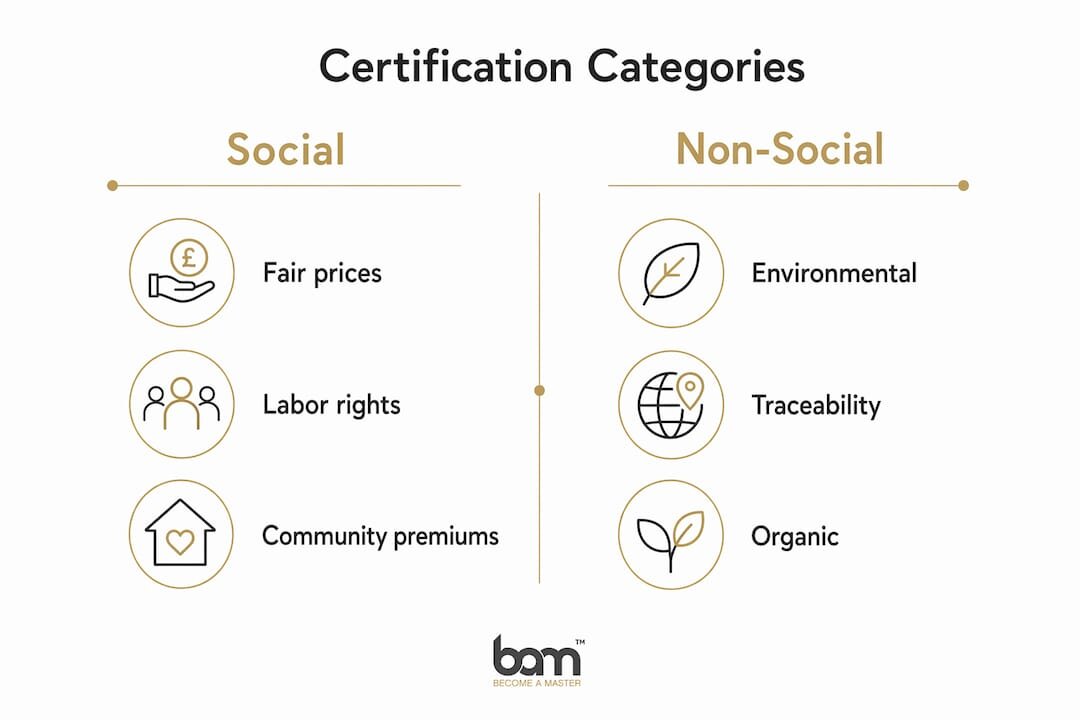
A logo signals participation in a structured programme with defined standards and audits. It does not signal that every requirement was met perfectly at every farm in every harvest year. Organic certification controls agrochemical inputs and farming practices; it is entirely separate from social or traceability standards. On a UK pack, you might see “Fairtrade certified” (social and trade terms), a Rainforest Alliance frog (environmental and farm management), or a Soil Association symbol (organic inputs). Each maps to a different category.
Fairtrade is built around structured trading conditions: a Fairtrade Minimum Price acts as a safety net when market prices fall, and a Fairtrade Premium is paid on top to certified producer organisations for collective investment. The UK and Germany are the largest markets for Fairtrade cocoa in Europe. Look for the distinctive green-and-blue mark and a licence number, which you can verify on the Fairtrade Foundation website. What it does not prove: guaranteed living income for individual farmers, superior flavour, or single-farm origin.
Rainforest Alliance merged with UTZ in 2018; the combined programme uses the green frog logo. Its 2020 Sustainable Agriculture Standard introduced Sustainability Differentials and Sustainability Investments as shared-responsibility tools. The focus is environmental management, biodiversity, and risk-based social compliance rather than a fixed price floor. In 2023, 51% of the world’s cocoa carried Rainforest Alliance certification. UTZ-branded packaging from before the merger may still appear in stock; the underlying programme is now unified.
The Soil Association is the UK’s leading organic certifier. Its mark confirms that synthetic pesticides and fertilisers were restricted during production. It does not address producer pay, flavour profile, or chain-of-custody traceability beyond organic input controls. Organic certification also does not use mass balance, so the actual ingredients in an organic-labelled bar are the certified ones.
Cocoa Horizons is Barry Callebaut’s own sustainability programme, focusing on farmer productivity, community investment, and traceability support. It appears on products made with Barry Callebaut couverture. The logo signals participation in a corporate programme with defined aims, but it is not a third-party certification in the same sense as Fairtrade or Rainforest Alliance. Verify claims by checking Barry Callebaut’s public programme documentation.
Pro Tip: When a pack carries both a Fairtrade logo and a Soil Association mark, the product addresses both social trade terms and organic input restrictions. Two stacked logos cover more ground than one.
Verification takes under five minutes once you know the steps. A certifier logo paired with a licence code is the quickest confirmation available to a UK buyer.
Pro Tip: Mainstream retail listings, such as those for a Hershey’s Chocolate Bar, show how certification logos and ingredient information appear in practice on commercial product pages. Comparing them against premium certified suppliers sharpens your eye for what genuine transparency looks like.
Traceability and single-origin notes can improve flavour predictability. When a supplier publishes the cooperative, region, and harvest year, you can replicate a recipe result across batches by reordering from the same lot. Generic certified bulk chocolate offers no such anchor.
Organic certification changes sourcing and may affect consistency or price, but it does not guarantee superior flavour. The flavour of cocoa depends on variety, terroir, fermentation, and drying, none of which organic standards directly control.
UK buyers should expect a price premium for certified chocolate, particularly Fairtrade and single-origin traceable lines. Specialist stock is sometimes seasonal or lot-limited, so ordering ahead for consistent recipe results is practical. For choosing good quality chocolate, certification is one signal among several; cocoa percentage, ingredient composition, and origin specificity all contribute.
Logos signal programme participation, not a complete provenance story. Certification outcomes vary depending on implementation, farmer support, and governance. Common limitations:
Experts recommend stacking signals rather than relying on a single badge. This is the professional standard for selecting premium ingredients.
Stacking rule: logo + public sourcing transparency + clean ingredient statement = highest immediate confidence.
Pro Tip: For identifying cocoa-quality dark chocolate, the ingredient list is as informative as any certification logo. Both checks take less than a minute.
Audits operate at three levels: on-farm, cooperative, and processor. On-farm audits check agricultural practices and social criteria. Cooperative-level audits verify record-keeping, premium management, and volume accounting. Processor audits confirm that certified cocoa is handled correctly through manufacturing.
Chain-of-custody models determine how strictly origin is preserved through the supply chain. Three main models exist:
Traceability commonly breaks down at the cooperative or processor stage, where mixing occurs. For higher-assurance purchases, request the chain-of-custody model used and ask for lot codes that link back to a specific cooperative or harvest.
Chocolate certifications are useful buying signals, but confident purchasing requires stacking a verified logo with supplier sourcing transparency and a clean ingredient list.
| Point | Details |
|---|---|
| Four certification categories | Social, environmental, traceability, and organic each cover different ground. |
| Verify the licence code | Find the registration number on the pack and confirm it on the certifier’s website. |
| Absence of a logo is not always a red flag | Small producers may lack certification due to cost; documented origin and direct-trade detail can substitute. |
| Mass balance limits traceability | Fairtrade and Rainforest Alliance both permit mass balance; request segregation documentation for single-origin lots. |
| Bamchocolate’s stacking approach | Bamchocolate recommends combining logo verification, supplier sourcing transparency, and ingredient checks for confident procurement. |
The conventional advice is to look for a Fairtrade or Rainforest Alliance mark and move on. That is too simple. A logo confirms programme participation; it does not confirm that the cocoa in the bar you are holding came from a specific farm, was processed without mixing, or that the premium reached the farmer who grew it. Mass balance accounting is legal and common. Audit frequency varies. Small farms are sometimes excluded from certification entirely because the compliance costs are disproportionate to their output.
The stacking approach addresses this directly. A logo plus a supplier sourcing page plus a clean ingredient list gives you three independent signals pointing in the same direction. If any one of them is missing or vague, that is useful information. A supplier who cannot name a cooperative or harvest year, despite carrying a certification logo, is telling you something about the depth of their traceability.

Organic certification is the most misread label in this category. Buyers often treat it as a premium quality signal. It is an agricultural input signal. It tells you what was not applied to the soil; it says nothing about fermentation quality, drying conditions, or whether the farmer received a fair price. Pair it with a Fairtrade mark and a transparent sourcing page, and the picture becomes much clearer.
Bamchocolate stocks premium baking chocolate and confectionery ingredients selected for quality, traceability, and ingredient integrity. For professional buyers and home bakers who need verified lots, the BAM Large Confectionery Bundle covers bulk requirements, while the basic confectionery bundle suits smaller-scale production. Every product page includes ingredient and sourcing detail so you can apply the stacking checklist before ordering. Browse the full baking accessories range or contact Bamchocolate directly to request provenance documentation or a bulk quote for recurring supply.
Prioritise certifier websites and supplier sourcing pages over front-of-pack claims. Where a certifier offers a public licence register, use it.
Chocolate certifications are third-party standards that verify social, environmental, traceability, or organic practices in cocoa supply chains. They give buyers a structured framework for evaluating sourcing claims, though no single logo guarantees every outcome.
Find the licence or registration number printed near the logo on the pack, then enter it on the certifier’s public verification page. The Fairtrade Foundation and Rainforest Alliance both maintain searchable licence registers.
Organic certification restricts synthetic inputs but does not control fermentation, drying, or variety, which are the primary drivers of flavour. Taste quality depends on those post-harvest factors, not on organic status alone.
Mass balance is an accounting model where certified and non-certified cocoa volumes are tracked administratively but may be physically mixed. If single-origin integrity matters for your recipe or sourcing policy, request segregation documentation from your supplier.
Yes. High audit costs exclude many small producers from formal certification. A supplier who publishes farm names, cooperative details, harvest years, and direct-trade premiums may offer stronger traceability than a certified supplier with no sourcing page.



 Confectionery tips




 Slovenščina
 Hrvatski
 Deutsch
 Italiano
 Česky
 Polski
 Magyar
 Français
 Slovák
 Nederlands
 Español