 info@bamchocolate.com
 Login


 en

 BAM Cake converter
 Login
Claudia
Avtorica vsebin


 Reading time:
14 minutes

Discover how to impress clients with premium artisan chocolate gifts. Personalize and elevate your brand presence in a memorable way.
Send premium artisan chocolate in personalised, branded packaging. That single decision covers quality, memorability, and brand presence in one parcel. For large-scale programmes, a Gift of Choice catalogue lets recipients select their own bar or set, cutting waste and lifting engagement. Start by setting a per-recipient budget and drafting your recipient list today.
Three elements make the difference between a gift that lands and one that gets forgotten:
Premium artisan chocolate in personalised, well-finished packaging is the most reliable way to impress clients with a gift that is remembered, shared, and associated with your brand.
| Point | Details |
|---|---|
| Quality markers first | Check for single-origin disclosure, bean-to-bar process, and cocoa percentage before ordering. |
| Personalisation over promotion | A handwritten note and bespoke wrapper outperform a large logo on the chocolate itself. |
| Packaging drives perception | Soft-touch finishes, tissue paper, and a branded insert card raise perceived value before the box is opened. |
| Gift of Choice for scale | For 50+ recipients, a curated catalogue with a branded redemption page reduces waste and produces measurable engagement data. |
| Bamchocolate for Austrian fulfilment | The BAM PREMIUM confectionery bundle and sample approval process make Bamchocolate a practical first call for corporate orders in Austria. |
Chocolate triggers a positive emotional response faster than almost any other consumable gift. The sensory combination of aroma, texture, and taste creates a memory trace that generic branded merchandise rarely matches. Socially, giving chocolate activates reciprocity: the recipient feels acknowledged, which strengthens the professional relationship without the awkwardness of a high-value cash equivalent.
Three business-relevant reasons chocolate outperforms generic gifting:
Chocolate gift sets consistently outperform multi-brand baskets for corporate recipients because the curation signals intent. A basket assembled from a cash-and-carry reads as filler; a single-source chocolate set reads as a decision.
According to MOO’s client gifting research, well-timed gifts tied to a milestone or renewal moment outperform flashier giveaways sent without context. Timing is the multiplier.
Pro Tip: Pair the gift with a specific milestone: contract renewal, a project sign-off, or a client anniversary. The same box of truffles lands twice as well when it arrives the day after a successful handover.
Prioritise bean-to-bar provenance, origin disclosure, cocoa percentage, and craftsmanship before you place any corporate order. A chocolate that cannot tell you where its cacao was grown is almost certainly blended commodity product, regardless of the price on the label.
Quality markers to check before ordering:
Artisan, single-source gifts create a stronger memory than generic multi-brand baskets, and personalised touches amplify that recall further. The certification is not just an ethical signal; it is a quality proxy that procurement teams and ESG-conscious clients notice.
Pro Tip: Always request a sample pack before committing to a corporate order. Taste the product yourself, check the packaging finish in person, and confirm allergen labelling meets EU FIC requirements. A supplier who refuses samples is a red flag.
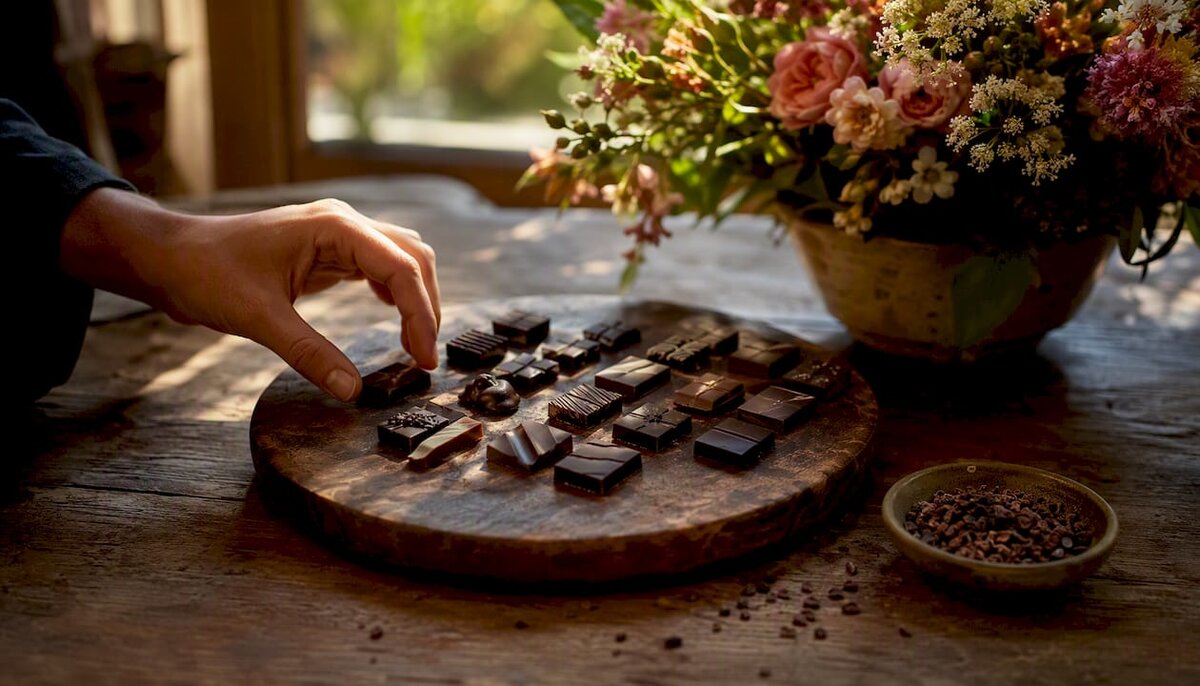
The most versatile options are single-origin bars and praline assortments: they suit most budgets, scale from five recipients to five hundred, and carry enough visual presence to feel considered. Below is a practical catalogue with use-case notes for each format.
Single-origin bars: clean, story-led, and easy to personalise with a bespoke wrapper. Best for welcome gifts, new-client onboarding, or a post-meeting thank-you. Budget: entry to mid-range. Lead time: 5–10 business days for branded wrappers.
Praline assortments: shareable, visually impressive, and suited to team-level recipients. Use for contract renewals, seasonal sends, or event follow-ups. Budget: mid-range. Packaging: rigid gift box with a divider tray.
Handcrafted truffles: highest perceived value per piece; best reserved for top-tier clients or board-level contacts. Shelf life is shorter (typically 3–4 weeks), so order close to the send date. Budget: premium.
Branded or logo chocolates: chocolate moulded or wrapped with your logo. Taste must come first; a beautifully branded bar that tastes of nothing is worse than no gift. Use for events, product launches, or trade shows where volume matters.
Seasonal and limited-edition collections: tie the gift to a moment (Christmas, Easter, a local Austrian festival). Seasonal food offerings add relevance and urgency. Budget: variable; order 3–4 weeks ahead of the occasion.
Spreads and tasting sets: a curated set of chocolate spreads or flavour-focused tasting kits works well for food-curious clients and makes an unusual desk gift. Unique chocolate gift sets in this format photograph well and encourage social sharing.
Desk-shareable boxes: a larger format box designed to be opened and passed around the office. Extends brand exposure beyond the named recipient. Budget: mid-range; MOQ typically 10 units.
Chocolate experiences: a virtual or in-person tasting session, or access to an online confectionery workshop. High perceived value, zero waste, and memorable. Best for VIP clients or team-building contexts.
A handwritten note paired with high-end chocolates is a consistently recommended, low-cost addition that raises perceived care. Add one to every format above.
Put the recipient first. Branding should be present but restrained; the goal is for the client to feel valued, not advertised at. A logo stamped across the front of a chocolate bar is a promotional item. A subtle embossed monogram on the outer box lid, paired with a personalised note inside, is a gift.
Practical personalisation options, from lightest to most involved:
Before reproducing any client logo or artwork on packaging, run a trademark and design search. BOIP (Benelux Office for Intellectual Property) provides tools and guidance for clearance across the Benelux region, and equivalent searches apply for Austrian and EU-wide marks. Skipping this step risks IP infringement, even when the client has given verbal approval.
Pro Tip: Keep your own logo to one placement only, and make it smaller than you think it needs to be. The recipient’s name, not your brand mark, should be the most prominent personal element.
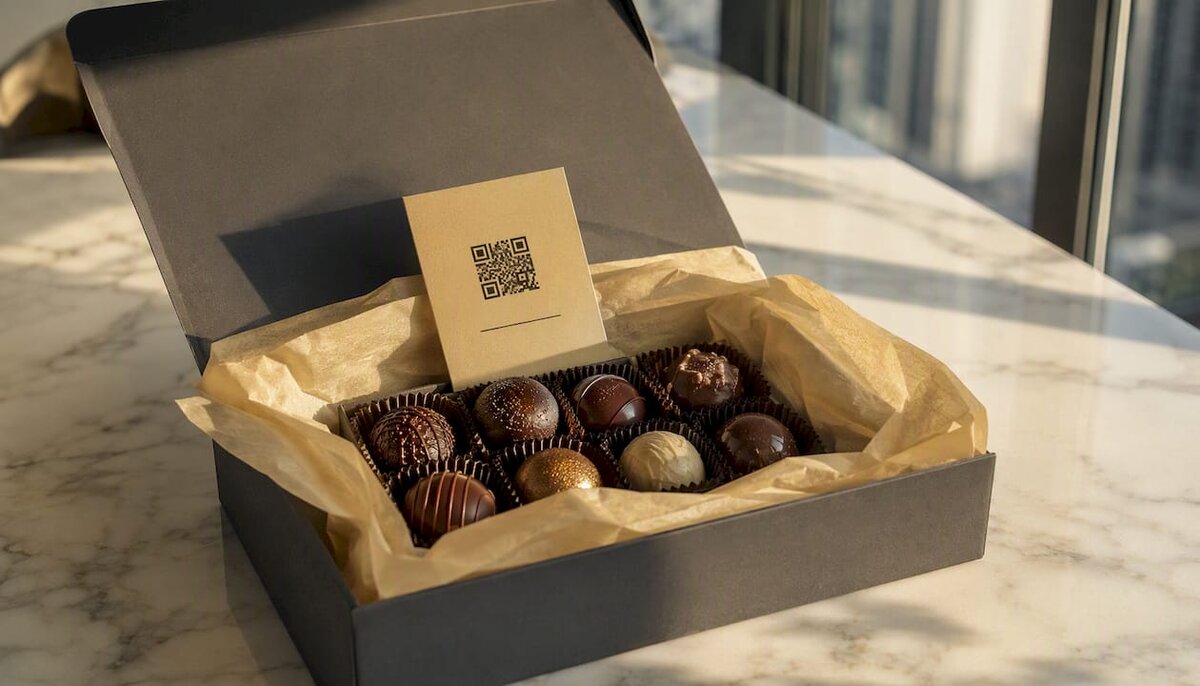
Packaging often determines perceived value before the recipient has tasted a single piece. A premium chocolate in a plain brown mailer reads as an afterthought; the same chocolate in a rigid, soft-touch box with tissue paper and a branded insert reads as a considered gift. The unboxing moment is part of the product.
Practical guidance by packaging layer:
Transparent and minimalist packaging that highlights the product itself is a strong current direction in premium food presentation, particularly for single-origin bars where the bean story is part of the appeal.
Pro Tip: Add a small call-to-action card inside the box: a QR code linking to a tasting RSVP, a personalised video, or a Gift of Choice portal. It turns a one-way gift into a two-way interaction.
Use this checklist to reach a purchase decision in under one hour. Work through it in order; each step eliminates a common mistake.
Red flags to avoid:
A Gift of Choice programme lets each recipient select their preferred chocolate from a curated catalogue, accessed via a branded landing page. The sender sets the budget and the product range; the recipient chooses. This eliminates the single biggest risk in corporate gifting: sending something the recipient cannot eat, does not want, or simply discards.
For large programmes (50+ recipients), Gift of Choice also produces measurable engagement data. You can track:
Implementation steps for a chocolate-focused Gift of Choice programme:
Gift of Choice programmes shift the gifting dynamic from assumption to invitation. The recipient feels respected rather than processed, and the sender gains data that makes every subsequent campaign more precise. For corporate chocolate programmes at scale, this approach reduces waste, improves engagement, and gives procurement teams a defensible ROI metric.
The most common mistake in corporate chocolate gifting is treating it as a procurement task rather than a communication decision. The product, the packaging, and the timing are all messages. A generic supermarket assortment says “we remembered you existed.” A single-origin bar in a personalised box, arriving the day after a project milestone, says something quite different.
What tends to get overlooked is the allergen and dietary check. Sending a nut-laden truffle box to a recipient with a nut allergy is not just a wasted gift; it signals that you did not pay attention. The dietary personalisation step in the checklist above is not optional.
For Austrian and DACH-region clients specifically, quality signals matter. The region has a strong confectionery culture, and recipients are likely to notice the difference between a commodity bar and a well-sourced artisan product. Chocolate’s suitability as a corporate and promotional gift is well-established, but the execution is what separates a memorable send from a forgettable one.
Branding restraint is the other underrated variable. The gifts that generate the most positive responses are almost always the ones where the sender’s logo is the smallest element in the box.
Bamchocolate offers curated corporate chocolate packages with Austria-based fulfilment, sample approval before any bulk order, and bespoke wrapper options for branded sends. The BAM PREMIUM confectionery bundle is the strongest option for high-touch clients: premium ingredients, considered packaging, and a flavour range that covers dark, milk, and specialty profiles. For mid-budget programmes, the BAM Basic pastry package covers welcome gifts and team sends without compromising on quality. Dietary-specific options, including sugar-free and protein-rich formats, are available for recipients with specific requirements. To request a sample pack or discuss a corporate quote, visit Bamchocolate and use the corporate enquiry contact.
Chocolate triggers positive emotional recall through taste and smell, making it more memorable than most branded merchandise. It is also shareable, culturally appropriate across the DACH region, and easy to personalise at almost any budget.
Pair each send with a specific milestone or occasion rather than a generic date, include a personalised note referencing the recipient by name, and use a QR code insert to link to a landing page or Gift of Choice portal. Tracking claim rates gives you data to improve each subsequent campaign.
Keep the message short, specific, and personal: reference the shared project, the occasion, or a detail about the recipient. A single sentence that shows you paid attention outperforms a paragraph of generic appreciation.
Single-origin cacao disclosure, a declared cocoa percentage, bean-to-bar production, and a Fairtrade or EU BIO certification are the clearest markers. Packaging finish, tasting notes, and a sample policy from the supplier all confirm the same standard.
Yes. Bamchocolate offers corporate packages with Austria-based fulfilment, sample approval before bulk orders, bespoke wrapper options, and dietary-specific product ranges including sugar-free and protein-rich formats.



 Confectionery tips



 Slovenščina
 Hrvatski
 Deutsch
 Italiano
 Česky
 Polski
 Magyar
 Français
 Slovák
 Nederlands
 Español