 info@bamchocolate.com
 Login


 en

 BAM Cake converter
 Login
Claudia
Avtorica vsebin


 Reading time:
11 minutes
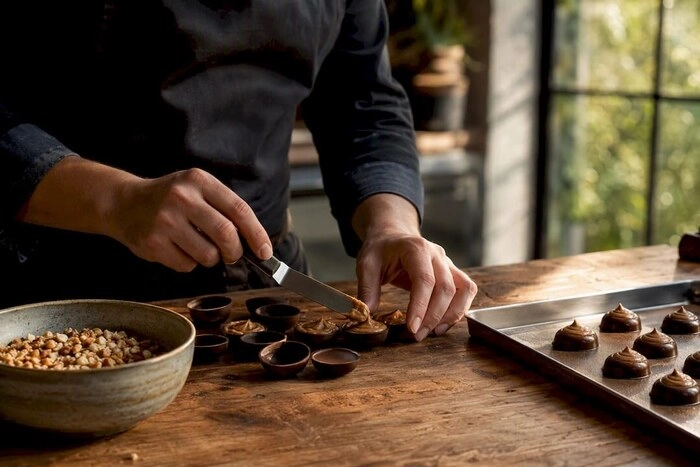
Discover how long filled pralines last, from one week to months. Learn how ingredients impact freshness and storage tips for optimal enjoyment.
Filled pralines last anywhere from one week to several months, and the deciding factor is almost never the chocolate shell. It is the filling. Dairy or cream ganache holds for 1 to 2 weeks refrigerated, alcohol-rich fillings such as egg liqueur stretch to several weeks refrigerated, and dense nut paste or low-moisture spreads can sit at a cool room temperature for several weeks. Frozen, most filled pralines are good for 2 to 3 months.
If you do not know exactly what is inside a praline someone gave you, refrigerate it in an airtight container. That single decision buys you time and protects against the two biggest risks: moisture and warmth.
The ingredient logic behind these numbers, and exactly how to store each type, is below.
Filling type determines praline shelf life far more than the chocolate shell does, so classify the filling before choosing a storage method.
| Point | Details |
|---|---|
| Dairy fillings need refrigeration | Keep ganache or cream-filled pralines 1 to 2 weeks in the fridge, or freeze up to 2 to 3 months. |
| Alcohol extends life, not indefinitely | Egg liqueur and similar fillings can last 4 to 6 weeks refrigerated, though flavour fades after week four. |
| Fruit fillings are the shortest-lived | Cook fruit first to lower water activity, then refrigerate and eat within 1 to 2 weeks. |
| Bloom is usually cosmetic, not dangerous | Grey or dull surfaces signal fat or sugar migration; mould, slime, or sour smell mean discard immediately. |
| Start with the right ingredients | Bamchocolate’s confectionery sets are formulated for creamy or fruit fillings that hold up to the storage timelines above. |
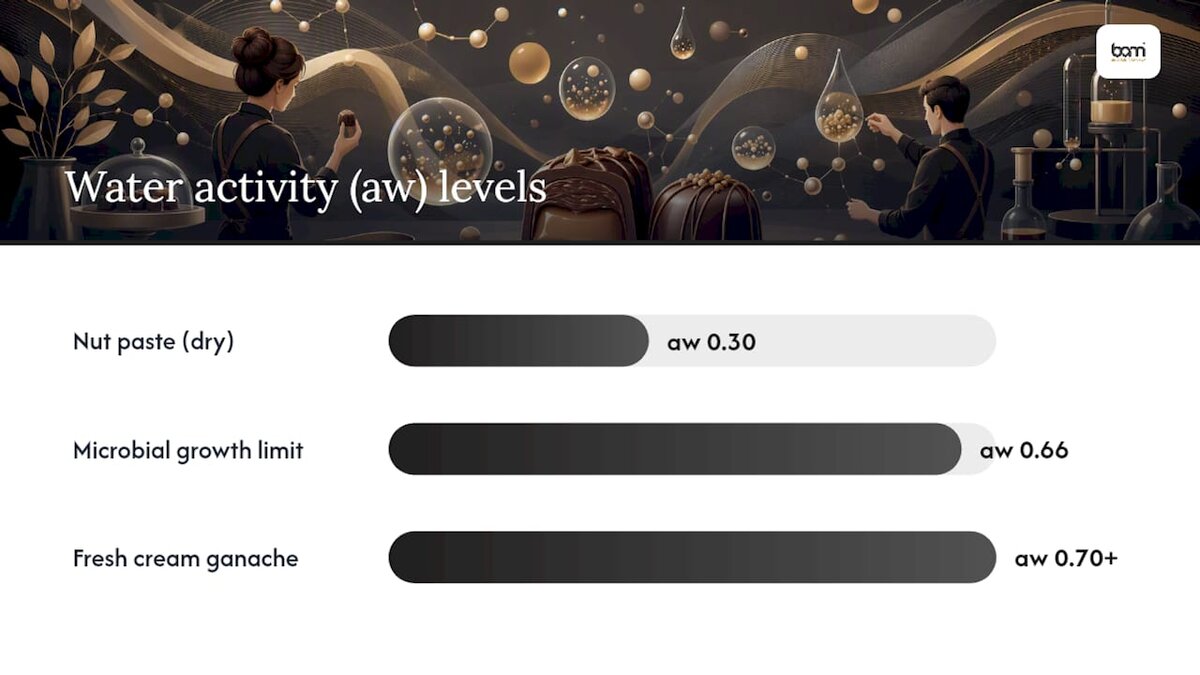
Shelf life for a filled praline is governed by a handful of measurable factors, not gut feeling. The industry term for the one that matters most is water activity, written aw, which measures how much “free” water is available in a filling for microbes to use. A dry nut paste might sit at aw 0.3. A fresh cream ganache can sit above 0.7. Anything above roughly 0.66 gives yeasts and moulds enough moisture to start growing, and predictive confectionery models confirm that fillings above that threshold need extra preservation, whether that is refrigeration, added alcohol, or a lower sugar-to-water ratio.
Alcohol changes the equation entirely. Once a filling contains alcohol above a certain level, most common spoilage organisms struggle to establish themselves, which helps egg liqueur pralines outlast plain cream ganaches by weeks rather than days. Fat and sugar work differently: they do not kill microbes, but a well-tempered fat matrix slows moisture migration from filling to shell, delaying the fat bloom and softened snap that signal ageing chocolate.
Hygiene during production matters just as much as the recipe itself. Fast cooling and a full 24-hour rest before packing reduce the initial microbial load a filling starts with, giving every other safeguard a head start.
A key spoilage organism to know: research into praline deterioration identified Zygosaccharomyces rouxii as a recurring cause of spoilage in filled chocolates. This yeast tolerates low water activity and moderate alcohol levels better than most spoilage organisms, which means a filling that looks “safe” on paper can still spoil if aw sits above 0.66 without another hurdle in place.
The ingredient decides both the storage location and the calendar. Treat these as working rules rather than absolutes, since exact figures shift with sugar content, moisture, and how carefully a filling was made.
| Filling type | Recommended storage | Typical shelf life |
|---|---|---|
| Dairy/cream ganache | Fridge, airtight | 1–2 weeks (2–3 months frozen) |
| Alcohol-rich (egg liqueur) | Fridge, airtight | 3–6 weeks |
| Fruit or purée | Fridge, airtight | 1–2 weeks |
| Nut paste/spread | Cool room, sealed | Several weeks (up to ~6 months industrial) |
Formulation choices, more sugar, added alcohol, or humectants, can extend shelf life further, but every one of those changes alters flavour and the ingredient list. That trade-off is worth weighing before you chase a longer date at the cost of taste.
Packaging decides whether your pralines make it to week two looking as good as they did on day one. Airtight tins, screw-top jars, and vacuum bags all outperform anything porous, since paper and card absorb moisture and pass odours straight through to the chocolate.
Pro Tip: Never unwrap refrigerated pralines the moment they come out of the fridge. Leave the sealed container on the counter for around an hour first, the temperature difference is what causes that dull, sweating bloom on the surface, not the fridge itself.
Good tempering technique also plays a quiet role here, since a properly set shell resists moisture migration far better than one that never fully crystallised.
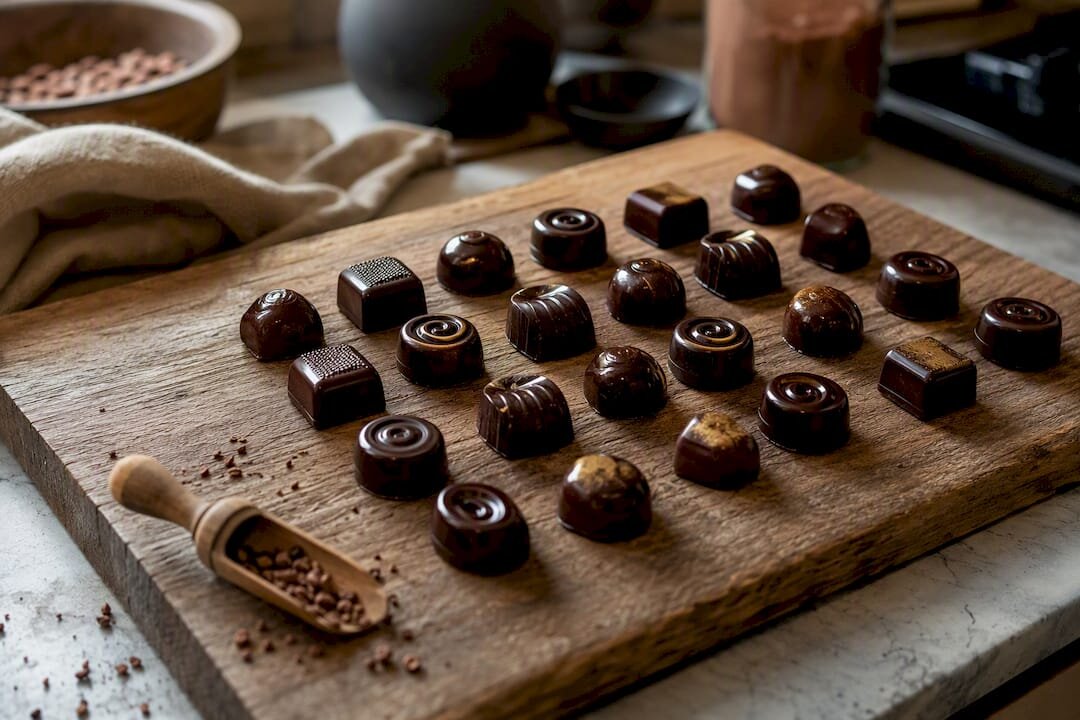
Freezing works well for most ganache and nut-paste fillings but poorly for water-heavy fruit purées, which turn watery and separate once thawed. If a filling is mostly fresh fruit, skip the freezer entirely and stick to the fridge timeline instead.
Most filled pralines hold well in the freezer for 2 to 3 months. Low-moisture nut fillings can occasionally go longer, but flavour intensity does drop the longer they sit, so treat the three-month mark as the point where quality, not safety, starts to slide.
Not every change in appearance means a praline has gone off, and mixing up the two leads to a lot of good chocolate thrown away unnecessarily. Learn to tell them apart quickly.
Microbial spoilage is unambiguous once you know what to look for: visible mould, a slimy surface, shells that bulge from gas building up inside, or a sour, off smell. Any one of these means the praline goes straight in the bin, no tasting required.
Cosmetic quality loss is a different story. Grey or white bloom, a softened snap, or a duller finish usually reflect fat or sugar migrating to the surface, an appearance issue rather than a safety one. Storage above roughly 15 to 18°C accelerates this fat and moisture movement, which is exactly why a stable, cool spot matters more than most people assume.
If you are unsure and the praline came from an industrially packaged product, contact the maker directly rather than guessing.
BAM - Become A Master built its reputation on ingredient-first guidance, and that is the lens worth applying every time you fill a praline. A few rules come up again and again in our recipe testing and reader questions.
For the recipe side of this, our guide on how top chocolatiers make filled pralines and the piece on ganache formulation go deeper into the ratios that decide how long a batch will hold.
Most advice on this topic treats “how long do pralines last” as a single number, and that is the part worth pushing back on. It is not one number. It is a filling-by-filling decision, and the biggest mistake home chocolatiers make is applying a dairy-ganache timeline to a fruit filling, or assuming alcohol automatically means “keeps forever” when the actual protection depends on the exact percentage used.
The conventional wisdom also underrates hygiene and rest time at the production stage. Recipes obsess over ratios and flavour pairings, but a filling that was rushed off the heat and packed warm starts its shelf-life countdown from a worse position than one that rested properly for 24 hours, regardless of what is in it.
If you take one thing from this guide, prioritise classifying your filling correctly before worrying about packaging or freezing. Get the ingredient logic right first. Everything else, tins, separators, cold packs, is secondary to that single judgement call.
— Andraz
Getting shelf life right starts with the ingredients you choose, not just the storage box you use afterwards. Bamchocolate stocks the confectionery sets built specifically for creamy fillings, giving you the ratios and quality of dairy and fat that hold up better under refrigeration than supermarket substitutes. For fruit-based fillings, whose shelf life is naturally shorter, the fruit fillings set is formulated to reduce excess moisture from the outset rather than fighting it after the fact.
If packaging is your gap, the baking accessories range covers the airtight containers and separators this guide recommends. Browse the current sets and pick the one that matches the fillings you make most, then build your next batch around ingredients designed to last rather than ones you are hoping will.
Refrigerate in an airtight container. It is the safest default when the filling type or its water activity is unknown.
Most filled pralines keep for 2 to 3 months in the freezer, provided they are double-wrapped and stored in a rigid, airtight box.
Usually yes. Bloom is typically fat or sugar migrating to the surface, a cosmetic issue rather than a safety one, unless it comes with mould, slime, or an off smell.
Not automatically. Alcohol above roughly 9 to 14% by volume meaningfully slows microbial growth, but the exact percentage in the recipe determines how much protection it actually gives.
Not reliably. Fruit purée fillings hold for only 1 to 2 weeks refrigerated even when cooked first, so they are not suited to long storage plans.


 Confectionery tips



 Slovenščina
 Hrvatski
 Deutsch
 Italiano
 Česky
 Polski
 Magyar
 Français
 Slovák
 Nederlands
 Español