 info@bamchocolate.com
 Login


 en

 BAM Cake converter
 Login
Claudia
Avtorica vsebin


 Reading time:
11 minutes
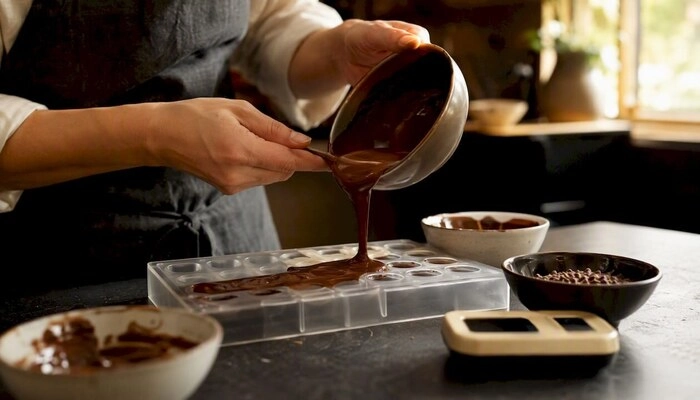
Join BAM's online praline course to master chocolate making at home with flexible lessons, expert support, and a comprehensive syllabus.
For home bakers in Austria, the most direct route to making professional-quality pralines is a structured online praline course with a clear syllabus, hands-on exercises, and either live small-group sessions or guided on-demand videos. BAM – Become A Master is among the recommended choices, combining a detailed lesson plan, practical technique coverage, and accessible enrolment for beginners and keen hobbyists.
Three reasons to choose it:
Enrol directly at Bamchocolate and have your starter equipment ready before the first lesson.
The most effective way to learn praline-making online is a structured course with a detailed syllabus, live or on-demand video lessons, and direct instructor support — BAM – Become A Master delivers all three for Austrian home bakers.
| Point | Details |
|---|---|
| Choose the right format | Live small-group sessions suit troubleshooting; on-demand suits flexible schedules. |
| Prepare before lesson one | Pre-weigh ingredients, clear your workspace, and test your camera at least one day ahead. |
| Storage matters | Keep pralines at 16–18°C in a dry, dark location; ganache-filled pieces keep for 10–14 days. |
| Evaluate before buying | Check for a full syllabus, a demo video, verified reviews, and a clear refund policy. |
| Bamchocolate starter kit | The BAM Basic pastry package covers core ingredients and tools for new course enrollees. |
The course is structured around progressive skill clusters, moving from foundational chocolate knowledge through to finished, decorated pralines. Typical on-demand packages in this category include 16 video lessons with over 140 minutes of runtime, plus downloadable recipe documentation — a useful benchmark for what to expect from a well-built confectionery programme.
| Module cluster | Topics covered | Learning outcome |
|---|---|---|
| Chocolate fundamentals | Couverture types, cocoa butter content, tempering theory | Select the right chocolate for each application |
| Tempering and shell work | Tabling, seeding, mould filling, shell thickness | Produce glossy, correctly set shells |
| Ganache and fillings | Cream ratios, glucose, flavour infusions, consistency | Make stable ganaches with correct texture |
| Moulding and de-moulding | Filling, capping, release technique | Remove pralines cleanly without cracking |
| Decoration and finishing | Transfer sheets, cocoa butter colour, hand-dipping | Present pralines to a professional standard |
| Shelf life and storage | Temperature, humidity, packaging | Extend freshness and avoid bloom |
Learners who complete the full course can temper couverture by hand, fill polycarbonate moulds, and produce at least three distinct praline types — truffles, moulded shells, and layered ganache pieces.
Both delivery models have genuine strengths, and the right choice depends on what you want to get out of the course.
On-demand video works well for learners who need scheduling flexibility. You can pause mid-ganache, rewind the tempering demonstration, and work at your own pace. The limitation is that you cannot ask a question in real time, so troubleshooting a soft ganache or a shell that won’t release from the mould requires either a community forum or a separate Q&A session.
Live small-group sessions run via Zoom and typically cap attendance at 8–10 participants so the instructor can give personalised guidance during hands-on work. Practitioners consistently report that this format is significantly better for troubleshooting problems caused by local humidity and kitchen temperature — variables that affect chocolate setting in Austrian homes, particularly in summer. The trade-off is a fixed schedule and a slightly higher price point.
Pro Tip: Position your camera so the instructor can see both your hands and the mould simultaneously. A top-down angle works well for mould filling; a side angle is better for showing ganache consistency. Good lighting matters more than camera quality.
A well-structured confectionery course teaches technique before recipes. Tempering is the foundation: without correctly crystallised cocoa butter, shells crack, surfaces bloom, and ganaches set unevenly. Bamchocolate’s practical tempering guide is a reliable reference to read before your first lesson.
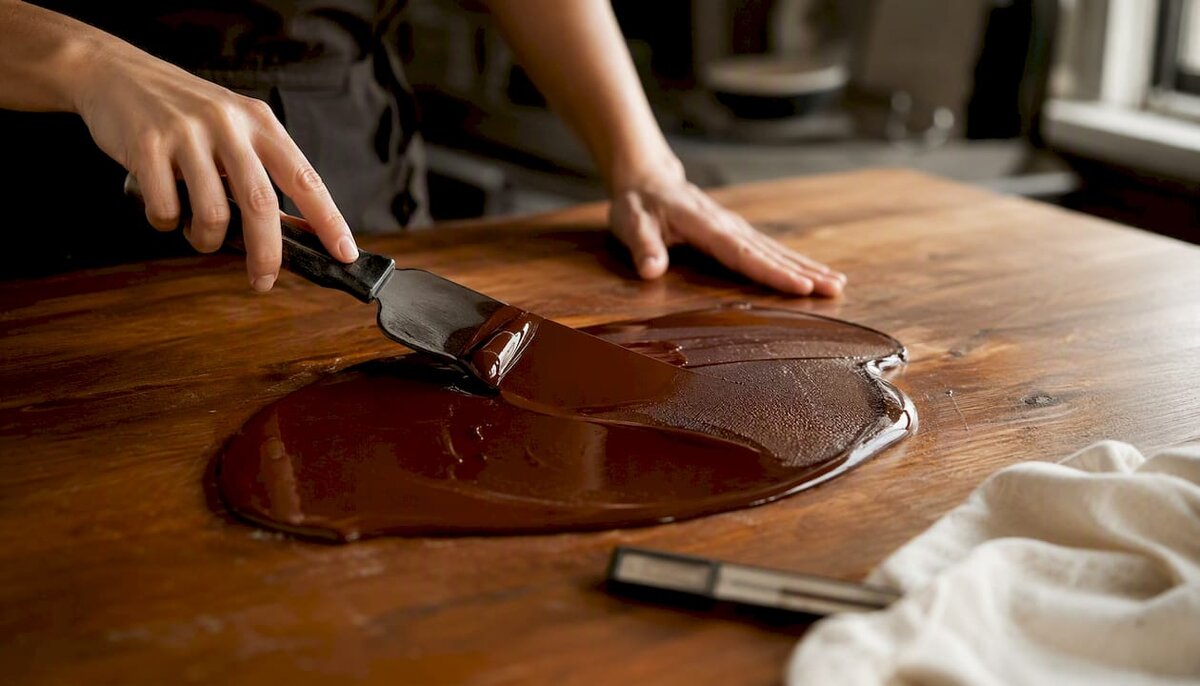
Beyond tempering, the course covers the full production sequence for chocolate pralines — from ganache ratios through to finished decoration.
| Technique | What you practise | Recipe example |
|---|---|---|
| Tempering (seeding method) | Melting, cooling, working temperature | Dark couverture shell |
| Ganache preparation | Cream-to-chocolate ratio, emulsification | Classic dark truffle filling |
| Mould filling and capping | Shell thickness, air-bubble removal | Moulded milk chocolate praline |
| Flavour infusions | Infusing cream with herbs, spices, coffee | Coffee ganache, raspberry filling |
| Hand-dipping | Fork technique, coating consistency | Dipped truffle with cocoa powder finish |
| Decoration | Transfer sheets, cocoa butter spray, piping | Layered ganache with gold transfer |
Lessons are documented in German, with recipe sheets included as downloads. For learners whose first language is not German, the step-by-step video format reduces reliance on language comprehension — most technique is demonstrated visually. The advanced technique article on Bamchocolate’s site covers master-level practises and works well as supplementary reading once you have completed the core modules.
You can source most items from Austrian supermarkets, specialist baking shops, or directly from Bamchocolate before your first lesson.
Equipment:
Ingredients:
The BAM Basic pastry package covers the core ingredients and several accessories in one order, which is practical if you want to avoid sourcing items individually before the course starts.
Online praline courses vary considerably in price depending on format, included materials, and support level. Before committing, work through this checklist.
Not every course that markets itself as professional delivers on that claim. A short evaluation process before purchasing saves time and money.
Bamchocolate’s published articles on master-level praline techniques give you a benchmark for the depth a serious course should reach.
Most problems in praline-making trace back to three causes: incorrect tempering temperature, ganache with too much moisture, or moulds that are not clean and dry.
| Problem | Likely cause | Fix |
|---|---|---|
| White bloom on surface | Chocolate out of temper or stored too warm | Re-temper carefully; store at 16–18°C |
| Shells crack on de-moulding | Over-crystallised or too thick a shell | Reduce working time; aim for 2–3mm shell |
| Ganache too soft to pipe | Cream ratio too high or under-emulsified | Reduce cream by 10%; blend thoroughly |
| Bubbles in finished shell | Air trapped during mould filling | Tap mould firmly on bench after filling |
| Pralines stick to mould | Mould not polished or chocolate under-tempered | Polish with cotton wool; check working temp |
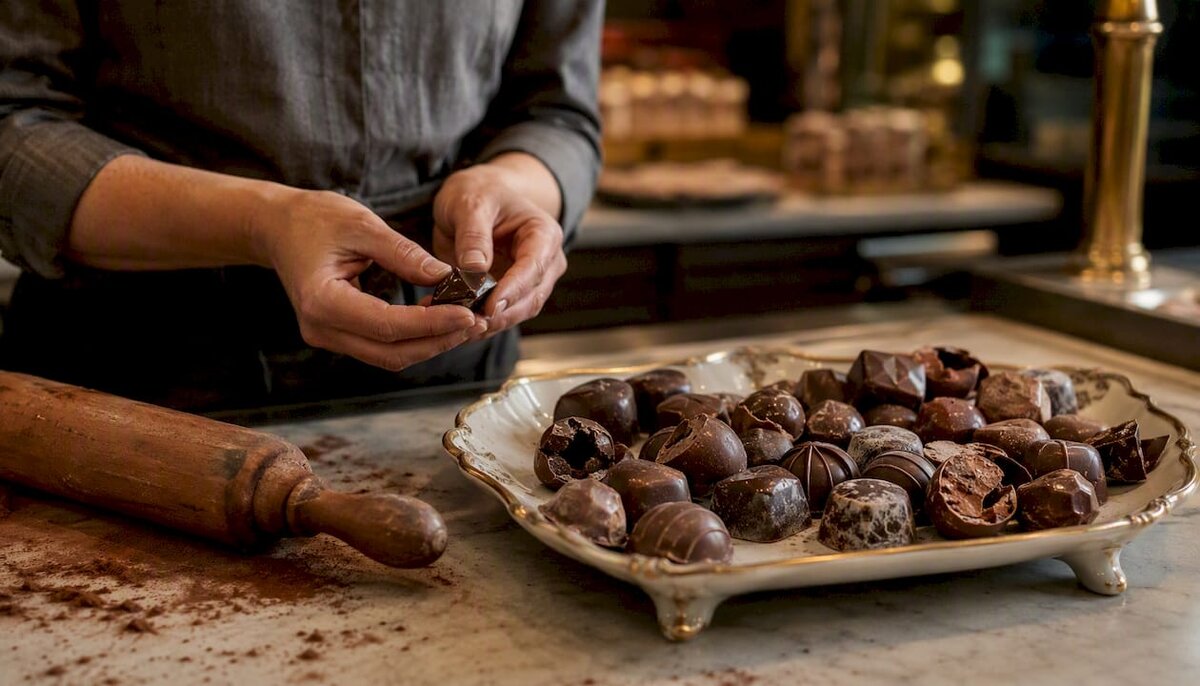
For storage, Bamchocolate’s chocolate storage guidance recommends keeping pralines at 16–18°C in a dry, dark location away from strong odours. In Austrian homes, a cool pantry or a dedicated chocolate drawer works well; the refrigerator introduces condensation and flavour transfer. Freshness expectations: ganache-filled pralines typically keep for 10–14 days at room temperature; moulded shells without fresh cream fillings can last up to four weeks under correct conditions.
In humid Austrian summers, work in an air-conditioned room or early in the morning when temperatures are lower.
Arriving at a live session without your ingredients pre-weighed or your workspace cleared is the single most common reason participants fall behind. Instructors in themed live courses typically send a shopping list in advance — act on it at least two days before class.
The pace of a live small-group session is faster than most first-time participants expect. An instructor working with 8–10 learners moves through each technique step at a pace that keeps the chocolate at the right temperature — which means you need to keep up, not pause to re-read a recipe. Mistakes happen, and that is the point. A ganache that splits or a shell that blooms in a live session gives the instructor a real problem to diagnose on camera, which is more instructive than watching a perfect demonstration.
Live Q&A is typically structured in two blocks: a short check-in after the tempering stage and a longer open session at the end. Follow-up questions are usually handled via email or a course forum within 24–48 hours. For learners who want to go further, the advanced technique content on BAM’s German-language site provides worked examples that extend well beyond what a single session can cover.
The BAM – Become A Master online praline course gives you a structured path from zero to finished pralines, with a full syllabus, downloadable recipe documentation, and access to live Q&A support. It is built for Austrian home bakers who want to move past YouTube tutorials and into a course with a clear progression and real instructor contact.
The BAM Basic pastry package covers the core ingredients and tools you need before lesson one. For learners who want a larger setup, the BAM Large Confectionery Bundle includes a broader range of fillings and accessories. The full range of baking accessories — moulds, thermometers, piping gear — is available in one place.
Visit Bamchocolate to browse the course, check current enrolment dates, and order your starter kit in a single session.
Most structured courses include video lessons covering tempering, ganache, moulding, and decoration, plus downloadable recipe documents. Well-built on-demand packages typically offer 16 or more lessons with over 140 minutes of content.
No. A digital probe thermometer, polycarbonate moulds, piping bags, and a bench scraper are sufficient for the first lessons. The BAM Basic pastry package covers the core items in one order.
Yes. The course content is in German, which makes it directly accessible for Austrian learners. Visual demonstrations reduce reliance on language comprehension for technique steps.
Ganache-filled pralines keep for 10–14 days at 16–18°C in a dry, dark location. Moulded shells without fresh cream fillings can last up to four weeks under correct storage conditions.
Live sessions run via Zoom. After purchase, participants receive an access link. Recordings are often available afterwards for review, and a minimum internet speed of 10 Mbps is sufficient for stable participation.



 Confectionery tips



 Slovenščina
 Hrvatski
 Deutsch
 Italiano
 Česky
 Polski
 Magyar
 Français
 Slovák
 Nederlands
 Español