 info@bamchocolate.com
 Login


 en

 BAM Cake converter
 Login
Claudia
Avtorica vsebin


 Reading time:
11 minutes

Explore five seasonal chocolate flavor families, pairing ideas, texture trends, and label checks to choose gifts with confidence. BAM shares practical advice.
Seasonal chocolate flavours fall into five families: winter spices and mint, bright spring citrus and florals, tropical summer fruits, cosy autumn nuts and caramel, and occasion-specific blends built for Valentine’s, Easter or Christmas. Choosing by family makes gifting simpler and more memorable, and this guide covers pairing science, texture trends, dietary notes and a practical checklist for buyers.
Each season carries its own flavour signature, and recognising it helps you shop with intent rather than guesswork.
Winter leans into peppermint, eggnog and rumnog, gingerbread, mulled spices and dark mint. These flavours pair naturally with darker cocoa percentages, since the warmth of spice and the sharpness of mint both cut through a heavier, more bitter base. A peppermint bark with visible candy shards or a gingerbread-spiced truffle signals this family at a glance.
Spring brings citrus such as orange and bergamot, floral notes like elderflower and lavender, pistachio, and light berries. These flavours rely on acidity and freshness, which is why they tend to sit on milk or lighter dark bases rather than heavy, bitter ones. Pistachio in particular has become a defining spring and Easter signal, with Tastewise data showing pistachio conversation up 94% year-on-year and carrot up 463% in Easter-related confectionery discussion, both earthy, contrast-driven flavours gaining ground fast.
Summer calls for tropical fruit (mango, passion fruit, coconut), confectioner-friendly chilled formats, and sea-salt contrasts. Lighter ganaches and fruit inclusions work better than dense, rich fillings here, since warm weather and heavier chocolate rarely mix well in either taste or practicality.
Autumn is caramel, toasted nuts, brown butter, pumpkin spice and warm ginger. These read as autumnal because they echo baking traditions, roasted and buttery, rather than bright or cold.
Occasion-specific blends overlay these seasonal families with symbolism: red and pink for Valentine’s, pastel shells and nest-shaped moulds for Easter, gold foil and spice for Christmas. Visible inclusions, nuts, candied peel, freeze-dried fruit, and provenance claims on origin or cocoa percentage are reliable shopping cues for a well-formulated seasonal product:
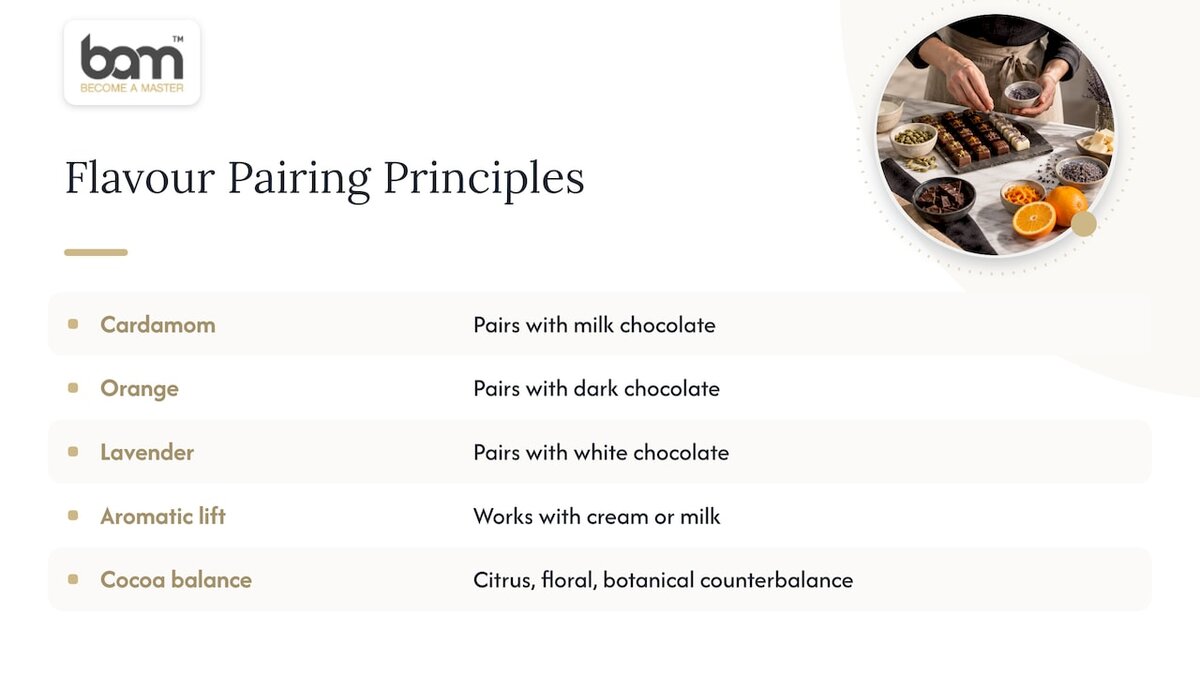
Cocoa itself carries a wide sensory range, from fruity and floral to roasted and earthy, and good pairing choices work with that complexity rather than against it. Cocoa flavour-pairing research points to citrus, floral and botanical notes as the most effective counterbalance to dark chocolate’s roasted character, since they introduce acidity and freshness that a heavier cocoa base lacks on its own.
Three practical rules follow from this. Aromatic lift, from cardamom, cinnamon or rose, works best against a cream or milk base, where there is less roasted bitterness to compete with. Aftertaste balance matters too: a pairing that tastes exciting on the first bite but turns muddy or overly sweet by the third is a formulation miss, not a flavour miss.
Formulation brings its own constraints. Aroma compounds can be volatile, so a spice or floral note that tastes vivid in a lab sample can fade over a seasonal selling window if the formulation does not account for aroma stability. Dairy proteins interact with certain aromatics in ways that mute or shift perceived flavour, which is why the same flavour-pairing guidance stresses considering cocoa type, dairy content and acidity together rather than one at a time. Cardamom in milk chocolate, orange in dark chocolate and lavender in white chocolate are three pairings that hold up well across a typical seasonal shelf life.
Flavour alone no longer carries a seasonal product. Industry reporting on 2026 Easter innovation shows multi-layered, hybrid and filled formats replacing the simple hollow-shell egg, with texture now doing as much work as taste in signalling premium quality.
Three formats dominate this shift:
Texture complements flavour directly: a crunchy inclusion offsets sweetness and keeps a rich filling from feeling heavy, while a smooth, creamy centre amplifies the roasted depth of a darker shell. The same reporting notes that even small increases in filling ratio or visible inclusions change how premium a product feels to the person opening it.
Pro tip: When choosing a seasonal gift, favour formats with visible inclusions or a clear filling layer, they tend to signal more deliberate formulation than a plain, single-texture bar.
Vegan and sugar-free seasonal chocolates have improved, though trade-offs remain: oat or coconut-based alternatives to milk chocolate can shift texture slightly, and sugar-free formulations sometimes carry a cooling aftertaste from the sweetener used. Neither is a flaw, but both are worth expecting rather than being surprised by.
On labelling, Slovenia’s implementing rules under EU Regulation 1169/2011 require prepacked foodstuffs to carry clear, unambiguous allergen declarations along with lot and date labelling. For promotional and seasonal sweets specifically, EU allergen guidance treats allergen disclosure as non-negotiable, which means a well-labelled seasonal box should always show allergens prominently, not in small print.
Before buying, check the ingredient list for your specific allergen concerns, note the best-before date against how long you plan to store the gift, and look for visible inclusion notes (nuts, dairy, gluten-containing additions) on the front of the pack. Transparent labelling like this is also part of what justifies premium seasonal pricing: it reflects genuine ingredient quality rather than just packaging.
Matching the right chocolate to the right person starts with a short set of questions rather than browsing endlessly.
Presentation finishes the job: a label window that shows the inclusions, a short pairing card suggesting a coffee, tea or wine match, and a ribbon or seasonal wrap all add perceived value without changing the product itself. A curated seasonal selection built around one of these themes, say, a spiced winter box paired with mulled wine notes, often lands better than a generic assortment, because it tells a single coherent story rather than offering ten unrelated flavours at once.
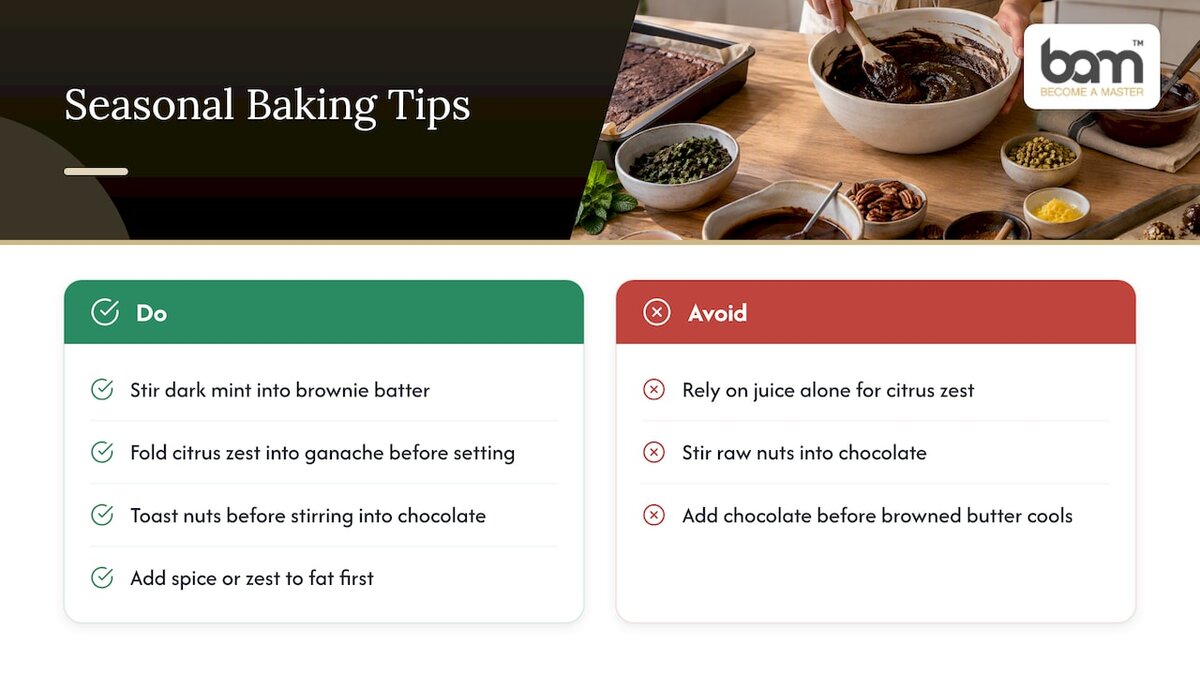
Baking with seasonal chocolate works best when the flavour family drives the whole recipe rather than sitting on top as decoration. For winter bakes, melt a dark mint or gingerbread-spiced chocolate directly into a brownie batter so the spice runs through the crumb, not just the glaze. For spring, fold citrus zest into a ganache before it sets, which keeps the aromatic oils fresher than adding juice alone. Pistachio works particularly well folded into a white chocolate blondie batter, echoing the earthy, contrast-driven profile that has become a defining spring signal in recent seasonal data.
Autumn bakes benefit from toasting nuts separately before stirring them into melted chocolate, since raw nuts can turn a bar or bark gummy rather than crisp. Brown butter chocolate chip cookies gain real depth when the butter is browned until it smells nutty, then cooled slightly before the chocolate is added, so the chocolate does not seize.
A general rule across all seasons: add spice or citrus zest to the fat (butter or cream) before combining with chocolate, since fat carries aromatic compounds more evenly than sugar or flour does. And always taste as you go, aroma compounds like cardamom and lavender vary in strength between brands, so a quantity that worked in one recipe may need adjusting with another.
Chocolate is sensitive to temperature, light and humidity, all three of which shorten the window in which a seasonal flavour tastes as intended. Store seasonal chocolate in a cool, dark place, ideally between 15 and 18 degrees Celsius, away from direct sunlight and strong-smelling foods, since chocolate absorbs odours easily.
Avoid the refrigerator unless the room temperature is genuinely too warm to manage otherwise. Chilling can cause sugar bloom, a dull white film that forms when moisture condenses on the surface, and it also mutes delicate top notes like citrus zest or floral botanicals that make seasonal flavours distinctive in the first place.
Keep filled or inclusion-heavy formats, egg shapes, layered bars, barks, in their original packaging until shortly before serving, since the fillings and inclusions are often more perishable than a plain bar. Once opened, reseal tightly or transfer to an airtight container, and aim to finish seasonal pieces within the window suggested on the best-before date rather than stretching them across months. Flavour depth, particularly from spices and florals, fades well before chocolate becomes unsafe to eat.
Behind every seasonal flavour sits a cocoa supply chain, and increasingly a set of specialty ingredients, citrus peel, botanicals, nuts, that come with their own sourcing questions. Cocoa sourcing has faced well-documented pressure in recent years, and industry coverage of 2026 Easter innovation notes that ambitious seasonal product development is happening despite ongoing cocoa market challenges, a sign that formulation and sourcing decisions are increasingly linked.
Provenance claims, origin-labelled cocoa, named botanical sources, traceable nut suppliers, are one of the clearest signals that a seasonal product has been sourced with more care than a generic, unlabelled bar. Buyers who care about ethical sourcing should look for these claims on packaging rather than assuming they apply by default, since not every seasonal product discloses origin information.
Specialty inclusions carry their own considerations too: freeze-dried fruit, botanicals like lavender or elderflower, and nuts such as pistachio each have supply chains that can be seasonal or regionally limited, which is part of why some flavour trends, pistachio among them, surge and recede as availability shifts. A transparent seasonal range tends to reflect that reality honestly rather than promising unlimited year-round supply of a genuinely limited ingredient.
We offer a specialised selection for people who want seasonal flavour choices explained, not just listed. Our curation priorities are consistent: clear provenance, visible inclusions that match what is described on the pack, flavour pairings balanced rather than novelty for its own sake, and dietary options, including sugar-free and protein-focused lines, presented honestly about texture trade-offs.
— Andraz
We curate seasonal selections around the same flavour families covered above, so you can shop by profile rather than guessing. Browse our BAM Chocolate range for seasonal bars built on balanced pairings, or go straight to our Gifts collection for ready-made seasonal presents.
Chocolate flavours generally group into cocoa-forward (dark, high-percentage), creamy (milk, white), fruit-paired (citrus, berry, tropical), spiced (cinnamon, cardamom, chilli) and floral or botanical (lavender, elderflower, rose). Seasonal ranges typically draw on all five groups, shifting emphasis depending on the time of year.
This refers to an informal guideline some shoppers use for tasting or gifting variety, keeping a selection to around five distinct bars or flavours so each one stays distinguishable rather than overwhelming the palate. It is not an official or regulated standard, just a practical way to curate a tasting or gift set.
Yes, vanilla is one of the most common flavourings used in both milk and white chocolate, often used to round out sweetness and soften cocoa’s natural bitterness. It also pairs well as a base note alongside stronger seasonal flavours like gingerbread or caramel.
Snack-format chocolate typically favours straightforward, widely liked flavours: milk chocolate, hazelnut, caramel and biscuit inclusions dominate because they travel well and appeal broadly. Seasonal snack formats add limited-run flavours like peppermint or pumpkin spice for a short window around the relevant holiday.



 Confectionery tips




 Slovenščina
 Hrvatski
 Deutsch
 Italiano
 Česky
 Polski
 Magyar
 Français
 Slovák
 Nederlands
 Español