 info@bamchocolate.com
 Login


 en

 BAM Cake converter
 Login
Claudia
Avtorica vsebin


 Reading time:
15 minutes

Discover the best sugar-free baking chocolates for UK bakers. From reliable melt to budget options, find your perfect fit for guilt-free treats!
BAM Chocolate’s sugar-free baking range is the most baking-ready option for UK home bakers, combining reliable melt behaviour, low net carbs, and clear ingredient labelling across ganache, cookie, and coating applications.
| Point | Details |
|---|---|
| Top pick for baking | BAM Chocolate sugar-free drops perform consistently across ganache, cookies, and coating tests. |
| Sweetener type matters | Erythritol and stevia blends carry lower glycaemic impact than maltitol; always check the label, not just the “sugar-free” claim. |
| Ganache adjustment | Add 5–10% cocoa butter by weight to prevent erythritol re-crystallisation and improve set. |
| Storage essentials | Keep opened sugar-free chocolate in an airtight container below 18 °C; avoid refrigeration to prevent fat bloom. |
| Where to buy | The BAM Basic pastry package is the recommended first order for UK bakers. |
Four products cover the realistic range of what UK home bakers will encounter: BAM Chocolate, Aldi Choc O Low, Cavalier, and Lily’s. Each uses a different sweetener strategy, which affects both taste and baking behaviour more than the “sugar-free” label suggests.
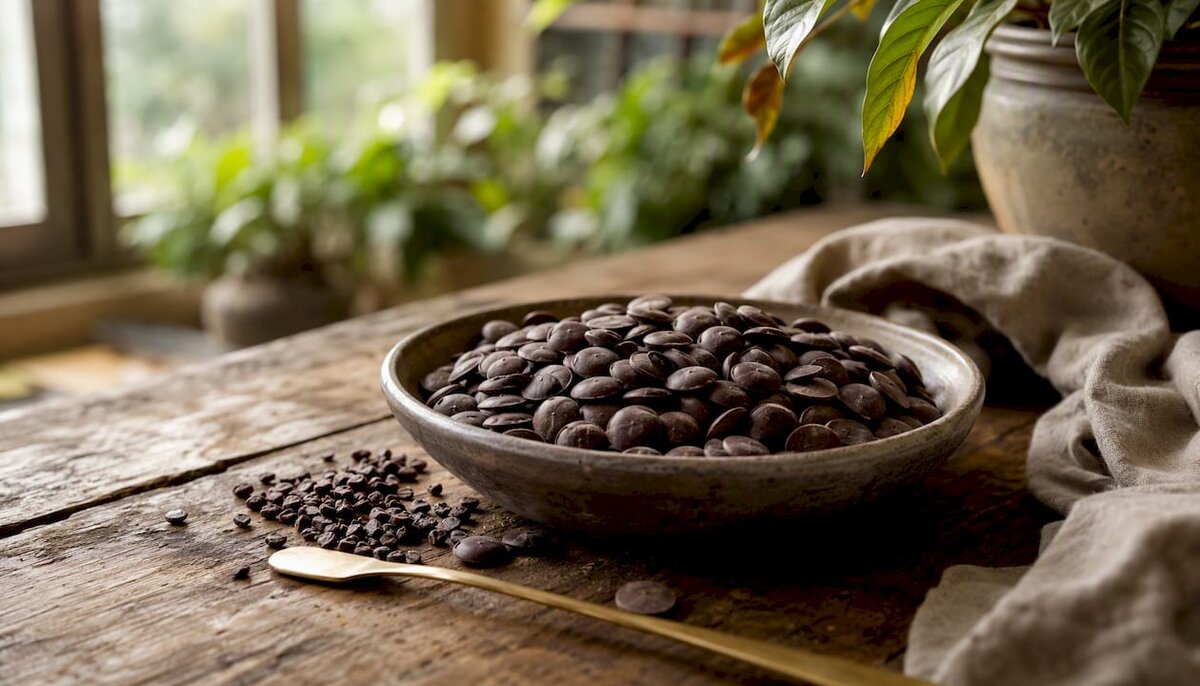
BAM positions itself as a specialist in premium baking chocolate and confectionery ingredients, with a sugar-free line designed specifically for kitchen use rather than snacking. The range includes dark chocolate drops and bars suited to ganache, tempering, and batter inclusion.
Sweetener: Erythritol and/or stevia blends depending on the product variant.
Nutrition snapshot (per 100 g, approximate): Around 400–430 kcal, under 10 g net carbs, with the bulk of carbohydrate coming from sugar alcohols that do not raise blood glucose in the same way as sucrose.
Baking performance:
Pros: Specialist baking formulation, clear labelling, available in baking-friendly drop format, supported by recipe resources and training.
Cons: Online-only purchase (no high-street presence); premium price point versus supermarket alternatives.
Verdict: The most baking-ready option in this review. BAM’s guidance on chocolate selection backs the technical claims with practical recipe notes.
A mainstream supermarket option available in Aldi stores across the UK. Sweetened with maltitol, which behaves closer to sugar in baking than erythritol does — useful for texture, but worth noting for anyone monitoring polyol intake.
Sweetener: Maltitol.
Nutrition snapshot (per 100 g): Typically around 460–480 kcal, with total carbohydrate higher than erythritol-based products because maltitol counts partially towards net carbs.
Baking performance:
Pros: Widely available in-store, low price, no specialist order required.
Cons: Maltitol has a higher glycaemic impact than erythritol; digestive sensitivity possible at larger servings; not ideal for tempering or fine confectionery work.
Verdict: A practical choice for casual baking without sugar, but not the first pick for precision work.
A Belgian brand available through specialist UK retailers and online. Cavalier uses erythritol as its primary sweetener, which gives it a cleaner flavour profile and a lower digestive risk than maltitol-heavy alternatives.
Sweetener: Erythritol (primary), sometimes with stevia.
Nutrition snapshot (per 100 g): Approximately 430–450 kcal, low net carbs, with erythritol largely excluded from net carb calculations.
Baking performance:
Pros: Belgian-quality base, erythritol sweetening, available in milk and dark variants.
Cons: Less widely stocked than supermarket options; price per 100 g is higher than Aldi.
Verdict: A strong mid-range option for bakers who want reliable performance without ordering from a specialist.
An American brand available in the UK primarily via Amazon and specialist health food retailers. Reviewers consistently rate Lily’s for flavour close to regular milk chocolate and good melt behaviour, though recent formulation changes — including added palm oil and soluble corn fibre — have produced mixed reactions and some reports of digestive complaints.
Sweetener: Stevia and erythritol blend.
Nutrition snapshot (per 100 g): Low net carbs; the chip format gives a low net carb count per serving in standard US serving sizes, a figure consistent across several keto-oriented chip formulations.
Baking performance:
Pros: Familiar chip format, good flavour, widely reviewed, gluten-free.
Cons: Formulation has changed; some users report digestive issues from soluble corn fibre; import pricing makes it expensive per 100 g in the UK; recent reviews flag mixed reactions to the updated recipe.
Verdict: Worth trying for cookie baking, but check the current ingredient list before buying in bulk.
The testing protocol used three standard bake applications to assess each product consistently. Results reflect single-batch tests; individual results may vary with different ovens or ambient temperatures.
Scoring rubric: Taste (25%), mouthfeel (20%), melt behaviour (20%), stability after baking or setting (20%), value per 100 g (15%). Scores were combined to produce the per-product verdicts above.
Transparency note: BAM Chocolate samples were sourced directly from Bamchocolate. Supermarket and import products were purchased at retail. Tests were single-batch; no blind panel was used. Results are indicative, not laboratory-grade.
Switching from standard baking chocolate to a sugar-free alternative is not a straight swap. Sugar does more than sweeten — it affects viscosity, browning, crystallisation, and moisture retention. Understanding those differences saves a lot of failed batches.
Key physical differences to watch:
Practical tips for better results:
Pro Tip: When making ganache with erythritol-sweetened chocolate, add a small amount of glucose syrup or cocoa butter to prevent re-crystallisation. A 5–10% addition by weight of the chocolate used is enough to stabilise the emulsion without altering the flavour significantly.
Troubleshooting common problems:
| Problem | Likely cause | Fix |
|---|---|---|
| Grainy ganache | Erythritol re-crystallising | Add 5–10% cocoa butter; reheat gently and re-emulsify |
| Ganache separation | Cream too hot or ratio off | Cool cream to 80 °C before adding; adjust to 1.2:1 chocolate-to-cream ratio |
| Dull sheen after setting | Incomplete tempering | Re-temper; ensure cooling to 27 °C before final rewarming |
| Fat bloom on coated pieces | Storage above 18 °C or rapid temperature change | Store in airtight container below 18 °C; avoid refrigerator |
| Pale, under-browned cookies | Reduced Maillard reaction without sugar | Add a small amount of inulin or increase baking time by 2–3 minutes |

“Sugar-free” covers a wide range of formulations, and the sweetener used matters as much as the absence of sucrose. Here is what to check before buying.
Label checklist:
Diabetes UK and NHS guidance: Both organisations advise that “sugar-free” does not automatically mean suitable for people managing blood glucose. Maltitol in particular has a glycaemic index of around 35, which is lower than sucrose but not negligible. Always check total carbohydrate content per serving, not just the sugar line, and consult a healthcare professional if you are managing diabetes or following a medically supervised low-carbohydrate diet.
Allergen and cross-contamination notes:
Buying channels:
Typical price ranges (approximate, UK retail):
Seasonal and shipping notes:
Chocolate melts in transit above approximately 28 °C. In summer months, reviewer communities consistently report melting problems with chocolate shipped without cold packs. When ordering online between May and September, choose sellers who offer insulated or cold-pack shipping, or order in smaller quantities to reduce waste risk.
| Product | Typical UK price per 100 g | Where to buy | Pack size |
|---|---|---|---|
| BAM Chocolate sugar-free | Specialist tier | BAMChocolate.com | Drops / bars, various sizes |
| Aldi Choc O Low | £1.50–£2.00 | Aldi in-store | 100 g bar |
| Cavalier sugar-free | £2.50–£4.00 | Holland & Barrett, Amazon UK | 100 g bar |
| Lily’s baking chips | £2.00–£3.00 | Amazon UK | 255 g bag |
These tests were conducted using BAM’s sugar-free dark chocolate drops, following the protocol described in the methodology section.
Observed outcome: Drops held their shape during baking with minimal spread. Flavour was clean and not bitter. Cookies were slightly paler than a sugar-containing equivalent, consistent with the reduced Maillard effect noted in the baking performance section. Texture after cooling: firm exterior, soft centre.
Observed outcome: Ganache set firmly with a smooth, glossy surface. No graininess. The cocoa butter addition noticeably improved creaminess. Suitable for truffles, tart fillings, and cake layers.
Observed outcome: Clean snap on release. Sheen was consistent across the mould surface. No fat bloom after 24 hours. Results comparable to standard couverture at the same cocoa percentage.
BAM’s in-house testing approach documents exact ratios, temperatures, and outcomes for each product batch. This reproducibility is what separates a specialist baking chocolate from a confectionery bar reformulated for snacking. Bakers who want detailed datasets or guidance on adapting these tests to their own recipes can contact the BAM team directly via Bamchocolate.
Note: Before-and-after photos from these tests are available on the BAM website and social channels.
Translate the test results into a direct buying decision based on what you are making.
Compared with regular baking chocolate: Sugar-containing couverture gives more consistent browning, a slightly more fluid melt, and a longer shelf life once opened. Sugar-free alternatives require minor recipe adjustments (more chocolate in ganache, chilled dough for cookies) but deliver comparable results in most home-baking applications. This gap narrows considerably when using a specialist baking formulation rather than a repurposed confectionery bar.
The most common mistake bakers make with sugar-free chocolate is treating it as a direct substitute and wondering why the ganache is grainy or the cookies spread too much. The adjustments are small — a little more chocolate, a touch of cocoa butter, a cooler kitchen — but they matter.
Andraz and the BAM team have worked through these adjustments across multiple product batches, incorporating feedback from bakers who use the range regularly. That feedback loop is how the formulations improve. If you test BAM’s sugar-free chocolate in your kitchen and get a result worth sharing, the team wants to hear it. The ambassador programme and online confectionery training are both open to bakers at any level, and the recipe resources on the site are updated as new test data comes in.
For UK home bakers who want a sugar-free baking chocolate that performs reliably across ganache, cookies, and coatings, the BAM Basic pastry package is the practical starting point. It brings together the core baking ingredients you need, including sugar-free chocolate options, in one order. Regular bakers or those supplying small events may find the BAM Large Confectionery Bundle a better fit for volume. Both ship across the UK, and the BAM site includes recipe guidance and baking accessories to support the full process. Visit Bamchocolate to check current pack sizes, bundle contents, and any available offers before placing your first order.
This article provides general information about sugar-free baking chocolates and is not a substitute for medical or dietary advice. If you are managing diabetes or a related condition, confirm sweetener suitability with a qualified healthcare professional.
BAM Chocolate’s sugar-free baking range is the most consistent performer across ganache, cookie, and coating tests for UK home bakers. For a widely available supermarket option, Cavalier (erythritol-based) is a reliable second choice.
Erythritol-sweetened dark chocolate drops, such as those in BAM’s range, melt cleanly and hold well in ganache and cookie doughs. Lily’s baking chips (stevia and erythritol) are also noted for good melt behaviour and versatility in brownies and cookies.
“Sugar-free” does not automatically mean low-calorie or suitable for all diets. Maltitol, used in many mainstream products, has a meaningful glycaemic impact. Erythritol and stevia blends carry a lower impact, but NHS and Diabetes UK both advise checking total carbohydrate content per serving rather than relying on the sugar-free label alone.
Yes. Aldi’s Choc O Low No Added Sugar bar is sweetened with maltitol and works adequately for cookie inclusion and simple ganache. It is not ideal for precision tempering or fine confectionery work, but it is the most accessible low-cost option for everyday baking without sugar.



 Confectionery tips




 Slovenščina
 Hrvatski
 Deutsch
 Italiano
 Česky
 Polski
 Magyar
 Français
 Slovák
 Nederlands
 Español