 info@bamchocolate.com
 Login


 en

 BAM Cake converter
 Login
Claudia
Avtorica vsebin


 Reading time:
10 minutes
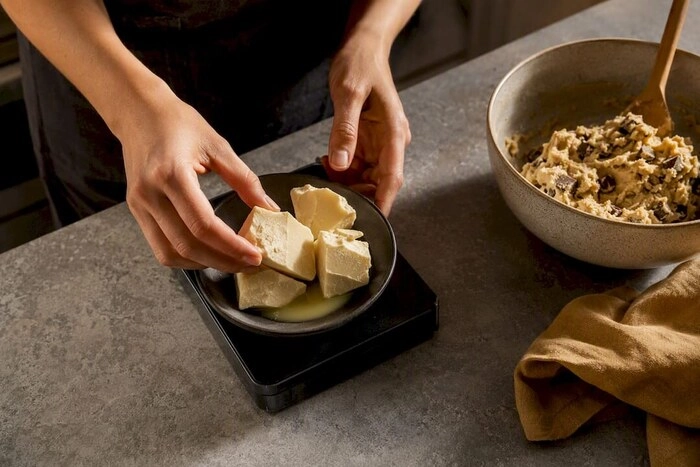
Weight based tips for home bakers: use 82% cocoa butter swaps, 0.5% viscosity tweaks, and batch tempering tips for glossy firm results.
Yes, cocoa butter belongs in baking, but only for certain jobs. It works brilliantly in shortbread, ganache, cookie dough, and chocolate coatings, and less well as a straight one-for-one swap for dairy butter in most cakes. Treat it as a specialist ingredient for shine, snap, and firmness, not an everyday butter replacement, and the substitution rules below will tell you exactly where it earns its higher price tag.
TL;DR:
- Cocoa butter should be used in baking mainly for its shine, snap, and firmness, rather than as a direct dairy butter replacement in most cakes.
- Substituting cocoa butter for butter involves using about 82% of the butter’s weight plus a liquid to restore moisture, with melting done carefully to avoid seizing.
- It performs best in recipes like cookies, ganache, and enrobing where its structural properties enhance contrast and appearance without relying on its ability to rise or aerate.
- Proper tempering and small incremental additions are crucial to achieve glossy finishes and avoid issues like bloom or streaky appearance.
- Always choose food-grade cocoa butter, store it in a cool, dark place, and buy natural or deodorized types depending on flavor needs.
Cocoa butter is the edible fat pressed from cocoa beans, and it behaves nothing like the fat you’re used to baking with. It melts just below body temperature, which is exactly why chocolate feels like it vanishes on your tongue rather than sitting there waiting to be chewed.
That melting behaviour comes from something called polymorphism. Cocoa butter can crystallise into six different structures, labelled Forms I through VI, and only Form V gives you the glossy snap you associate with good chocolate. Get the wrong form and you end up with a dull, soft, or crumbly result, which is why tempering matters so much when cocoa butter is doing structural work rather than just flavouring something.
Compare that to what you already know. Cocoa powder is the dry solid left after the fat is removed, so it brings colour and bitterness but almost none of the richness.
Keep these properties in mind before you substitute anything:
Weight, not volume, is how professional bakers handle this swap, and you should too. When replacing dairy butter, start at roughly 82% of the butter weight in cocoa butter, then make up the rest with a liquid, whether that’s water, milk, or cold coffee, to replace the moisture butter would otherwise have supplied.
Oil swaps work slightly differently. Cocoa butter can replace some or all of the oil in a recipe, but because it sets hard at room temperature rather than staying liquid, expect a firmer finished texture. This matters most in brownies and traybakes, where a full oil swap can leave the crumb noticeably stiffer once cooled.
Here’s how to approach it step by step:
Worked example: a shortbread recipe calling for butter becomes cocoa butter plus a similar amount of cold water or milk, whisked in once the fat has cooled to room temperature but is still soft.
Pro Tip: Keep a small jar of melted cocoa butter on the side when baking cookies. A teaspoon brushed over the dough before it goes into the oven gives you a subtle sheen and a crisper edge without altering the flavour.
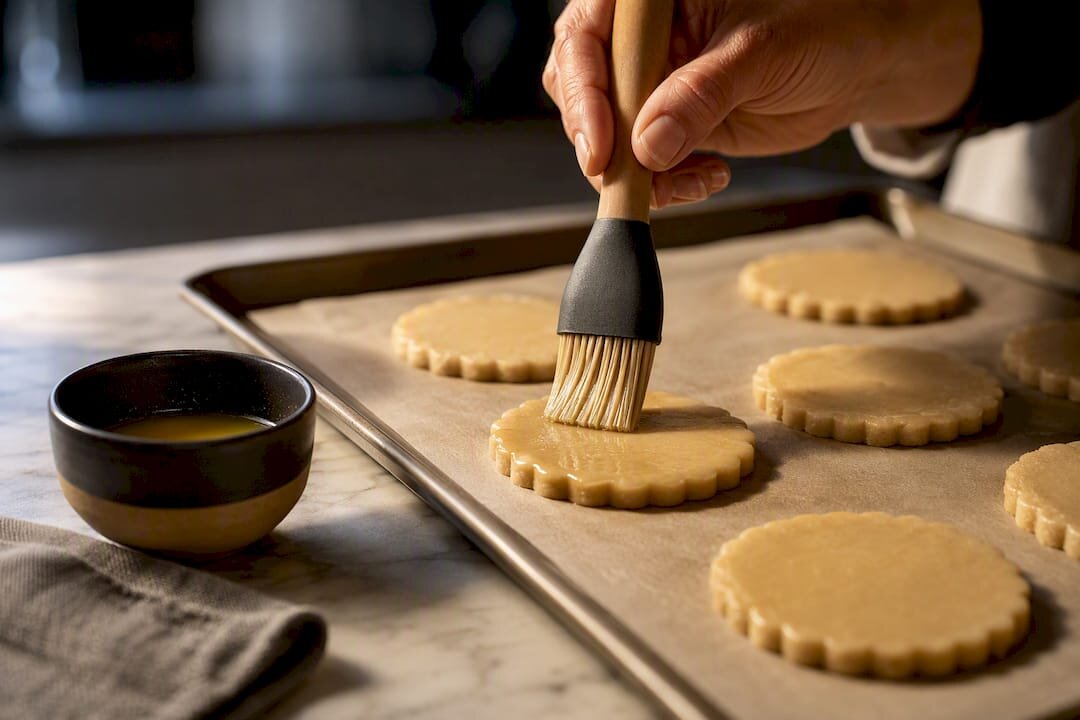
Cocoa butter earns its keep most clearly in bakes where snap, shine, or a firm set matter more than rise. Here’s where it genuinely improves the result:
The common thread is restraint. Cocoa butter changes texture disproportionately to the amount used, so small, weighed additions consistently outperform guesswork.
Most cocoa butter problems trace back to one of two things: the wrong crystal form, or the wrong amount added at the wrong stage. Getting Form V to form reliably is what separates glossy, snapping chocolate work from a dull, streaky mess, and it depends on hitting specific temperature windows during melting and cooling, a process covered in detail in guides on tempering chocolate properly.
Viscosity is the other lever. If your couverture or coating chocolate is too thick to flow evenly, start with additions around 0.5% by weight, roughly 5g per kilogram of chocolate, and test the flow before adding more.
A useful benchmark: additions of just 0.5% by weight measurably reduce viscosity without noticeably softening the final set, while enrobing work sometimes calls for 1 to 5% depending on how thin you need the coating to run.
Watch for these common faults:
Work in a cool kitchen, ideally below 22°C, and you’ll have far more control over set times than fighting a warm summer afternoon.
Only ever buy cocoa butter explicitly labelled edible or food-grade. Cosmetic-grade cocoa butter, sold for skin and lip products, isn’t intended for consumption and may not meet food safety standards, even though it looks and smells identical.
Beyond that, your main choice is aroma. Natural (sometimes called aromatic) cocoa butter carries a genuine chocolate scent and flavour, which suits chocolate work, cookies, and ganache. Deodorised cocoa butter is neutral, and it’s the better pick for delicate vanilla or fruit-based bakes where you don’t want a chocolate undertone competing with other flavours.
When shopping, look for:
Bamchocolate’s guide on how well you know cocoa butter walks through these distinctions in more depth if you want to match the grade to your recipe before buying.
Cocoa butter is remarkably stable. Kept cool, dark, and sealed away from air, it lasts anywhere from two to five years without meaningful quality loss.
The main enemy isn’t time, it’s odour. Cocoa butter absorbs smells from its surroundings readily, so store it in an airtight container, away from strong-smelling foods like onions or spices. And always double-check the label before eating anything, since only products explicitly marked edible are safe for baking.
Professional chocolatiers rarely add cocoa butter by guesswork, and the technique worth borrowing is seeding: introducing a small amount of already-tempered cocoa butter, sometimes as a micro-powder, into melted chocolate to trigger fast, reliable Form V crystallisation.
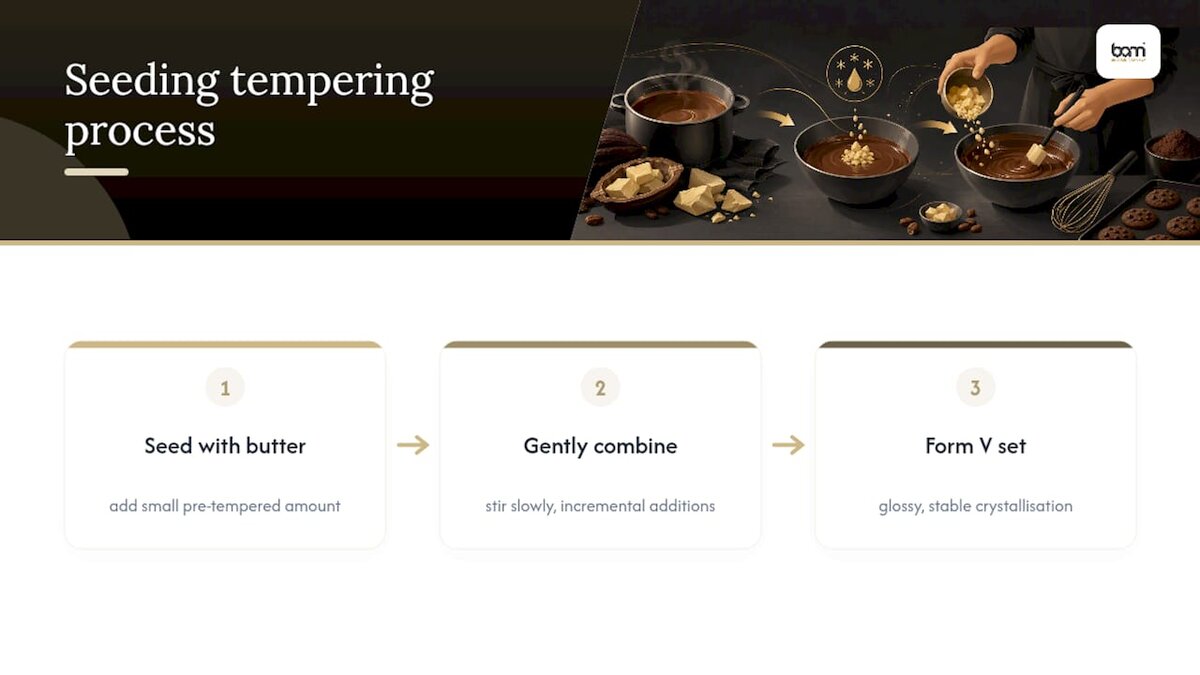
For viscosity work, the same incremental logic applies at home. Bamchocolate’s practical guide to melting chocolate and its breakdown of versatile cocoa butter uses both cover these incremental methods in more detail, alongside the tools that make measuring small percentages far easier than eyeballing it.
Pro Tip: Buy a set of digital scales that measure to 0.1g. At the percentages chocolatiers work with, kitchen scales that round to the nearest gram simply aren’t precise enough.
Experimenting with cocoa butter doesn’t need to be intimidating, but it does reward a methodical approach. Weigh everything, write down what you used, and taste-test before scaling the ratio up or down for the next batch.
Worth remembering: cocoa butter costs considerably more than dairy butter gram for gram, so it makes far more sense as a finishing touch or decorative flourish than an everyday pantry swap. Save it for the bakes where its shine, snap, or firm set genuinely earns the extra cost, and keep dairy butter for the rest.
— Andraz
Sourcing cocoa butter that’s genuinely food-grade, properly labelled, and paired with recipe guidance is harder than it should be, particularly when cosmetic-grade products are sold right alongside edible ones with barely a difference on the packaging. Bamchocolate solves that by stocking cocoa butter and confectionery ingredients that are clearly labelled for baking, with recipe support built into the product pages rather than left for you to work out alone.
If you’re setting up to experiment properly, the baking accessories range covers the tools and ingredients this article has walked through, from precision scales to tempering essentials. Home bakers wanting a fuller starting point should look at the Basic pastry package, a curated bundle that pairs foundational ingredients with the accessories needed to get consistent results from the first attempt. Browse the range now and pick the bundle that matches the bakes you’re planning next.
For deeper technical grounding, the Wikipedia entry on cocoa butter covers polymorphism and melting behaviour in detail, while JayArr Chocolate’s guide to viscosity adjustment and Just Chocolate’s technical guide to enrobing and glazing both offer practical detail worth returning to as your technique develops.
Yes, cocoa butter works well in cookies, shortbread, ganache, and coatings, though it’s best used as a partial substitute rather than a full swap for dairy butter in most cakes.
Coconut oil behaves similarly at room temperature and works as a practical substitute, while vegetable shortening offers a neutral, budget-friendly alternative for firmness without added flavour.
Natural cocoa butter carries a mild, genuine chocolate aroma and flavour, while deodorised cocoa butter is processed to be neutral and flavourless, which suits recipes where you don’t want a chocolate undertone.


 Confectionery tips




 Slovenščina
 Hrvatski
 Deutsch
 Italiano
 Česky
 Polski
 Magyar
 Français
 Slovák
 Nederlands
 Español