 info@bamchocolate.com
  Login
Login 

 en
en 
 BAM Cake converter
  Login
Login Claudia
Avtorica vsebin


 Reading time:
6 minutes
Reading time:
6 minutes 
Discover the essential guide to defining chocolate inclusions. Elevate your baking with delicious ingredients for flavor and texture!
A chocolate inclusion is any solid ingredient added to finished chocolate that stays distinct within the chocolate matrix rather than dissolving during refining. The definition specifically excludes core chocolate ingredients: cacao, cocoa butter, sugar, milk powder, and vanilla. Everything else added intentionally for flavour, texture, or visual contrast qualifies.
Common chocolate inclusion types include:
Each inclusion sits at an interface between two materials with different moisture content, fat composition, and thermal behaviour. Managing those interfaces is the real craft.
Inclusions interrupt chocolate’s snap, melt, and aroma profile in ways that are never neutral. A hazelnut changes how the bar breaks. A cherry shifts acidity and chew. A salt crystal alters sweetness in the first second and bitterness in the finish.
Key sensory effects by inclusion type:
Moisture is the most serious production risk. Even a trace of water in an inclusion can cause tempered chocolate to seize, producing a grainy texture and lost snap. Every inclusion must be bone dry before contact with the chocolate mass.
Pro Tip: Check dried fruit and freeze-dried ingredients for residual moisture before use. Freeze-dried fruit in particular can reabsorb ambient humidity during storage, which will compromise your chocolate’s snap and shelf life.
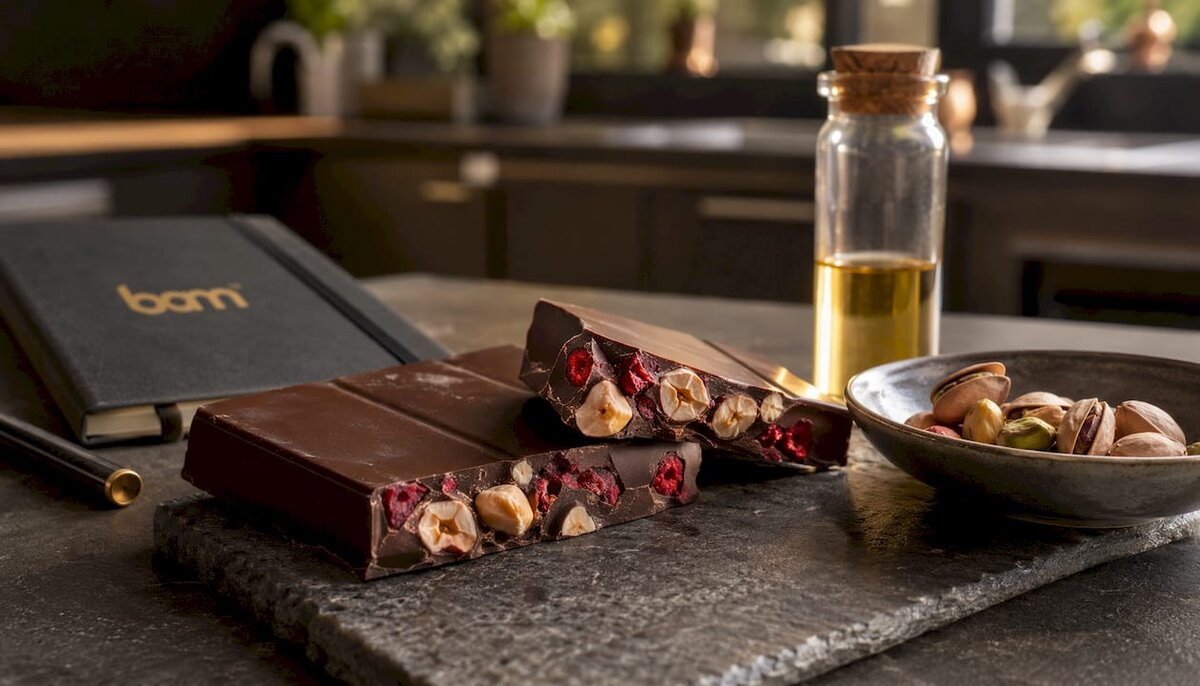
Fat migration from nuts is a separate concern. Nut oils migrate into the chocolate matrix over time, altering snap, gloss, and crystal structure, and accelerating bloom. Walnuts, with their higher polyunsaturated fat content, migrate faster than almonds.
Consumers generally fall into two distinct texture preference groups. “Smooshers” favour slow, uniform melts with minimal interruption. “Suckers” seek crunchy, multi-layered textures that demand chewing and deliver complex flavour release. Targeting the wrong group with the wrong inclusion is a straightforward way to disappoint.
Practical implications for bakers:
Knowing your target consumer’s texture preference before selecting inclusions saves reformulation time and prevents flavour mismatches.
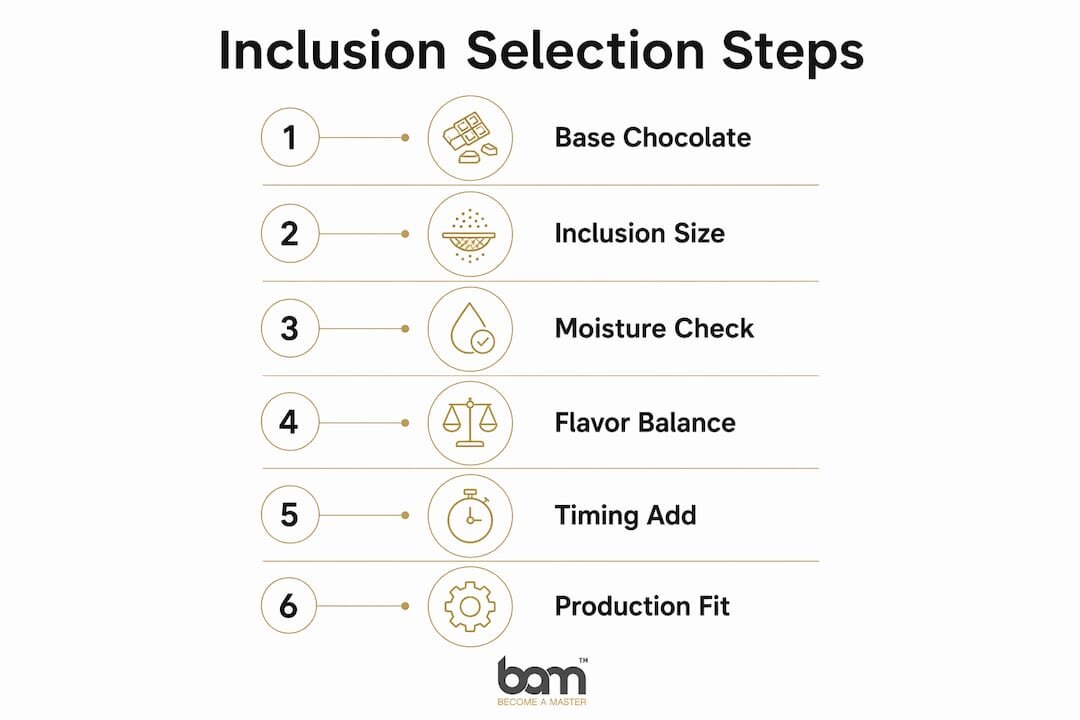
Successful inclusion use depends on five practical factors, as outlined by industry specialists at Luker Chocolate.
1. Machinery constraints
Large or irregular inclusions cause blockages and inconsistent dosing in automated production. Align inclusion size with your production line before committing to a recipe. Manual application suits artisanal runs; automated integration requires uniform, consistently sized pieces.
2. Flavour balance
The best inclusion bars are built around a relationship between the base chocolate and the addition. A small proportion of salty or tart inclusions creates desirable contrast; excessive use overwhelms the palate. Avoid using inclusions to mask weak base chocolate. Salt, for instance, is better understood as contrast than as a repair for flat flavour.
3. Moisture management
Hygroscopic ingredients such as caramel and certain dried fruits absorb moisture rapidly, becoming sticky and compromising texture. Improper moisture management leads to fat bloom or sugar bloom. Store inclusions in sealed, dry conditions and verify moisture levels before production.
4. Production efficiency
Larger inclusion percentages slow dosing machinery, increasing manufacturing time and cost per unit. Align inclusion density with production capacity and packaging format from the outset.
5. Timing and technique
Add inclusions after tempering, not before. Cold inclusions can thicken the chocolate mass suddenly or disturb crystal structure. For better shelf life, embed inclusions within the moulded bar rather than placing them on the surface, where they are exposed to air and moisture. Nuts pair well with almonds in almond-based bakes to illustrate how fat-rich inclusions interact with baked structures.
Pro Tip: Embedded inclusions consistently outperform surface decorations for shelf life. If your format allows it, fold inclusions into the chocolate mass before moulding rather than pressing them onto the back of the bar.
Selecting the right base chocolate before choosing inclusions is the logical starting point. The base’s sweetness, bitterness, and fat content determine which inclusions will contrast well and which will clash.
Bamchocolate (BAM, Become A Master) is a specialist source for premium baking ingredients and confectionery products, with a catalogue built around quality and culinary precision. For bakers and pastry chefs working with inclusions, the range covers:
Bamchocolate’s focus on organic, sophisticated flavours and professional-grade ingredients makes it a practical resource for bakers at every level.
Chocolate inclusions work best when the base chocolate and the addition are chosen as a pair, not as independent decisions.
| Point | Details |
|---|---|
| Definition | Inclusions are solid ingredients added to finished chocolate that do not dissolve during refining. |
| Moisture risk | Even a trace of water in an inclusion can cause tempered chocolate to seize; all inclusions must be bone dry. |
| Consumer types | Smooshers prefer uniform melts; suckers prefer crunchy, multi-layered textures. Match inclusions accordingly. |
| Production constraints | Large or irregular inclusions slow dosing machinery and increase manufacturing cost per unit. |
| Shelf life | Embedded inclusions protect ingredients from air and moisture better than surface decorations. |
Any solid ingredient added to finished chocolate that does not dissolve during refining counts as an inclusion. Core ingredients such as cacao, sugar, milk powder, and cocoa butter are excluded from this definition.
Even a trace of water in an inclusion can cause tempered chocolate to seize irreversibly, producing a grainy texture and lost snap. Every inclusion must be completely dry before contact with the chocolate mass.
Nut oils migrate into the chocolate matrix over time, altering snap, gloss, and crystal structure, and accelerating bloom. Polyunsaturated nuts such as walnuts migrate faster than monounsaturated varieties such as almonds.
Inclusions are added after tempering, during the moulding stage. Adding them earlier risks disturbing the crystal structure or thickening the chocolate mass prematurely.
Use inclusions to contrast or enhance the base chocolate’s existing flavour notes rather than to overpower them. A small proportion of a strong inclusion, such as salt or tart fruit, creates contrast; excessive use overwhelms the palate and masks the chocolate itself.



 Confectionery tips



 Slovenščina
 Hrvatski
 Deutsch
 Italiano
 Česky
Česky
 Polski
 Magyar
 Français
 Slovák
 Nederlands
 Español