 info@bamchocolate.com
 Login


 en

 BAM Cake converter
 Login
Claudia
Avtorica vsebin


 Reading time:
18 minutes

Discover how to design unique branded chocolate gifts with our practical guide. Ensure polished results and avoid costly mistakes!
For corporate gifting, the fastest route to a polished result is a full-colour wrapped bar or a rigid-assortment box with a thermoformed insert and printed outer sleeve. Submit your logo as an editable vector file, confirm your minimum order quantity, and request both a digital proof and a physical sample before approving production. That sequence alone prevents most delays and costly reprints.
Quick-start checklist:
Pro Tip: Contact Bamchocolate to request a bespoke quote and sample pack. Include your logo file, preferred format, quantity, and delivery date in the initial brief — it cuts the first response cycle by half.
Designing branded chocolate gifts that hold up in production and land well with recipients comes down to format choice, artwork preparation, and a disciplined proof-and-sample flow before any production run starts.
| Point | Details |
|---|---|
| Choose format first | Match product type to objective: wrapped bars for bulk campaigns, rigid assortments for VIP gifts. |
| Prepare artwork to spec | Submit editable vector files in CMYK with Pantone references, 300 DPI raster elements, and 3 mm bleed. |
| Always request a physical sample | Digital proofs cannot confirm board weight, insert fit, or finish accuracy — approve a physical sample before production. |
| Plan lead times early | Allow 3–6 weeks from artwork approval; book summer and Christmas slots at least 8 weeks ahead. |
| Bamchocolate for B2B orders | Bamchocolate handles briefing through fulfilment with artwork support, sampling, and corporate packaging options. |
Format choice shapes brand perception before the recipient even opens the box. Each product type serves a different objective, budget, and logistics constraint.
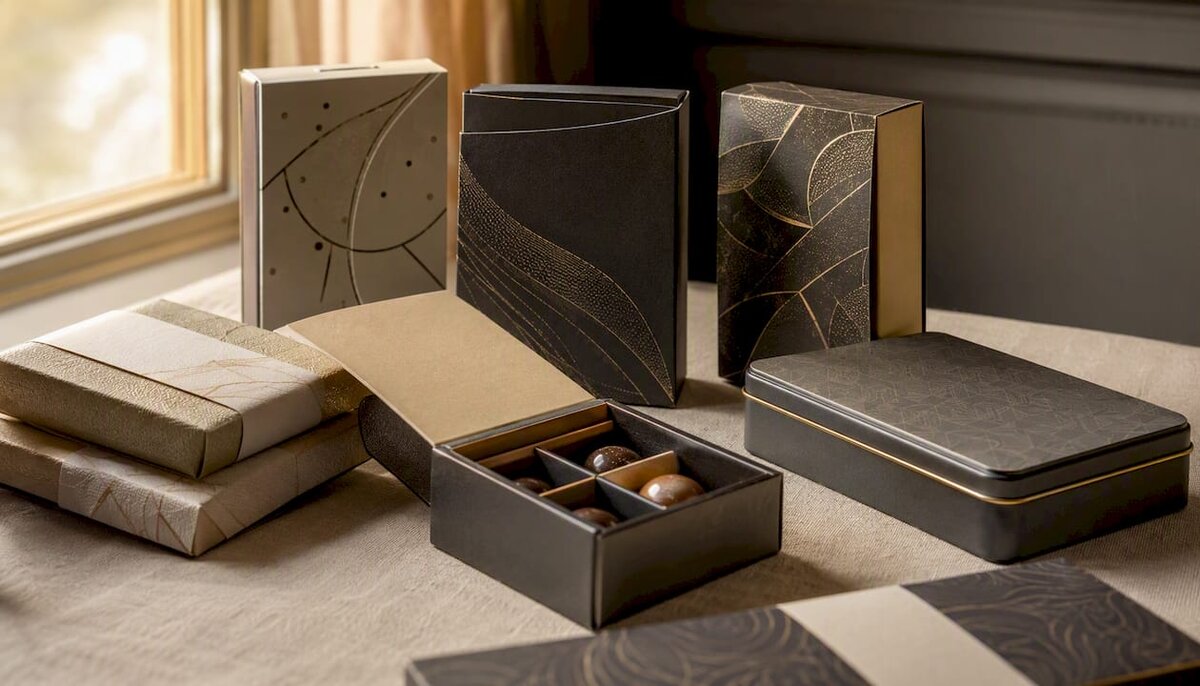
Wrapped chocolate bars are the workhorse of corporate gifting. A full-colour printed wrapper gives maximum surface area for brand messaging, and bars are light, stackable, and easy to post. Unit costs are low at scale, making them the default for bulk promotional runs, trade-show giveaways, and conference handouts. The finish is typically a printed paper or foil-laminate sleeve.
Rigid boxed assortments sit at the premium end. A rigid lid-and-base box with a thermoformed or cardboard insert holding bonbons or pralines reads as a considered, high-value gift. These suit VIP client presents, board-level thank-you gifts, and product launches where perceived quality matters more than unit cost. Expect a higher per-unit price and more complex logistics due to weight and fragility.
Folding carton assortments offer a middle ground: more structure than a wrapper, less cost than a rigid box. A printed folding carton with a paper insert works well for mid-tier gifting, seasonal campaigns, and employee recognition programmes. They fold flat for storage and are lighter to ship.
Bonbon and praline boxes (often windowed) let the product speak visually. A clear acetate window on a branded carton shows the chocolates inside, which increases perceived quality without requiring the recipient to open the box first. Useful for gifting where the product itself is the hero.
Tins are reusable and carry strong shelf-presence. A printed tin with a lid survives transit well and tends to be kept by recipients, extending brand exposure beyond the initial gift moment. Seasonal disc sets packaged in tins are popular for Christmas and Easter campaigns.
Seasonal discs and novelty formats (moulded shapes, advent formats) work for themed campaigns. Branding is applied via edible transfer sheets or printed packaging rather than the chocolate surface itself in most cases, though custom moulds are available for larger orders.
As independent testing confirms, descriptive product information — single-origin details, flavour notes — raises perceived gift quality. Including a small flavour menu card inside any assortment box lifts the unboxing experience at minimal cost.
The decoration method determines how sharp your logo looks on the finished product and how much it costs. Choosing the wrong method for the substrate wastes budget and can produce illegible results on small formats.
Foil stamping, embossing, and spot UV varnish are available on rigid boxes and higher-grade folding cartons, but not on lightweight wrappers or tins. Solid bleached sulphate (SBS) board handles deep embossing and heavy metallic foil at 210–380 GSM; folded boxboard (FBB) at 190–390 GSM is a cost-effective alternative for seasonal volumes where heavy embossing is not required.
Pro Tip: Keep your logo at least 8 mm wide on small formats such as bonbon wrappers or disc labels. Below that threshold, fine serifs and thin strokes disappear in print. Use a simplified, single-colour version of your logo for anything under 20 mm wide, and always check legibility on the supplier’s physical proof before approving production.
Packaging is not a container — it is the first physical expression of your brand the recipient touches. The structure you choose defines which finishes, inserts, and sustainability options are even possible, which is why packaging design follows a five-gate sequence: structure first, then material, insert, compliance, and finish. Reversing that order is the most common cause of production failures and food-safety recalls.
Packaging format options and their brand impact:
Thermoformed PET trays are the most reliable insert for mixed-assortment boxes. Standard bonbon footprints typically vary in width around three centimeters; a small cavity clearance is recommended to prevent scuffing and drift during transit without making the chocolates rattle. Paper compartment inserts are a lower-cost alternative for uniform-size products but offer less protection on multi-leg courier routes. Where allergen separation is required — for example, nut-containing and nut-free pieces in the same box — thermoformed trays with sealed compartments are the only reliable solution.
Recycled board (PCW) is available for folding cartons and performs well for standard digital or litho print, but it cannot support deep embossing or heavy foil stamping — the fibre structure is too variable. Biodegradable PLA trays are an option for inserts, though food-contact compliance certification must be verified for each market. Aqueous coatings are recyclable; UV and laminate coatings typically are not, which matters if your recipients or procurement policy require recyclable packaging. For seasonal gifting campaigns, FBB board gives better yield than SBS for high-volume runs where embossing is not a priority.
Message cards, personalised hangtags, and belly bands add a corporate messaging layer without redesigning the core box. A hangtag printed with the recipient’s name and a short brand message costs very little per unit and meaningfully increases the sense of personalisation.
The chocolate formulation inside the box matters as much as the packaging around it. Well-made chocolates with careful flavour balance and reliable shipping insulation are what recipients remember — and what drives the positive association with your brand.
Chocolate types for corporate briefs:
Common dietary requirements to plan for:
Ask every prospective supplier for copies of their HACCP plan and, where applicable, IFS Food or BRC certification. Organic and Fair Trade or direct-trade declarations add a provenance story that resonates with recipients and aligns with corporate ESG commitments. A modern slavery statement on a supplier registry is a concrete due-diligence artefact — request it as part of your standard supplier onboarding.
Run a small internal tasting panel before approving the final product. Ask the supplier for descriptive tasting notes and sample photos in advance so your panel knows what to expect and can give structured feedback rather than subjective impressions.
Pricing for branded chocolate gifts scales with format complexity, board grade, finish, and insert type. A printed wrapper on a standard bar is the lowest-cost entry point; a rigid box with foil stamping, a thermoformed insert, and a custom mould is the highest. The table below shows representative ranges — actual quotes will vary by supplier, volume, and specification.
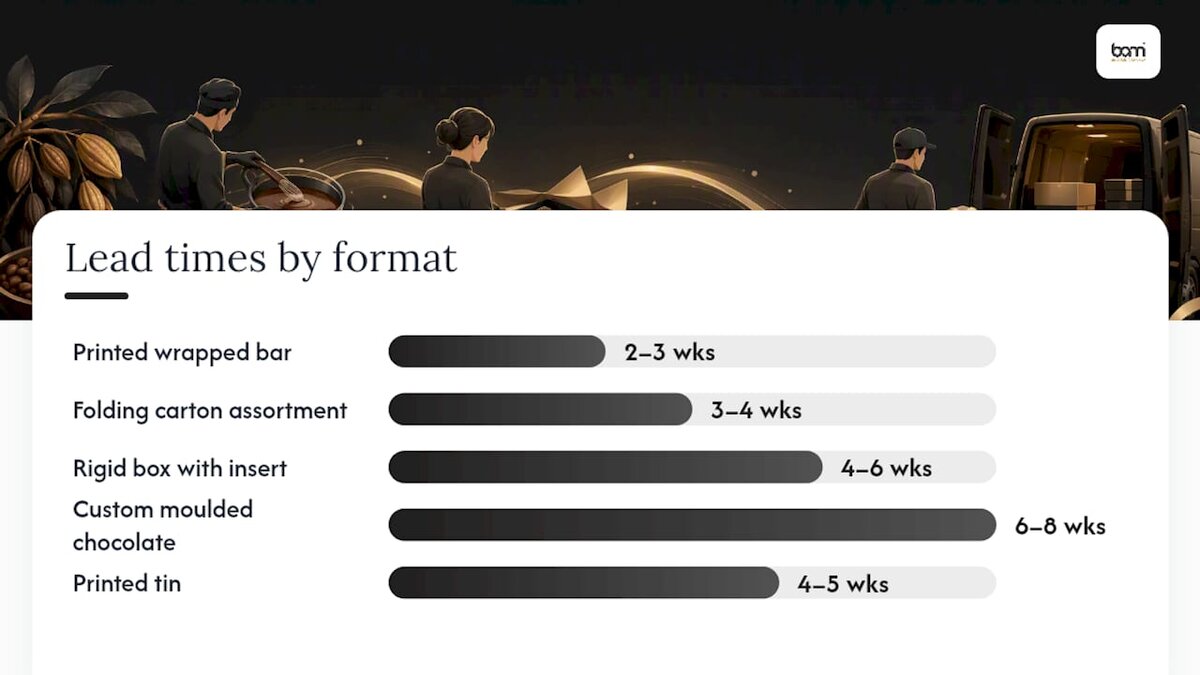
| Format | Typical MOQ | Indicative unit cost range | Lead time (from artwork approval) |
|---|---|---|---|
| Printed wrapped bar | 50 units | Low–mid range | 2–3 weeks |
| Folding carton assortment | 50 units | Mid range | 3–4 weeks |
| Rigid box with insert | 25–50 units | Mid–high range | 4–6 weeks |
| Custom moulded chocolate | tens of units | High (plus tooling) | 6–8 weeks |
| Printed tin | tens of units | Mid–high range | 4–5 weeks |
Key cost drivers to watch:
Physical samples usually carry a small charge (covering materials and courier), which is credited against the first production order with most reputable suppliers. Digital proofs are typically provided at no cost. Never skip the physical sample to save time — a digital proof cannot reveal insert fit, board rigidity, or colour accuracy on the actual substrate.
Follow this sequence for every branded chocolate gift order, regardless of format or volume. Skipping steps is the primary cause of production delays and reprints.
| Parameter | Requirement |
|---|---|
| File format | AI, EPS, or PDF/X-1a (editable vector) |
| Colour mode | CMYK; Pantone references for brand colours |
| Raster resolution | 300 DPI at final print size |
| Bleed | 3 mm on all edges |
| Transparency | Flatten all layers before submission |
| Dieline | Build within supplier’s provided dieline |
| Fonts | Outline all fonts or embed in the file |
Pro Tip: Ask the supplier to send the digital proof as a 3D mockup render alongside the flat dieline PDF. A 3D render reveals how the design wraps around corners and folds — problems that are invisible on a flat proof but obvious on the finished box.
Chocolate is one of the most temperature-sensitive products in corporate gifting. Bloom — the white, streaky surface discolouration caused by fat or sugar migration — is irreversible and makes a premium gift look defective on arrival. The buyer, not just the supplier, shares responsibility for specifying the right transit conditions.
Shipping best practices:
Seasonal risk management:
Summer months (June–August in Central Europe) present the highest risk. Schedule production and delivery to avoid peak-heat transit windows where possible, or specify cold-chain courier options. For Christmas campaigns, book production slots by October at the latest — most suppliers reach capacity in November, and rush fees apply from mid-October onwards. Seasonal gifting inspiration for event planners, such as this list, confirms that lead-time planning is the single most common failure point in festive corporate gifting.
Handling notes for returns and damaged goods:
Document the claims process with your supplier before placing the order, not after. Agree a photographic evidence requirement (images within 24 hours of delivery), a replacement turnaround time, and whether replacements are shipped at the supplier’s cost or credited.
Pro Tip: For summer deliveries, ask your supplier to ship on a Monday or Tuesday. Parcels that enter the courier network on a Wednesday or Thursday risk sitting in a warm depot over the weekend — a common cause of bloom that is entirely avoidable with scheduling.
A supplier who cannot answer the following questions clearly is not ready for a corporate gifting brief. Use this checklist at the first conversation.
Essential questions to ask every supplier:
Red flags that warrant further due diligence or a different supplier:
Trust signals to require in writing:
For first-time suppliers, negotiate a pilot run of 25–50 units before committing to the full order. The cost of a pilot is small relative to the risk of a full production run that fails on quality, finish, or transit. As the packaging engineering guidance makes clear, design and production failures are almost always traceable to decisions made before production starts — not during it.
Bamchocolate handles corporate chocolate gifting from initial brief through to B2B fulfilment. The process runs in five stages: briefing, digital proof, physical sample, production, and delivery with order reporting. Each stage has a named sign-off point, which means no production run starts without written client approval.
What Bamchocolate offers for branded corporate orders:
To request a quote, submit your brief with format preference, quantity, delivery date, and logo file. For buyers who want to evaluate product quality before committing, the BAM Basic pastry package and the confectionery set with creamy fillings serve as practical starting points for an internal tasting panel.
Bamchocolate’s B2B team responds to corporate enquiries within one business day. Include your target delivery date in the first message — it determines which formats and finishes are feasible within your timeline.
The gap between what looks impressive in a supplier catalogue and what actually lands well with recipients is wider than most buyers expect. After seeing many corporate gifting briefs, a clear pattern emerges: the orders that generate the strongest feedback are rarely the most elaborate ones.
Simple, highly branded wrappers on quality chocolate outperform complex packaging in bulk campaigns — every time. Recipients notice the chocolate first. If it tastes good and the branding is clean and legible, the gift does its job. A rigid box with five mediocre pralines and a foil-stamped lid leaves a worse impression than a well-wrapped bar of genuinely good chocolate.
The other consistent pattern: buyers who skip the physical sample approval almost always regret it. A digital proof looks convincing on screen. The actual box, with its insert, its board weight, and its printed finish under real light, is a different object. One round of physical sample approval is the cheapest quality-assurance step in the entire process, and it is the one most often cut when timelines get tight.
For VIP gifting, the detail that moves the needle most is not the packaging — it is the flavour menu card inside. A small printed card with tasting notes, origin details, and a short brand message turns a box of chocolates into a considered, curated experience. It costs almost nothing to produce and is the element recipients mention most often when they respond to thank the sender.
Bamchocolate gives procurement teams a direct route to premium branded chocolate gifts without the complexity of managing multiple specialist suppliers. One point of contact covers artwork support, sampling, packaging configuration, and fulfilment — whether the order is 50 units for a client event or a bulk seasonal campaign.
The BAM Large Confectionery Bundle is the starting point for higher-volume corporate orders, while the BAM Pastry set with exotic fillings suits VIP gifting where premium flavour variety is the priority. Both are available with corporate packaging and personalised inserts.
To get started, send your brief — format, quantity, delivery date, and logo file — to Bamchocolate’s B2B team via Bamchocolate. Expect a quote and initial digital proof within one business day. Physical samples ship within the week following brief confirmation.
MOQs vary by format, with wrapped bars and rigid boxed assortments requiring moderate minimum orders, and custom-moulded chocolates requiring larger minimum orders due to tooling costs.
From artwork approval, allow 2–3 weeks for wrapped bars, 4–6 weeks for rigid boxes, and 6–8 weeks for custom moulds.
Submit an editable vector file (AI, EPS, or PDF/X-1a) in CMYK colour mode with Pantone references for brand-critical colours, 300 DPI raster elements at final print size, 3 mm bleed, and all fonts outlined.
Yes. A digital proof cannot confirm board rigidity, insert fit, or finish accuracy under real light. Requesting a physical sample is the most cost-effective quality-assurance step in the process.
Bamchocolate offers sugar-free and premium single-origin formulations alongside standard milk and dark options. Confirm specific dietary requirements — vegan, gluten-free, nut-free — at the briefing stage so the correct product and labelling can be specified.


 Confectionery tips


 Slovenščina
 Hrvatski
 Deutsch
 Italiano
 Česky
 Polski
 Magyar
 Français
 Slovák
 Nederlands
 Español