 info@bamchocolate.com
 Login


 en

 BAM Cake converter
 Login
Claudia
Avtorica vsebin


 Reading time:
8 minutes
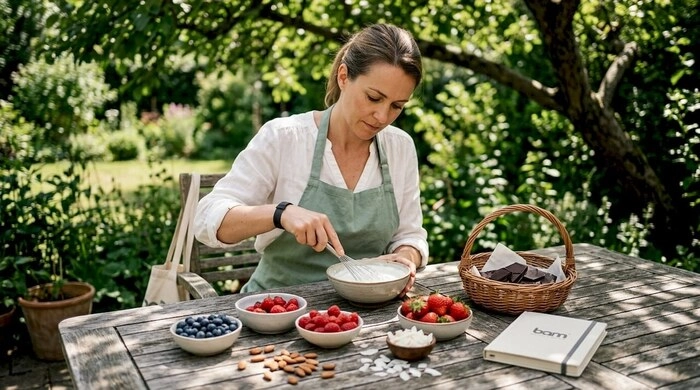
Discover the top 10 diet-friendly dessert options list! Enjoy satisfying, low-calorie treats without refined sugars while staying healthy.
TL;DR:
- Diet-friendly desserts are low in refined sugars and calories but use nutrient-dense ingredients like fruits and nuts. They support blood sugar balance and sustained energy without sacrificing flavor or texture. Consuming these desserts a few times weekly and pairing them with protein helps promote overall health goals.
Diet-friendly desserts are defined as sweet treats low in refined sugars and calories, built around nutrient-dense ingredients such as fruits, nuts, healthy fats, and fibre. The standard industry term for this category is “better-for-you desserts,” and the diet-friendly dessert options list below draws on that same principle. These desserts support blood sugar balance and sustained energy rather than the sharp spikes that follow refined sugar. Dietitians consistently recommend replacing sweetness with fibre-rich foods rather than cutting dessert entirely. The result is a practical approach: eat well, stay satisfied, and never feel deprived.
The best low-calorie desserts deliver real flavour without excessive calories or refined sugars. A healthy blueberry pie comes in at roughly 130 calories per slice, using oats and natural fruit rather than pastry and white sugar. Mini mango cheesecakes made with Greek yogurt and almond flour bases sit at around 330 calories per serving. Both options prove that calorie-conscious choices do not require sacrificing texture or taste.
The key to keeping calories low is ingredient substitution, not portion restriction. Swapping cream cheese for Greek yogurt cuts fat while adding protein. Using oats or almond flour instead of refined white flour adds fibre and slows digestion.
Pro Tip: Chill your Greek yogurt filling for at least two hours before serving. It firms up to a texture close to traditional cheesecake without any added cream.

Sugar-free dessert ideas work best when natural sweeteners replace refined sugar rather than simply removing sweetness altogether. Dates, maple syrup, and fruit purees each bring fibre alongside sweetness, which slows glucose absorption. Fibre-rich alternatives to sugar such as berries, dates, and bittersweet chocolate support sustained energy and blood sugar control. That makes them far more useful than artificial sweeteners, which provide no nutritional benefit.
Naturally sweetened options worth making at home include:
Understanding which sweeteners actually support health is worth the effort. Bamchocolate’s guide on natural sweeteners vs sugar explains the nutritional differences clearly.
Replacing refined sugar with fibre-rich, antioxidant-packed ingredients like berries, dates, and bittersweet dark chocolate supports sustained energy and better blood sugar control, without eliminating the pleasure of dessert.
Gluten-free dessert options and keto-friendly sweets share a common foundation: they replace wheat flour with nut-based alternatives and reduce total carbohydrate content. This makes them suitable for people managing coeliac disease, gluten sensitivity, or a low-carb high-fat diet. The substitution changes both texture and structure, so understanding the mechanics matters.
Low-carb coconut macaroons contain only 3 grams of carbohydrates per cookie. That figure makes them one of the most practical keto-friendly sweets available. They require just shredded coconut, egg whites, and a touch of natural sweetener.
Flourless chocolate cookies use almond butter or tahini as the binding agent. They are naturally gluten-free and deliver a dense, fudgy texture that rivals traditional biscuits. A small amount of dark chocolate chips adds depth without pushing carb counts high.
Almond flour and crushed pecans form the base of most gluten-free tart crusts. These crusts work well with fruit fillings, chocolate ganache, or yogurt-based creams. Bamchocolate’s article on low-carb chocolate options covers how dark chocolate fits naturally into this style of baking.
Pro Tip: When using almond flour for a tart crust, press the mixture firmly and evenly into the tin before chilling. A loose press leads to crumbling when you slice.
Removing sugar and gluten from a dessert recipe changes its physical structure. Sugar retains moisture and aids browning. Gluten provides elasticity and holds baked goods together. Replacing both at once requires deliberate technique.
| Challenge | Cause | Solution |
|---|---|---|
| Crumbly nut-based crust | No gluten for structure | Press firmly, add chopped nuts |
| Icy frozen dessert | Too much water, too little fat | Use full-fat coconut milk or cashews |
| Dry baked goods | Nut flours absorb more moisture | Add an extra egg or a spoon of nut butter |
| Flat cookies | No sugar caramelisation | Chill dough before baking, use baking powder |
| Grainy texture in mousse | Unmelted sweetener | Use liquid sweeteners or blend thoroughly |
The fat-to-water ratio is the single most important variable in frozen better-for-you desserts. Full-fat coconut milk or blended cashews create a scoopable, creamy texture. Water-heavy fruit purees freeze rock-hard and lose their appeal entirely. For baked goods, almond flour requires firm pressing or added binding agents to prevent crumbling, because it lacks the gluten structure that holds wheat-based crusts together.
Nutrient density is the key to healthy dessert satisfaction, not zero calories. A dessert built on healthy fats, fibre, and natural sugars curbs hunger more effectively than a calorie-free option with no nutritional value. This is the most common misunderstanding about better-for-you desserts: people assume “healthy” means “calorie-free.” It does not.
Practical guidance for fitting desserts into a health-focused routine:
Bamchocolate’s resource on making healthier confectionery offers practical ingredient guidance for home bakers who want to reduce sugar without losing flavour.
The most effective approach to diet-friendly desserts is replacing refined sugars and wheat flour with nutrient-dense alternatives that deliver fibre, healthy fats, and natural sweetness.
| Point | Details |
|---|---|
| Nutrient density over calorie counting | Choose desserts built on fibre, healthy fats, and natural sugars rather than simply low-calorie options. |
| Natural sweeteners outperform refined sugar | Dates, maple syrup, and fruit purees add fibre alongside sweetness, supporting blood sugar control. |
| Nut-based crusts need firm pressing | Almond flour lacks gluten structure; press firmly and add chopped nuts to prevent crumbling. |
| Fat-to-water ratio governs frozen texture | Full-fat coconut milk or cashews create creamy frozen desserts; water-heavy purees freeze solid. |
| Frequency matters more than portion size | Enjoying better-for-you desserts a few times per week supports health goals without restriction. |
The biggest mistake I see health-conscious bakers make is treating “sugar-free” as the finish line. They remove the sugar, the dessert tastes flat, and they conclude that healthy baking is joyless. The real issue is that they have not replaced what sugar actually does: it adds moisture, browning, and structure. Once you understand that, the fix becomes obvious.
My go-to approach is to build flavour from the fat source first. A good dark chocolate, a ripe Medjool date, or a full-fat coconut cream carries more flavour per gram than any amount of refined sugar. Bamchocolate’s piece on dark chocolate and health reinforced something I had already found in practice: quality dark chocolate is not a compromise. It is genuinely the better ingredient.
The other thing worth saying plainly: most people do not need to eliminate dessert. They need to change what their dessert is made of. A chia pudding sweetened with mashed banana and topped with berries is not a sacrifice. It is a genuinely good dessert that also happens to support your health goals. The restriction mindset is the problem, not the dessert itself.
— Andraz
Health-conscious baking starts with the right ingredients and tools. Bamchocolate’s baking accessories range includes products suited to sugar-free and gluten-free preparation, from precision moulds to specialist baking aids. For those building a full recipe repertoire, the BAM Basic pastry package brings together core confectionery ingredients in one bundle, well suited to the low-calorie and naturally sweetened recipes covered here. The BAM Protein Pudding Cheesecake Raspberry is a ready-to-use option for those who want a nutrient-dense dessert without the preparation time. All products are available directly from Bamchocolate.
A diet-friendly dessert is low in refined sugars and calories, and built around nutrient-dense ingredients such as fruits, nuts, healthy fats, and fibre. The focus is on nutrient density rather than calorie elimination.
Sugar-free desserts using natural sweeteners like dates or fruit purees can support blood sugar control, as their fibre content slows glucose absorption. Low-carb coconut macaroons, for example, contain only 3 grams of carbohydrates per cookie.
Gluten-free desserts using almond flour, coconut, and dark chocolate can be genuinely indulgent. The key is managing moisture and pressing nut-based crusts firmly to maintain texture.
Dietitians recommend enjoying better-for-you desserts a few times per week as part of a balanced diet. Pairing them with a protein source further supports stable energy levels.
Medjool dates are one of the most effective natural sweeteners for healthy dessert recipes because they add fibre, minerals, and a caramel-like flavour alongside sweetness. Mashed banana and maple syrup are strong alternatives for liquid-based recipes.


 Confectionery tips




 Slovenščina
 Hrvatski
 Deutsch
 Italiano
 Česky
 Polski
 Magyar
 Français
 Slovák
 Nederlands
 Español