 info@bamchocolate.com
 Login


 en

 BAM Cake converter
 Login
Claudia
Avtorica vsebin


 Reading time:
14 minutes

Get ready to bake this holiday season! Our festive baking essentials list covers all you need, from ingredients to tools. Check it out!
Stock these six categories and you are ready to bake all season: dry cupboard ingredients, fats, dairy and eggs, spices and flavourings, chocolate and fillings, nuts and dried fruit, and tools and packaging. That is the core of any practical festive baking essentials list, and everything below expands each category with quantities, timing, and product picks.
Quick shop-ready checklist (tick off before you go):
Pro Tip: Print this list and split it into two columns: “store cupboard” and “fridge/freezer”. Shop the cupboard items in early November to beat seasonal shortages, then top up perishables the week before you bake.
A downloadable version of the full checklist appears in the printable section below.
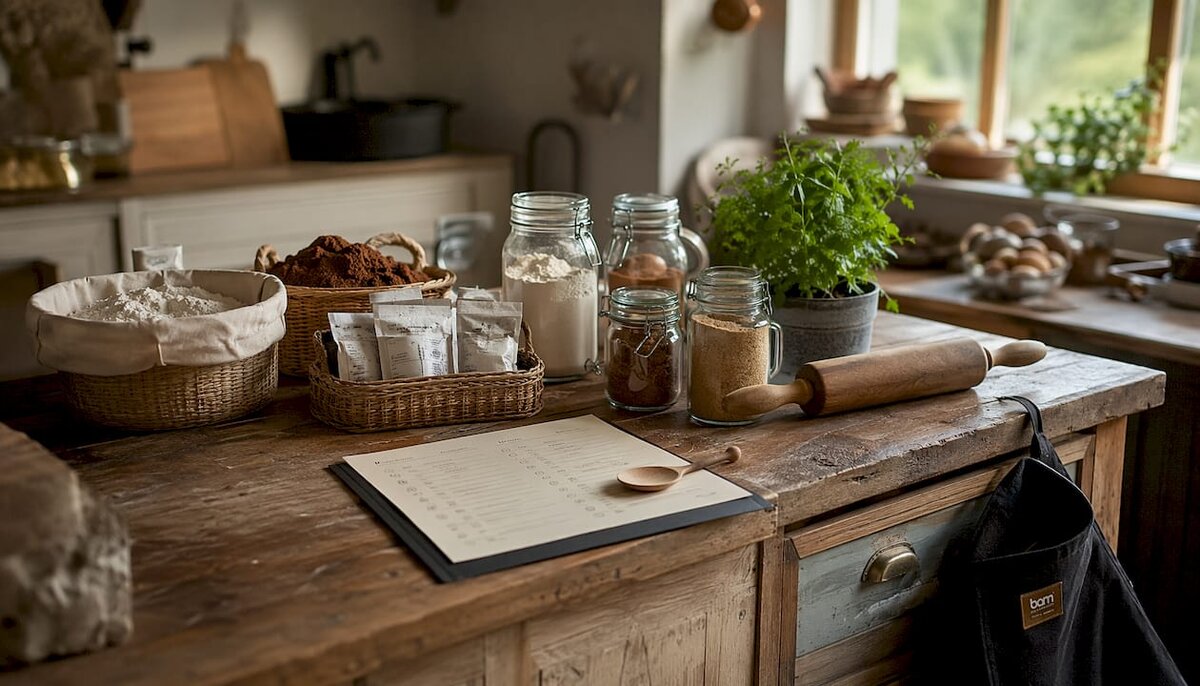
A well-stocked pantry is the difference between a smooth baking week and three emergency supermarket trips. The holiday baking pantry checklist approach groups dry ingredients by type so you can shop once and cover most festive recipes.
| Ingredient | Small batch (2 doz.) | Medium batch (6 doz.) | Large batch (12 doz.) |
|---|---|---|---|
| Plain flour | 500 g | 1 kg | 2.5 kg |
| Self-raising flour | 500 g | 1 kg | 1.5 kg |
| Caster sugar | 500 g | 1 kg | 2 kg |
| Icing sugar | 500 g | 1 kg | 2 kg |
| Light brown sugar | — | 500 g | 1 kg |
| Cocoa powder | 100 g | — | 500 g |
| Baking powder | 1 tin | 1 tin | 2 tins |
| Bicarbonate of soda | 1 box | 1 box | 2 boxes |
For Christmas cake and stollen, add strong bread flour (500 g–1 kg) and fast-action dried yeast (2–3 sachets). Gelatine or pectin is often recommended if you plan to make jellied fillings or set custards.
Cocoa powder: natural cocoa (lighter, more acidic) suits recipes that use bicarbonate of soda as the leavener. Dutch-process cocoa (darker, milder) works better in recipes calling for baking powder. When in doubt, check the recipe’s leavening agent.
Sweeteners and syrups: golden syrup and black treacle are non-negotiable for gingerbread and Christmas pudding. Maple syrup and molasses are useful for American-style cookies and spiced loaves. Buy 454 g tins of golden syrup and treacle; they keep for months once opened.
Storage tips for pantry items:
| Original | Substitute | Adjustment needed |
|---|---|---|
| Plain flour | Gluten-free plain blend | Add ¼ tsp xanthan gum per 100 g |
| Caster sugar | Granulated sugar | Blitz briefly to fine texture |
| Buttermilk | Milk + 1 tsp lemon juice | Let stand 5 minutes before using |
| Whole egg | 1 tbsp ground flaxseed + 3 tbsp water | Works in cookies and loaves |
| Butter (in cookies) | Coconut oil (solid) | Reduce by about 10% by weight |
Weighing ingredients by weight rather than volume reduces variability, which matters most when you are scaling a cookie recipe from two dozen to twelve. Using a digital kitchen scale is considered one of the most important tools for baking.
Must-have tools:
A comprehensive gear list for Christmas baking covers 21 items, but the nine above handle 90% of festive recipes. Add a hand mixer or stand mixer if you plan to make meringues, buttercream, or more than four batches of cookie dough in a day.
Bakeware quantities for holiday throughput:
Pro Tip: A portion scoop of a suitable size gives you uniform cookie dough balls in seconds. A bench scraper cuts dough cleanly and doubles as a bowl scraper. Both cost under £10 and save more time than any appliance upgrade.
Piping and decorating basics: two or three piping bags, a set of nozzles (round, star, leaf), and a small offset spatula. Disposable piping bags are worth having for royal icing work where colour changes are frequent.
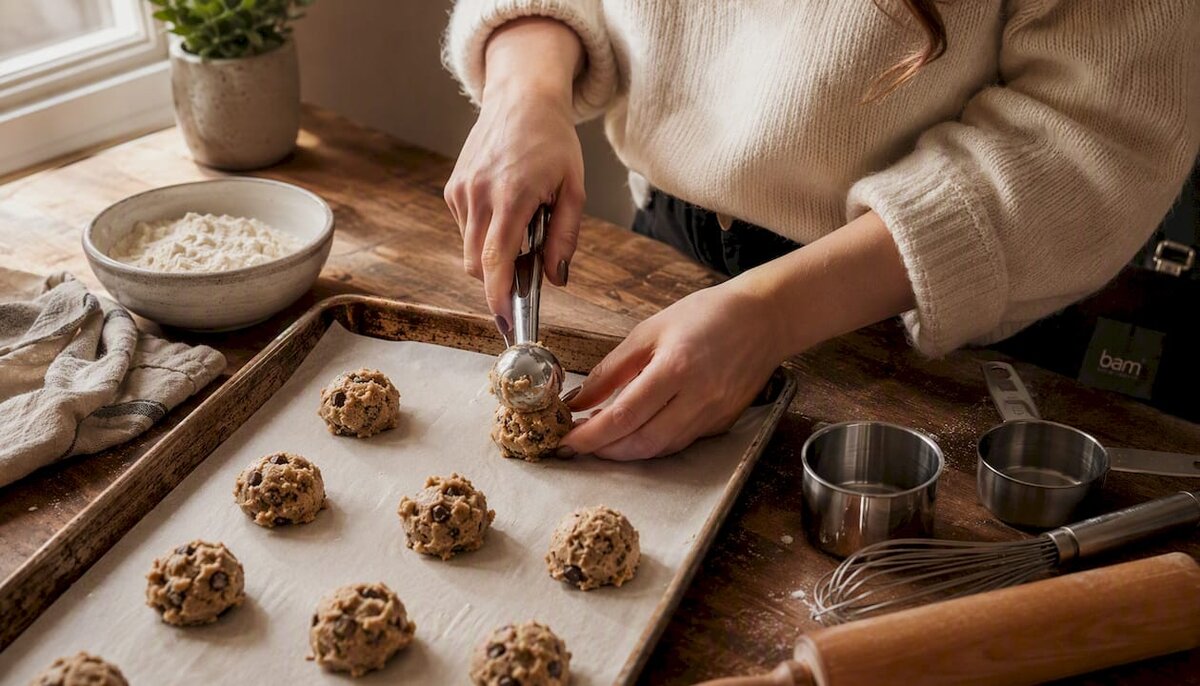
Decoration supplies are easy to overlook until you are standing at the kitchen counter with a tray of cooled biscuits and nothing to pipe with. Stock these before you start.
Decoration essentials:
One safety note: check that glitter is labelled edible (made from starch or mica approved for food use), not merely “non-toxic” or “food safe”. Non-edible glitter should not be consumed, even if it is sold alongside baking supplies.
Gift packaging supplies:
For fragile items such as chocolate shards or piped royal icing decorations, layer parchment between pieces and pack tightly in a rigid tin. Avoid stacking more than two layers. For DIY chocolate gift ideas, a rigid box with a paper liner keeps pieces intact during transit.
Batch baking works best when you plan backwards from Christmas Day. The make-ahead approach groups bakes by how far ahead they can be prepared without losing quality.
Timeline by item:
Freezing rules:
Freeze components rather than finished decorated goods where possible. Plain bakes and unfilled cakes freeze far better than iced or cream-filled items.
Fridge storage limits:
The Food Standards Agency (FSA) recommends keeping cooked foods at or below 5°C in the fridge and using within the timeframes above. When in doubt, label everything with the date it was made.
Pro Tip: Label every container with the item name, date made, and “use by” date before it goes into the freezer. A strip of masking tape and a permanent marker takes ten seconds and saves a lot of guesswork in December.
For broader holiday prep planning, grouping ingredients by storage requirement (ambient, fridge, freezer) before you shop makes the whole process faster.
Dietary needs and mid-bake disasters both call for fast answers. This section covers the most common ones.
| Original | Substitute | Notes |
|---|---|---|
| 1 egg | 1 tbsp ground flaxseed + 3 tbsp water | Set for 5 min; best in cookies and loaves |
| Whole milk | Oat or soy milk | 1:1 swap; avoid rice milk in custards |
| Butter | Dairy-free block (not spread) | Use same weight; avoid soft tub margarine |
| Plain flour | Gluten-free plain blend | Add xanthan gum if not included |
| Caster sugar | Coconut sugar | Slightly darker result; 1:1 by weight |
Allergen safety: when baking for others with allergies, use separate bowls and utensils for allergen-free batches, and prepare those batches first before handling any allergen-containing ingredients.
Troubleshooting common problems:
Pro Tip: If a bake fails repeatedly, check three things first: the age of your baking powder (replace after 12 months), the accuracy of your oven temperature, and whether your butter was at the correct temperature. Most failures trace back to one of these.
Standard supermarket baking chocolate works for brownies and simple cookies, but couverture chocolate gives a noticeably better result in truffles, dipped biscuits, and moulded chocolates. The difference is cocoa butter content: couverture typically contains 31–38% cocoa butter, which gives a thinner, glossier melt and a cleaner snap. For guidance on which chocolate to choose for baking, the type of recipe determines the right choice.
Bamchocolate (BAM - Become A Master) is a UK-available specialist source for couverture, curated confectionery bundles, and baking accessories. Their product range suits home bakers who want professional-quality results without sourcing multiple small items separately.
Recommended BAM products for festive baking:
Practical sourcing tips:
Pro Tip: Buy couverture in 1 kg or 2.5 kg blocks rather than small bags. It stores well in a cool, dry place for several months and costs less per gram than pre-portioned chips.
A one-page printable checklist should cover four columns: ingredient/item, quantity needed, quantity in stock, and to buy. Print it, stick it to the fridge, and tick off as you shop.
What to include on your printable checklist:
| Bake type | Small family (2 doz.) | Party of 12 | Gifting (30 pieces) |
|---|---|---|---|
| Cookies/biscuits | — flour, 125 g butter | — | 1.5 kg flour, — butter |
| Traybakes | 1 × 20 cm tin batch | 2 × 20 cm tin batches | 3 × 20 cm tin batches |
| Christmas cake | 1 × 20 cm cake | 1 × 25 cm cake | 2 × 20 cm cakes |
| Mince pies | 12 pies, 1 sheet | — | 48 pies, 4 sheets |
Online vs in-store buying tips:
Pack size notes:
Example shopping basket for a Christmas cookie day (3 varieties, 6 dozen total):
For broader planning, the holiday meal prep guide covers staged shopping and batching strategies that work well alongside this checklist.
A well-planned festive baking essentials list, stocked by early November and organised by category, lets you bake all season without repeat shopping trips or last-minute shortages.
| Point | Details |
|---|---|
| Stock early, by category | Shop dry cupboard items in early November; top up perishables the week before baking. |
| Weigh, don’t measure by volume | A digital scale set to 1 g accuracy gives consistent results across all batch sizes. |
| Freeze components, not finished goods | Plain sponge layers and unbaked doughs freeze well for up to two months; iced or cream-filled items do not. |
| Label everything with a date | Mark every frozen or stored item with the date made and a use-by date before storing. |
| Use Bamchocolate for speciality chocolate | The BAM Basic pastry package and baking accessories range cover couverture and confectionery supplies for UK home bakers. |
Most festive baking failures happen before the oven is switched on. A missing ingredient, the wrong type of chocolate, or an underpowered mixer at 10 PM on Christmas Eve: these are planning problems, not skill problems. The checklist exists to remove that friction entirely.
One thing worth saying plainly: the quality of your chocolate matters more than most bakers expect. Switching from standard baking chips to a proper couverture changes the texture of truffles, the gloss of dipped biscuits, and the flavour of ganache in ways that are immediately noticeable. It is not about spending more for its own sake. It is about using an ingredient that actually behaves the way the recipe expects it to.
The same logic applies to tools. An oven thermometer costs very little and eliminates one of the most common causes of failed bakes. A digital scale removes the single biggest source of inconsistency in home baking. These are not upgrades. They are the baseline.
The checklist in this article is built around that principle: stock the right things, in the right quantities, at the right time, and the baking itself becomes straightforward.
For home bakers who want professional-quality results without sourcing every item separately, Bamchocolate offers a practical one-stop option. The BAM Basic pastry package covers core confectionery ingredients in a single order, suited to first-time truffle makers and experienced bakers alike. The baking accessories range adds the smallwares and additives that standard supermarkets rarely stock. For gifting, the BAM Apron and Baking Glove set makes a practical present for any home baker on your list. All products ship to UK addresses. Browse the full range at bamchocolate.com and place your order by early December to allow for peak-season delivery.
The downloadable checklist is available in the printable section above. Print it, split it into store-cupboard and fridge/freezer columns, and use it as your single shopping reference for the season.
The core list covers a digital scale, oven thermometer, baking trays, cooling racks, mixing bowls, and measuring spoons, plus dry pantry staples including flour, sugar, cocoa, baking powder, and bicarbonate of soda.
The 3:2:1 rule is a pastry ratio: 3 parts flour, 2 parts fat, and 1 part water by weight. It gives a reliable shortcrust base that scales easily for mince pies and tarts.
BBC Good Food’s festive collection highlights mince pies, yule log slices, and spiced shortbread as consistently popular bake sale items. All three travel well and can be made a day or two ahead.
Christmas fruitcake and stollen can be made three or more weeks ahead. Shortbread and gingerbread biscuits keep well in an airtight tin for one to two weeks. Cream-filled items should be made within 48 hours of serving.
Bamchocolate stocks couverture and curated confectionery bundles with UK delivery. The BAM Basic pastry package is a practical starting point for home bakers new to working with couverture.


 Confectionery tips



 Slovenščina
 Hrvatski
 Deutsch
 Italiano
 Česky
 Polski
 Magyar
 Français
 Slovák
 Nederlands
 Español