 info@bamchocolate.com
 Login


 en

 BAM Cake converter
 Login
Claudia
Avtorica vsebin


 Reading time:
9 minutes
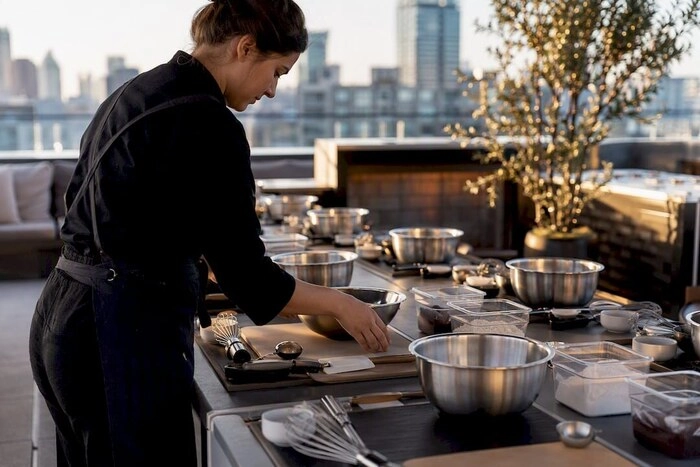
Discover how to host engaging corporate baking sessions that enhance teamwork, ensuring every detail, from format to food safety, is covered.
A well-run corporate baking session works as a team-building format when you get three things right: the format matches your team’s dynamic, the logistics are locked down early, and someone owns food safety from booking to clean-up. Get those three right and the rest follows.
Here’s a run-sheet to work from:
If you’re short on time, brief a supplier this week and confirm headcount by Friday.
A successful corporate baking session depends on matching format to team dynamic, booking six to eight weeks ahead, and collecting dietary data before confirming headcount.
| Point | Details |
|---|---|
| Match format to team | Use collaborative bakes for new teams, competitive bake-offs for established, competitive teams. |
| Book six to eight weeks out | Lock venue and instructor at six weeks, finalise menu at four weeks. |
| Keep instructor ratio tight | Aim for one facilitator per 10 to 15 guests for safety and flow. |
| Collect dietary data early | Send allergy and intolerance forms at RSVP stage, not on the day. |
| Use BAM for kits and gifting | BAM’s corporate packages bundle confectionery sets, aprons, and packaging for events of any size. |
Baking gives every person a visible role within minutes, whether they’re the measurer, the mixer, or the one piping the finish. That’s the mechanism behind most successful team-building baking events: a shared task with a fast feedback loop. You see the result rise, brown, or collapse in under an hour, and the group either owns the outcome together or figures out what went wrong together.
Instructor-to-guest ratio is the biggest lever for how smoothly a session runs. Aim for at least one professional facilitator per 10 to 15 guests to keep supervision tight and stations moving. For HR teams building cross-functional empathy, a collaborative bake works better than a competitive one because the goal is shared success rather than winning.
Match the format to what you actually want the day to produce. A hands-on class builds skill and confidence; a bake-off injects competitive energy; a chocolatier workshop leans into craft and precision. Competitive formats suit naturally competitive teams such as sales groups, while collaborative bakes work better for newly formed or cross-functional teams still building trust.
| Format | Best group size | Energy level | Best for |
|---|---|---|---|
| Hands-on class | 10-30 | Moderate | Skill-building, mixed seniority groups |
| Competitive bake-off | 18-30 | High | Sales teams, established teams wanting rivalry |
| Bake-for-a-cause | 15 | Moderate | Cross-functional teams, CSR-linked events |
| Chocolatier workshop | 10 | Calm, focused | Client entertaining, senior leadership offsites |
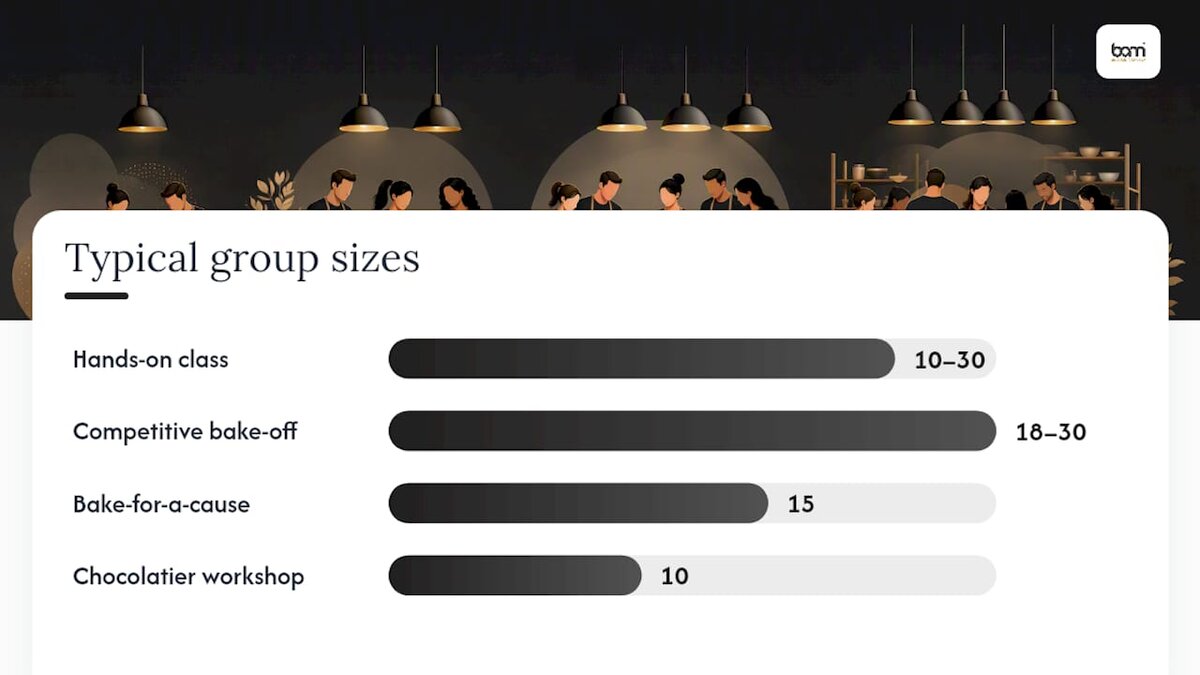
Groups of 10 to 16 stay intimate enough for full participation, and 18 to 30 tends to be the energetic sweet spot for competitive formats. Beyond 60 people, plan on splitting into parallel sessions rather than one oversized room.
Pro Tip: If your team has just merged with another department, skip the bake-off. Competition too early can harden the very divides you’re trying to dissolve.
Corporate baking sessions succeed or fail on logistics, not the recipe. Work backwards from the event date.
Vendors commonly recommend this exact rhythm: chefs and venues locked six weeks out, menus finalised four weeks out, with a day-of checklist to close the gaps.
Budget across five line items: venue hire, instructor or chef fees, ingredients, kit (aprons, gloves, packaging), and a contingency line of roughly 10% for last-minute substitutions. Supplies-wise, plan per-station quantities for ingredients and equipment, PPE for anyone handling raw dough or hot trays, and packaging if participants take bakes home.
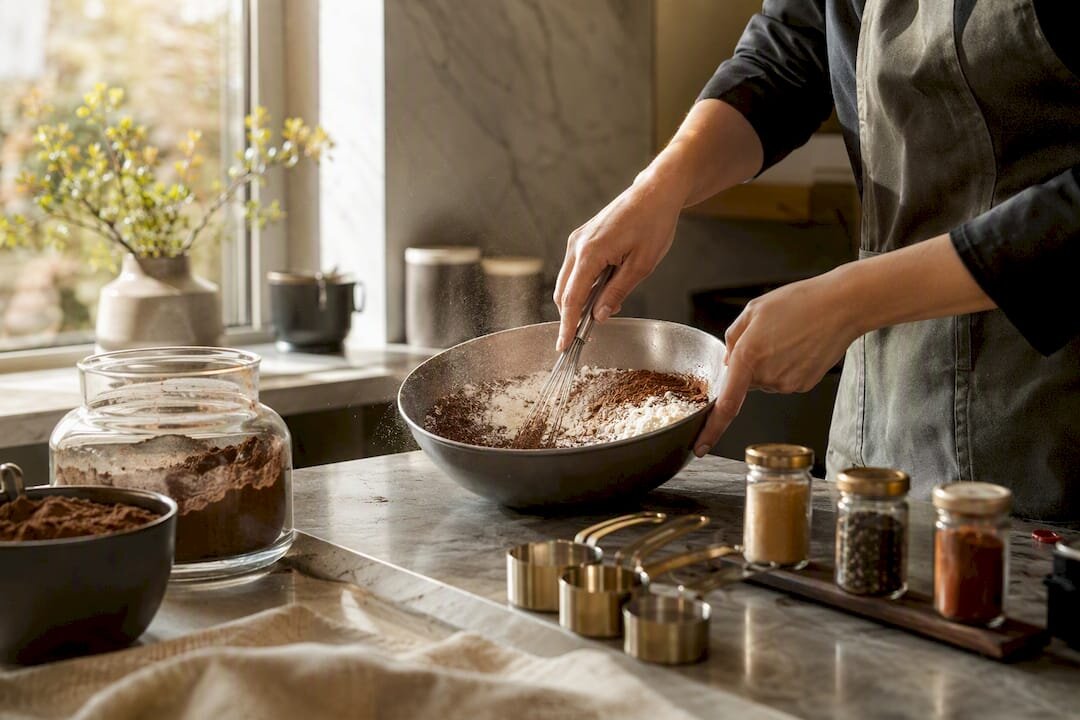
Food safety rests on four principles: clean, separate, cook, and chill. Handwashing, avoiding cross-contamination, hitting safe cooking temperatures, and refrigerating perishables promptly cover most of the risk. Collect allergy and intolerance data at RSVP stage, not on the day, and label every shared ingredient clearly at each station.
One detail planners routinely miss: electrical load. A room with three ovens and four stand mixers can trip an office circuit breaker fast. A pre-event site visit to check capacity avoids a session grinding to a halt over a blown fuse.
Ask every vendor the same set of questions before you sign anything, so quotes are actually comparable.
Recording exact ratios and whether clean-up is included avoids the day-of surprises that sink an otherwise well-planned event. Ask for menu flexibility too: a supplier who can swap in dairy-free or nut-free options without re-quoting the whole event saves you a week of email chains.
If you’d rather buy the kit yourself and run the session with an internal facilitator, BAM - Become A Master stocks corporate packages built around confectionery sets, aprons, and branded packaging designed for exactly this kind of event.
Pro Tip: Ask for a sample menu with substitutions already built in, not one you have to request changes to after signing.
Copy these straight into your run-sheet and scale the phases to fit your slot.
Most hands-on formats run best between two and three hours: under two hours feels rushed, over three risks losing momentum. For the 60-minute slot, drop judging depth and keep tasting informal.
Assign four day-of roles before the session starts:
Send one email two weeks before the session covering timing, dress code (closed-toe shoes, sleeves rolled), accessibility needs, and any allergen-handling notes.
Catering brief templates recommend explicit dietary-question fields collected well before the event, not on arrival. If you’re sending kits for hybrid or remote participants, pack ingredients, a printed recipe card, and simple video-call instructions so they can bake alongside the room.
Track participation rate, a short post-event survey on teamwork and communication, and any anecdotal skill transfer people mention afterwards.
Ask five or six quick questions: Did the session meet your expectations? Did you work well with people outside your usual team? Would you attend a similar event again? What format would you prefer next time? Any dietary or logistics issues to flag?
Planners fixate on the menu and forget the room. Ventilation, plug sockets, and floor space for ten stations matter more than the recipe.
Pro Tip: Pack one spare apron and glove set per station. Someone always spills.
There are other routes to a baking session: hire an independent chef, book a dedicated cookery school, or run it entirely in-house with borrowed kit. Each works, but each also means chasing separate suppliers for instructors, ingredients, and takeaway packaging.
BAM’s corporate packages fold that into one order. Its confectionery sets, aprons, and baking accessories come in bundles sized for a single table or a full office floor, with dietary-friendly options such as sugar-free and protein-rich lines for teams with mixed dietary needs. Planners can order supply-only kits to hand to their own facilitator, or bulk sets sized for branded giveaways afterwards, avoiding the multi-supplier juggling that eats a planner’s week. Bulk gifting guidance points to booking lead times well ahead of your event date, and BAM’s corporate team works to the same rhythm.
If you’re planning a session for ten people or two hundred, start with the basic pastry package as your baseline kit and scale up from there, or get in touch about a corporate enquiry directly through BAM’s site.
For deeper supplier-brief templates, the corporate catering brief guide covers dietary-question fields in detail. The festive meal offerings guide is useful for substitution planning at scale. For gifting logistics, the bulk order gifting guide covers lead times and packaging. Planners sourcing kits directly can browse BAM’s baking accessories or read about choosing chocolate for baking.
Definitions vary across kitchens, but it commonly refers to a ratio guideline (often 3 parts flour, 2 parts fat, 1 part liquid or sugar) used to teach quick dough proportions in workshop settings.
There’s no single fixed list, but food-safety guidance for hands-on workshops centres on four consistent principles: clean, separate, cook, and chill, alongside briefing participants on these steps before they start.
Try themed rounds (seasonal, retro, “invent a flavour”), blind taste judging, or a charity angle where entry fees or proceeds go to a chosen cause. Mixing departments into teams rather than letting existing cliques form is a reliable way to boost cross-team interaction.

Book six to eight weeks ahead: reserve the venue and instructor around six weeks out, then finalise the menu and dietary accommodations at four weeks.
Yes. BAM sells confectionery sets, aprons, and baking accessories in bundles suited to both small teams and large corporate groups, with dietary-friendly options included.


 Chocolate interviews



 Slovenščina
 Hrvatski
 Deutsch
 Italiano
 Česky
 Polski
 Magyar
 Français
 Slovák
 Nederlands
 Español