 info@bamchocolate.com
 Login


 en

 BAM Cake converter
 Login
Claudia
Avtorica vsebin


 Reading time:
14 minutes
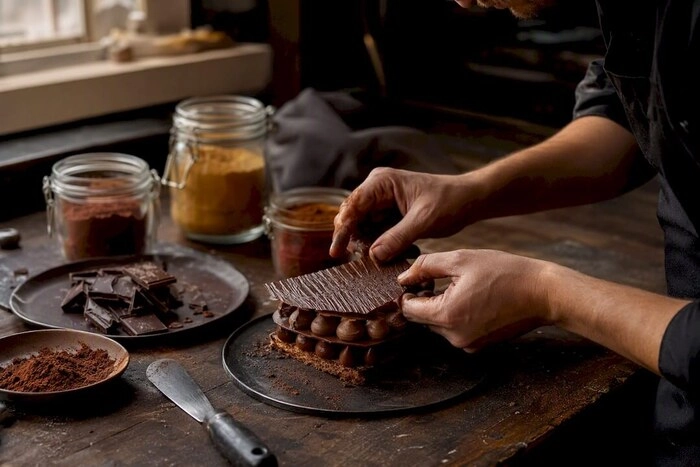
Discover if BAMChocolate's ambassador program is right for food creators. Unlock perks and elevate your culinary content today!
BAMChocolate’s ambassador programme suits creators who already cook on camera. If your feed is full of recipe videos, batch bakes and behind-the-scenes chocolate work, this influencer programm lebensmittel vergleich guide will tell you whether applying is worth your time. The short answer: yes, if you fit the profile below.
Three signals point to a good match:
If that sounds like your channel, the next move is straightforward: build a short media kit and pitch BAMChocolate directly, using the structure later in this guide.
BAMChocolate’s ambassador programme rewards recipe-first creators who commit to repeat placements, treat product seeding as creative material, and negotiate usage rights in clear, separate tiers.
| Point | Details |
|---|---|
| Fit comes first | Apply only if your content is genuinely recipe-driven, not product mentions bolted onto unrelated posts. |
| Long-term beats one-off | Three to six month ambassador terms build recall and compound value that single sponsored posts can’t match. |
| Metrics over followers | Save rate, completion rate, and comment intent predict purchase behaviour better than audience size. |
| Contracts need four clauses | Confirm usage rights, exclusivity scope, payment schedule, and termination terms before signing anything. |
| BAMChocolate rewards consistency | Ambassadors who use monthly product drops as recipe prompts, not obligations, get first access to new lines. |
Ambassadors typically start with product seeding: surprise boxes, product-of-the-month drops, and access to seasonal confectionery lines before they reach general shoppers. Beyond the free product, BAMChocolate offers recipe support and editorial input, meaning ambassadors get help shaping content around ingredients that photograph and film well, rather than being left to guess what a chocolate brand wants.
Some collaborations run on a straightforward product-for-content basis; others include a retainer or per-post fee once a creator has proven consistent output. Deliverables usually cover a mix of formats: a dedicated recipe video, short vertical cuts for Reels or TikTok, still photography for the brand’s own channels, and sometimes extended usage rights if BAMChocolate wants to run the content as paid social.
Pro Tip: Ask upfront whether “usage rights” cover organic reposting only or paid ads too. These are two different values, and treating them as one line item is how creators undersell themselves.
Food brands don’t chase the biggest following. They chase the creator whose audience actually bakes what they see.
Follower count is the weakest predictor of purchase intent in this category. A save button pressed by someone planning to bake tomorrow is worth more than a passive like.
Recipe-first content beats banner-style placement, and the viewing numbers back this up. TikTok data on food creators shows micro creators averaging around 2,118 views per post, and mid-tier creators around 9,154, figures that reward native integration over obvious advertising. Product seeding reinforces the same pattern: sending surprise boxes to creators tends to generate varied, reusable organic assets that a single paid post rarely produces.
The value compounds over time rather than in one burst. This is why ambassador relationships, not single sponsored posts, are the format food brands increasingly favour.
BAMChocolate’s structure, built around monthly exclusives and a recurring surprise-box format, maps onto this pattern directly rather than treating each post as an isolated transaction.
Not every “ambassador” pitch is worth taking. A checklist protects your time and your content library.
| What to verify | Why it matters |
|---|---|
| Deliverable cadence | Confirm exact counts and formats per month, not a vague “a few posts” |
| Payment terms | Know whether pay is per-post, retainer, or product only, and when it lands |
| Usage rights scope | Separate organic reposting from paid ad usage, with clear durations |
| Exclusivity clause | Check whether you’re blocked from other chocolate or bakery brands, and for how long |
| Reporting requirements | Understand what metrics you must supply and how often |
| Termination terms | Confirm notice periods and what happens to content already delivered |
Red flags worth walking away from: pay-to-play arrangements where you fund the product yourself, usage rights left undefined, unpaid rights to run your content as ads, or a termination clause that isn’t written down anywhere.
Pro Tip: Negotiate usage fees in tiers: one rate for organic brand reposts, a higher rate for paid social, and a separate buyout if the brand wants indefinite ad use. Bundling all three into one flat fee almost always favours the brand, not you.
A strong pitch does three things fast: proves you understand the brand, proves you understand your own audience, and proposes a campaign that actually fits both. Buyers evaluate quickly when creators package their value clearly, so a rambling introduction email costs you attention you don’t get back.
Apply through BAMChocolate’s ambassador page directly, or via a short, specific outreach email. Expect a review of your content history and engagement quality before any offer discussion begins.
Pro Tip: Skip the generic “I love your brand” opener. Lead with the one campaign idea. Brands remember the pitch that came with a plan.
Payment shapes vary by creator tier and deliverable type. Nano and micro creators most often receive product plus a modest per-post fee; established food creators with consistent output can negotiate a monthly retainer; usage fees for paid ads sit separately from either.
Ambassador programmes differ from one-off sponsorships precisely because they include ongoing deliverables and a signed agreement, rather than a single invoice for a single post. Prioritise four clauses before signing anything: usage rights scope, exclusivity boundaries, payment schedule, and what happens to your content if the relationship ends. Ask for a tiered fee schedule upfront rather than negotiating it after the fact, when you have far less leverage.
Almost always, yes, and the reasoning isn’t just financial. A single sponsored post asks an audience to trust a brand they’ve seen once. By the fifth appearance, that same brand reads as part of your established content, not an interruption to it. Recognition builds recall, and recall is what actually drives someone to buy chocolate instead of scrolling past it.
Industry guidance on food and beverage partnerships suggests structuring ambassador terms around a three to six month minimum. That window gives a brand time to see whether repeat exposure changes behaviour, and gives the creator enough posts to smooth out the inevitable one or two that underperform. A single sponsored video lives or dies on its own; a six-month arrangement can absorb a quiet week without anyone panicking.
There’s a pay argument here too. Per-post economics on a one-off deal are almost always higher upfront because the brand is paying for a single moment of attention with no future guarantee. Retainer-based ambassador work pays less per individual post but adds up over a longer run, plus product perks that a one-off deal rarely includes. For creators who genuinely enjoy the brand’s products, that trade tends to work out better over a full season than chasing a string of unrelated one-off sponsorships.
The catch is that long-term arrangements require more from you: consistency, reporting, and a willingness to keep a product visible even in months when your own content plans go elsewhere. That’s a fair trade only if the product fits your channel in the first place, which is why the fit questions earlier in this guide matter more than the pay questions.
Ambassador results in the confectionery space tend to follow a pattern rather than a single headline number. Creators who commit to recipe-first content over several months typically see their own engagement climb alongside the brand’s, because a well-made baking video earns saves and shares on its own merit, with the product simply along for the ride.

Recipe-driven partnerships in the wider baking and confectionery category have been linked to measurable commercial upside for brands, including documented cases of meaningful website revenue increases tied to creator collaborations when the content genuinely integrates the product rather than bolting it on. That pattern holds inside BAMChocolate’s own ambassador relationships: creators who feature a product-of-the-month inside an actual bake, rather than an unboxing, consistently produce content that gets reused across the brand’s own channels, extending the value of a single collaboration well past its original posting date.
What separates a successful BAMChocolate ambassador from a one-off collaborator isn’t follower count. It’s a willingness to keep showing up with fresh recipe ideas built around whatever surprise box or seasonal line lands that month. Creators who treat the monthly product drop as a creative prompt, rather than an obligation, tend to stay in the programme longest and get first access to newer product lines as a result.
Your first few pieces of content set the tone for everything after them, so treat the opening stretch as a chance to prove format and reliability before asking for more.
Start with the deliverable you’re most confident in. If your strongest content is a full recipe walkthrough, lead with that rather than trying to master short-form cuts you’ve never made before. Consistency in your existing strength earns more trust than an average attempt at an unfamiliar format.
Keep a simple record of your own numbers: save rate, completion rate, and any comments asking where to buy the product. This becomes the evidence you bring to your next negotiation, and it takes a few minutes per post to log properly.
Ask questions before you film, not after. If the brief is vague on which product variant to feature or how long the video should run, a quick message saves a reshoot. Brands remember ambassadors who clarify early over ones who guess and get it wrong.
Don’t disappear between posting windows. A short check-in, a behind-the-scenes story, or a quick note about an upcoming recipe idea keeps the relationship active rather than transactional. Ambassador programmes reward creators who feel like collaborators, not vendors delivering on a schedule and nothing else.
Finally, resist the urge to feature every product from every brand you work with in the same video. Confectionery content that reads as a single clear collaboration performs better than a cluttered post trying to satisfy three sponsors at once.
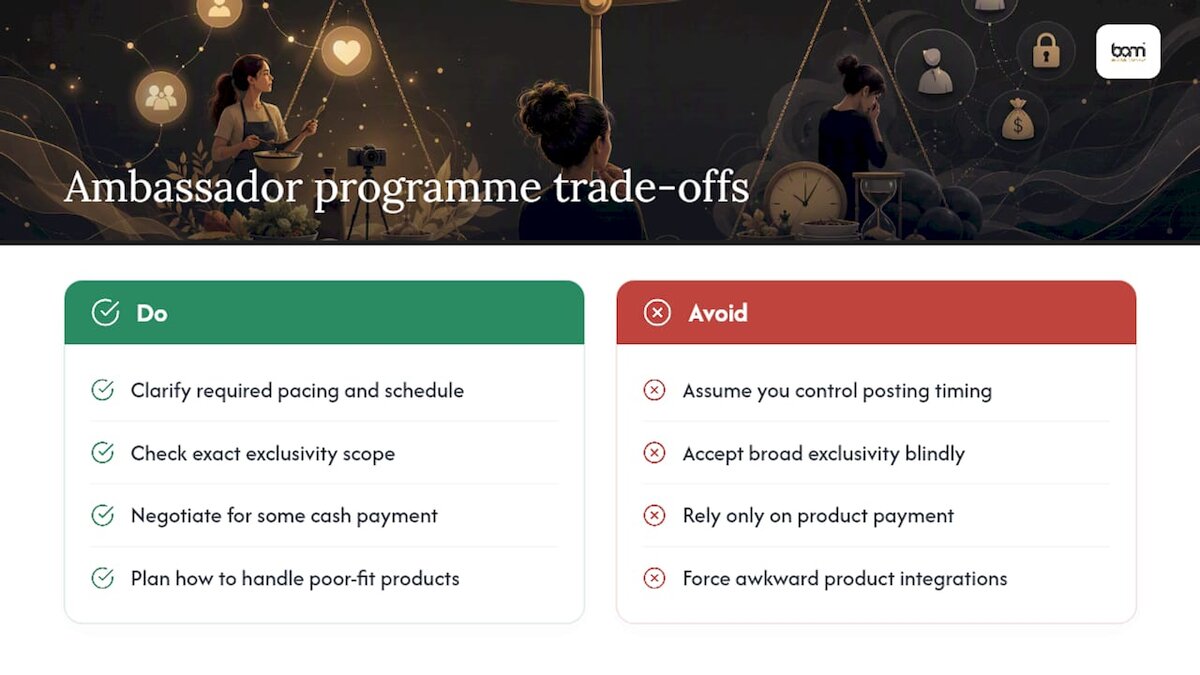
No ambassador arrangement is entirely upside, and it’s worth being honest about the trade-offs before you sign anything.
The most common friction point is pacing mismatch. Brands work on monthly or seasonal calendars; creators often work in bursts tied to whatever inspires them that week. An ambassador agreement asks you to produce content on a schedule you don’t fully control, which can feel restrictive if your usual process is spontaneous.
Exclusivity clauses can also box you in more than expected. Agreeing not to feature competing chocolate or bakery brands for a set period is standard, but it’s worth checking exactly how broad that restriction is before accepting it, particularly if you already work with adjacent brands.
Product fit fatigue is a quieter risk. A product-of-the-month structure is exciting for the first few cycles, but if a particular month’s release doesn’t suit your usual recipes, forcing it into content anyway shows, and audiences notice when integration feels strained rather than natural.
Payment structures weighted toward product rather than cash can also be a genuine constraint for creators who need income, not ingredients. It’s reasonable to ask whether a programme can flex toward more cash compensation once you’ve proven consistent output, rather than assuming the terms are fixed forever.
None of this makes ambassador work a bad choice for the right creator. It simply means going in with clear expectations about pacing, scope, and how compensation might evolve, rather than assuming every month will feel effortless.
We look for creators who treat a recipe as the whole point, not the vehicle for a sponsorship. Repeat collaborations tell us more about fit than a single polished post ever could, because consistency reveals whether someone actually enjoys working with our products.
Authenticity matters more than production value. A slightly rough video of someone genuinely excited about a new spread outperforms a slick edit that feels like an advert. If your content already leans this way, reach out. We’d rather hear from you directly than have you wonder if you fit.
If the fit sounds right, the next step is simple: put together a short media kit and reach out with a specific campaign idea rather than a general introduction. BAM - Become A Master’s ambassador programme is built around exactly the kind of recipe-first, repeat collaboration this guide has described, with monthly product drops and surprise boxes designed to give ambassadors fresh material rather than a single static brief.
Start by browsing the starter pastry package and the baking accessories range to see what a typical product-of-the-month collaboration might include, and use them to shape your pitch’s campaign idea. For creators already producing full-length recipe content, the large confectionery bundle offers enough variety for a short recipe series rather than a single video.
Email your pitch with a subject line that states your niche plainly, something like “Sugar-free dessert creator, ambassador enquiry”, attach two or three of your best recipe videos, and include your save and completion rates. That combination, not follower count, is what gets a reply.
It means comparing food and baking ambassador offers on concrete terms: deliverables, pay structure, usage rights and exclusivity, rather than just following count. BAMChocolate’s programme is built around recipe-first content and repeat collaborations, which is the format food brands increasingly favour.
Both, depending on tier. Early-stage collaborations often run on product plus a modest per-post fee, while creators with proven, consistent output can negotiate a monthly retainer alongside product perks.
Industry guidance points to a three to six month minimum, long enough for repeat exposure to build audience recall without locking either side into an unworkable arrangement.
Save rate, completion rate, and examples of comments showing purchase intent matter more than follower count, since these signals predict who actually buys the product.
Yes. Ambassador programmes in the food category regularly accept smaller creators who show consistent, recipe-first content, since evidence of engagement matters more than raw audience size.


 Chocolate interviews




 Slovenščina
 Hrvatski
 Deutsch
 Italiano
 Česky
 Polski
 Magyar
 Français
 Slovák
 Nederlands
 Español