 info@bamchocolate.com
 Login


 en

 BAM Cake converter
 Login
Claudia
Avtorica vsebin


 Reading time:
15 minutes
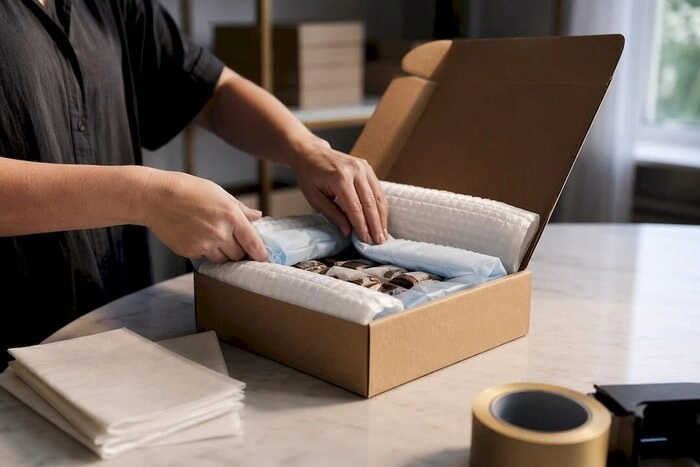
Practical, low waste packouts and carrier rules for small sellers. Get a copyable checklist to keep chocolate stable for 24–48 hours during summer transit.
Yes, summer chocolate shipping works, provided you control three variables at once: insulation, coolant, and time in transit. The core rule is simple. Keep the parcel in a stable cool microclimate, ideally around 15 to 18°C, rather than trying to freeze it solid. When forecasted temperatures on the route make that impossible within your transit window, the correct move is to hold the order, not gamble on it.
TL;DR:
- Proper insulation and a single large conditioned gel pack can typically keep chocolate below 18°C for 24 to 48 hours in summer conditions.
- Using reflective Mylar sheeting and fully filling the box reduces temperature fluctuations and prevents condensation and bloom.
- Shipping should be scheduled early in the week and involve next-day or guaranteed overnight services in warm weather to avoid delays in hot depots.
- Avoid sending highly filled chocolates or during extreme heat; solid bars and hard pralines are more heat-tolerant options for summer orders.
- Customers should be advised to open packages promptly, store chocolates in a cool, dark place, and reheat sealed filled products slowly to prevent damage.
The insulation layer decides whether your coolant even has a chance. Foam and Styrofoam liners remain the standard choice for small sellers because they slow heat transfer cheaply and pack flat between orders. Foam mailers work for single bars or small pralines but lose effectiveness on bigger, denser boxes. Reflective Mylar sheeting adds a useful second skin against radiant heat, particularly for parcels sitting on a hot delivery van floor for a few hours.
Coolant choice depends on scale and budget:
Chocolate softens noticeably above roughly 25°C, so the goal is moderation, not extremes. Never let a coolant pack touch the product directly. Direct contact with an overly cold pack can trigger condensation and bloom once the parcel warms back up at the doorstep, which looks like a quality failure even though the chocolate never actually melted.
A repeatable packout beats a clever one. Follow this sequence every time:
Pro Tip: One large, properly conditioned gel pack outperforms several small ones of the same total weight, because higher mass retains cold longer and more evenly throughout the box.
Avoid dispatching late in the week. A parcel that misses Friday collection can sit in a warm depot over the weekend with nobody watching the clock.
Carrier choice should track the weather forecast, not habit. Match your service level to the destination’s expected high temperature rather than defaulting to whatever you always use:
Guaranteed delivery windows matter more in July and August than in any other month, because a missed delivery attempt often means a full extra day baking in a van or a locker.
Some days, no packout will save the parcel. Set a simple rule: if the route’s forecast high, combined with your realistic transit time, would push the box beyond a safe range for longer than your insulation can manage, hold the order. Practitioners generally recommend holding shipments rather than shipping into conditions no reasonable coolant setup can offset.
Practical ways to build this into your shop:
Not every chocolate format carries the same risk. Solid bars have more thermal mass and tolerate short heat exposure better than filled pieces, which is why bars are usually the safest product to ship in a heatwave. Filled chocolates and pralines with ganache or cream centres are more fragile thermally. Their softer centres shift and separate faster once warm, and dividers with off-centre coolant placement help keep the temperature gradient even across the box.
Cooled or express shipping typically adds a noticeable surcharge over standard ground rates, and building that into your product pricing in June through August avoids an awkward conversation at checkout.
Before scaling any summer shipping process, run one test shipment through your actual carrier lane with a cheap temperature data logger inside the box. Check the maximum and minimum readings and how long the parcel spent above 20°C.
Copy this packout as your starting checklist:
BAM - Become A Master builds its own packing guidance around exactly this logic, tested against real summer conditions rather than assumptions carried over from winter shipping.
Delivery is not the finish line. What happens in the first hour after the parcel lands matters almost as much as the shipping itself.
Advise customers to open the box immediately rather than leaving it on a doorstep or in a hot car boot. If the chocolate feels warm or slightly soft, it should rest at room temperature in a shaded, cool spot rather than going straight into the fridge, since a rapid temperature drop can trigger the same condensation and bloom risk that overcooling causes in transit. Once it reaches room temperature, storing it in a dry, dark cupboard around 15 to 18°C, away from direct sunlight and strong-smelling foods, keeps both flavour and texture intact. Chocolate absorbs odours easily, so a cupboard shared with onions or spices is a bad idea.
If a customer does need to refrigerate chocolate during a genuine heatwave, it should be sealed in an airtight container first, and brought back to room temperature slowly before unwrapping. Opening a cold pack straight from the fridge invites condensation on the surface, which reads as a quality fault even when nothing has actually gone wrong. A short note included with every summer order, explaining these three steps, cuts down on confused messages and mistaken “it arrived melted” complaints that are really about how it was handled after arrival, not during transit. Guidance on proper storage conditions can be shared as a simple link on the packing slip or order confirmation email.
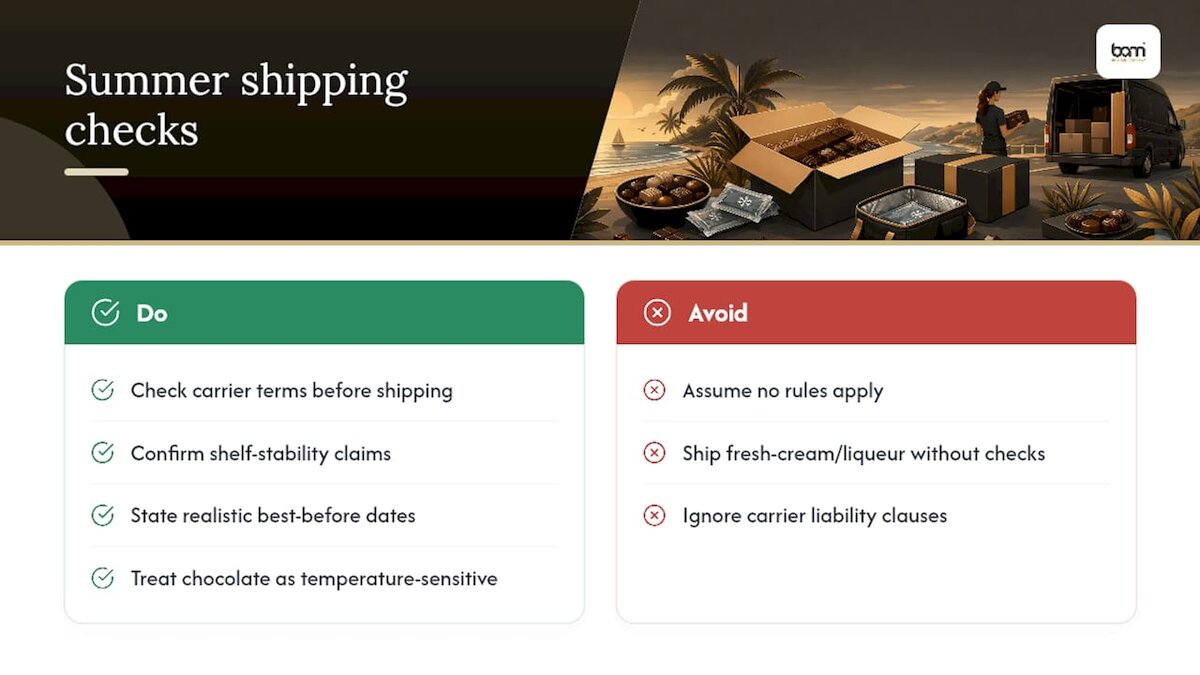
Chocolate itself is not classed as a hazardous or restricted perishable in most parcel networks, so no special licence is generally required to ship it within Austria or across the EU. Carriers do, however, set their own terms around temperature-sensitive goods, and some explicitly disclaim liability for melting or quality loss once ambient conditions exceed a stated threshold, so checking your carrier’s own terms of carriage before a heatwave saves an argument later.
Where restrictions genuinely bite is on ingredients, not the finished chocolate bar. Products containing fresh dairy fillings, cream ganaches, or alcohol above certain thresholds can fall under separate food-safety or customs rules, particularly for cross-border shipments outside the EU’s single market. If your product range includes fresh-cream pralines or liqueur-filled chocolates, it is worth confirming shelf-stability claims match what your packaging and labelling state, since food-safety authorities in Austria and across the EU expect accurate best-before dating tied to realistic storage conditions, not idealised ones.
None of this amounts to a blanket summer shipping ban. It simply means treating chocolate as what it is: a temperature-sensitive food product, not a inert parcel, and keeping your terms of sale honest about that risk during the hottest months. Most sellers never encounter a legal issue at all. The practical risk sits entirely in quality and customer satisfaction, not compliance.
Demand for chocolate does not vanish in summer. It shifts. Gift occasions like birthdays, anniversaries, and corporate thank-yous continue year round, but buyers become noticeably more cautious about ordering during known heatwaves, and search behaviour around terms like melt-resistant or cooled delivery options tends to spike alongside temperature warnings.
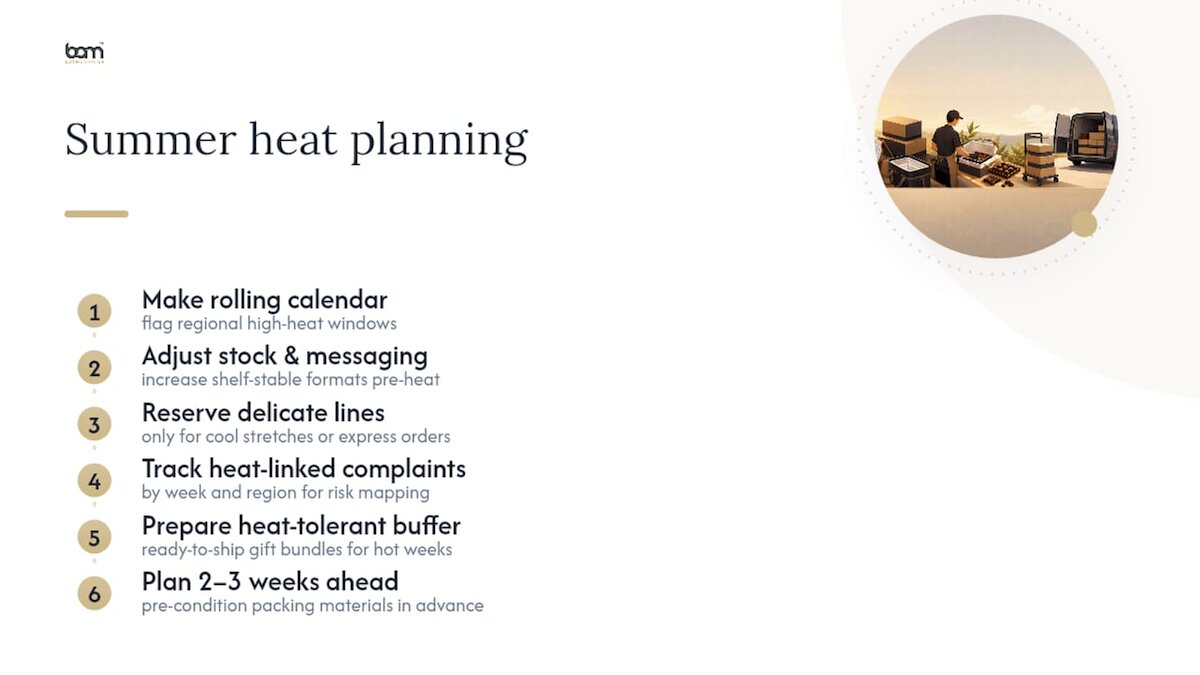
A practical approach is to build a rolling calendar that flags known high-heat windows in your region and adjusts stock and messaging around them, rather than reacting order by order. Stocking slightly more shelf-stable formats, like solid bars and hard pralines, ahead of a forecast heatwave gives you inventory you can ship confidently without upgrading every order to express cooling. Reserve your most delicate, cream-filled lines for cooler stretches or for customers explicitly opting into express shipping.
Small sellers benefit from tracking which weeks generate refund or complaint requests tied to heat, since that data builds a far more accurate seasonal risk map than generic weather averages. If July consistently produces complaints from a particular region, that is a stronger signal than a national forecast. Building a small buffer of ready-to-ship, heat-tolerant gift bundles for exactly these weeks means you are never scrambling to reformulate an order on a 34°C afternoon. Planning two to three weeks ahead of known heat events, rather than day-to-day, also gives you time to pre-condition packing materials properly instead of rushing a same-day pack.
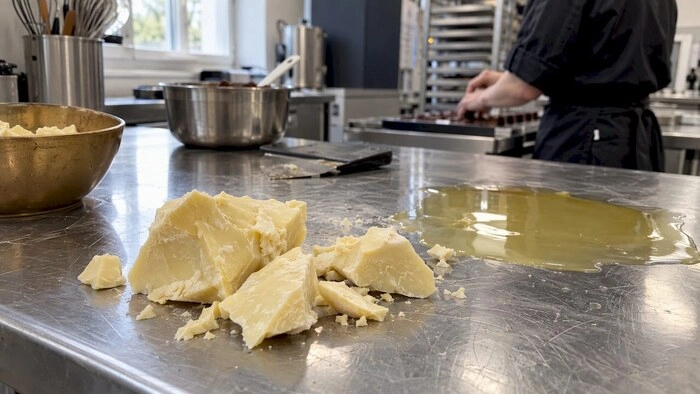
Three distinct problems get lumped together under “melted chocolate,” and only one of them is actually melting.
Fat bloom shows up as a dull grey or white streaky film on the surface, caused by cocoa butter separating and recrystallising after temperature swings. It is a cosmetic issue, not a safety one; the chocolate is still perfectly edible, but it looks unappealing and undermines trust in a gift order. Sugar bloom looks similar but feels slightly grainy or gritty, caused by moisture dissolving surface sugar that then recrystallises once dry. This is the direct result of condensation, which happens when chocolate moves from a cold environment into a warmer, humid one too quickly, exactly the scenario overcooling with frozen packs creates.
Deformation, meaning actual softening, bending, or fused pieces, signals genuine heat exposure past the chocolate’s structural limit, not just a cosmetic issue.
Mitigation for all three starts at the packing stage: moderate, stable cooling rather than freezing, a buffer between coolant and product, and fast handoff to a carrier. If bloom does appear on delivered stock, gentle retempering can sometimes restore the surface finish on bars, though filled pieces are harder to rescue. Reading up on proper tempering technique helps explain why some batches bloom more readily than others in the first place.
Sustainable packaging choices and summer performance are not automatically at odds, but some greener materials do trade off against thermal performance, and it is worth knowing which ones before switching.
Recyclable paper-based void fill performs fine as a buffer material but offers essentially no insulation value on its own, so it should never replace a proper foam or insulated liner in hot months. Biodegradable foam alternatives, made from mushroom mycelium or cornstarch composites, have improved but still generally lag behind traditional expanded polystyrene on pure insulating performance, meaning a slightly thicker layer may be needed to match protection levels.
Where sustainability genuinely wins without any performance trade-off is on the coolant side. Reusable gel packs and PCM systems, run through many shipping cycles, produce far less landfill waste than single-use ice packs bought fresh for every order, and this is one area where the greener option is also the operationally smarter one for regular sellers. A simple pack-return incentive, offering a small discount for customers who post back a liner or gel pack, can meaningfully cut single-use packaging volume for sellers shipping locally at scale. Choosing recyclable corrugated boxes over laminated alternatives also keeps the outer packaging out of general waste, provided the box has not been heavily contaminated by condensation.
Most small sellers overcomplicate this. You do not need a laboratory cold chain. A foam liner, one large conditioned gel pack, and a one to two day transit window covers the vast majority of summer orders safely. Save PCM packs and dry ice for genuinely premium or long-haul shipments, since they cost more to run properly than most order values justify. The cheapest lever by far is a short, honest message telling the customer what to expect and what to do on arrival. It costs nothing and prevents most of the complaints that packing alone never could.
*— Andraz
Preparing a summer-ready parcel starts with choosing formats that travel well in the first place. Bamchocolate stocks curated bundles built around exactly this problem: the BAM Basic pastry package and the BAM Large Confectionery Bundle are packed in shipping-friendly formats designed to hold up better on the road than loose, delicate pieces. For sellers assembling their own packouts, the baking accessories range covers the practical extras that keep a box tidy and properly sealed. For general packaging and prep ideas outside the chocolate category itself, the meal prep guidance from Wild Foodz is a useful companion read. Corporate and bulk buyers planning warm-weather gifting can get tailored advice by reaching out directly through Bamchocolate’s contact page before placing a large order. Browse the shipping-friendly bundles now and check what fits your next order before the next heatwave lands.
Yes, chocolate can be shipped safely in summer with insulated packaging, a properly conditioned coolant, and a transit time matched to the destination’s forecast temperature.
It can, provided the box is insulated, the product is separated from the coolant, and delivery happens within a controlled window, generally 24 to 48 hours for a standard foam liner and gel pack setup.
Use an insulated liner or foam box, add a large conditioned gel pack rather than several small ones, fill remaining space to reduce air volume, and dispatch early in the week to avoid weekend transit delays.
A regular uninsulated parcel is risky once temperatures climb past roughly 25°C, since chocolate softens quickly without protection; adding even basic foam insulation and a gel pack significantly improves the odds of arrival intact.


 Confectionery tips


 Slovenščina
 Hrvatski
 Deutsch
 Italiano
 Česky
 Polski
 Magyar
 Français
 Slovák
 Nederlands
 Español