 info@bamchocolate.com
  Login
Login 

 en
en 
 BAM Cake converter
  Login
Login Claudia
Avtorica vsebin


 Reading time:
10 minutes
Reading time:
10 minutes 
Discover what baking cocoa is and how it impacts your baking. Learn the differences to elevate your desserts with rich chocolate flavor.
TL;DR:
- Baking cocoa is unsweetened cocoa powder derived from dried cocoa solids, used in baking for its concentrated chocolate flavor. There are two main types: natural, which is acidic and reacts with baking soda, and Dutch-processed, which is alkalized and reacts with baking powder—using them interchangeably without adjustments can ruin baked goods. Keeping both types in your pantry and understanding their interactions with leavening agents ensures consistent, flavorful results in various recipes.
Baking cocoa is one of those ingredients that sits in almost every baker’s cupboard, yet it causes more confusion than almost anything else in a recipe. Many home bakers treat baking cocoa and cocoa powder as the same thing, or worse, reach for a sweetened hot chocolate mix when the recipe calls for neither. Understanding what is baking cocoa, how it differs from related products, and which type to use in a given recipe is the difference between a dense, flat brownie and one with a proper rise and deep chocolate flavour.
| Point | Details |
|---|---|
| Baking cocoa is unsweetened | It contains no added sugar and is distinct from hot cocoa mixes or drinking chocolate. |
| Two main types exist | Natural cocoa is acidic; Dutch-processed is alkalized. Each pairs with a different leavening agent. |
| Swapping types causes problems | Using Dutch-processed cocoa in a recipe written for natural cocoa can produce flat, dense results. |
| Substitutions follow set ratios | Replace unsweetened baking chocolate with cocoa powder using a 3:1 cocoa-to-fat ratio. |
| Natural cocoa has more antioxidants | Natural cocoa retains significantly higher flavanol levels than Dutch-processed varieties. |
Baking cocoa is unsweetened cocoa powder, made from the dry cocoa solids left behind after cocoa butter is pressed out of ground cacao beans. That is it. No sugar, no milk solids, no added flavourings. What you get is pure, concentrated chocolate flavour in powder form.
This is where the first misconception trips people up. Baking cocoa is not the same as hot cocoa mix or drinking chocolate. Those products contain sugar and often dried milk powder. Using them in a cake recipe will throw off the sweetness, texture, and structure of your bake entirely. If a recipe calls for baking cocoa, it means unsweetened cocoa powder, full stop.
The fat content in baking cocoa varies depending on how it has been processed. It typically contains between 10 and 26% fat, and this matters more than most bakers realise. Higher-fat cocoa produces a richer, more tender crumb. Lower-fat versions absorb more liquid and can make baked goods slightly drier if you do not adjust your recipe accordingly. Cocoa powder also contributes to baking structure because of its starch and protein content, functioning partly like flour in balancing batter consistency and moisture ratios.
Pro Tip: Check the ingredient list on any cocoa product before baking. If it lists sugar or milk solids, it is not baking cocoa and will not behave like one in a recipe.
Not all baking cocoa is the same. There are two main types you will encounter, and choosing the wrong one for your recipe can genuinely ruin the result.
Natural cocoa powder is the less processed of the two. It is simply dried, ground cocoa solids with nothing added. It has a pH between 5.0 and 6.0, making it acidic. That acidity gives it a sharp, slightly fruity, and intense chocolate flavour. It also means it reacts with baking soda in recipes, producing carbon dioxide and giving your bake a proper lift.
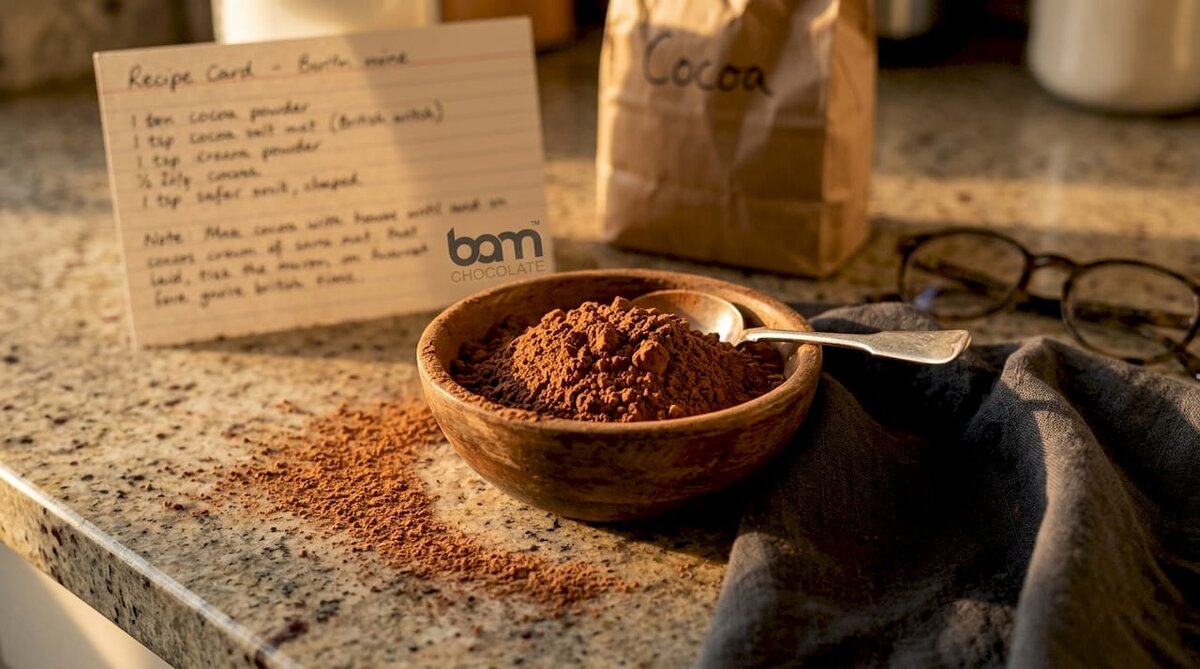
Dutch-processed cocoa is natural cocoa that has been treated with an alkalising agent to neutralise its acidity. The result is a pH of 6.5 to 8.0, a much smoother and mellower flavour, and a noticeably darker colour. Because it is no longer acidic, it does not react with baking soda. Recipes using Dutch-processed cocoa rely on baking powder for leavening instead.
There is also a third variety worth knowing: black cocoa powder. This is a heavily alkalized version of Dutch-processed cocoa, producing an almost jet-black colour and a very mild, smooth flavour. It is what gives Oreo biscuits their distinctive dark appearance. You can explore BAM Black cocoa powder if you want to experiment with this variety at home.
Here is a side-by-side comparison of the three types:
| Type | pH level | Flavour | Colour | Pairs with |
|---|---|---|---|---|
| Natural cocoa | 5.0–6.0 | Intense, slightly fruity | Light to medium brown | Baking soda |
| Dutch-processed | 6.5–8.0 | Smooth, mellow | Deep brown | Baking powder |
| Black cocoa | 8.0+ | Very mild, smooth | Near black | Baking powder |
A few things to keep in mind when shopping:
Pro Tip: If a recipe does not specify which type to use, look at the leavening agent. Baking soda signals natural cocoa; baking powder signals Dutch-processed.
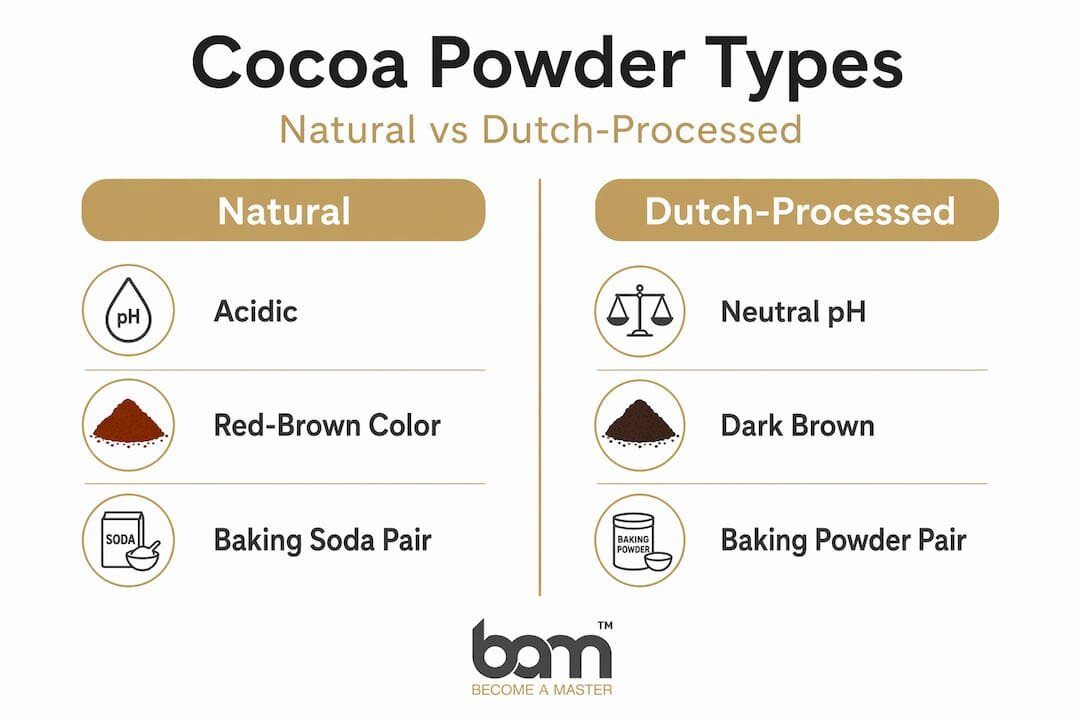
Understanding the chemistry behind baking cocoa is what separates consistent bakers from those who get unpredictable results. The acidity of natural cocoa is not just a flavour characteristic. It is a functional ingredient that activates baking soda.
When natural cocoa meets baking soda in a batter, an acid-base reaction occurs. This produces carbon dioxide bubbles, which make your cake or muffins rise. Remove that acidity by swapping in Dutch-processed cocoa without adjusting anything else, and the baking soda has nothing to react with. The result is a flat, dense bake, and often a metallic aftertaste from unreacted baking soda sitting in the finished product.
The reverse is also true. Use natural cocoa in a recipe designed for Dutch-processed, and the extra acidity can interfere with baking powder, producing an over-risen bake that collapses or tastes slightly sour.
Cocoa powder also affects fat-to-liquid ratios and texture in baking because of its starch and protein content. Swapping a high-fat Dutch-processed cocoa for a low-fat natural cocoa in a recipe without adjusting the fat content can leave your cake noticeably drier. These are not theoretical concerns. They show up in the finished bake.
Practical tips for using baking cocoa correctly:
Pro Tip: Dutch-processed cocoa is ideal for no-bake recipes, frostings, and hot chocolate because its improved solubility in liquids gives a smoother, less grainy result.
Sometimes you are mid-recipe and realise you are out of cocoa powder. Knowing how to substitute correctly can save the bake.
The most reliable substitution works in both directions between unsweetened cocoa powder and unsweetened baking chocolate. Here is how to approach it:
One thing to avoid entirely: do not substitute sweetened hot cocoa mix or drinking chocolate for baking cocoa. The sugar content will throw off the recipe balance, and no amount of adjustment will fully compensate.
Pro Tip: If you are unsure how a substitution will affect your recipe, bake a small test batch before committing to a full quantity. Half the recipe, same ratios, and you will know exactly what to expect.
Beyond the chemistry, there are good reasons to pay attention to which type of baking cocoa you buy.
I have watched home bakers struggle with cocoa-related failures more times than I can count, and the cause is almost always the same. They treat cocoa powder as a single, interchangeable ingredient when it is not.
In my experience, the single most common mistake is using Dutch-processed cocoa in an old American recipe that relies on baking soda for lift. The bake comes out dense and slightly metallic, and the baker assumes the recipe is faulty. It is not. The cocoa type is wrong for the leavening.
What I have learned is that building a small but deliberate baking cocoa pantry makes everything easier. Keep one natural and one Dutch-processed cocoa on hand. Know which European and American recipes lean toward which type. And do not be afraid to experiment. Swapping cocoa types in a recipe you know well is one of the best ways to understand how much difference it actually makes to colour, flavour, and texture. The results will surprise you.
— Andraz
If you are ready to stock your pantry properly, Bamchocolate carries a focused selection of quality baking cocoa and related products suited to home bakers at every level. The BAM Cocoa powder 500 g is a solid everyday option, and the black cocoa powder is worth having for anyone who wants to experiment with deeper colour and flavour in their bakes.
For those who want to go further, the baking accessories range includes additives and tools that complement cocoa-based recipes directly. If you are starting out or building your ingredient collection, the BAM Basic pastry package brings together the essentials in one place. There are also recipe resources available, including the 101 BAM pastry recipe book, which gives you practical starting points for putting different cocoa types to work in real recipes.
Baking cocoa is unsweetened cocoa powder made from dried cocoa solids after cocoa butter has been extracted. It contains no added sugar and is distinct from hot cocoa mixes or drinking chocolate.
Yes, the terms are used interchangeably. Both refer to unsweetened cocoa solids in powder form. The distinction that matters more is whether the cocoa is natural or Dutch-processed.
No. Baking cocoa contains no added sugar and has a naturally bitter, intense chocolate flavour. Any sweetness in a finished recipe comes from sugar added separately.
You can substitute one for the other in a 1:1 ratio by weight, but you must adjust the leavening agent. Using Dutch-processed cocoa in a recipe designed for natural cocoa without changing the leavening often results in a flat, dense bake with a metallic taste.
Baking cocoa is available in most supermarkets, specialist food shops, and online retailers. For premium natural and Dutch-processed options, Bamchocolate stocks a range of quality cocoa powders suited to home baking.



 Tales of chocolate



 Slovenščina
 Hrvatski
 Deutsch
 Italiano
 Česky
Česky
 Polski
 Magyar
 Français
 Slovák
 Nederlands
 Español