 info@bamchocolate.com
  Login
Login 

 en
en 
 BAM Cake converter
  Login
Login Claudia
Avtorica vsebin


 Reading time:
10 minutes
Reading time:
10 minutes 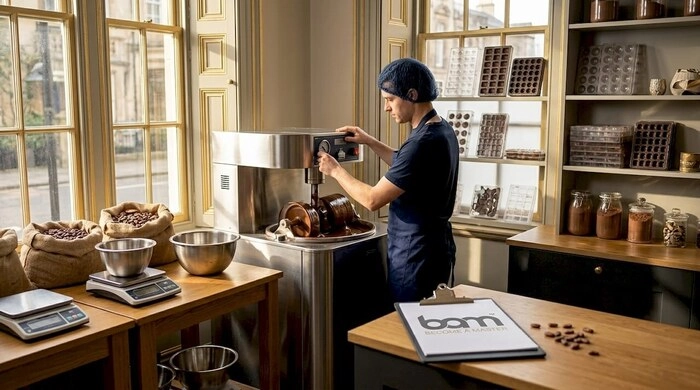
Discover what is chocolate conching and how it transforms chocolate. Unveil the secrets to crafting smooth, exceptional confections today!
TL;DR:
- Chocolate conching involves mechanically agitating chocolate to evenly distribute cocoa butter, remove moisture, and develop flavor through heat and aeration. The process occurs in three phases—dry, pasty, and liquid—each producing specific physical and chemical changes that influence texture and aroma; controlling time, temperature, and airflow is essential. Proper management of moisture and conching parameters is crucial for consistent quality, flavor development, and achieving the desired finished product.
Chocolate conching is defined as the mechanical agitation of chocolate mass to evenly distribute cocoa butter, remove moisture and volatile acids, and develop flavour through frictional heat and controlled aeration. Invented by Rodolphe Lindt in 1879, the process transforms gritty, harsh-tasting chocolate paste into the smooth, complex product you recognise today. The conche machine, named for its original shell-like shape, remains the central piece of equipment in chocolate production at every scale. Understanding what chocolate conching does, and how to control it, is the difference between average confections and genuinely exceptional ones.
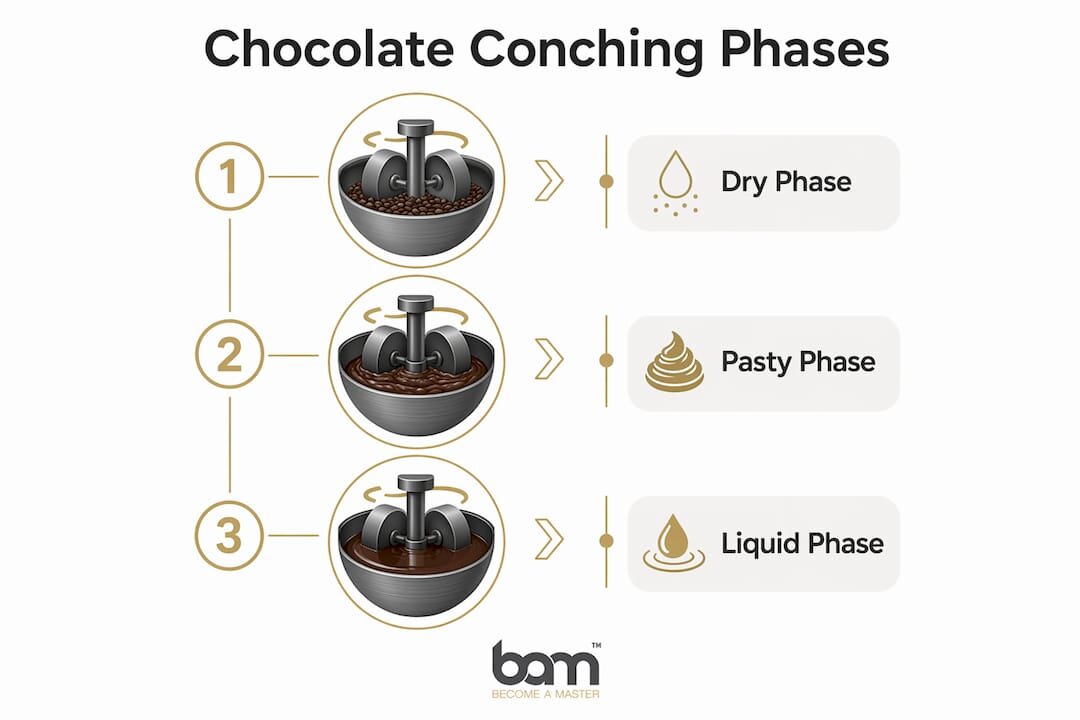
Conching operates across three distinct phases: dry, pasty (plastic), and liquid. Each phase produces specific physical and chemical changes, and skipping or shortening any one of them leaves a measurable mark on the finished chocolate.
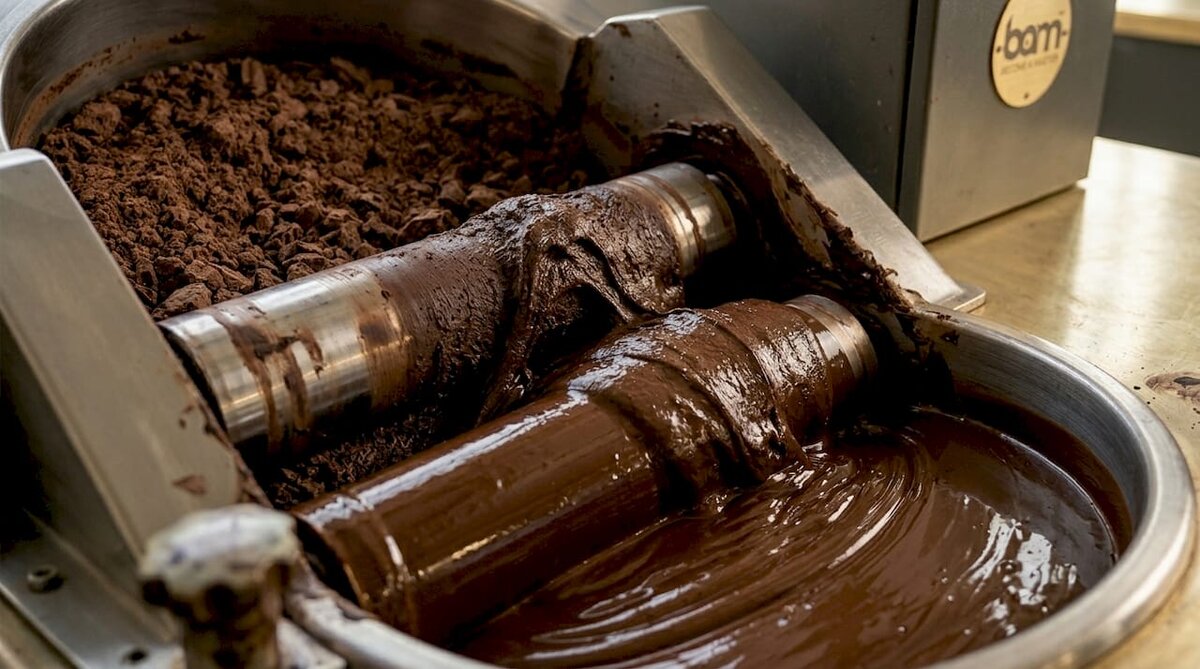
The dry phase begins with the chocolate mass in a crumbly, low-fat state. Temperatures for dark chocolate reach 60 to 80°C during this stage, which lasts between 4 and 12 hours. The heat and mechanical shearing drive off moisture and volatile acids, including acetic acid carried over from fermentation. This is where the most significant acid removal occurs, and it is why under-conched chocolate often tastes sharp or fermented.
The pasty phase follows as cocoa butter is gradually added. The mass becomes plastic and workable. Shearing continues to round off sharp particle edges, which directly improves flow properties and mouthfeel. Particle shaping at this stage reduces graininess and creates the preconditions for the silky texture associated with premium chocolate.
The liquid phase completes the process. The chocolate reaches full fluidity as the remaining cocoa butter coats every non-fat solid particle uniformly. Lecithin or other emulsifiers are typically added here to stabilise viscosity. The result is a chocolate mass with consistent flow, predictable snap, and a clean aroma profile.
Pro Tip: Control airflow during the dry phase deliberately. Increasing air circulation accelerates volatile acid removal but can also strip desirable fruity aroma compounds. Reduce airflow once the pasty phase begins to preserve the aromatic notes you want in the finished bar.
Conching time varies from under 12 hours in modern industrial settings to several days in traditional methods. The difference is not simply speed. Equipment design, batch size, and shear intensity all determine how much work the conche can do per hour.
Traditional longitudinal conches, still used by some artisan producers, require extended run times because their shearing action is less intense. Modern single-shaft and rotary conches apply far greater mechanical force per unit of time. Bühler’s next-generation single-shaft conche, for example, saves up to 2% fat and reduces energy consumption by 30% compared to previous designs, while delivering improved taste and mouthfeel consistency. That is a meaningful efficiency gain at industrial scale.
Extended conching does not always produce better chocolate. Beyond a certain point, additional time removes aroma compounds you may want to retain, and the returns on texture improvement diminish. The practical implication: longer is not automatically better. Matching conching time to your recipe, equipment, and flavour target is what produces consistent results.
| Equipment type | Typical conching time | Key advantage | Typical outcome |
|---|---|---|---|
| Traditional longitudinal conche | 48 to 72 hours | Gentle, gradual processing | Deep flavour development, artisan character |
| Modern rotary conche | 12 to 24 hours | Higher throughput | Good texture, reliable consistency |
| Single-shaft conche (e.g. Bühler) | 8 to 12 hours | Intense shear, fat efficiency | Smooth mouthfeel, lower fat usage |
| Small-batch melanger | 24 to 48 hours | Accessible for craft makers | Variable results, dependent on operator skill |
Conching is often misunderstood as a texture step. It is equally a flavour development step, and the two cannot be separated. The aroma profile of dark chocolate is actively reshaped during conching, not simply mellowed. A 2026 study detected 63 aroma-active compounds in chocolate before refining and conching, with only 35 remaining afterwards. This means conching removes nearly half of the detectable aroma compounds. The profile that remains is not a diluted version of the original. It is a different profile.
Conching intensity directly determines which volatile compounds survive and which are lost. Two chocolates made from identical recipes but conched at different temperatures or airflow levels can taste noticeably different. One may carry more fruit and acidity; the other may read as roastier and cleaner. This is why conching parameters are often proprietary at commercial producers. Small adjustments define brand character.
Key flavour and aroma changes during conching:
The practical takeaway for chocolate makers: roasting and fermentation set the raw material, but conching determines the final flavour signature. If your chocolate tastes too acidic or too flat, the conching parameters are the first variable to adjust.
Moisture is the most disruptive variable in the conching process. Even small increases in moisture content raise chocolate viscosity sharply, making the mass difficult to process and the finished product prone to texture defects. Industrial targets sit below 0.5% moisture, reduced from a starting point of roughly 1.5 to 2%. Hitting that target requires deliberate temperature and airflow management throughout all three phases.
Temperature affects both the rate of moisture evaporation and the stability of aroma compounds. Higher temperatures in the dry phase accelerate acid and moisture removal but risk destroying heat-sensitive aroma precursors. Lower temperatures preserve more volatile complexity but extend processing time. There is no universal setting. The correct temperature depends on your cocoa origin, roast level, and target flavour profile.
A critical and often overlooked point: cleaning conching equipment with water introduces moisture that contaminates subsequent batches. Industry practice is to clean conches using cocoa butter, which dissolves residue without adding water. This single protocol prevents a significant source of batch-to-batch inconsistency.
Steps for managing moisture and temperature effectively:
Pro Tip: If your finished chocolate feels gummy or has an unusually high viscosity, check moisture before adjusting your recipe. A single contamination event during cleaning can raise moisture enough to affect the entire batch.
Consistent conching quality requires more than sensory evaluation. At industrial scale, ATR-FTIR spectroscopy combined with chemometrics now provides rapid, high-accuracy monitoring of chemical and physical changes throughout the conching process. This method achieved an R² prediction value above 0.95 and an RMSEP below 0.9 for key quality parameters, meaning it can detect improper processing before a batch is finished.
The practical value of spectroscopic monitoring is early intervention. If temperature, airflow, or shear intensity deviates from target parameters, the system flags the change in real time. Producers can correct course mid-batch rather than discovering defects after cooling and moulding. For craft makers without access to spectroscopic equipment, the equivalent discipline is rigorous logging of every conching run: time, temperature at each phase transition, airflow setting, and sensory notes at the end of each phase.
Steps for quality control during conching:
Chocolate conching is the process that determines both texture and flavour in finished chocolate, operating through three sequential phases that remove moisture and acids, redistribute cocoa butter, and reshape the aroma profile.
| Point | Details |
|---|---|
| Three-phase structure | Dry, pasty, and liquid phases each serve distinct functions; skipping any phase degrades quality. |
| Moisture target | Industrial conching reduces moisture from 1.5 to 2% down to below 0.5% for correct texture. |
| Flavour reshaping | Conching removes nearly half of detectable aroma compounds, actively redefining the flavour profile. |
| Equipment matters | Modern single-shaft conches cut processing time and fat usage compared to traditional methods. |
| Moisture contamination | Clean conching equipment with cocoa butter, not water, to prevent viscosity defects. |
I have worked with chocolate at enough scales to say this plainly: most texture and flavour problems that makers attribute to their cocoa origin or roast profile are actually conching problems. The dry phase is where the real work happens, and it is the phase most often cut short when time is tight.
What commercial producers rarely discuss publicly is how much their conching parameters define their house character. The evolution of chocolate manufacturing in Europe over the past century is largely a story of conching refinement, not ingredient sourcing. The cocoa matters, but the conche is where the character is set.
For small-scale and artisan makers, my honest recommendation is to treat your first 20 batches as calibration runs. Log everything. Taste at the end of each phase, not just the finished bar. You will start to recognise what under-conched chocolate tastes like at the pasty stage, and that recognition is worth more than any equipment upgrade. Once you can read the process by taste and texture, you can start making deliberate adjustments to develop something genuinely your own. Experimentation within controlled parameters is how distinct chocolate identities are built.
— Andraz
Understanding the conching process is the foundation. Having the right equipment and ingredients to practise it is the next step. Bamchocolate stocks a curated range of baking accessories suited to home chocolate makers and culinary enthusiasts, from confectionery tools to ingredient sets designed for precision work. The BAM Basic pastry package is a practical starting point for anyone building out their chocolate-making setup, covering the core tools needed for tempering, moulding, and finishing work that follows conching. Browse the full range at Bamchocolate to find products matched to your level and ambitions.
Chocolate conching is the mechanical agitation of chocolate mass in a conche machine to distribute cocoa butter evenly, remove moisture and volatile acids, and develop flavour through heat and aeration. The process was invented by Rodolphe Lindt in 1879.
Conching time ranges from 8 to 12 hours in modern industrial conches to 48 to 72 hours in traditional longitudinal conches. Batch size, equipment type, and target flavour profile all influence the required duration.
Conching removes volatile acids such as acetic and butyric acid, reducing sourness and harsh off-notes, while also driving off many fruity and floral aroma compounds. A 2026 study found that refining and conching reduced detectable aroma-active compounds from 63 to 35.
Even small increases in moisture raise chocolate viscosity significantly, causing texture defects in the finished product. Industrial conching targets moisture below 0.5%, and equipment should always be cleaned with cocoa butter rather than water to prevent contamination.
Yes. Knowing the three phases of conching and the role of temperature, airflow, and time allows home makers to diagnose texture and flavour problems accurately and adjust their process rather than their recipe. A melanger used at home replicates the core mechanics of industrial conching at small scale.



 Confectionery tips



 Slovenščina
 Hrvatski
 Deutsch
 Italiano
 Česky
Česky
 Polski
 Magyar
 Français
 Slovák
 Nederlands
 Español