 info@bamchocolate.com
  Login
Login 

 en
en 
 BAM Cake converter
  Login
Login Claudia
Avtorica vsebin


 Reading time:
9 minutes
Reading time:
9 minutes 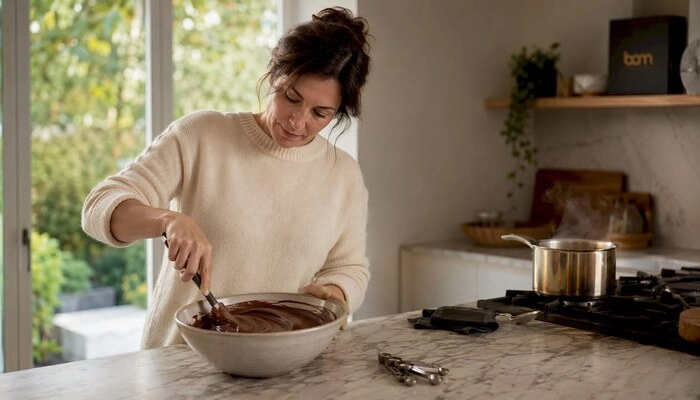
Discover the ultimate chocolate truffle crafting guide! Master stable ganache and create delicious truffles at home with ease.
The secret to great homemade chocolate truffles is a stable ganache: chocolate and double cream emulsified together, chilled until firm, then shaped and coated. Get the ratio right and the rest follows naturally. A batch of truffles costs a moderate amount in ingredients and requires a short amount of active work, with a few hours of chilling time.
Core ingredients:
Coating options:
Equipment needed:
Steps at a glance:
Pro Tip: Finely chop the chocolate before you start. Coarse pieces do not melt fully in the cream, leaving lumps in the ganache.
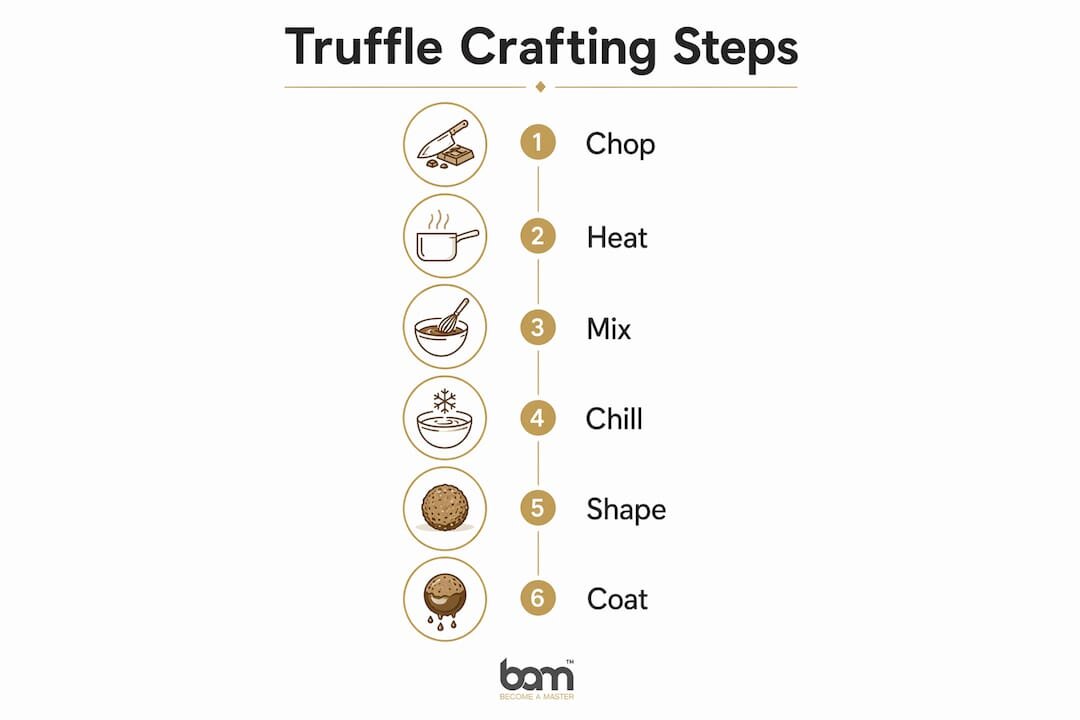
The ganache is the whole recipe. Every other step depends on getting it right.
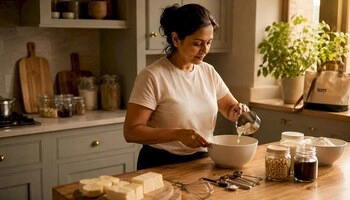
Place finely chopped chocolate in a heatproof bowl. Heat the double cream in a small saucepan until just simmering, with small bubbles forming at the edges. Do not let it boil. Pour the hot cream over the chocolate and leave it for 90 seconds without stirring. The residual heat melts the chocolate from below. Then stir gently from the centre outward in small circles, gradually expanding, until the mixture is completely smooth and glossy.
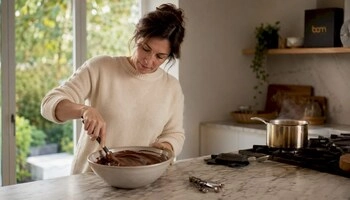
Add the softened butter and stir until fully incorporated. Add the salt. The finished ganache should look like thick, glossy chocolate pudding. If any chocolate pieces remain unmelted, set the bowl briefly over a pan of gently simmering water and stir again.
Pour the ganache into a shallow container and smooth the top. Press cling film directly onto the surface to prevent condensation forming. Refrigerate for 2 hours until firm enough to hold a spoon impression but still yielding. If you chill it for longer than 4 hours, remove it from the fridge 10 minutes before rolling so it does not crack.
Use a melon baller or two teaspoons to scoop portions of roughly 15–18g each. Roll each piece briefly between your palms to form a rough ball, then place on a parchment-lined tray. Refrigerate for 15 minutes to re-firm. For a rounder, more regular shape, roll each truffle a second time after that 15-minute rest, when the outer surface has set slightly.
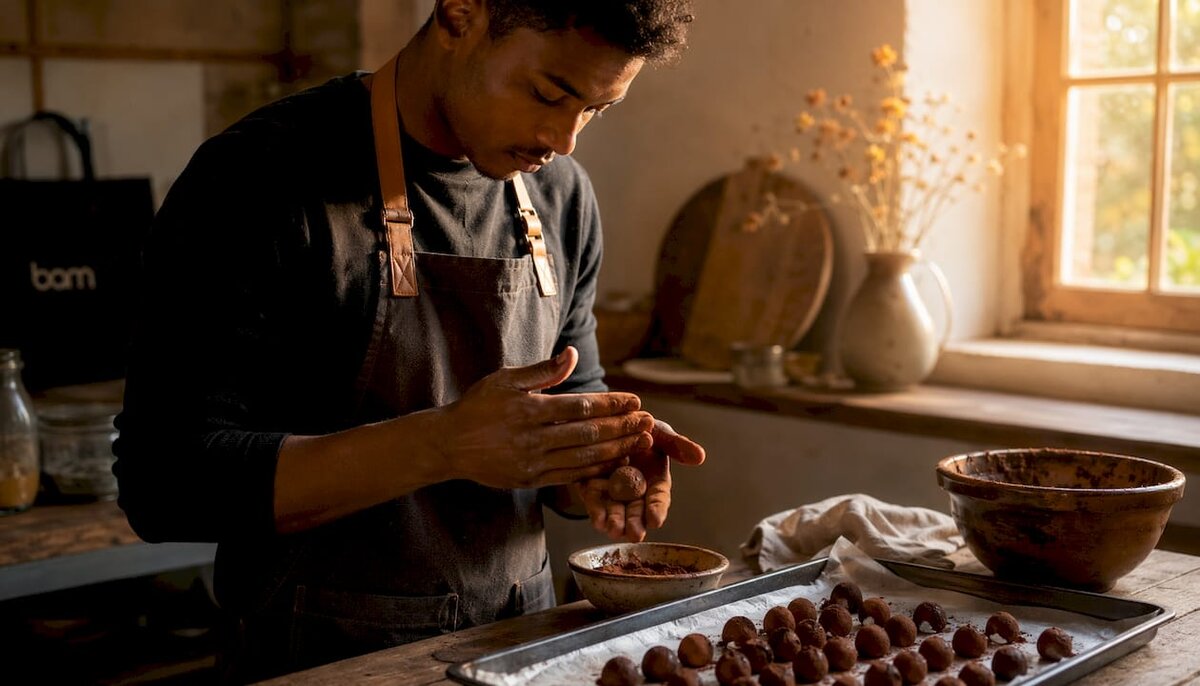
Pro Tip: Keep your hands cold throughout rolling. Run them under cold water, dry completely, then work quickly. An ice pack nearby helps between batches. You can also use food-safe gloves to avoid transferring hand heat to the ganache.
For a cocoa coating, sift cocoa powder into a shallow bowl and roll each truffle to coat completely. Tap off the excess. For a chocolate shell, the chocolate must be tempered first. Melt 200g of finely chopped dark chocolate to 50°C, then stir in 50g of room-temperature chopped chocolate until the mixture cools to 32°C. This seeding method produces a glossy, snapping shell without specialist equipment. Dip each chilled truffle using a fork, tap off the excess, and place on parchment to set.
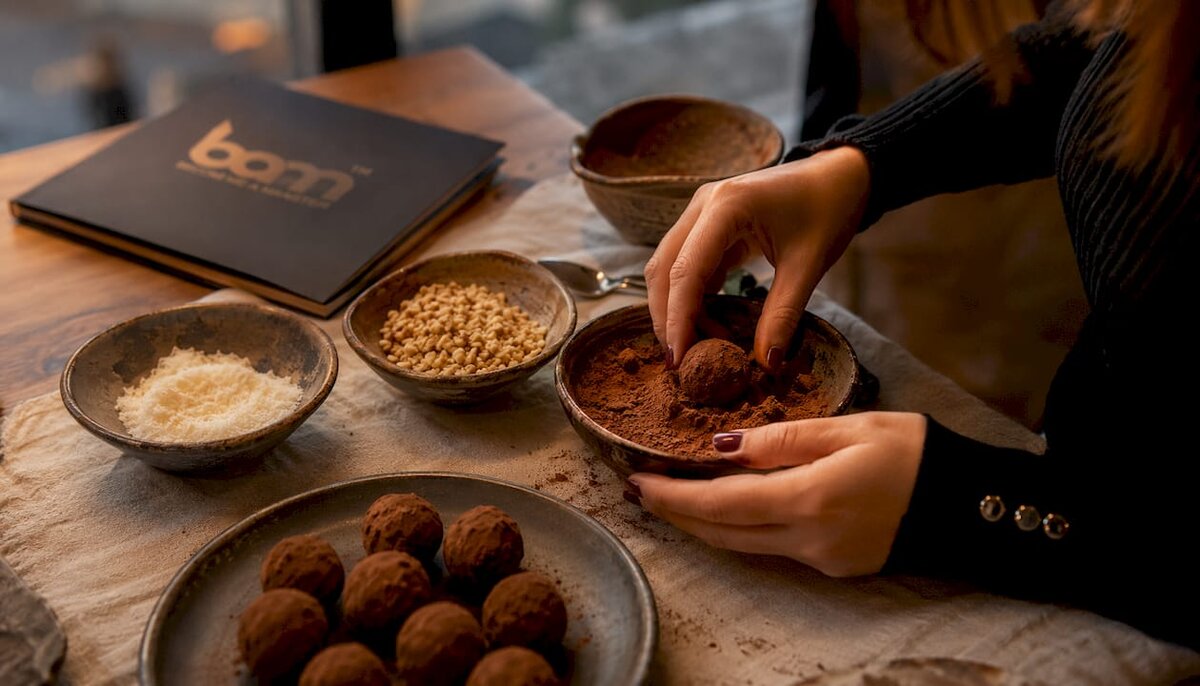
For a visual walkthrough of all four coating styles, the truffle tutorial from Bamchocolate covers each method clearly.
Chocolate quality is the single biggest variable. Choose a chocolate you enjoy eating on its own, with cocoa solids in the mid to high range, sold as a block or bar in the baking aisle. Chocolate chips contain stabilisers that prevent smooth melting and affect the final texture, so avoid them entirely.
Double cream is non-negotiable for proper ganache consistency. Anything with less than 30% fat will not allow the ganache to firm up enough to roll. The ideal ganache ratio is approximately one part cream to two parts chocolate by weight (for example, 100ml double cream to 200g dark chocolate). This produces a ganache firm enough to hold its shape after rolling yet soft enough to melt immediately on the tongue.
Butter, added in a moderate amount relative to the chocolate, contributes smoothness and a richer mouthfeel. It also helps the ganache stay scoopable after refrigeration rather than turning rock-hard. Softened butter incorporates cleanly; cold butter risks breaking the emulsion.
Flavouring ideas:
Pro Tip: When infusing cream with solids like spices or herbs, steep for at least an hour before straining and reheating. Rushing this step produces a faint, flat flavour rather than a clean, distinct one.
Cocoa-coated truffles keep for up to 2 weeks refrigerated. Chocolate shell-coated truffles last up to 3 weeks. Store both covered, and bring to room temperature for 15 minutes before serving so the ganache melts properly on the tongue.
Most truffle problems trace back to one of three causes: the wrong ratio, incorrect temperature, or rushing a step.
Ganache too soft to rollThe cream-to-chocolate ratio is off. Too much cream leaves the ganache loose. Return it to the fridge for longer, or gently re-melt and stir in additional finely chopped chocolate to correct the balance.
Ganache too hard or crumblyToo much chocolate relative to cream, or over-chilling. Leave the ganache at room temperature for 10–15 minutes before attempting to roll. Do not microwave it directly.
Greasy or split ganacheOverheated cream is the usual cause. If the ganache looks oily or grainy, gradually whisk in a small amount of warm cream, a tablespoon at a time, to re-emulsify. An immersion blender helps stabilise the emulsion quickly. Avoid adding cold cream, which can shock the mixture further.
Chocolate not meltingThe cream was not hot enough, or the chocolate pieces were too large. Place the bowl over a pan of gently simmering water and stir until smooth. Finely chopped chocolate melts far more reliably than roughly broken pieces.
Sticky mixture during rollingChill the portioned mounds on a lined tray for 20–30 minutes before rolling. Wearing food-safe gloves or dusting hands lightly with cocoa powder also reduces sticking. Do not try to rush rolling at room temperature.
Condensation on the surfacePressing cling film directly onto the ganache before chilling prevents moisture from forming on the surface. If coating truffles in advance, store them uncoated and apply the cocoa or chocolate shell just before serving.
Hygiene notes: wash hands thoroughly before handling ganache, use clean utensils throughout, and keep all equipment dry. Water contamination causes chocolate to seize.
The difference between a good truffle and a great one usually comes down to chocolate selection. Bamchocolate recommends choosing high-quality block chocolate with a clearly stated cocoa solid percentage, clean ingredient list, and a flavour you find genuinely appealing on its own. The ganache amplifies the chocolate’s character rather than masking it.
Ganache ratio nuance matters more than most home cooks expect. The standard 1:2 cream-to-chocolate ratio works for 70% dark chocolate. For chocolate at 60% cocoa solids, reduce the cream slightly, as lower-percentage chocolate contains more sugar and less cocoa butter, making the ganache softer at the same ratio. For anything above 70%, add an extra tablespoon or two of cream to compensate for the higher proportion of dry cocoa solids.
Tempering chocolate for a shell coating transforms the result. A properly tempered chocolate shell is glossy, snaps cleanly, and extends shelf life. The seeding method, melting to 50°C then cooling to 32°C by stirring in room-temperature chocolate, is reliable at home without a marble slab or specialist thermometer. Work quickly once the chocolate is in temper, as it sets fast.
For flavour infusions, Bamchocolate’s guide on ganache flavouring techniques covers advanced methods including layered spice infusions and fruit-forward combinations. Understanding how chocolate melts at a structural level also helps you avoid the most common ganache failures before they happen.
Pro Tip: Make a double batch. The active preparation time is identical whether you make 30 or 60 truffles. They store well refrigerated for up to 2 weeks, and they make excellent gifts. Doubling is almost always the right decision.
Bamchocolate stocks everything you need for truffle making, from baking accessories including pastry tools and gloves, to the BAM Confectionery Set Creamy Fillings for those who want a curated starting point. The BAM Basic Pastry Package is a practical option if you are setting up a home confectionery kit from scratch.
A stable ganache at a 1:2 cream-to-chocolate ratio, made with 60–70% cocoa solid block chocolate and double cream, is the foundation of every successful homemade chocolate truffle.
| Point | Details |
|---|---|
| Ganache ratio | Use 100ml double cream to 200g dark chocolate (a 1:2 cream-to-chocolate ratio by weight) for a rollable, melt-in-the-mouth texture. |
| Chocolate choice | Use 60–70% cocoa solid block chocolate; chocolate chips contain stabilisers that prevent smooth melting. |
| Chilling time | Chill ganache for 2 hours minimum; press cling film directly onto the surface to prevent condensation. |
| Keeping hands cold | Use gloves or chill hands in cold water before rolling to stop hand heat melting the ganache. |
| Tempering for shells | Melt chocolate to 50°C, cool to 32°C using the seeding method for a glossy, snapping shell. |
Use block or bar chocolate with 60–70% cocoa solids, sold in the baking aisle. Block chocolate melts smoothly, whereas chocolate chips contain stabilisers that prevent proper emulsification.
The cream-to-chocolate ratio is likely off, or the cream fat content is too low. Use full-fat double cream and stick to 100ml cream to 200g chocolate (a 1:2 cream-to-chocolate ratio by weight); chill for at least 2 hours in a shallow container.
Gradually whisk warm cream into the broken ganache, one tablespoon at a time, until it re-emulsifies. Overheated cream is the most common cause of splitting.
Cocoa-coated truffles keep for up to 2 weeks refrigerated; chocolate shell-coated truffles last up to 3 weeks. Bring them to room temperature for 15 minutes before serving.
Only if you want a glossy, snapping shell. The seeding method, cooling melted chocolate from 50°C to 32°C by stirring in room-temperature chocolate, works reliably at home without specialist equipment.


 Confectionery tips


 Slovenščina
 Hrvatski
 Deutsch
 Italiano
 Česky
Česky
 Polski
 Magyar
 Français
 Slovák
 Nederlands
 Español