 info@bamchocolate.com
  Login
Login 

 en
en 
 BAM Cake converter
  Login
Login Claudia
Avtorica vsebin


 Reading time:
10 minutes
Reading time:
10 minutes 
Master your e-commerce baking workflow! Discover practical steps to streamline your online bakery operations and boost sales today.
TL;DR:
- An e-commerce baking workflow connects order collection, production, baking, and fulfillment to reduce waste and chaos.
- Adopting a batch-order model, linked BOM management, and digital platforms enables precise, scalable bakery operations.
- Implementing backward scheduling and consistent cutoff policies ensures timely production and customer satisfaction.
An e-commerce baking workflow is a structured, end-to-end process connecting order collection, production planning, baking, and fulfilment to run an online bakery without waste or chaos. Most bakers who struggle with online sales are not failing at baking. They are failing at process. 70% of bakery success comes from operations, not baking skill alone, which means the systems you build around your oven matter as much as what goes inside it. This guide covers the four pillars of an effective digital baking workflow: the batch-order model, recipe and bill of materials (BOM) management, integrated order platforms, and production scheduling.
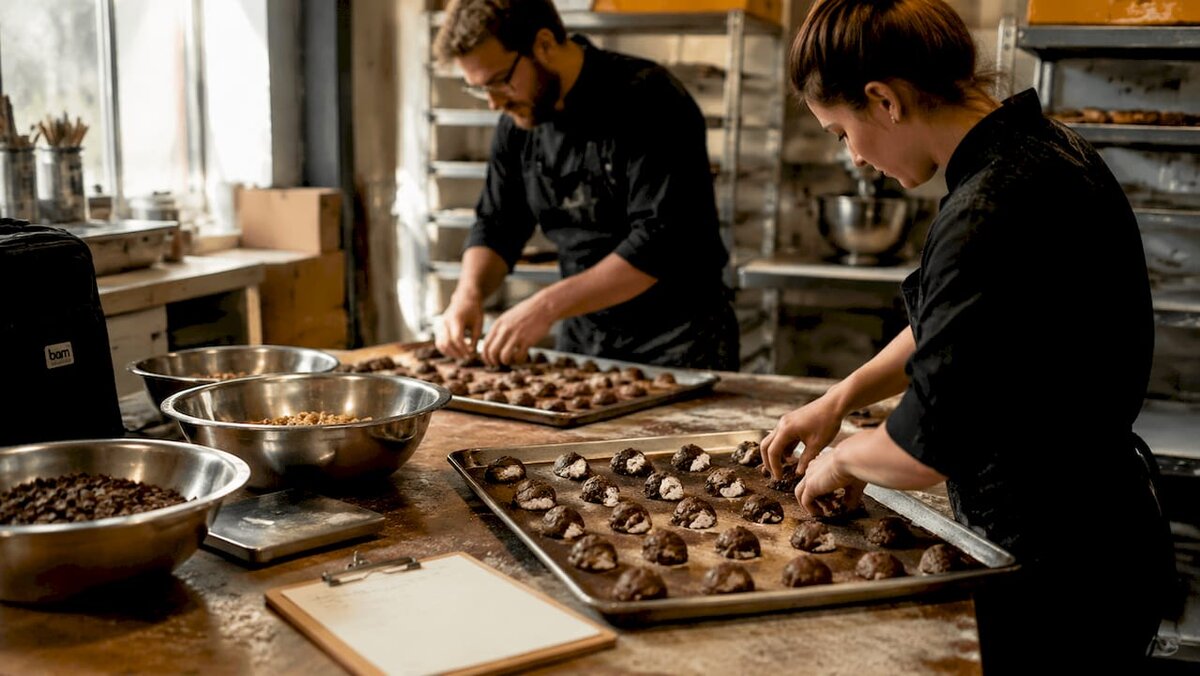
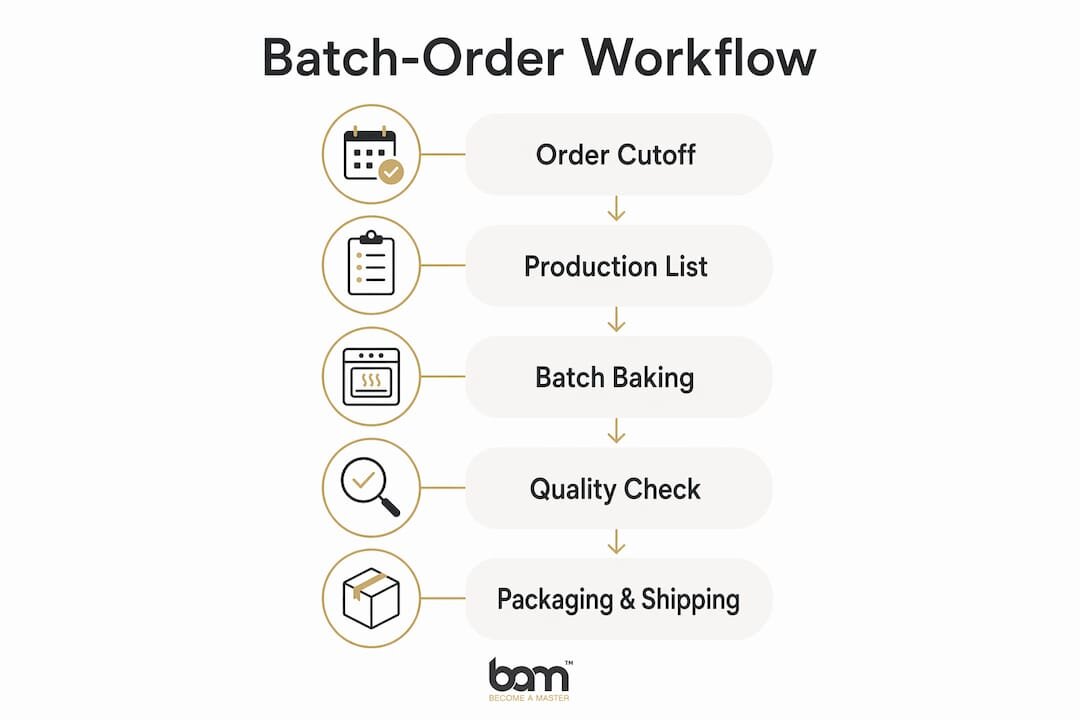
The batch-order model is the single most impactful structural change an online bakery can make. Its core principle is straightforward: you collect orders and payments before you bake anything. No speculative production, no guessing demand, no end-of-day surplus.
A typical weekly rhythm looks like this:
The financial case for this approach is compelling. Unsold product costs average bakeries 15 to 20% of daily inventory, roughly £650 to £1,000 per month. Baking only what customers have already paid for eliminates that loss entirely. The speculative bake-to-sell model, where you bake first and hope to sell, transfers all financial risk onto you. The batch model transfers it back to confirmed demand.
Batch-order systems close orders at a fixed time and automatically generate production lists for exact quantities, enabling precise ingredient purchasing and baking plans. This means your shopping list on Thursday morning is not a guess. It is a calculation.
The hardest part of this model is enforcing the cutoff. Customers will ask for exceptions. A hard order cutoff is initially resisted but becomes easier with repetition and clear communication. State your cutoff in every order confirmation, on your website, and in your social media posts. Consistency trains your customers faster than any policy document.
Pro Tip: Set an automated reply on your order platform that reminds customers of the next order window the moment the current one closes. This converts “I missed it” into “I’ll order next week” rather than a lost customer.
Recipe management and bill of materials (BOM) management are related but distinct. A recipe defines the method and proportions for a single product. A BOM translates that recipe into a purchasing and inventory document, listing every ingredient by weight, unit cost, and supplier. Together, they form the backbone of consistent quality and controlled costs.
Linking BOMs to production orders automates ingredient calculations and prevents both overbuying and stock-outs. When you receive 40 orders for your chocolate tart, the system calculates exactly how much dark chocolate, butter, and cream you need, then checks that against your current stock. You order only the difference.
The benefits compound at scale:
Software tools like VasyERP integrate BOM management with production planning, so a single confirmed order triggers an automatic cascade through inventory, purchasing, and scheduling. AI-enabled forecasting within these platforms analyses historical order data to predict demand peaks, reducing procurement errors before they happen.
| Management type | Primary function | Key benefit |
|---|---|---|
| Recipe management | Defines method and proportions | Consistent product quality across batches |
| BOM management | Translates recipe to purchasing data | Prevents overbuying and stock-outs |
| Integrated BOM + production | Links orders to ingredient requirements | Automates calculations and scheduling |
Pro Tip: Build your BOMs before you launch, not after you scale. Retrofitting ingredient data into a system when you are already handling 50 orders a week is far more disruptive than setting it up at order number one.
For practical guidance on baking quality consistency, the fundamentals of ingredient ratios and timing apply whether you are baking for one or one hundred.
Managing orders across Instagram DMs, email, WhatsApp, and a website simultaneously is not a workflow. It is archaeology. Every bake day spent cross-referencing three spreadsheets and a notebook is time and accuracy lost. The solution is a single platform that handles order intake, payment, confirmation, bake list generation, and packing labels in one connected system.
Bake day logistics fail when orders, bake lists, and packing labels are disconnected, leading to time-consuming cross-referencing and errors. The fix is a connected system where the bake list comes directly from orders and packing labels derive from the bake list. Platforms like MyPorch and RationalGo are built specifically for this. Digital order platforms with integrated bake lists and packing label generation reduce manual errors and bake day logistics burdens significantly.
| Feature | Manual tools (Google Forms, spreadsheets) | Dedicated bakery platforms (MyPorch, RationalGo) |
|---|---|---|
| Order intake | Manual entry, error-prone | Automated, customer self-service |
| Payment collection | Separate step, often delayed | Integrated at checkout |
| Bake list generation | Manual compilation | Auto-generated from confirmed orders |
| Packing labels | Typed or handwritten | Printed directly from order data |
| Subscription orders | Not supported | Built-in recurring order management |
| Custom cake configurator | Not available | Guided steps with portfolio examples |
The transition point matters. Dedicated bakery management apps are recommended after roughly 15 orders per week, because manual systems become unmanageable beyond that threshold. Below 15 orders, a well-organised spreadsheet is adequate. Above it, the overhead of manual reconciliation starts costing you real orders and real time.
Specialised features worth prioritising include wholesale portals with invoice management for restaurant or café clients, subscription order handling for weekly regulars, and digital cake configurators. Cake configurators with guided steps increase order conversion rates significantly compared to Instagram DM inquiries, by restricting incompatible options and showing real portfolio examples.
Production scheduling for an online bakery starts at the end and works backwards. Fix your delivery or pickup time first, then map every stage backwards: cooling, baking, proofing, prep, and ingredient receipt. This backward scheduling approach prevents the common failure of underestimating how long cooling alone takes before a product can be packed.
Key considerations for bake day logistics:
Manual recipe and inventory forecasting is insufficient when managing multiple sales channels. Unified data access is necessary for effective dynamic reallocation when, for example, a wholesale client increases their order at short notice.
Pro Tip: Use a production checklist for every bake day, even when you know the process by heart. Checklists remove the cognitive load of remembering sequence and free your attention for quality control.
Understanding cake shelf life is also a direct input to your production schedule. Products with shorter shelf lives must be baked closer to delivery, which affects how you sequence your week.
An effective e-commerce baking workflow requires the batch-order model, connected digital systems, standardised recipe management, and backward-scheduled production planning working together.
| Point | Details |
|---|---|
| Adopt the batch-order model | Collect payment before baking to eliminate waste and unpredictable production costs. |
| Link BOMs to production orders | Automate ingredient calculations to prevent overbuying and maintain consistent quality. |
| Consolidate onto one platform | Use a dedicated bakery app after 15 orders per week to remove manual reconciliation errors. |
| Schedule production backwards | Fix delivery time first, then map every stage backwards to avoid timing failures. |
| Enforce order cutoffs consistently | Communicate cutoffs clearly and hold them firmly. Customers adapt quickly with repetition. |
The most common mistake I see from bakers moving into online sales is treating the workflow as something to sort out later, once orders pick up. That logic is backwards. The workflow is what allows orders to pick up without the whole operation collapsing under the weight of them.
The batch-order model feels restrictive at first. Customers push back on cutoffs. You worry about losing sales. In practice, the opposite happens. When customers know your order window closes on Wednesday, they plan around it. The predictability you create for yourself becomes a feature they value, not a limitation they resent.
Digital integration is not a luxury for large operations. I have seen bakers handling 20 orders a week spend two hours on bake day morning just reconciling what they owe to whom. That is two hours of production time lost to administration. A connected platform from orders to labels solves this at any scale.
The detail most guides skip is the emotional cost of a disorganised bake day. When you are mid-production and unsure whether you have accounted for a last-minute order, the quality of everything on your bench suffers. Process discipline is not bureaucracy. It is what keeps your attention on the baking.
My honest recommendation: adopt management tools earlier than you think you need them. The right infrastructure built at order number ten is far less painful than the same infrastructure retrofitted at order number fifty.
— Andraz
Bamchocolate stocks the ingredients and accessories that make a well-planned bake day run cleanly. The baking accessories range includes gloves, confectionery sets, and production tools that reduce handling time and improve safety during high-volume bake days. For bakers building standardised recipes into their workflow, the BAM pastry recipe book provides 101 tested formulations ready to convert into BOMs. If you are sourcing premium chocolate for a custom cake range, Bamchocolate’s gourmet chocolate selection covers both everyday production and special-occasion orders. Quality ingredients are the foundation of any repeatable baking process.
An e-commerce baking workflow is the end-to-end process connecting order intake, production planning, baking, and fulfilment for an online bakery. It replaces ad hoc decision-making with a repeatable system that reduces waste and improves customer reliability.
The recommended transition point is around 15 orders per week. Beyond this threshold, manual tools become unmanageable and start costing both time and orders.
The batch-order model eliminates unsold product by baking only confirmed, prepaid orders. This removes the 15 to 20% daily inventory loss that speculative bake-to-sell models typically incur.
A bill of materials (BOM) translates a recipe into a purchasing document, listing every ingredient by weight and unit cost. Linking BOMs to production orders automates ingredient calculations and prevents both overbuying and stock-outs across your supply chain.
Start with your confirmed delivery or pickup time and work backwards through every stage: cooling, baking, proofing, prep, and ingredient receipt. This backward scheduling method prevents timing failures caused by underestimating post-bake stages like cooling and packing.



 Confectionery tips



 Slovenščina
 Hrvatski
 Deutsch
 Italiano
 Česky
Česky
 Polski
 Magyar
 Français
 Slovák
 Nederlands
 Español