 info@bamchocolate.com
  Login
Login 

 en
en 
 BAM Cake converter
  Login
Login Claudia
Avtorica vsebin


 Reading time:
11 minutes
Reading time:
11 minutes 
Discover how to customize baking recipes with confidence! This guide teaches you how substitutions affect your bakes for perfect results.
TL;DR:
- Understanding ingredient roles helps bakers modify recipes without upsetting the balance of structure, moisture, fat, sweetness, or leavening.
- Accurate substitutions and proper scaling require knowing each ingredient’s function and applying specific adjustments, especially for leavening agents and liquids.
- Following a step-by-step process—identifying needs, mapping roles, testing changes, and recording results—ensures reliable recipe customization and improved baking outcomes.
Learning how to customize baking recipes is one of the most useful skills a home baker can develop. But it trips people up constantly. You swap one ingredient, follow the rest of the recipe exactly, and the result is flat, dense, or just wrong. The problem is almost never the substitution itself. It is that most recipes are a careful balance of structure, moisture, fat, sweetness, and leavening. Change one without understanding what it does, and the whole system shifts. This guide gives you the tools to modify recipes with confidence, not guesswork.
| Point | Details |
|---|---|
| Understand ingredient roles | Every ingredient serves a function; replace the function, not just the ingredient. |
| Adjust moisture when substituting | Liquid sweeteners and dairy alternatives change moisture levels and require compensating adjustments. |
| Scale leavening carefully | Leavening agents do not scale linearly; reduce them by 10 to 20% when quadrupling a recipe. |
| Weigh, do not measure by volume | Grams are far more accurate than cups, especially when halving or scaling down. |
| Test in small batches first | Write down every change and test a small portion before committing to a full bake. |
Before you swap anything, you need to know what each ingredient actually does. Most baking ingredients fall into one of five roles: structure, moisture, fat, sweetness, or leavening. Swap within the same role and your bake stays balanced. Swap across roles and things unravel quickly.
Here is what each role covers:
Pro Tip: Before modifying any recipe, write down which role each ingredient plays. This single step will prevent most substitution mistakes before you even start.
Once you see a recipe through this lens, substitution becomes logical rather than experimental. You are not replacing butter with oil. You are replacing one fat source with another, and then adjusting for the fact that oil adds more liquid fat per gram than butter does.
Knowing the role is step one. Executing the substitution well is step two. Here is a practical process for the most common swaps home bakers need to make.
Eggs: One large egg weighs roughly 50 grams without the shell. For structure and binding, a flax egg (one tablespoon of ground flaxseed mixed with three tablespoons of water, rested for five minutes) works well in dense bakes like brownies. Aquafaba (the liquid from a tin of chickpeas) at three tablespoons per egg suits lighter cakes and meringues.
Butter: Replace with the same weight of coconut oil for a similar fat content. For a lower-fat option, unsweetened apple purée replaces half the butter in muffins and quick breads, though it adds moisture and sweetness, so reduce sugar slightly.
Dairy: Buttermilk, sour cream, and plain yogurt are interchangeable in a 1:1 ratio due to similar acidity and moisture content. To make a quick buttermilk substitute, add one tablespoon of lemon juice or white vinegar to one cup of milk and leave it for five to ten minutes.
Sugar: Honey and maple syrup can replace granulated sugar, but liquid sweeteners add extra moisture, which affects density and how the bake sets. Reduce other liquids by about 60ml for every 240ml of liquid sweetener used, and lower the oven temperature by 15°C to prevent over-browning.
Leavening: If you are out of baking powder, use a quarter teaspoon of baking soda plus half a teaspoon of cream of tartar per teaspoon of baking powder required. For more detail on how these two agents behave differently, the leavening agent guide from Bamchocolate covers the chemistry clearly.
| Ingredient | Substitute | Adjustment needed |
|---|---|---|
| Butter (100g) | Coconut oil (100g) | None for most recipes |
| Buttermilk (240ml) | Milk + lemon juice (240ml) | Rest for 5 to 10 minutes before using |
| Sugar (200g) | Honey or maple syrup (150ml) | Reduce other liquids by 60ml; lower oven by 15°C |
| 1 egg | Flax egg or aquafaba | Works best in dense or moist bakes |
| Baking powder (1 tsp) | Baking soda + cream of tartar | Use ¼ tsp soda + ½ tsp cream of tartar |
Pro Tip: Always test a substitution in a small batch before making it for an event or a gift. A quarter of the recipe is enough to check texture, flavour, and rise.
Adjusting baking time after a substitution is often necessary. Honey-sweetened bakes brown faster, so check them five minutes early. Dairy-free batters can be slightly denser and may need an extra three to five minutes. Use the visual and tactile cues covered in this guide to knowing when bakes are done rather than relying solely on the timer.
Scaling is where even experienced bakers make mistakes. Doubling a recipe is usually straightforward. Going to four times the quantity, or cutting down to a third, requires more thought.

Professional bakers use baker’s percentage to scale recipes, with flour always set at 100% and all other ingredients expressed as a percentage of the flour’s weight. A standard white sandwich loaf runs roughly: flour 100%, water 65%, salt 2%, yeast 1%, sugar 3%, fat 3%. Once you know these ratios, scaling to any batch size is a multiplication exercise.
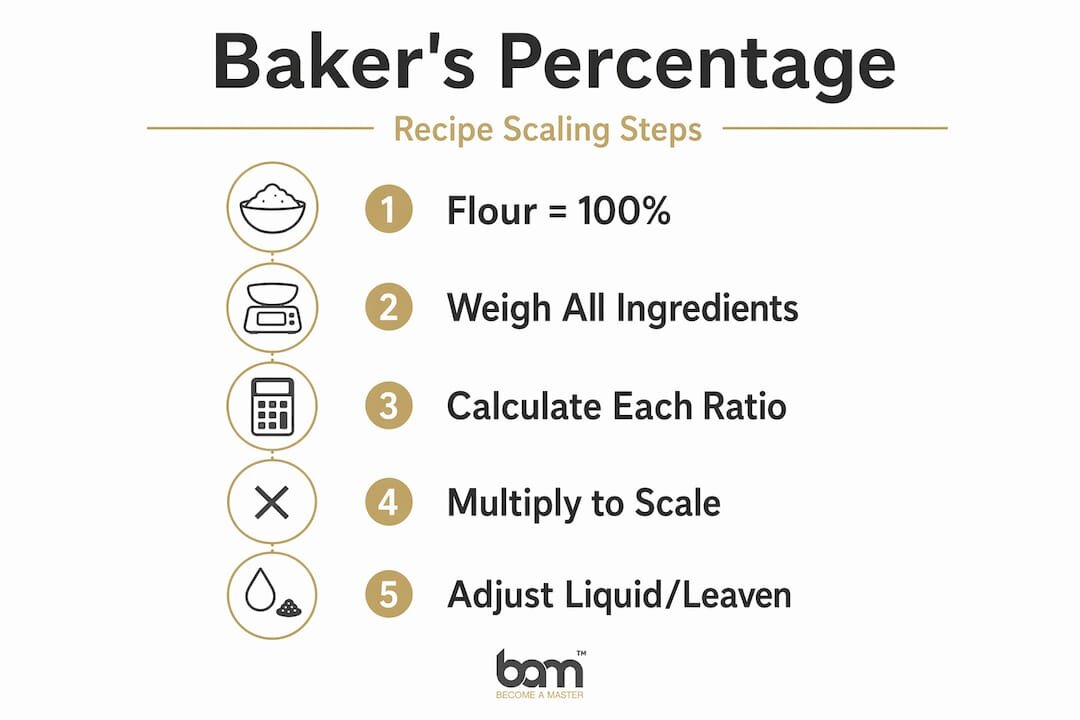
Here is how a simple scaling calculation works:
| Ingredient | Original (g) | Scale factor (x3) | Scaled amount (g) |
|---|---|---|---|
| Flour | 250 | x3 | 750 |
| Butter | 125 | x3 | 375 |
| Sugar | 150 | x3 | 450 |
| Baking powder | 8 | x2.7 (reduced 10%) | 21.6 |
| Milk | 80 | x3 | 240 |
Notice that baking powder is scaled at a reduced factor. When scaling by 4x or more, leavening agents should be reduced by 10 to 20% to avoid a bitter metallic aftertaste and structural weakness. The same principle applies to spices. Double the recipe and double the cinnamon. Quadruple it and use only three times the cinnamon, then taste and adjust.
Key points to keep in mind when scaling:
Pro Tip: Keep a scaling notebook. Write the original recipe, your scale factor, every adjustment you made, and the result. After three or four iterations, you will have a reliable custom version you can repeat without thinking.
This is the process that turns theory into a reliable bake. Follow it in order and you will avoid the most common pitfalls.
Common issues and their likely causes:
For specific cake modifications, the practical cake baking tips on the Bamchocolate site offer additional guidance on texture and structure.
I spent a long time treating recipes as fixed rules rather than starting points. When something went wrong after a substitution, I blamed the substitute. The actual problem was that I had no framework for understanding what I had changed and why it mattered.
The shift happened when I started thinking about what each ingredient was doing rather than what it was. Once I understood that fat controls tenderness and that adjusting fat content changes gluten development, I could make informed decisions instead of guesses. A brioche stays tender even after heavy kneading because the fat content is so high. That is not magic. It is chemistry you can use.
The other lesson I learned the hard way: note-taking is not optional. I have made the same mistake three times on the same recipe because I did not write down what went wrong the first time. Your notes are your recipe. The printed version is just the starting point.
My honest advice is to start with master base recipes and modify flavour before you modify structure. Swap the vanilla for almond extract. Add citrus zest. Change the chocolate type. These changes carry almost no risk and build your confidence for the more technical substitutions later. Experiment carefully. Build systematically. The results are genuinely worth it.
— Andraz
Precise customisation starts with quality ingredients and the right tools. Bamchocolate stocks a full range of baking accessories designed for accurate measurement and consistent mixing, which makes a real difference when you are adjusting ingredient ratios and testing new formulations. For bakers who want a solid foundation to modify from, the 101 BAM pastry recipe collection provides versatile bases across multiple bake types. If you want to experiment with flavour profiles without starting from scratch, the BAM Confectionery set with fruit fillings and the BAM Pastry set with exotic fillings give you ready-to-use options that integrate cleanly into modified recipes.
Substituting ingredients in baking means replacing one ingredient with another that performs the same functional role, such as swapping butter for coconut oil to maintain fat content. The goal is to preserve the recipe’s balance of structure, moisture, fat, sweetness, and leavening.
Replace milk with a plant-based alternative in a 1:1 ratio, and use coconut oil or a dairy-free spread in place of butter at the same weight. Buttermilk can be replicated by adding one tablespoon of lemon juice to one cup of plant-based milk and resting it for five minutes.
Leavening agents do not scale linearly. When multiplying a recipe by four or more, reduce baking powder or soda by 10 to 20% to avoid bitterness and structural collapse. Large batches also retain heat, which can over-proof yeast doughs if you do not adjust water temperature or fermentation time.
Crack the egg, whisk it lightly, then weigh it. A standard large egg is around 50g without the shell, so use 25g of whisked egg for half a recipe. This is far more accurate than trying to divide an egg by eye or using volume measurements.
You can reduce sugar by up to 25% in most recipes with minimal impact on texture. Beyond that, you risk a drier crumb, reduced browning, and less moisture retention, since sugar does more than sweeten. If you reduce sugar significantly, consider adding a small amount of honey or apple purée to compensate for lost moisture.



 Tales of chocolate



 Slovenščina
 Hrvatski
 Deutsch
 Italiano
 Česky
Česky
 Polski
 Magyar
 Français
 Slovák
 Nederlands
 Español