 info@bamchocolate.com
  Login
Login 

 en
en 
 BAM Cake converter
  Login
Login Claudia
Avtorica vsebin


 Reading time:
11 minutes
Reading time:
11 minutes 
Discover must have baking ingredients to elevate your home baking! Stock your pantry efficiently and enhance your recipes with this essential guide.
TL;DR:
- Knowing your core baking ingredients saves time, money, and prevents last-minute store runs.
- Stocking versatile, long-lasting staples like flour, sugar, butter, eggs, and leavening agents ensures recipe flexibility and quality.
Whether you bake once a week or once a month, knowing your must have baking ingredients before you start a recipe saves time, money, and a last-minute dash to the shops. The problem most home bakers face is not a lack of recipes. It is opening a cupboard and finding it half-stocked with the wrong things. This guide covers the core pantry staples, the next-level additions that expand what you can make, and practical storage advice to keep everything fresh and ready to use.
| Point | Details |
|---|---|
| Stock the core ten first | All-purpose flour, sugars, leavening agents, salt, butter, eggs, vanilla, and milk cover most recipes. |
| Leavening agents differ | Baking soda and baking powder are not interchangeable; knowing when to use each prevents flat bakes. |
| Storage matters as much as quality | Airtight containers and cool conditions extend the shelf life of flour, sugar, and leavening agents significantly. |
| Organic options reduce residue risk | Choosing organic flour and dairy reduces exposure to chemical residues without sacrificing baking performance. |
| Tailor your pantry to your baking style | Chocolate bakers, bread makers, and vegan bakers each need a slightly different set of staples. |
Not every ingredient deserves a permanent spot in your cupboard. The ones that do earn their place by meeting a few clear criteria.
Versatility is the first test. A must-have ingredient should work across multiple recipe types. All-purpose flour, for example, appears in cakes, biscuits, pastry, and bread. An ingredient used in only one recipe type is a specialty item, not a staple.
Shelf life matters too. Pantry staples should last long enough to be useful without constant restocking. Granulated sugar keeps almost indefinitely. Butter freezes well. These qualities make ingredients practical for everyday baking.
Function is the third consideration. Every baking staple performs a specific job: structure, leavening, moisture, binding, or flavour. Leavening agents function differently from one another, so understanding what each ingredient does helps you choose the right one for each recipe.
Quality and source also play a role, particularly for health-conscious bakers. Organic options are worth considering for ingredients like flour, where residue risk is highest among conventional grains. Finally, think about dietary needs in your household. Knowing which staples have reliable substitutes makes your pantry more flexible.
Pro Tip: Before restocking your pantry, write down the five recipes you bake most often and list the ingredients they share. Those shared ingredients are your non-negotiable staples.
Ten pantry staples form the backbone of most home baking recipes. Many recipe developers do not even list them in full, assuming you already have them. If you are building your pantry from scratch, start here.
All-purpose flour is the single most used ingredient in home baking. It provides structure in cakes, body in biscuits, and the base for most pastry doughs. Bread flour and cake flour each have their uses, but all-purpose covers the widest range. Stock it first and add speciality flours as your baking expands.
Granulated sugar does more than sweeten. It aerates butter during creaming, contributes to browning, and retains moisture in finished bakes. Brown sugar adds a deeper, slightly caramel flavour and more moisture due to its molasses content. Both belong on your baking staples list.
These two are not the same thing, and using the wrong one will ruin a recipe. Baking soda reacts immediately with an acid (like buttermilk or lemon juice) to produce lift. Baking powder works in two stages, reacting once when wet and again when heated. For more detail on getting this right, the tips on baking powder and soda from Bamchocolate are worth reading before your next bake.
Salt does not just season. In baking, it controls yeast activity, strengthens gluten, and balances sweetness. Leaving it out of a cake recipe produces a flat, oddly sweet result. Fine sea salt is the most practical choice for baking because it dissolves evenly.
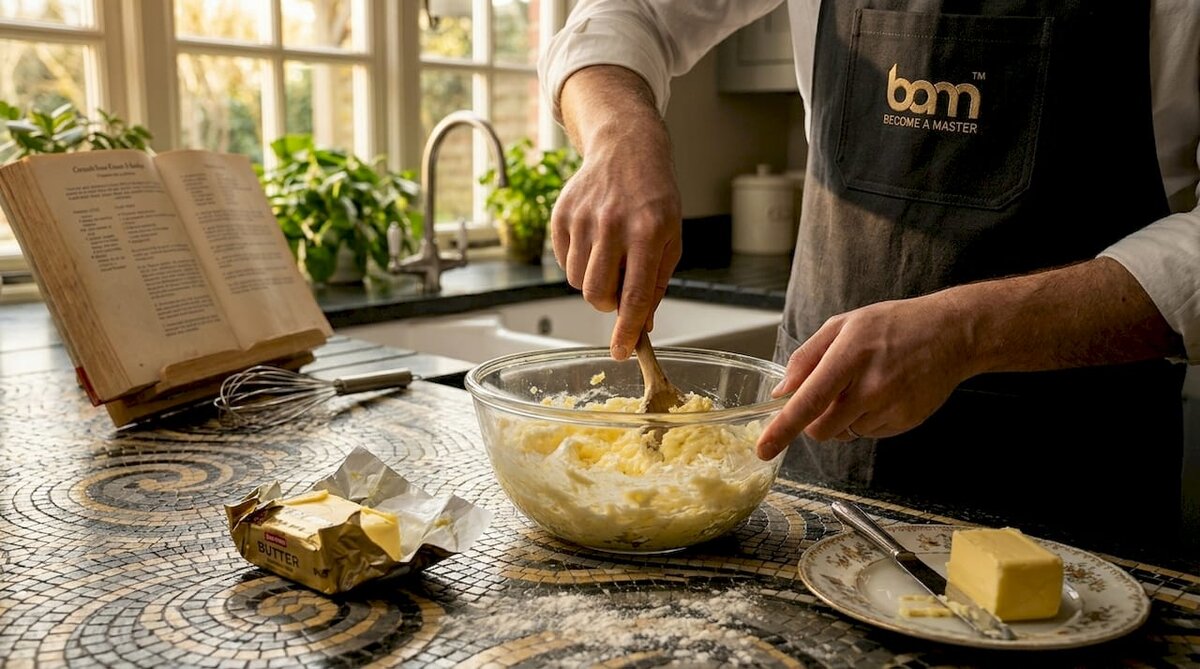
Butter contributes flavour and texture in almost every baked good. It coats flour proteins to create tenderness, and it melts during baking to produce flakiness in pastry. Unsalted butter gives you control over the salt level in your recipe. Keep a block in the fridge and extras in the freezer.
Eggs are one of the hardest working ingredients in baking. They provide structure through protein coagulation, moisture, richness, and act as a binding agent that holds everything together. Whole eggs, yolks, and whites each behave differently, which is why so many recipes specify which part to use.
Pure vanilla extract is a flavour amplifier. It does not taste strongly of vanilla in most recipes. Instead, it rounds out and deepens the overall flavour profile of cakes, biscuits, and custards. Avoid imitation vanilla if you can. The real thing makes a noticeable difference.
Milk adds moisture and a small amount of fat and protein to baked goods. It also helps dissolve sugar and activates leavening agents. Full-fat milk produces the richest results, but semi-skimmed works in most recipes. Plant-based milks such as oat or soy are reliable substitutes in most cases.
Pro Tip: Crack eggs into a small bowl before adding them to your batter. This prevents shell fragments from ending up in your mix and lets you check for freshness first.
Once your core pantry is in place, these additions unlock more complex recipes and give you greater flexibility.
| Ingredient | Shelf life | Best storage method | Organic worth it? |
|---|---|---|---|
| All-purpose flour | 6 to 12 months in pantry, up to 2 years frozen | Airtight container, cool and dark place or freezer | Yes, highest residue risk |
| Whole grain flour | 1 to 3 months in pantry | Freezer recommended due to natural oils | Yes |
| Granulated sugar | Indefinite | Airtight container, away from moisture | Optional |
| Baking soda | 2 to 3 years unopened, 1 year once opened | Cool, dry cupboard away from moisture | No |
| Butter | 1 month refrigerated, 6 to 9 months frozen | Wrapped tightly, away from strong-smelling foods | Yes |
| Vanilla extract | 4 to 5 years | Dark cupboard, sealed bottle | Yes |
Flour stored in airtight containers in cool, dark places maintains quality far longer than flour left in its paper bag. Whole grain flours contain natural oils that go rancid quickly, so the freezer is the better option for those.
Baking soda loses potency over time. To test whether yours is still active, drop a small amount into a bowl of hot water with a splash of vinegar. If it bubbles vigorously, it is still good. If the reaction is weak, replace it before your next bake.
Organic flour reduces exposure to chemical residues that concentrate in conventional grain crops. For bakers who bake frequently, the switch to organic flour and butter is one of the more impactful quality upgrades you can make. The flavour difference is subtle but real, particularly in simple recipes where each ingredient is prominent.
Pro Tip: Decant all dry ingredients into labelled glass or food-grade plastic containers as soon as you bring them home. This prevents pest contamination, keeps ingredients fresher, and makes it easy to see when stocks are running low.
A pantry built for chocolate cake baking looks different from one built for sourdough. Knowing your habits helps you prioritise.
The goal is a pantry that supports your actual baking, not an idealised version of it. Build gradually, replace as you go, and let your recipe choices guide what you add next.
I have made the mistake of buying too many specialty items before I had the basics properly sorted. A jar of freeze-dried raspberry powder is no use if you have run out of baking powder. The core ten ingredients are not exciting to shop for, but they are what actually get you through a recipe without stopping halfway.
When I switched to organic flour and butter, I noticed the difference most in simple recipes: a plain sponge cake, a shortbread biscuit. The flavour is cleaner. There is less of that faint chemical aftertaste you sometimes get with conventional products. Traditional baking without synthetic additives genuinely does produce a better result, and I think that applies to home baking just as much as it does to professional bread-making.
The storage habits took me longer to develop. I lost a bag of almond flour to pantry moths before I started using sealed containers for everything. Now every dry ingredient goes straight into a labelled container the moment it enters the kitchen. It sounds like extra effort but it takes about thirty seconds and saves real waste.
My advice: stock the core ten, learn how each one behaves, and add specialty items only when a recipe you actually want to make calls for them. A well-stocked basic pantry will take you further than a cupboard full of ingredients you bought on impulse.
— Andraz
Bamchocolate offers a curated range of baking additives and accessories suited to home bakers at every level. Whether you are building your first pantry or looking to upgrade your existing supplies, the product range covers the key baking ingredients covered in this guide and more.
For those starting out, the BAM Basic Pastry Package brings together core confectionery ingredients in one bundle, removing the guesswork from your first shop. More experienced bakers can explore the BAM Large Confectionery Bundle for a broader selection of premium ingredients suited to complex recipes.
Bamchocolate also stocks the 101 BAM Pastry Recipe book, a practical reference for bakers who want to put a well-stocked pantry to work across a wide range of pastry styles and skill levels.
The ten core staples are all-purpose flour, granulated sugar, brown sugar, baking soda, baking powder, salt, butter, eggs, vanilla extract, and milk. These ingredients cover the majority of standard baking recipes.
All-purpose flour lasts 6 to 12 months stored in a cool pantry and up to 2 years if kept in an airtight container in the freezer.
No, they are not directly interchangeable. Baking soda is roughly three times stronger and requires an acidic ingredient to activate. Using one in place of the other without adjusting quantities will affect the rise and texture of your bake.
Organic flour is the better choice if you bake frequently, as conventional flour carries the highest residue risk among grain crops. The flavour difference is most noticeable in simple recipes with few ingredients.
Drop a small amount into hot water with a splash of vinegar. Strong bubbling means it is still active. Weak or no reaction means it has lost its potency and should be replaced.



 Tales of chocolate



 Slovenščina
 Hrvatski
 Deutsch
 Italiano
 Česky
Česky
 Polski
 Magyar
 Français
 Slovák
 Nederlands
 Español