 info@bamchocolate.com
  Login
Login 

 en
en 
 BAM Cake converter
  Login
Login Claudia
Avtorica vsebin


 Reading time:
10 minutes
Reading time:
10 minutes 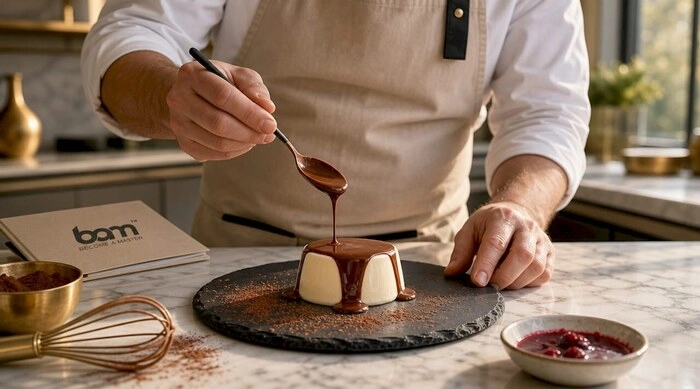
Discover the vital role of dressings in desserts. Elevate your creations with flavors, textures, and stunning presentations!
TL;DR:
- Dessert dressings enhance flavor, moisture, texture, and visual appeal, serving as finishing elements. Choosing the correct type—sauce, syrup, or cream—depends on the dessert’s structure and desired presentation. Proper application temperature, viscosity, and stabilization are crucial for achieving professional, appealing results.
Dessert dressings are sauces, toppings, and finishing preparations that add flavour, moisture, texture, and colour to both cooked and uncooked desserts. The term covers everything from a glossy chocolate ganache poured over a tart to a sharp raspberry coulis pooled beside a panna cotta. In professional kitchens, these preparations are called dessert sauces or finishing sauces. The role of dressings in desserts goes well beyond sweetness: they balance flavour, control mouthfeel, and determine whether a plate looks polished or amateurish. Understanding how they work gives you precise control over every dessert you make.
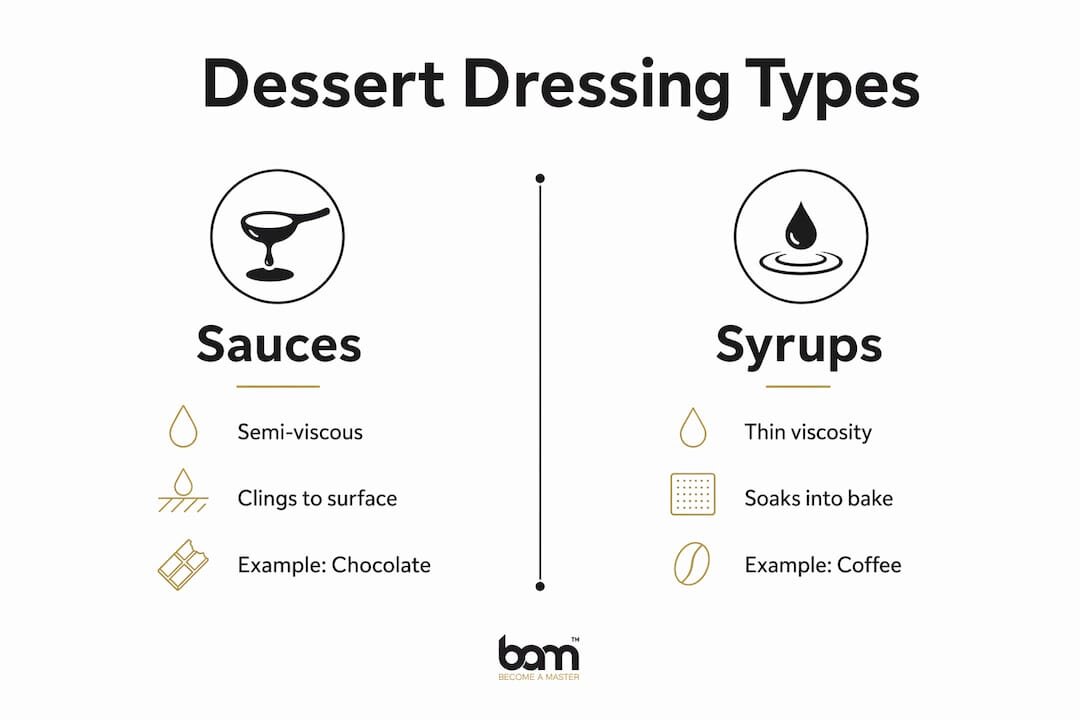
Dessert sauces are defined as finishing preparations that serve multiple simultaneous roles: flavour addition, moisture delivery, textural contrast, and visual interest. Three broad categories cover most applications.
Dessert sauces are semi-viscous preparations that cling to a surface. Chocolate sauce, caramel sauce, and crème anglaise all belong here. Their body comes from dissolved sugars, emulsified fats, or starch, and that body is what keeps them sitting on top of a dessert rather than running off the plate.
Syrups are thinner and penetrate porous structures. A coffee syrup brushed onto génoise layers or a citrus syrup soaked into a polenta cake works by absorption rather than surface coating. Thin syrups flow and soak into porous bases, while sauces stay distinct for artistic effect. This distinction matters when you are choosing what to apply to a sponge versus a mousse.
Topping creams such as whipped cream, mascarpone cream, and crème chantilly provide volume and decoration. They are applied after the dessert is plated and serve both a textural and a visual function.
| Type | Consistency | Best use | Examples |
|---|---|---|---|
| Dessert sauce | Semi-viscous, clings | Plated desserts, drizzling | Chocolate sauce, caramel, coulis |
| Syrup | Thin, flows freely | Soaking sponge cakes, layering | Coffee syrup, citrus syrup |
| Topping cream | Light, aerated | Decoration, volume, contrast | Whipped cream, crème chantilly |
| Custard/curd | Thick, pourable | Filling, pouring sauce | Crème anglaise, lemon curd |
The category you choose should match the physical structure of the dessert you are finishing. A dense flourless chocolate cake needs a sauce that sits on the surface. A light Victoria sponge benefits from a syrup that keeps it moist.
A dessert dressing is not merely a sweet addition. Effective dessert dressings are functional elements deliberately chosen for flavour complementarity and texture. The science behind this is more accessible than it sounds.

Moisture and balance. Dry or crumbly desserts such as shortbread, biscotti, or a slightly overbaked brownie become far more enjoyable when paired with a sauce that reintroduces moisture at the point of eating. The sauce does not fix the bake; it completes the experience by providing what the baked component cannot supply on its own.
Viscosity and mouthfeel. Sauce success is strongly influenced by physical behaviour such as viscosity and cling, which directly affect flavour retention and presentation. A sauce that is too thin disappears on the palate before flavour compounds have time to register. A sauce that is too thick coats the mouth and suppresses the flavour of the dessert beneath it. The target is a consistency that flows when poured but clings at rest.
This behaviour has a technical name: pseudoplastic flow. Rheological properties such as pseudoplastic behaviour allow dessert sauces to flow when poured but cling to desserts at rest, which is critical for presentation. In practical terms, this is why a well-made caramel sauce drapes beautifully over ice cream but does not pool into a puddle on the plate.
Flavour delivery. Dressings can intensify, contrast, or complement the base dessert. A tart passion fruit coulis cuts through the richness of a white chocolate mousse. A salted caramel sauce deepens the flavour of a plain vanilla cheesecake. Pairing a fruit-forward dressing with chocolate works particularly well because acidity lifts the cocoa notes. For guidance on getting that pairing right, the Bamchocolate article on combining fruit and chocolate is worth reading before you experiment.
Pro Tip: When selecting a dressing for a rich, fat-heavy dessert such as chocolate mousse or cheesecake, choose a dressing with noticeable acidity. Fruit coulis, citrus curd, or a lightly sweetened berry sauce will cut through the fat and make each mouthful taste cleaner.
Sauces contribute key structural and visual elements in plated desserts, pairing with main components and garnishes to create a complete composition. Presentation is where the choice of dressing becomes most visible.
Viscosity determines what is possible. A mid-viscosity sauce produces clean drizzle lines and glossy pools. A very thin sauce spreads uncontrollably and makes a plate look messy. Before plating, test your sauce on a cold plate. If it spreads more than 3 centimetres from the pour point in under ten seconds, it needs further reduction or a small addition of starch.
Match the dressing to the dessert geometry. A tall, structured dessert such as a layered entremet benefits from a sauce poured beside it rather than over it, preserving the geometry. A flat tart or a slice of cake can take a drizzle across the top. Panna cotta is a classic example: a starch-thickened berry coulis poured around the base frames the dessert without obscuring it.
Temperature timing matters. Professional recipes specify pouring at 25 to 30 degrees Celsius to respect gelatin set and sauce consistency. Pouring a hot sauce onto a cold, set dessert can melt the structure. Pouring a cold sauce onto a warm dessert can cause it to seize. Bring both components to compatible temperatures before plating.
Common pitfalls to avoid:
Garnishes placed after the sauce is applied, such as a sprig of fresh mint, a few freeze-dried raspberry pieces, or a dusting of cocoa powder, anchor the composition and signal to the diner what flavours to expect. For a practical example of how chocolate-based sauces work in a finished dessert, the Bamchocolate guide to chocolate mousse in a cup shows the layering approach clearly.
Making dessert dressings at home is straightforward once you understand what each ingredient does. The three most useful dressings to master are chocolate sauce, fruit coulis, and whipped topping cream.
Chocolate sauce requires chocolate, cream, and optionally butter. The ratio of chocolate to cream determines thickness. A 1:1 ratio by weight produces a pourable ganache. A 2:1 chocolate-to-cream ratio produces a thicker, spoonable sauce. Butter added at the end gives gloss. For the technical side of working with chocolate, the Bamchocolate article on tempering chocolate explains how temperature affects texture and finish.
Fruit coulis requires fresh or frozen fruit, sugar, and lemon juice. The steps are:
Whipped topping cream requires cold double cream and icing sugar. Whip to soft peaks for a pourable consistency, or firm peaks for piping and decoration.
Stabilising your dressings. Separation is the most common problem with homemade sauces. Modified starches stabilise emulsions, prevent separation, and maintain smooth texture in dessert dressings. For home use, a small amount of cornflour or arrowroot achieves a similar result. Mix the starch with cold liquid before adding it to a hot sauce to avoid lumps.
Pro Tip: Store chocolate sauce and fruit coulis in sealed glass jars in the refrigerator. Reheat chocolate sauce gently in a bain-marie rather than a microwave to prevent the fat from separating. Fruit coulis can be reheated directly in a small saucepan over low heat with a splash of water to restore pourability.
The most effective dessert dressings are chosen for viscosity, flavour contrast, and structural compatibility with the dessert they finish.
| Point | Details |
|---|---|
| Match type to structure | Use sauces on plated desserts and syrups on porous bakes like sponge cakes. |
| Viscosity controls presentation | A mid-viscosity sauce clings and drizzles cleanly; too thin and it pools uncontrollably. |
| Temperature timing is critical | Apply sauces at 25 to 30 degrees Celsius to protect set desserts and maintain sauce consistency. |
| Stabilise with starch | Cornflour or modified starch prevents separation and maintains smooth texture in homemade dressings. |
| Flavour contrast works best | Pair acidic dressings with rich, fat-heavy desserts to balance each mouthful. |
From my experience working with dessert recipes across a wide range of formats, the dressing is almost always the last thing a home baker thinks about and the first thing a professional baker plans. That order of priority is backwards.
The base dessert sets the structure. The dressing sets the experience. A technically perfect panna cotta served without a sauce is a blank canvas. The same panna cotta with a sharp blackcurrant coulis and a few drops of chocolate ganache becomes a complete dish with a clear flavour story.
What I find most interesting right now is the move towards reduced-sugar and functional dressings. Fruit-based coulis made with minimal added sugar, or dressings incorporating protein-rich ingredients, are appearing on menus where previously only classic caramel or chocolate sauce would have been acceptable. This is not a trend driven by restriction. It is driven by bakers who want their dressings to do more work: add nutrition, introduce unfamiliar flavours, and create contrast that a standard sweet sauce cannot provide.
My advice is to treat the dressing as a design decision, not an afterthought. Choose it before you finalise the base recipe, and let the two inform each other. The results are consistently better.
— Andraz
Bamchocolate stocks a focused range of products built for home bakers who take dessert finishing seriously. The baking accessories range includes tools for precise sauce application, drizzling, and plating work. For those who want to work with ready-made creamy dressings and fillings, the confectionery set with creamy fillings provides a practical starting point. If you prefer a broader selection, the large confectionery bundle covers sauces, fillings, and dressings across multiple flavour profiles. All products are available directly from Bamchocolate with delivery across Europe.
Dessert dressings add flavour, moisture, texture, and visual appeal to finished desserts. They function as finishing sauces that complete the dish rather than simply adding sweetness.
A dessert sauce is semi-viscous and clings to the surface of a dessert, while a syrup is thinner and designed to soak into porous structures such as sponge cake or génoise.
Add a small amount of cornflour or modified starch to the sauce during preparation. Modified starches form shear-resistant networks that prevent separation and maintain a smooth, consistent texture.
Apply sauce at approximately 25 to 30 degrees Celsius. This temperature range preserves the set of gelatin-based desserts and keeps the sauce at the correct consistency for pouring and presentation.
Fruit coulis, particularly raspberry, passion fruit, or blackcurrant, work well with chocolate because their acidity contrasts with the richness of the cocoa. Salted caramel sauce is a reliable alternative for a deeper, warmer flavour profile.


 Confectionery tips



 Slovenščina
 Hrvatski
 Deutsch
 Italiano
 Česky
Česky
 Polski
 Magyar
 Français
 Slovák
 Nederlands
 Español