 info@bamchocolate.com
 Login


 en

 BAM Cake converter
 Login
Claudia
Avtorica vsebin


 Reading time:
10 minutes
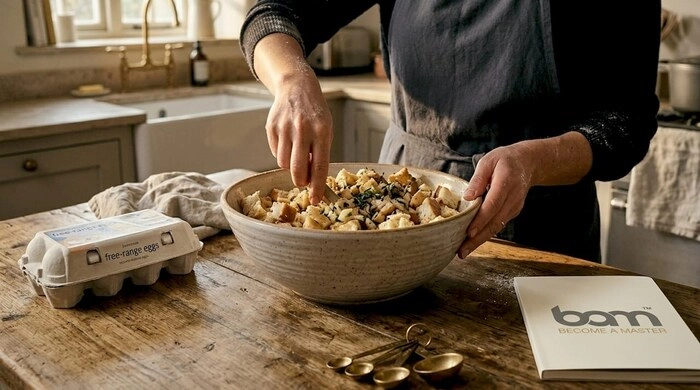
Discover what is baking dressing and how it differs from stuffing. Learn preparation techniques, food safety tips, and more in our clear guide!
TL;DR:
- Baking dressing is a bread-based side dish baked separately from poultry, ensuring food safety and optimal texture. It develops a crispy crust and moist interior by controlling ingredients, preparation, and resting time, unlike stuffing cooked inside a bird. The technique allows for versatile flavors and easy adaptation to dietary preferences, making it a reliable, predictable alternative.
Baking dressing is one of those culinary terms that causes genuine confusion, even among experienced home cooks. If you have ever wondered what is baking dressing and how it differs from stuffing, you are not alone. Many people use the two terms interchangeably, yet they describe distinct preparations with different cooking methods, textures, and food safety profiles. This guide cuts through the confusion, covering everything from the origins of the term and core baking dressing ingredients to practical preparation techniques, types of baking dressings, and the safety reasons why many cooks now prefer it over traditional stuffing.
| Point | Details |
|---|---|
| Baking dressing defined | A savoury bread-based side dish baked separately from poultry, not inside it. |
| Food safety advantage | Baking separately removes cross-contamination risks and allows precise temperature control. |
| Texture control | Separate baking produces a crisp golden top and a custardy, moist interior. |
| Ingredient flexibility | Cornbread, white bread, herbs, aromatics, eggs, and broth are all common bases. |
| Culinary versatility | Baking dressing works as a side dish or a full casserole-style main course. |
At its most straightforward, dressing is a savoury bread-based side dish baked in a separate dish rather than cooked inside a bird. That single distinction, where it is cooked, is what separates dressing from stuffing in both culinary tradition and practical outcome.
The terminology itself has regional roots. The word “dressing” is largely a Southern US term while “stuffing” is more common in northern regions, though the two terms overlap considerably depending on who you ask. What matters more than the label is the cooking method: dressing goes into the oven in its own baking dish, while stuffing goes inside the cavity of a turkey or chicken.
Because baking dressing cooks in open air rather than surrounded by meat juices, it develops characteristics that stuffing simply cannot replicate:
These qualities make baking dressing a genuinely different dish, not just a renamed version of stuffing. Once you understand the distinction, you will find baking dressing recipes far more approachable and the results far more predictable.
Food safety is not a secondary consideration here. It is one of the strongest arguments for choosing baking dressing over stuffing, and the guidance from food safety authorities is clear.
The USDA does not recommend stuffing a whole turkey due to cross-contamination risks and the difficulty of achieving safe internal temperatures. Stuffing cooked inside a bird must reach 165°F (74°C) at its centre to be considered safe. The problem is that by the time the stuffing reaches that temperature, the surrounding breast meat is almost certainly overcooked and dry.
“Baking dressing separately guarantees both food safety and optimal texture of meat and dressing.” Serious Eats
This is not a minor inconvenience. Cooking stuffing inside a bird risks overcooked poultry and undercooked stuffing because the two components require different amounts of heat and time. The stuffing sits in a cold, enclosed cavity, which slows its heating considerably. Meanwhile, the outer layers of the bird are already done.
Baking dressing separately solves both problems at once. You can pull the bird from the oven at the correct internal temperature for the meat, and you can monitor the dressing independently until it reaches the right colour, set, and temperature. There is no guesswork and no compromise.
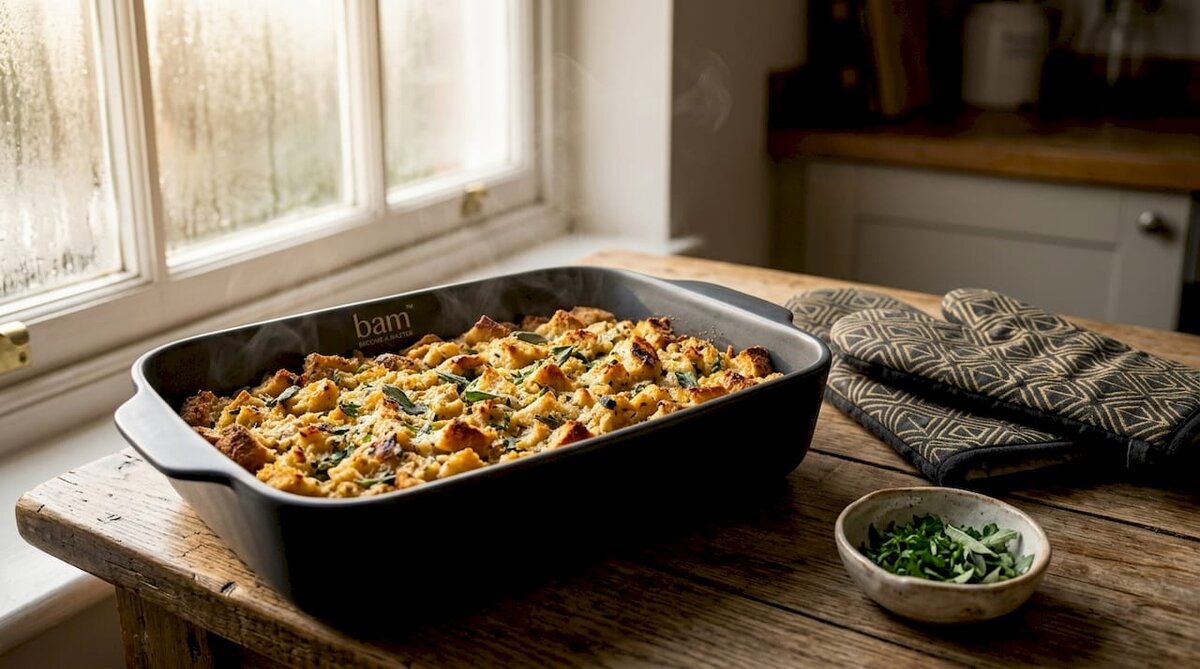
Pro Tip: If you want the flavour of drippings in your baking dressing without the safety risks, simply spoon a few tablespoons of roasting juices over the top of the dressing during the last 15 minutes of baking.
For guidance on monitoring baking doneness accurately, the Bamchocolate article on knowing when baked goods are done offers useful principles that translate well to savoury baking too.
Getting the ingredients right is where most home cooks either succeed or fall short with baking dressing. The process is straightforward, but the details matter.
The core baking dressing ingredients are consistent across most recipes: cubed bread (white, sourdough, or cornbread), butter, onion, celery, fresh herbs such as sage and thyme, eggs, and good-quality stock. From this base, the variations are nearly endless.
Pro Tip: Mixing your dressing a day or two before baking enhances the final dish quality considerably. The overnight rest is not optional if you want depth of flavour.
One important note on cornbread: cornbread requires less drying than wheat bread due to its different gluten structure. Over-drying cornbread damages its texture and produces a gritty, dry result rather than the custardy interior you are aiming for. Dry it briefly or simply use day-old cornbread.
For broader tips on getting bread-based bakes right, the Bamchocolate guide on preparing biscuits and bread textures covers useful foundational techniques.
Understanding the main types of baking dressings helps you choose the right approach for your meal and adapt recipes to your preferences.
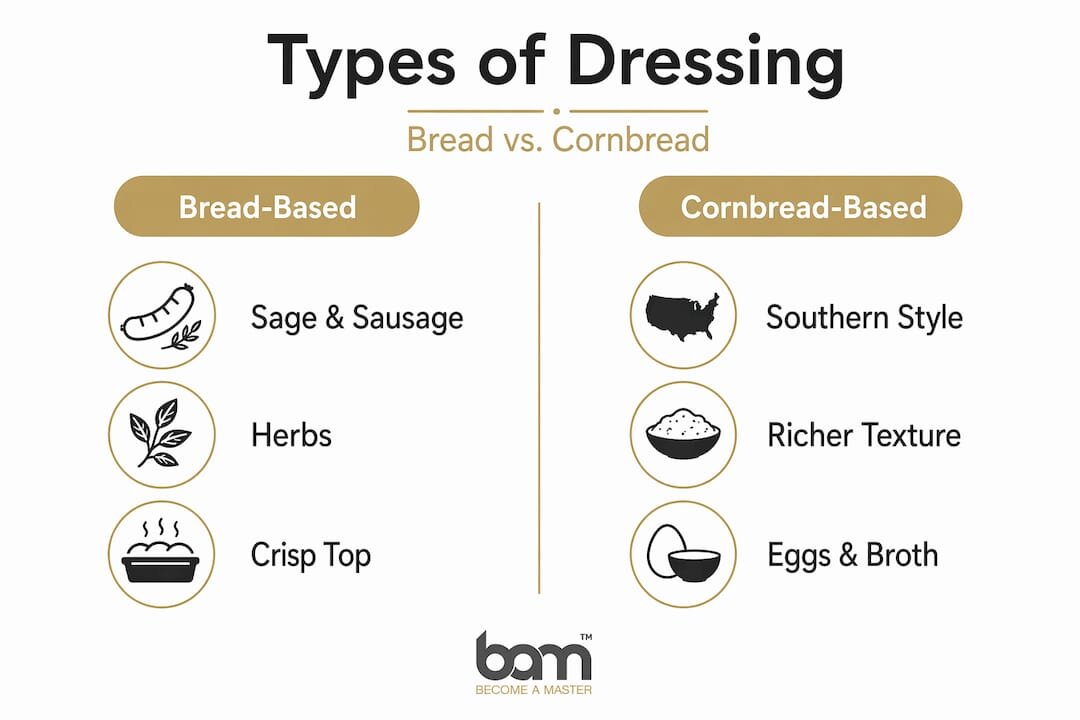
| Type | Base bread | Key flavours | Best used for |
|---|---|---|---|
| Classic sage and sausage | White or sourdough bread | Sage, thyme, pork sausage | Roast turkey or chicken dinners |
| Southern cornbread dressing | Crumbled cornbread | Onion, celery, sage, rich stock | Thanksgiving, holiday gatherings |
| Meatless herb dressing | Mixed white and wholemeal bread | Fresh herbs, mushrooms, vegetable stock | Vegetarian meals, lighter suppers |
| Chicken and dressing casserole | Cornbread or white bread | Shredded chicken, cream sauce, herbs | One-dish main course |
Southern-style cornbread dressing uses crumbled cornbread mixed with onions, celery, herbs, eggs, and broth, baked at 175°C to 200°C for 30 to 50 minutes. It is arguably the most iconic version of baking dressing in American Southern cooking, and the custardy texture it produces is quite different from the firmer, more structured result of a white bread dressing.
The chicken and dressing casserole deserves a mention as a standalone dish. Rather than serving dressing alongside roast poultry, you fold shredded cooked chicken directly into the dressing mixture before baking. Homemade cream sauce enhances flavour and texture significantly in this format, far more so than tinned soup, which is a common shortcut. A simple roux-based sauce made with butter, flour, and stock takes ten minutes and transforms the result entirely.
For dietary adaptations, baking dressing is genuinely flexible. Swap chicken stock for vegetable stock, omit the sausage, and add roasted mushrooms or chestnuts for a meatless version that holds its own at any table. Gluten-free bread works reasonably well as a substitute, though the texture will be slightly denser.
I will be direct: I stopped stuffing birds years ago, and I have not missed it once. The food safety argument alone is compelling, but what actually converted me was the texture.
When you bake dressing in its own dish, you get to decide what it becomes. I prefer a slightly wetter mixture going in, which produces a centre that is almost custardy, like a savoury bread pudding. That texture is impossible to achieve inside a bird because the surrounding meat absorbs moisture inconsistently.
The lesson that took me longest to learn was about resting time. I used to bake the dressing immediately after mixing, and the result was always uneven. Some pieces of bread were saturated while others stayed dry. Resting overnight changed everything. The bread absorbs the liquid uniformly, and the flavours settle into each other in a way that no amount of extra seasoning can replicate.
What I find most home cooks miss is the importance of generously buttering the baking dish and not compacting the mixture too firmly. A loose, airy pack gives the heat room to circulate and creates that desirable contrast between the crisp top and the soft interior. Press it down like a brick and you get a brick.
Baking dressing also rewards creativity in a way that stuffing does not. I have made versions with toasted walnuts and dried cranberries, with fennel and Italian sausage, and with roasted garlic and Gruyère. Each one worked because the base technique is sound. Once you understand the structure, the variations follow naturally.
— Andraz
Getting the best results from baking dressing recipes starts with having the right tools and quality ingredients to hand. Bamchocolate stocks a full range of baking accessories and additives suited to both savoury and sweet baking, from quality baking dishes to precision ingredients that make a measurable difference in texture and flavour.
For those who want structured inspiration beyond a single recipe, the 101 BAM pastry recipe collection offers a curated set of recipes that can spark ideas across baking styles. The BAM Basic pastry package is also worth exploring if you are stocking a home kitchen with reliable, quality staples. Good ingredients are not a luxury in baking. They are the foundation of consistent results.
Stuffing is cooked inside the cavity of a bird, while dressing is baked separately in its own dish. The cooking method determines the name in most culinary traditions, though regional terminology also plays a role.
Baking dressing can be a balanced side dish depending on the ingredients used. Using good-quality stock, fresh herbs, and whole-grain bread improves the nutritional profile, while versions with heavy cream or sausage are richer. Meatless and lower-fat adaptations are straightforward to prepare.
White bread, sourdough, and cornbread are the most common choices. Oven-dried bread absorbs flavours best and produces the ideal texture. Cornbread should be dried less aggressively to preserve its custardy quality.
Yes, and it is actively recommended. Mixing dressing one to two days before baking allows the bread to absorb the liquid evenly and the flavours to develop fully. Store it covered in the refrigerator and bake when needed.
Bake dressing at 175°C to 200°C until the top is golden brown and the centre is set but not dry. If the dressing contains poultry or meat, the internal temperature should reach 74°C to meet food safety standards.



 Confectionery tips


 Slovenščina
 Hrvatski
 Deutsch
 Italiano
 Česky
 Polski
 Magyar
 Français
 Slovák
 Nederlands
 Español