 info@bamchocolate.com
  Login
Login 

 en
en 
 BAM Cake converter
  Login
Login Claudia
Avtorica vsebin


 Reading time:
9 minutes
Reading time:
9 minutes 
Discover what is compound chocolate and how it benefits your baking! Learn key differences and why it’s perfect for reliable results.
TL;DR:
- Compound chocolate is a versatile, cost-effective alternative to couverture, ideal for high-volume coating and decoration. It uses vegetable fats instead of cocoa butter, requiring no tempering but producing a firmer, waxier texture with milder flavor. Proper application depends on understanding its limits, as it is best suited for products where durability and ease of use outweigh complex cocoa aroma.
Compound chocolate is defined as a confectionery product made by blending cocoa powder or chocolate liquor with vegetable fats instead of cocoa butter, removing the need for tempering entirely. Also called compound coating or chocolatey coating, it is the go-to choice for high-volume baking, industrial confectionery, and anyone who wants reliable results without specialist equipment. Understanding what sets it apart from couverture chocolate helps you make smarter decisions at every stage of baking, from coating cake pops to decorating pastry figures.
Compound chocolate is a confectionery product made by blending cocoa powder or chocolate liquor with vegetable fats and sweeteners, rather than the cocoa butter used in traditional chocolate. That single substitution changes everything about how it behaves in the kitchen.
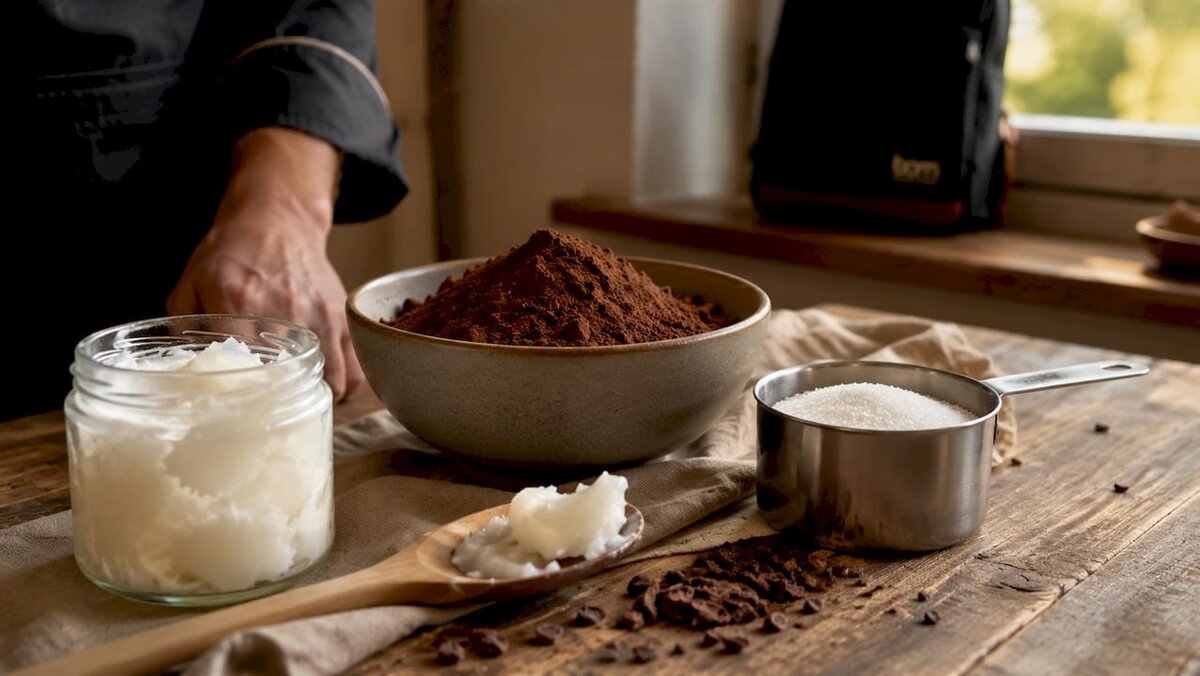
The core ingredients are:
The vegetable fats used are the defining factor. Palm kernel oil sets firm at room temperature and melts cleanly above it. Coconut oil produces a slightly softer result. Hydrogenated oils extend shelf life further but can introduce a waxy mouthfeel. The choice of fat directly affects the finished product’s texture, melting point, and overall quality.
Traditional chocolate, by contrast, relies on cocoa butter derived from cocoa beans. Cocoa butter has a precise crystalline structure that requires tempering to achieve a glossy finish and clean snap. Vegetable fats do not share this structure, which is why compound chocolate sets without any tempering at all. Some manufacturers produce what are called supercompounds, where cocoa butter partially replaces the vegetable fat to improve flavour while retaining some of the processing ease.
Pro Tip: Work compound chocolate at 3–5°C above its melting point for a smooth, professional finish. Too hot and it will be too thin to coat evenly; too cool and it will set before you finish.
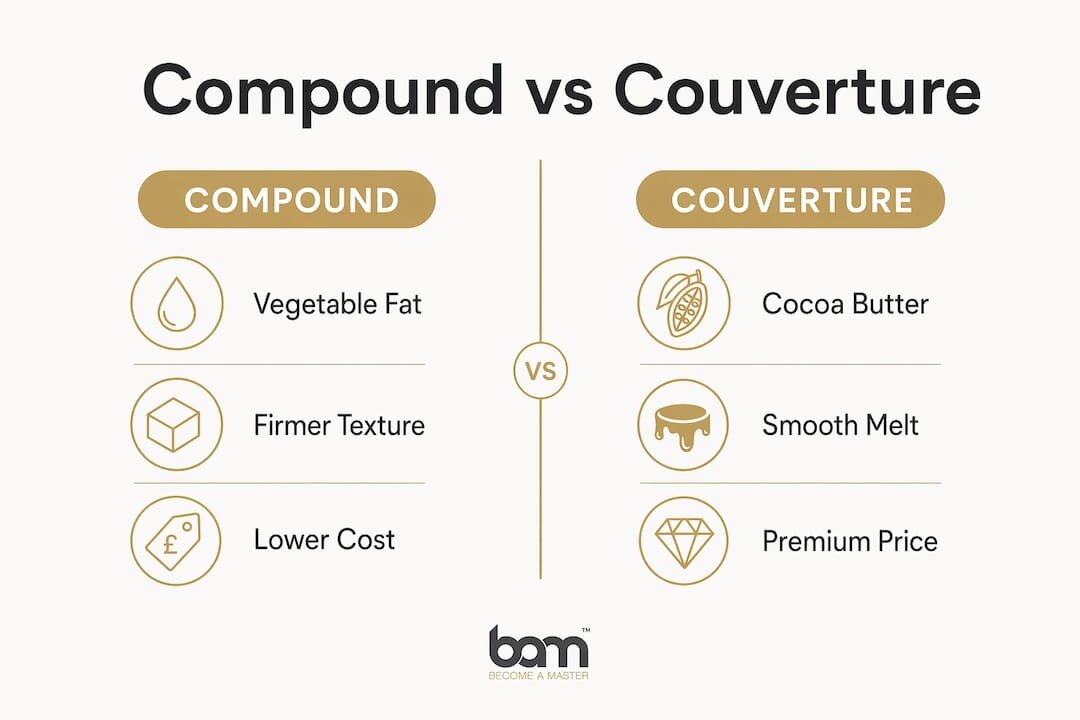
The difference between compound and couverture chocolate comes down to three things: flavour complexity, mouthfeel, and how each behaves under heat.
| Factor | Compound Chocolate | Couverture Chocolate |
|---|---|---|
| Primary fat | Vegetable fat (palm kernel, coconut) | Cocoa butter |
| Tempering required | No | Yes |
| Flavour profile | Milder, less complex | Rich, complex cocoa aroma |
| Mouthfeel | Firmer, waxier | Smooth, melts at body temperature |
| Cost per pound | Approximately £1.50–£4.00 | Can exceed £8.00 |
| Fat bloom resistance | High | Lower without correct tempering |
| Best use | Coating, enrobing, decoration | Premium confectionery, truffles |
Compound chocolate delivers a firmer bite and a waxier texture compared to couverture’s melt-in-mouth quality. The vegetable fats do not melt at body temperature the way cocoa butter does, so the sensation on the palate is noticeably different. For a premium chocolate truffle, that difference matters enormously. For a coated biscuit or a cake pop, most consumers will not notice.
The flavour gap is real but manageable. Replacing cocoa butter with vegetable fats compromises the melt and flavour experience but improves stability and ease of use. Compound chocolate carries a milder, less nuanced chocolate note. Professionals often use it as a carrier for added flavours, such as caramel, raspberry, or mint, rather than as a standalone chocolate flavour.
On the cost side, compound chocolate costs approximately £1.50–£4.00 per pound, while couverture can exceed £8.00 per pound. That represents a cost saving of 50–75% in production. For a small bakery producing hundreds of coated items per week, that saving is significant.
Pro Tip: If you are new to chocolate tempering techniques, start with compound chocolate to build confidence in coating and decorating before moving to couverture.
Compound chocolate is ideal for coating and decorating applications where speed and durability matter more than flavour complexity. It is the standard choice across industrial bakeries, school kitchens, and home bakers working at volume.
Here are the most common and effective applications:
The compound chocolate benefits extend beyond the kitchen. It is more stable at high temperatures, resistant to fat bloom, and suited to longer shelf life and less climate-controlled environments. That makes it the preferred choice for products sold at outdoor markets, in warm climates, or shipped without refrigeration.
Compound chocolate also comes in a wider range of colours and flavours than most couverture ranges. White, dark, milk, pink, and even flavoured varieties are widely available. Many of these are also suitable for vegan diets, as they contain no dairy, though you should always check the label for milk derivatives in the cocoa powder or flavourings used.
For anyone learning to work with chocolate, compound chocolate removes the most technically demanding step. You can focus on pastry decorating techniques without worrying about crystallisation or bloom.
Compound chocolate has genuine limitations, and knowing them helps you avoid costly mistakes.
Industry experts recommend compound chocolate when efficiency and cost are priorities, and couverture for premium, flavour-focused products. The decision is straightforward once you know your audience and your production scale. If you are unsure which to choose for a specific recipe, the guide on choosing chocolate for baking covers the key decision points clearly.
The trade-off is not about one being better than the other. It is about matching the right material to the right application. Compound chocolate used well, in the right context, produces excellent results. Used in the wrong context, it undermines the finished product.
Compound chocolate is the practical, cost-efficient alternative to couverture, best suited to coating, decoration, and high-volume baking where ease of use outweighs the need for complex flavour.
| Point | Details |
|---|---|
| Core definition | Compound chocolate replaces cocoa butter with vegetable fats, removing the need for tempering. |
| Cost advantage | Compound chocolate costs 50–75% less than couverture, making it practical for high-volume production. |
| Best applications | Use it for cake pops, biscuit coating, chocolate figures, and decorative work. |
| Key limitation | It produces a waxier mouthfeel and milder flavour than couverture; not suited to premium confectionery. |
| Critical rule | Never mix compound chocolate with couverture; incompatible fats prevent proper setting. |
When I first started working with chocolate in a professional kitchen, compound chocolate was treated as the inferior option. We used couverture for everything and looked down on anything made with vegetable fats. That view is too simple, and it costs people time and money.
Compound chocolate is not a compromise. It is a different tool. I use it regularly for high-volume coating work, for products going to outdoor events, and whenever I need a reliable set without a tempering machine. The results are consistent, the workflow is faster, and the cost savings are real.
Where I have seen beginners go wrong is in expecting compound chocolate to taste like couverture. It will not. If you want that deep, complex cocoa flavour, use couverture. If you want a clean, firm coating that sets in minutes and holds up in a warm room, compound chocolate is the right choice.
The one rule I enforce without exception: never mix the two. I have seen batches ruined by a small amount of couverture contaminating a compound chocolate coating. The fats are incompatible and the result is a coating that never sets properly.
My advice is to treat compound chocolate as a specialist ingredient, not a cheap substitute. Understand what it does well, use it in those contexts, and you will get professional results every time. The quality chocolate selection guide at Bamchocolate is a good starting point if you want to understand the full spectrum of options before committing to a purchase.
— Andraz
Working with compound chocolate is straightforward when you have the right tools and ingredients to hand. Bamchocolate stocks a full range of baking accessories designed for coating, moulding, and decorating work, from silicone moulds to dipping tools. For those starting out or scaling up, the BAM Basic pastry package brings together the core confectionery ingredients and accessories you need in one place. If you want to go further, the BAM Large Confectionery Bundle covers a wider range of applications. Browse the full range at Bamchocolate and find the right setup for your kitchen.
Compound chocolate is a confectionery coating made from cocoa powder and vegetable fats instead of cocoa butter. It does not require tempering and is widely used for biscuit coating, cake pops, and chocolate figures.
Many compound chocolates are vegan, as they contain no dairy by default, but you should always check the label. Some formulations include milk powder or milk-derived ingredients in the cocoa or flavouring components.
Compound chocolate works well for coating, enrobing, and decoration, but it is not a direct substitute for couverture in recipes where flavour and melt quality are central. Use it where ease of use and durability matter more than flavour complexity.
The vegetable fats in compound chocolate are incompatible with cocoa butter in couverture. Mixing the two prevents proper setting and can ruin the texture of the finished product entirely.
Melt compound chocolate gently in a bain-marie or microwave in short bursts, then work it at 3–5°C above its melting point. Unlike couverture, it does not need to be tempered, but overheating will thin it out and affect the finished coating.


 Confectionery tips


 Slovenščina
 Hrvatski
 Deutsch
 Italiano
 Česky
Česky
 Polski
 Magyar
 Français
 Slovák
 Nederlands
 Español