 info@bamchocolate.com
  Login
Login 
 en
en 
 BAM Cake converter
  Login
Login Claudia
Avtorica vsebin


 Reading time:
10 minutes
Reading time:
10 minutes 
Discover why choose plant-based desserts in our comprehensive guide! Learn about health benefits, sustainability, and how to indulge guilt-free.
TL;DR:
- Plant-based desserts have expanded beyond health food aisles, driven by consumer demand for sustainability and indulgence. The health benefits are real but depend on using high-quality, minimally processed ingredients like whole foods and healthy fats. Advances in natural texturisers and ingredients like dark chocolate now allow for desserts that are both satisfying and environmentally friendly.
Plant-based desserts have moved well beyond the health food aisle. The vegan confectionery market was valued at approximately US$2.0 billion in 2026 and is projected to reach US$3.4 billion by 2032, driven by mainstream consumers seeking healthier, more sustainable options. Yet many people still hesitate, wondering whether plant-based sweets can genuinely satisfy or whether they are simply a compromise. This guide addresses those concerns directly. You will find a balanced look at the health advantages of plant-based desserts, the environmental case, the culinary reality, and the practical steps for making smart choices.
| Point | Details |
|---|---|
| Health advantages are real but nuanced | Plant-based sweets can reduce saturated fat and boost fibre, but ingredient quality determines the outcome. |
| Environmental impact is measurable | Choosing plant-based options lowers greenhouse gas emissions and water use compared to dairy-based desserts. |
| Texture and taste have improved significantly | Natural texturisers and high-quality plant fats now produce genuinely indulgent results. |
| Label reading is non-negotiable | Some plant-based desserts are high in calories, allergens, or added sugar, so checking labels matters. |
| Dark chocolate is your reliable starting point | Naturally dairy-free and rich, dark chocolate makes plant-based baking straightforward and satisfying. |
The most common reason people ask why choose plant-based desserts is health. The honest answer is that the benefits are real, but they depend almost entirely on what goes into the recipe.
Swapping dairy butter for plant-based oils and nut butters can reduce saturated fat by 30 to 50 per cent while maintaining a similar mouthfeel. That is a significant shift for anyone managing cholesterol or cardiovascular risk. Coconut oil, almond butter, and cashew cream all contribute fat that keeps textures rich without the animal-derived saturated load. The difference shows up not just on a nutrition label but in how you feel after eating.
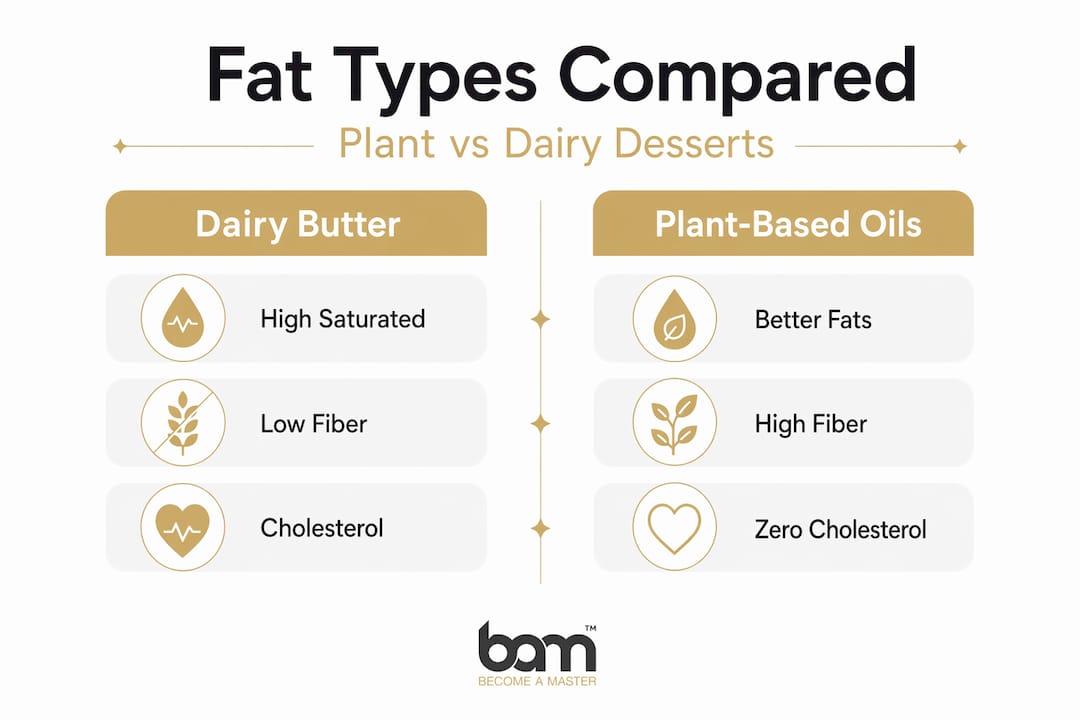
A 2023 study of over 126,000 participants found that higher consumption of whole and minimally processed plant foods relates to lower risk of cardiovascular disease, cancer, and mortality. The key word is quality. A plant-based brownie made with refined flour, palm oil, and high-fructose syrup offers little advantage over a conventional one. When you use whole-food ingredients such as oat flour, medjool dates, or raw cacao, the nutritional picture changes considerably.
Here is what the health advantages of plant-based desserts actually look like in practice:
Pro Tip: Watch out for the “plant-based” label on processed products. Plant-based does not equal low-calorie or allergen-free. Nuts, seeds, soy, and added sugars can push calories up and introduce allergen risks, so always read the full ingredient list.
One important nuance: sugar-free desserts are not automatically healthier. Dietitian Maya Feller noted in 2025 that sugar-free products are often highly processed and may contain more fat to compensate for taste. A small portion of a well-made, real-sugar plant-based dessert is frequently a better choice than a heavily processed sugar-free alternative.
The reasons to choose plant-based sweets extend beyond your own health. The environmental case is grounded in measurable data, not sentiment.
Dairy production requires substantially more water, land, and energy per kilogram of output than plant-based alternatives. Producing one litre of dairy milk generates roughly three times the greenhouse gas emissions of oat milk. When you scale that across a batch of panna cotta or a cream-filled gateau, the cumulative difference becomes significant. Choosing plant-based dessert options is one of the more tangible ways an individual can reduce their food-related carbon footprint without dramatic lifestyle changes.

Beyond emissions, there is the question of animal welfare. Dairy farming involves practices that many consumers find ethically uncomfortable once they look closely. Plant-based desserts remove that concern entirely, offering a cleaner conscience alongside the treat.
There is also the sourcing dimension. Cacao, for example, can be grown under shade-forest conditions that preserve biodiversity and support smallholder farmers. When you choose vegan chocolate made from ethically sourced cacao, you are supporting an agricultural model that benefits ecosystems and communities simultaneously.
| Factor | Dairy-based desserts | Plant-based desserts |
|---|---|---|
| Greenhouse gas emissions | High (dairy, eggs) | Lower (plant oils, nut milks) |
| Water use | High | Moderate to low |
| Land use | High (grazing, feed crops) | Lower overall |
| Animal welfare impact | Direct | Minimal to none |
| Allergen profile | Dairy, eggs common | Nuts, soy possible |
Plant-based chocolate offers a particularly compelling case, delivering indulgent texture and heart-health benefits by eliminating dairy and cholesterol while retaining antioxidants from cacao.
The most persistent myth about plant-based desserts is that they taste like a compromise. That was largely true a decade ago. It is not true now.
Replicating creaminess and mouthfeel without dairy remains the primary technical challenge, and it is the challenge driving the most interesting innovation in the food industry today. Natural texturisers such as Acacia fibre and locust bean gum now allow manufacturers and home bakers alike to achieve the silky, dense qualities that make a dessert genuinely satisfying. Acacia fibre is particularly useful because it doubles as a texturiser and prebiotic, improving both mouthfeel and gut health simultaneously.
Dark chocolate is a reliable base for plant-based desserts. It is naturally dairy-free, rich in flavour, and works across a wide range of applications from mousses to tarts to truffles. You do not need butter, cream, or eggs to build something genuinely indulgent when you start with high-quality dark chocolate. The complex cocoa notes carry the dessert in a way that no substitute ingredient needs to compensate for.
Plant fats also play a more sophisticated role than many people realise. Cocoa butter, for instance, undergoes a crystallisation process during tempering that produces the characteristic snap and gloss of good chocolate. Understanding this is why you will find 5 reasons to try vegan chocolate worth reading if you are new to plant-based confectionery.
Here are the plant-based dessert types that demonstrate this innovation most clearly:
Pro Tip: When baking at home, chill your cashew-based fillings for at least four hours before serving. The texture firms up considerably and the flavour deepens, making the result far more convincing than a freshly blended version.
Knowing why plant-based desserts matter is one thing. Putting that knowledge into practice is another. Here is a straightforward approach to making better choices, whether you are buying ready-made products or baking from scratch.
Read ingredient labels carefully. Look for whole-food ingredients in the first three positions. If refined sugar, palm oil, or glucose syrup appears near the top, the health advantages diminish quickly. Check for allergens including nuts, soy, and gluten, which appear frequently in plant-based products.
Reduce sugar gradually when baking. You can typically cut refined sugar by 20 to 25 per cent in most plant-based recipes and compensate with ripe fruit, vanilla, or a small amount of a natural sweetener. The texture changes slightly, but the flavour often improves.
Use fruit-based desserts for everyday occasions. Fruit-based plant desserts such as baked pears, poached plums, or a raw berry tart have a longer fridge life than dairy-based equivalents because they lack dairy that spoils quickly. This reduces food waste and keeps healthy options readily available through the week.
Integrate desserts mindfully rather than eliminating them. A small, well-made plant-based dessert after a balanced meal is a reasonable and enjoyable part of any diet. The goal is not restriction but informed choice.
Experiment with texturisers before committing to a recipe. Agar agar, psyllium husk, and flaxseed gel all behave differently depending on temperature and acidity. Test small batches before scaling up, particularly for set desserts and mousses.
I have spent a fair amount of time tasting, testing, and thinking about plant-based confectionery, and the honest truth is that my scepticism lasted longer than it should have. I assumed that removing dairy and eggs meant removing the things that make desserts worth eating.
What changed my view was not a single product but the gradual accumulation of well-made ones. A properly tempered dark chocolate truffle made with cocoa butter and no dairy is, in my experience, often better than its milk chocolate counterpart. The flavour is cleaner, the finish is less cloying, and the quality of the cacao comes through without being masked by cream.
What I have learned is that the question is rarely “plant-based or not.” It is always “what quality of ingredients, and how much care went into making this?” A poorly made plant-based dessert is still a poorly made dessert. But a well-crafted one, built on good chocolate, whole-food fats, and thoughtful technique, does not ask you to compromise on anything.
The area where I think most people still underestimate plant-based options is texture. The innovation happening with natural fibres and plant fats is genuinely exciting. If you have not tried a cashew cheesecake or an aquafaba mousse made with quality ingredients, you are working from an outdated assumption. Explore with curiosity. The results will likely surprise you.
— Andraz
If you are ready to put these ideas into practice, Bamchocolate offers a range of professional-grade ingredients designed for exactly this kind of baking. The baking accessories range includes texturisers, stabilisers, and specialist ingredients that make plant-based desserts easier to get right at home. For those who want a structured starting point, the BAM Basic pastry package brings together the core confectionery ingredients you need for plant-based recipes. If you want inspiration alongside ingredients, the 101 BAM pastry recipe collection covers a wide range of plant-based and adaptable pastry techniques. Quality ingredients make a measurable difference to the final result.
Plant-based desserts can reduce saturated fat and dietary cholesterol while increasing fibre and micronutrient content, particularly when made with whole-food ingredients like oat flour, nuts, and raw cacao. The quality of ingredients determines the actual health benefit.
Not automatically. Some plant-based products are highly processed and high in calories, added sugar, or allergens. Choosing options made with whole-food ingredients and minimal processing gives you the clearest health advantage.
Yes, with the right ingredients. Natural texturisers such as Acacia fibre and locust bean gum, along with plant fats like cocoa butter and cashew cream, now produce results that closely match dairy-based creaminess and mouthfeel.
Dairy production generates significantly more greenhouse gas emissions and uses more water and land than plant-based alternatives. Choosing plant-based dessert options is one of the more direct ways to reduce your food-related environmental impact.
Yes. Dark chocolate is naturally dairy-free and works across a wide range of desserts including truffles, mousses, ganaches, and tarts. It provides rich flavour and good texture without requiring butter, cream, or eggs.



 Confectionery tips



 Slovenščina
 Hrvatski
 Deutsch
 Italiano
 Česky
Česky
 Polski
 Magyar
 Français
 Slovák
 Nederlands
 Español