 info@bamchocolate.com
  Login
Login 

 en
en 
 BAM Cake converter
  Login
Login Claudia
Avtorica vsebin


 Reading time:
11 minutes
Reading time:
11 minutes 
Learn how to bake with dietary chocolate alternatives like carob and date paste for rich, flavorful treats that fit sugar-free and vegan diets.
TL;DR:
- Baking with dietary chocolate alternatives relies on using ingredients like carob powder, date paste, and plant-based chocolates to meet various dietary needs. Proper substitution involves adjusting fat, sugar, and moisture to replicate traditional chocolate’s functional roles in recipes. These alternatives enhance flavor and texture without compromising dietary restrictions, expanding options for healthier or allergen-free baked goods.
Baking with dietary chocolate alternatives means using ingredients such as carob powder, date paste, and plant-based chocolates to replace traditional chocolate while meeting sugar-free, dairy-free, and vegan requirements. These substitutes are not compromise options. When chosen correctly and used with the right technique, they produce baked goods with genuine depth of flavour and satisfying texture. Carob, for instance, is naturally sweet and caffeine-free, making it a strong choice for those with chocolate allergies or stimulant sensitivities. Date paste adds mineral richness alongside natural sweetness. Plant-based chocolates and cocoa-free alternatives like NextCoa™ extend the options further, covering everything from vegan brownies to allergen-free confectionery fillings.
The four most reliable chocolate substitutes for home baking are carob powder, date paste, unsweetened cocoa powder combined with fat and a sweetener, and plant-based dark chocolate. Each one serves a different purpose depending on your dietary needs and the recipe you are working with.
Carob powder is the most accessible starting point. It carries a caramel-like sweetness without any caffeine, making it suitable for children, those avoiding stimulants, and anyone with a chocolate allergy. It works well in cookies, cakes, and brownies where you want a rich brown colour and mild sweetness without adding extra sugar.
Date paste is a less obvious choice but a genuinely useful one. A 2026 study on chocolate spreads found that replacing sucrose with up to 50% date paste improved mineral content and texture without harming spreadability. That 50% threshold is the practical sweet spot: above it, sensory scores drop and the paste can make batters too dense.
Unsweetened cocoa powder combined with fat and a sweetener is the most flexible DIY substitute. It gives you full control over sweetness and fat content, which matters when you are adapting a recipe for multiple dietary restrictions at once. The key is treating it as a building block rather than a direct swap.
Plant-based alternatives such as vegan dark chocolate and NextCoa™ from Cargill use upcycled grape seeds to mimic chocolate functionality. NextCoa™ is designed for bake-stable drops, wafers, and fillings, and carries vegan certification. It fills a genuine gap for bakers who need allergen-free, cocoa-free performance in professional-style applications.
| Alternative | Flavour profile | Best use | Dietary compatibility |
|---|---|---|---|
| Carob powder | Sweet, caramel, mild | Cakes, cookies, brownies | Vegan, caffeine-free, nut-free |
| Date paste | Rich, fruity, earthy | Spreads, fudge, energy bars | Vegan, refined sugar-free |
| Cocoa powder + fat | Intense, bitter, adjustable | Any baked good | Vegan if plant fat is used |
| Vegan dark chocolate | Deep, complex, rich | Ganache, mousse, cookies | Dairy-free, often gluten-free |
| NextCoa™ drops | Mild, chocolate-like | Fillings, wafers, drops | Vegan, allergen-free |
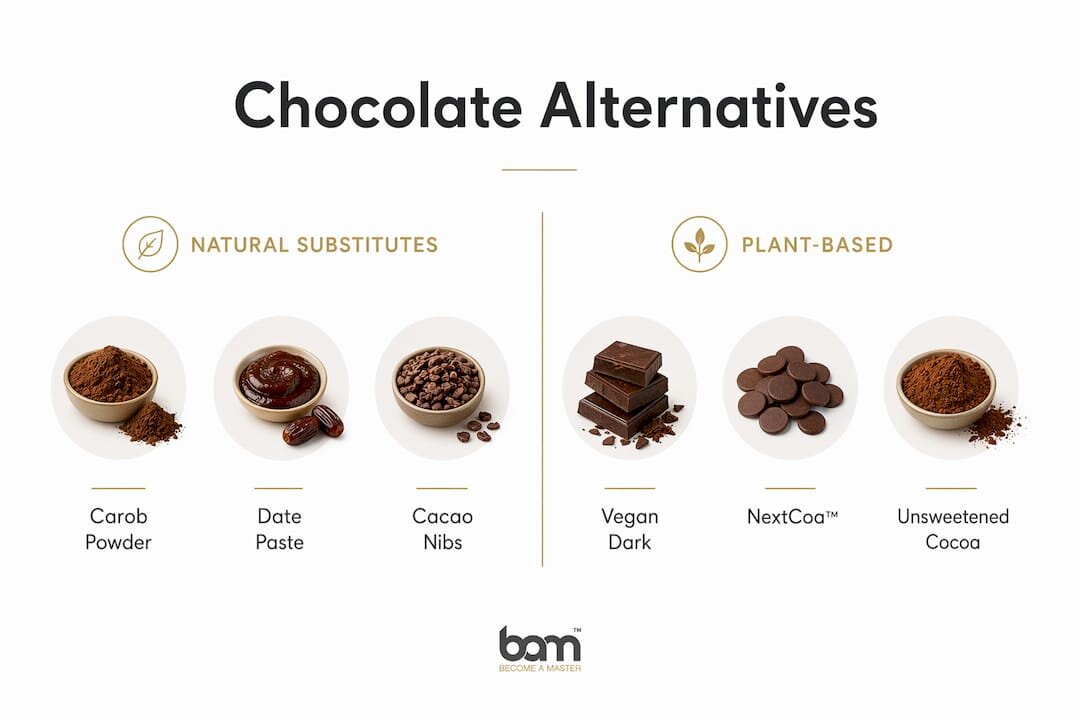
Pro Tip: Choosing between cacao nibs and carob comes down to intensity. Use cacao nibs when you want nutritional density and a bold, slightly bitter flavour. Use carob when you want natural sweetness and a gentler profile without caffeine.
Getting the substitution right is where most home bakers run into trouble. The issue is almost never the alternative itself. It is the failure to account for the fat, sugar, and moisture that traditional chocolate brings to a recipe.
Follow these substitution ratios as a starting point, then adjust based on your specific recipe:
When you are working with cocoa powder as a substitute, adding 2 teaspoons of fat per tablespoon of cocoa is non-negotiable. Skip this step and the result is a dry, chalky texture that no amount of extra liquid will fix.
For sugar-free baking, the choice of sweetener matters as much as the chocolate substitute. A 1:1 powdered erythritol and monk fruit blend works well for most cakes and cookies because it provides both sweetness and bulk. Allulose is the better option for brownies and moist cakes because it browns and retains moisture in a way that closely mimics sucrose. Stevia works in small amounts but causes bitterness above 1 teaspoon, which is a common mistake in low-sugar chocolate baking.
Pro Tip: If your sugar-free baked goods come out with a gritty or crystallised texture, erythritol is almost always the cause. Switch to powdered erythritol or replace it with allulose for a smoother result.
Baking with chocolate alternatives is not just about swapping one ingredient for another. Each substitute interacts differently with the other components in a recipe, and dietary restrictions often stack. A vegan baker who also avoids gluten and refined sugar needs to think about three separate ingredient categories at once.
Here are the key considerations by dietary category:
Some baked goods adapt to chocolate alternatives more naturally than others. Knowing where each substitute performs best saves you from unnecessary trial and error.
Pro Tip: When adapting a classic chocolate cake recipe for vegan and gluten-free baking simultaneously, make one change at a time. Replace the chocolate first, test the result, then adjust the flour blend. Changing everything at once makes it impossible to identify what needs correcting.
For further guidance on choosing chocolate for baking, Bamchocolate covers the full spectrum from couverture to compound and everything in between.
Successful baking with chocolate alternatives requires matching the right substitute to the recipe, then adjusting fat, sugar, and binding agents to compensate for what traditional chocolate provides.
| Point | Details |
|---|---|
| Match substitute to recipe type | Carob suits cookies and cakes; date paste works best in spreads and fudge; cocoa powder suits any baked good with fat added. |
| Always replace fat when using cocoa powder | Add 2 teaspoons of butter or plant-based fat per tablespoon of cocoa to avoid dry, chalky results. |
| Choose the right sugar alternative | Use allulose for moist, brownable results; use powdered erythritol for structure; avoid stevia above 1 teaspoon. |
| Gluten-free baking needs a binder | Add xanthan gum for cakes and cookies, or psyllium husk gel for breads, regardless of which chocolate substitute you use. |
| Date paste at 50% substitution is the sweet spot | Research confirms best sensory results at 50% date paste replacement; higher ratios reduce spreadability and flavour balance. |
I spent a long time approaching chocolate alternatives with the wrong mindset. I treated them as inferior stand-ins, something you used when you had no other option. That attitude produced mediocre results, and I blamed the ingredients rather than my technique.
The shift came when I started treating each alternative as its own ingredient with its own logic. Carob is not failed chocolate. It is a genuinely different product with a flavour profile that suits certain recipes better than cocoa ever would. Date paste in a brownie does not taste like a compromise. It tastes like a richer, more complex version of the original.
The mistake I see most often from other bakers is skipping the fat adjustment when using cocoa powder. That single omission is responsible for more failed batches than any other error. The second most common mistake is using too much stevia, which turns an otherwise good cake bitter in a way that is very difficult to correct.
My current approach is to keep carob powder, allulose, and a quality vegan dark chocolate in stock at all times. Those three cover the majority of dietary restrictions and recipe types. From there, date paste and cacao nibs handle the more specific applications. If you are just starting out, begin with carob in a simple cookie recipe. It is forgiving, naturally sweet, and gives you an immediate sense of what these substitutes can actually do.
— Andraz
Bamchocolate stocks a curated selection of products that work directly alongside the substitutes covered in this article. The baking accessories range includes specialist tools, gloves, and confectionery sets suited to working with plant-based chocolates, carob, and alternative fillings. For recipe inspiration, the 101 BAM pastry recipe book covers a wide range of adaptations for dietary preferences including sugar-free and dairy-free baking. Both are practical additions to any home baker’s setup, particularly when you are working with new ingredients and need reliable guidance alongside quality tools.
Yes. Replace 1 oz of unsweetened baking chocolate with 3 tablespoons of cocoa powder plus 1 tablespoon of fat such as butter or coconut oil. Always add the fat or the texture will be dry and chalky.
Carob powder substitutes cocoa powder at a 1:1 ratio by weight. Because carob is naturally sweeter, reduce any added sugar in the recipe by approximately 25% to avoid an overly sweet result.
Allulose is the most functional option for moist, brownable baked goods such as brownies and cakes. A powdered erythritol and monk fruit blend works well for cookies and firmer bakes where crystallisation is less of a concern.
Most chocolate alternatives including carob, cocoa powder, and vegan dark chocolate are naturally gluten-free. The challenge in gluten-free baking is the flour blend, which requires a binder such as xanthan gum or psyllium husk gel to hold structure.
NextCoa™ is a cocoa-free confectionery alternative developed by Cargill using upcycled grape seeds. It is designed for bake-stable drops, wafers, and fillings, and is certified vegan and allergen-friendly, making it suitable for professional and home baking applications.



 Confectionery tips



 Slovenščina
 Hrvatski
 Deutsch
 Italiano
 Česky
Česky
 Polski
 Magyar
 Français
 Slovák
 Nederlands
 Español