 info@bamchocolate.com
 Login


 en

 BAM Cake converter
 Login
Claudia
Avtorica vsebin


 Reading time:
11 minutes
Discover the vital role of dietary products in baking! Transform your home baking with functional ingredients for delicious, nutritious treats.
TL;DR:
- Dietary ingredients in baking, such as enzymes, fibres, and binders, function as precision tools that improve structure, moisture, and shelf life of baked goods. Proper understanding and measurement are essential, as exceeding substitution limits or misapplying ingredients can reduce quality and texture. Ultimately, methodical experimentation and accurate hydration control enable home bakers to craft healthier, high-quality gluten-free and fibre-enhanced baked treats.
Dietary products in baking are defined as functional ingredients, including fibres, enzymes, and binding agents, that modify the structural, nutritional, and sensory properties of baked goods. The role of dietary products in baking extends well beyond simple nutrition. Ingredients such as xanthan gum, psyllium husk, microbial lipases, and vegetable fibres each perform specific technical functions: binding dough, extending shelf life, improving crumb texture, and supporting gluten-free formulations. Understanding how these ingredients work gives home bakers the tools to produce baked goods that meet specific dietary needs without sacrificing quality.
Dietary ingredients are not passive additions. Each one interacts with the dough or batter in a measurable way, affecting everything from rise and crumb structure to moisture retention and shelf life.
Enzymes: the invisible workhorses
Microbial lipases are among the most studied functional additives in bread baking. They improve loaf volume by 15 to 35%, increase dough stability by 20%, and extend shelf life by one to two days. That shelf life extension is significant for home bakers who bake in batches and want to avoid waste. Lipases work by modifying the fat structure in dough, which strengthens the gluten network and produces a finer, more uniform crumb. You can read more about extending baked goods freshness on the Bamchocolate resource pages.
Dietary fibres: texture and health in one ingredient
Vegetable fibres from sources such as apple pomace, carrot residue, and oat bran serve a dual purpose. They increase the fibre content of the finished product and alter water absorption in the dough. Fibre additives affect water distribution, which means liquid quantities and baking times must be adjusted to avoid a dense or gummy crumb. This is not a flaw in the ingredient. It is a technical property that, once understood, becomes a tool for recipe control.
Binding agents in gluten-free baking
Xanthan gum and psyllium husk are the two most widely used binders in gluten-free formulations. Their role is not to substitute gluten loosely. Psyllium husk replicates gluten’s structural network, forming a gel that traps gas bubbles and gives dough its elasticity. Without a binder, gluten-free baked goods crumble, collapse, or fail to rise. The distinction matters: these are precision tools, not interchangeable fillers.
Key functional roles at a glance:
Adding more fibre does not automatically produce a better result. There are clear formulation limits, and exceeding them produces baked goods with hard crumbs, reduced volume, and poor palatability.
Substitution limits for vegetable fibre additives are 5 to 10% in yeast-leavened breads and up to 20% in cookies and gluten-free products. The higher tolerance in cookies and gluten-free items reflects the different structural demands of those products. A yeast bread relies on a precise gluten network and gas retention. A cookie does not, so it tolerates more fibre without structural failure.
| Product type | Recommended fibre substitution limit | Key quality risk if exceeded |
|---|---|---|
| Yeast-leavened bread | 5 to 10% | Reduced volume, dense crumb |
| Cookies and shortbreads | Up to 20% | Dry texture, crumbling |
| Gluten-free products | Up to 20% | Gummy or overly dense crumb |
Agro-industrial by-products such as tomato skin, beetroot pulp, and citrus peel are increasingly used as functional fibre sources in bakery formulations. These are not mere fillers. They actively adjust dough rheology, meaning they change how the dough flows and holds its shape. For home bakers, this translates to a practical rule: when you add a fibre-rich ingredient, reduce the liquid slightly and check the dough consistency before committing to the full bake.
Pro Tip: When substituting more than 5% of your flour with a vegetable fibre or whole grain powder, add liquid in small increments rather than all at once. Fibre absorbs water progressively, and the dough will tighten as it rests.
Baking time also requires adjustment. Fibre-rich doughs retain more moisture internally, which can make the crust appear done before the centre has set. An extra five to ten minutes at a slightly lower temperature often produces a better result than a shorter bake at high heat.
Gluten-free baking requires a different technical approach from conventional baking. The most common reason gluten-free bakes fail is not a poor recipe. It is the application of conventional baking instincts to a fundamentally different system.
Follow these steps for consistent results:
Pro Tip: If your gluten-free loaf is collapsing in the centre, the batter is likely too wet or the binder quantity is insufficient. Increase psyllium husk by half a teaspoon and extend the rest period before baking.
Healthier baking is not about removing everything enjoyable. It is about substituting strategically so that the nutritional profile improves without the texture or flavour suffering. The practical tips for baking cakes on Bamchocolate cover hydration and starch incorporation in detail, and the same principles apply when working with dietary ingredients.
Practical approaches for home bakers:
The how to make healthier confectionery guide on Bamchocolate covers additional substitution strategies for confectionery and baked goods, including sugar-free and protein-enriched options.
Dietary products in baking function as precision tools that control texture, structure, shelf life, and nutrition. Using them correctly requires understanding their technical limits, not just their health benefits.
| Point | Details |
|---|---|
| Enzymes extend shelf life | Microbial lipases improve loaf volume by up to 35% and add one to two days of freshness. |
| Fibre substitution has limits | Keep vegetable fibre additions to 5 to 10% in yeast breads and up to 20% in cookies or gluten-free products. |
| Binders are structural tools | Psyllium husk and xanthan gum replicate gluten’s network; dosage precision determines success or failure. |
| Rest time matters | Resting gluten-free batter for 10 to 30 minutes allows binders to hydrate and form proper gel structure. |
| Weigh, do not measure by volume | A digital scale is the most reliable way to control hydration and consistency in dietary baking. |
By Andraz
The biggest mistake I see home bakers make with dietary ingredients is treating them as drop-in replacements. You cannot swap psyllium husk for xanthan gum in equal quantities and expect the same result. They behave differently in dough, absorb water at different rates, and produce different textures. I learned this the hard way with a gluten-free sourdough that looked perfect going into the oven and came out with the structural integrity of wet sand.
The second lesson is that precision matters more in dietary baking than in any other type. A digital scale is not optional. When you are working with psyllium husk, a difference of two grams can be the difference between a loaf that holds its shape and one that collapses. Volume measurements simply do not give you that control.
What I find genuinely interesting about this area is how much the science has advanced. Microbial lipases, once only available to industrial bakers, are now accessible to home bakers through specialist suppliers. Agro-industrial fibre sources like apple pomace and beetroot pulp, which were once discarded, are now recognised as functional ingredients that improve both nutrition and texture. The gap between professional and home baking is narrowing, and dietary ingredients are a large part of why.
My advice: start with one substitution at a time. Change the binder, or the flour, or the fat source. Not all three at once. Document what you change and what the result looks like. Baking with dietary products rewards methodical experimentation far more than intuition.
— Andraz
Bamchocolate stocks a curated range of baking additives and accessories suited to dietary and functional baking, including binders, texture improvers, and specialist ingredients for gluten-free and high-fibre recipes. For those looking to build a full baking repertoire, the 101 BAM pastry recipe book covers a wide range of formulations including dietary-conscious options, while the BAM Basic pastry package provides an ingredient bundle suited to experimentation across different baking styles. Whether you are refining a gluten-free loaf or adding fibre to your standard cake recipe, Bamchocolate’s product range supports both the ingredients and the knowledge needed to bake with confidence.
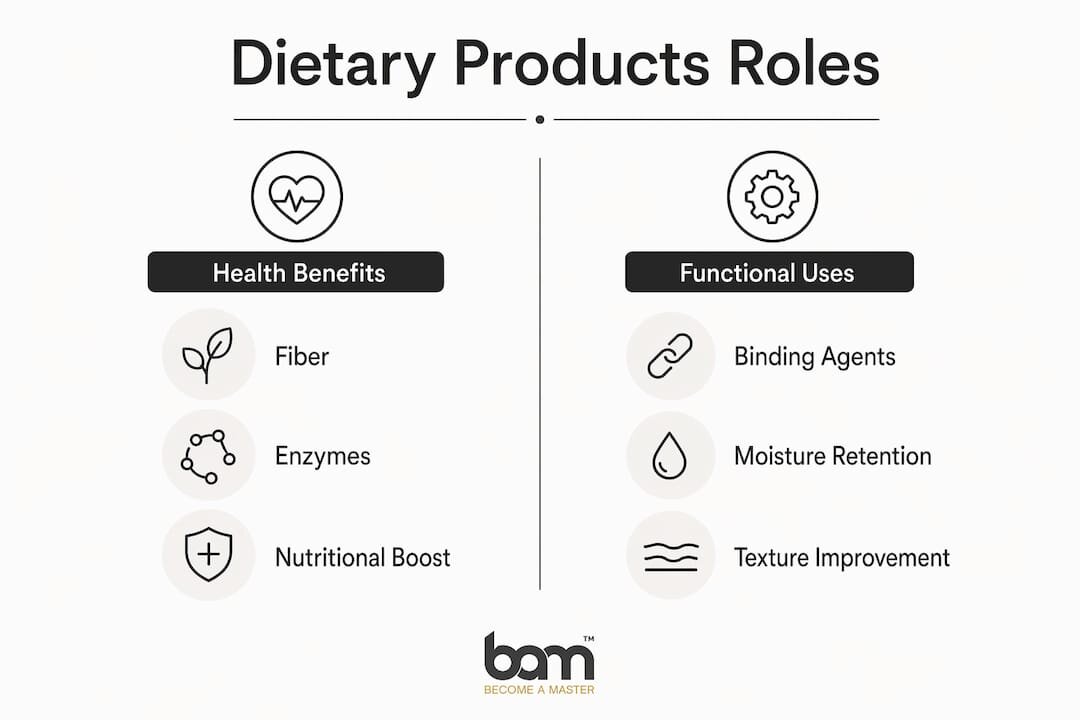
Dietary products in baking serve functional roles including binding, moisture retention, volume improvement, and shelf life extension. Ingredients such as psyllium husk, xanthan gum, microbial lipases, and vegetable fibres each affect dough structure and the final texture of baked goods.
Xanthan gum requires ½ to 1 teaspoon per cup of gluten-free flour blend, while psyllium husk requires 1 to 2 teaspoons per cup. Using the correct dosage is critical: too little produces crumbling, and too much creates a gummy texture.
Vegetable fibre can be added to most baked goods, but substitution limits vary. Yeast breads tolerate 5 to 10% fibre substitution, while cookies and gluten-free products can handle up to 20%. Exceeding these limits reduces volume and produces a hard or dense crumb.
Resting gluten-free batter for 10 to 30 minutes allows binders like psyllium husk to fully hydrate and form a gel structure. Skipping this step results in a looser batter that bakes unevenly and produces a poor crumb.
Yes. Fibre-rich doughs retain more internal moisture, which can make the crust appear done before the centre has set. Reducing the oven temperature slightly and extending the bake time by five to ten minutes typically produces a more evenly baked result.



 Confectionery tips




 Slovenščina
 Hrvatski
 Deutsch
 Italiano
 Česky
 Polski
 Magyar
 Français
 Slovák
 Nederlands
 Español