 info@bamchocolate.com
  Login
Login 

 en
en 
 BAM Cake converter
  Login
Login Claudia
Avtorica vsebin


 Reading time:
10 minutes
Reading time:
10 minutes 
Master the premium baking ingredient workflow with our 2026 guide. Learn to ensure quality and traceability for consistent results in your baking.
TL;DR:
- A premium baking ingredient workflow integrates sourcing, storage, processing, and traceability to ensure consistent product quality. Proper ingredient handling, controlled storage microclimates, and precise process control are essential components for successful implementation. Traceability systems connect raw material specifications to finished products, enabling proactive quality management and rapid issue identification.
A premium baking ingredient workflow is a controlled, integrated process that links ingredient selection, storage, processing, and traceability to deliver consistent product quality at every stage. Industry professionals refer to this as ingredient process management, though the workflow framing better captures the sequential, interdependent nature of each step. Whether you are tempering couverture chocolate or scaling dry goods for a commercial run, the quality of your output depends as much on how you handle ingredients as on which ingredients you choose. This guide covers every stage of that process, from sourcing decisions through to audit-ready traceability, using 2026 best practices and real production examples.
Effective premium baking ingredient selection starts with supplier reliability, not price. A supplier who delivers consistent lot specifications, accurate labelling, and timely documentation reduces variability before ingredients even reach your kitchen or production floor. Sensory quality, including aroma, colour, particle size, and moisture content, must be verified against a written specification sheet on every delivery. Without that baseline, even the best recipe produces inconsistent results.
When sourcing chocolate specifically, choosing the right chocolate for your application matters as much as the supplier. Couverture chocolate requires a minimum cocoa butter content that affects tempering behaviour and final gloss. Dark, milk, and white varieties each carry different fat and sugar profiles that interact differently with other ingredients in your formula.
The table below outlines the main premium ingredient categories and the sourcing factors that most affect workflow quality.
| Ingredient category | Key sourcing criteria | Workflow risk if neglected |
|---|---|---|
| Couverture chocolate | Cocoa butter %, origin, lot traceability | Bloom, poor snap, tempering failure |
| Specialty flours | Protein content, moisture, milling date | Inconsistent dough hydration |
| Nut pastes and pralines | Fat content, particle size, freshness | Separation, off-flavours in fillings |
| Sugars and syrups | Purity grade, moisture activity | Caking, crystallisation in batches |
| Freeze-dried fruits | Water activity, colour stability | Moisture migration, texture failure |
Beyond the table, three sourcing practices separate professional workflows from ad hoc buying:
Controlled storage is the most underestimated step in any high-quality baking supplies operation. Ingredients that arrive in perfect condition can degrade within days if stored incorrectly, and the damage is often invisible until you are mid-batch.
Controlled storage microclimates with temperatures between 10°C and 21°C and relative humidity between 30% and 50% reduce caking, moisture uptake, and mould risks in dry premium ingredients. This means that a single poorly ventilated storeroom can undermine an otherwise excellent sourcing programme. The action threshold for humidity is 55% relative humidity sustained for 48 hours. At that point, dry goods including specialty flours, sugars, and freeze-dried fruits begin absorbing moisture at a rate that affects their functional properties.
For chocolate, the risks are different but equally damaging. Fat bloom occurs when chocolate is exposed to temperature fluctuations that cause cocoa butter to migrate and recrystallise on the surface. Sugar bloom results from condensation. Both are storage failures, not processing failures. Detailed guidance on chocolate storage conditions covers the specific temperature bands and packaging requirements that prevent both defect types.
Practical storage rules for a professional workflow:
Pro Tip: Install a low-cost data logger in each storage zone and set automated alerts at 53% relative humidity. This gives you a two-percentage-point buffer before the 55% action threshold, enough time to intervene before ingredient quality is affected.
Processing is where ingredient quality either holds or fails. The steps below apply to chocolate-based production, which represents the most technically demanding category in premium baking ingredient management, but the control principles transfer directly to pastry creams, nut-based fillings, and laminated doughs.

1. Verify ingredient condition before processing begins. Check lot codes against your specification sheet. Confirm chocolate is at ambient temperature (18°C to 20°C) before melting. Cold chocolate introduced to a warm process creates condensation and uneven melting.
2. Melt to full liquefaction. For dark couverture, melt to 50°C to 55°C. This erases all previous crystal structures. Chocolate tempering requires melting to erase prior crystals, cooling to form stable Form V seed crystals, then reheating to remove unstable forms. Skipping full liquefaction means residual unstable crystals carry through and cause streaking or dullness in the finished product.
3. Cool to seeding temperature. For dark chocolate, cool to 27°C to 28°C while agitating. This is where Form V crystals nucleate. Agitation is not optional. Without it, crystal distribution is uneven and the temper is inconsistent across the batch.
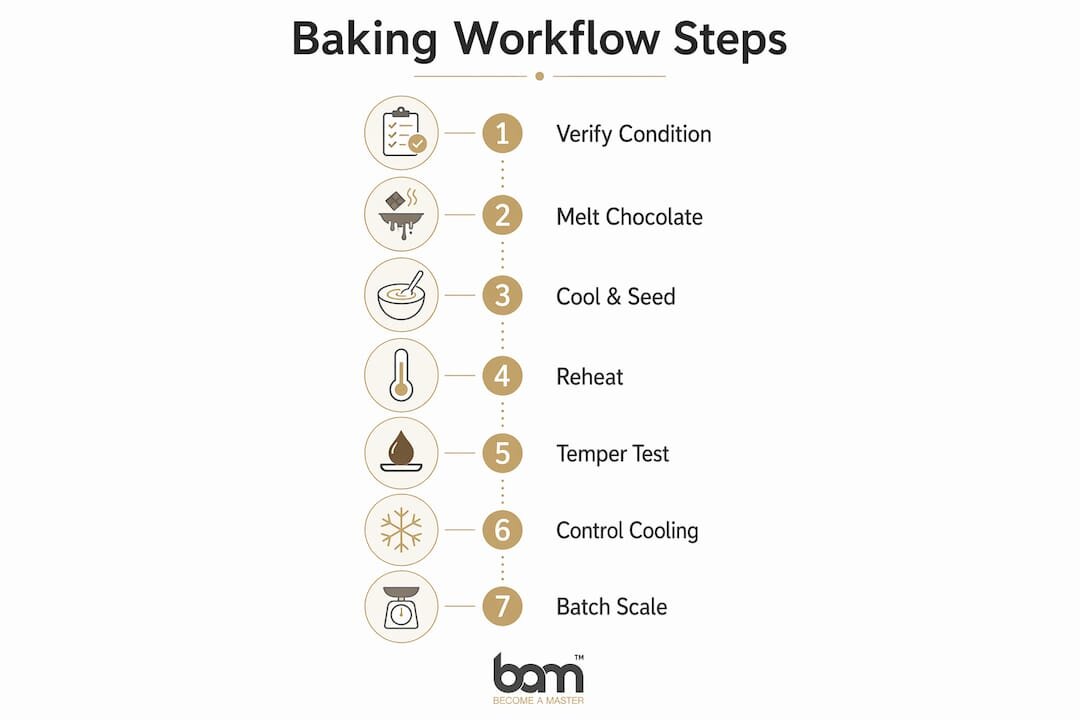
4. Reheat to working temperature. Bring dark chocolate to 31°C to 32°C. This melts out the unstable Form IV crystals while preserving Form V. The working temperature window is narrow, typically 1°C to 2°C, so use a calibrated thermometer rather than touch or visual assessment.
5. Conduct a temper test. Apply a small amount to a marble slab or acetate strip. A correctly tempered chocolate sets within three to five minutes at room temperature with a clean snap and even gloss. Dullness or soft set indicates under-tempering. Streaking or a mottled surface indicates over-tempering or uneven cooling.
6. Control the cooling environment. Cooling tunnel conditions including air temperature, velocity, dew point, and residence time must be controlled alongside tempering to prevent defects. A correctly tempered chocolate placed into a poorly controlled cooling environment will still bloom. Treat tempering and cooling as one coupled system.
7. Batch scale with precision. For dry ingredient workflows, custom pre-blending reduces manual scaling errors and improves batch consistency. Pre-blended dry mixes for pastry creams, sponge bases, or lamination doughs remove the most common source of within-batch variability: human weighing error.
Pro Tip: If you are producing multiple chocolate varieties in one session, always process white chocolate last. White chocolate is the most sensitive to contamination from darker varieties and picks up off-colours and flavours from residual cocoa solids on equipment.
Traceability is not a compliance checkbox. It is a quality tool that connects raw ingredient specifications to finished product outcomes, and it is the foundation of any mature baking ingredient management system.
FSMA 204 traceability requires capturing and integrating Key Data Elements across ERP, WMS, 3PL, and trading partner systems for electronic, sortable data export on demand. For commercial bakers, this means every ingredient lot received must be linked to the batches it entered, the products those batches produced, and the customers or channels those products reached. The deadline for full FSMA 204 compliance is July 2028, but building the data infrastructure now avoids a costly retrofit later.
Data-driven quality control tools such as NIR spectroscopy and automated crumb evaluation link finished product attributes back to raw material specifications, reducing physical baking tests and improving consistency. This is the practical payoff of traceability: when a batch fails, you can identify within minutes whether the root cause was the flour lot, the chocolate temper, or the storage condition, rather than repeating the entire production run.
The table below compares common traceability system approaches by feature and benefit.
| System type | Key features | Primary benefit |
|---|---|---|
| ERP (e.g. inecta, SAP) | Lot tracking, CoA storage, batch records | End-to-end audit trail |
| WMS (warehouse management) | Real-time stock location, FIFO enforcement | Reduces expired stock and picking errors |
| EDI integration | Automated supplier data exchange | Reduces manual data entry errors |
| Feedback database | Links raw specs to finished product QC data | Faster root cause analysis |
| Paper-based log | Low cost, no software required | Suitable for very small operations only |
Building a feedback database is the step most small and mid-sized bakeries skip. Linking your flour protein content records to your finished loaf volume data, or your chocolate temper index to your enrobing defect rate, creates a predictive quality system rather than a reactive one.
A premium baking ingredient workflow requires controlled sourcing, calibrated storage, precise processing, and integrated traceability to maintain product quality at every stage.
| Point | Details |
|---|---|
| Source with specification | Request a CoA for every lot and maintain two approved suppliers per critical ingredient. |
| Control storage microclimates | Keep temperature at 10°C to 21°C and humidity at 30% to 50% with daily logged monitoring. |
| Treat tempering as a system | Chocolate tempering and cooling are coupled. Control both or defects will follow. |
| Pre-blend to reduce variability | Custom dry pre-blends remove manual weighing error, the most common source of batch inconsistency. |
| Build a traceability database | Link raw ingredient specs to finished product outcomes to shift from reactive to predictive quality control. |
After working closely with ingredient-led production, the pattern I see most often is this: bakers invest heavily in sourcing premium ingredients, then handle them in ways that erase the quality advantage they paid for. A single temperature excursion in storage, one unverified lot, or a temper conducted by feel rather than calibrated thermometer can reduce a premium couverture to a product indistinguishable from a commodity chocolate.
The insight that changed how I think about this comes from scaling premium food products. A case study in scaling premium craft food showed 3x business growth through workflow refinement and ingredient control, not through better ingredients alone. The craft was already there. The system was not. That distinction matters enormously for any baker moving from artisan to commercial scale.
The other thing I would push back on is the idea that traceability is a large-operation concern. Even a small patisserie producing 200 units a week benefits from a simple lot-code log. When a customer reports a texture issue, you want to know in ten minutes whether it was the flour batch or the storage humidity, not spend two days re-testing. The data infrastructure does not need to be expensive. It needs to be consistent.
— Andraz
Bamchocolate stocks a focused range of baking accessories designed to support professional ingredient handling, from precision tools for tempering to storage-compatible packaging formats. For bakers building out a complete confectionery workflow, the BAM Basic pastry package brings together core ingredients and accessories in a single, workflow-ready bundle. If you are working with fillings specifically, the creamy fillings confectionery set covers the ingredient range needed for ganaches, pralines, and cream-based centres. All products are sourced to consistent quality specifications, so the lot-to-lot variability that disrupts production workflows is minimised from the start.
A premium baking ingredient workflow is an integrated process covering ingredient selection, controlled storage, processing, and traceability to maintain consistent product quality. It applies equally to chocolate-based confectionery, pastry production, and dry goods management.
Store dry premium ingredients at 10°C to 21°C with relative humidity between 30% and 50%. The action threshold for humidity is 55% sustained for 48 hours, at which point caking and moisture uptake become significant risks.
Tempering failure is most often a process control issue, not an ingredient issue. Incomplete melting leaves residual unstable crystals, uneven agitation produces inconsistent Form V nucleation, and poor cooling tunnel conditions cause bloom even when the temper itself is correct.
FSMA 204 requires lot codes, product descriptions, quantities, locations, dates, and related documents for Critical Tracking Events including receiving, transforming, and shipping. These records must be available in electronic, sortable format on demand, with full compliance required by July 2028.
Custom pre-blending removes manual weighing from the production step, which is the most common source of within-batch variability. Pre-blended dry mixes for sponge bases, pastry creams, or lamination doughs deliver the same ratio of ingredients in every batch without relying on operator accuracy at the scales.



 Confectionery tips



 Slovenščina
 Hrvatski
 Deutsch
 Italiano
 Česky
Česky
 Polski
 Magyar
 Français
 Slovák
 Nederlands
 Español