 info@bamchocolate.com
  Login
Login 

 en
en 
 BAM Cake converter
  Login
Login Claudia
Avtorica vsebin


 Reading time:
11 minutes
Reading time:
11 minutes 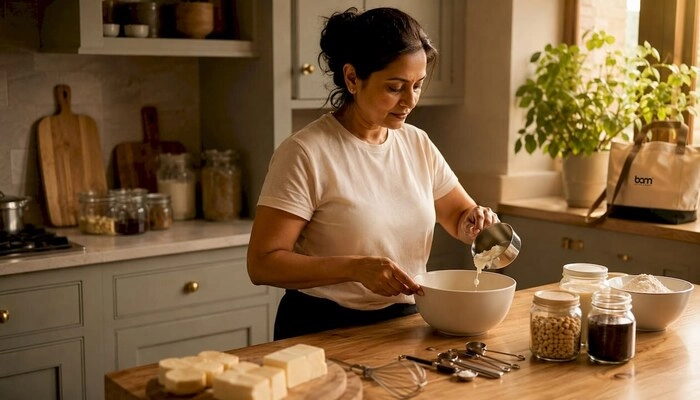
Discover effective special diet baking substitutions for flour, sugar, fat, and eggs. Bake deliciously for vegan, gluten-free, and low-fat diets!
The most effective special diet baking substitutions cover four core categories: flour, sugar, fat, and eggs. Getting these right means you can bake for vegan, gluten-free, diabetic-friendly, and low-fat diets without losing texture or flavour.
Key substitutions at a glance:
All of these ingredients are widely available in UK supermarkets and health food shops. When buying gluten-free products, look for the crossed-grain symbol, which is the standard UK and European certification mark for coeliac-safe foods.
Pro Tip: Never swap every ingredient at once. Change one category per recipe trial so you can identify what affects texture or rise, then adjust from there.
Gluten-free baking is not a simple 1:1 flour swap. Technique, hydration, and binders affect the outcome far more than ingredient replacement alone, which is why choosing the right flour for your specific diet matters from the start.
Gluten-free flour blends are the most reliable starting point. Store-bought blends are formulated to replace plain wheat flour cup for cup, and they typically include a mix of rice flour, potato starch, and tapioca. If your blend does not already contain xanthan gum, add xanthan gum at ¼ to ½ tsp per cup of flour. Without it, gluten-free baked goods crumble and lack chew. You can also make your own blend: whisk together 2 cups white rice flour, ⅔ cup potato starch flour, and ⅓ cup tapioca flour, then store in an airtight container.
For individual flour types, the choice depends on what you are baking:
For allergen-free baking, avoid almond and other nut flours entirely. Use oat, rice, or sorghum flour instead, and check that your blend carries no “may contain nuts” warning on the UK label.
Gluten-free batters tend to be wetter than traditional batters, and the finished goods are often drier. Adding 1 tbsp of extra liquid per cup of flour helps lighten the texture. For high-altitude baking in the UK, decrease liquid by 2 tbsp and raise oven temperature by 25°F to improve structure and rise.
Pro Tip: Weigh your gluten-free flours on a kitchen scale rather than using measuring cups. These flours are finer than wheat flour and pack unevenly, making volume measurements unreliable for consistent results.
Sugar does more than sweeten. It adds bulk, retains moisture, and drives browning through caramelisation. When you swap it out, all three of those functions change, so understanding your substitute before you bake saves a lot of failed batches.
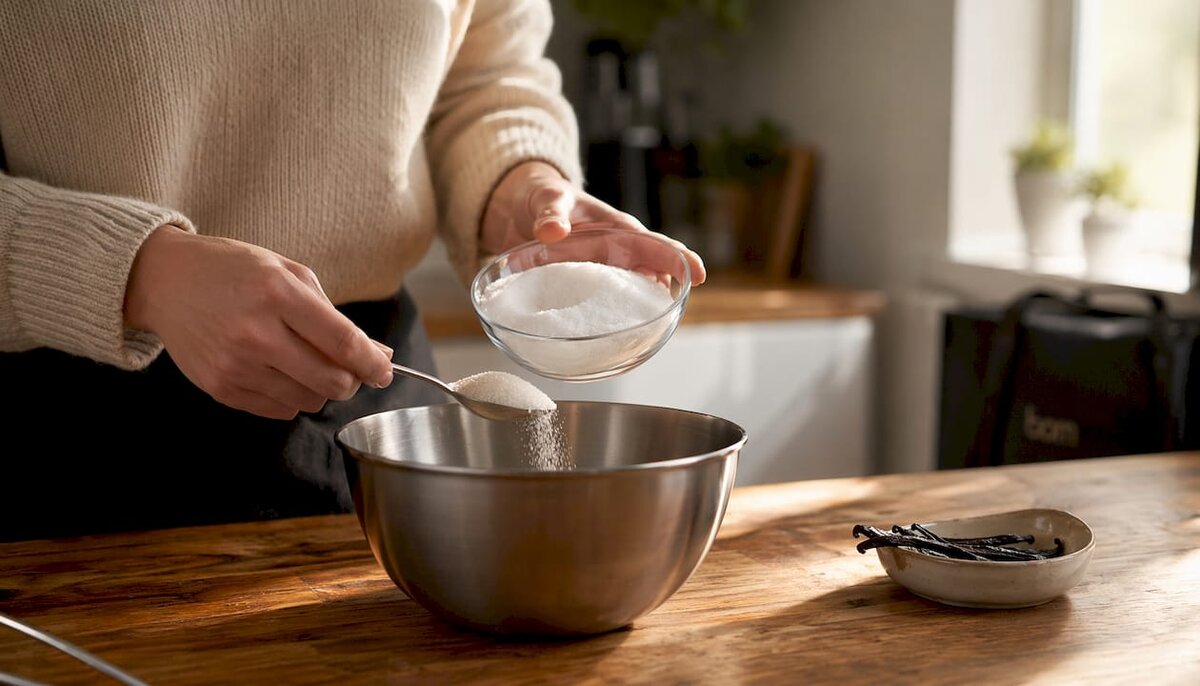
The American Diabetes Association states that nonnutritive sweeteners are acceptable for people managing diabetes when they reduce overall calorie and carbohydrate intake. Stevia and monk fruit are natural nonnutritive options; sucralose, aspartame, and saccharin are synthesised alternatives. Sugar alcohols such as erythritol, xylitol, and sorbitol are nutritive but lower in calories than regular sugar.
The critical rule: do not replace more than half the sugar in any baked goods recipe with a substitute. Beyond 50%, texture and volume suffer noticeably. Blends that contain some real sugar alongside a substitute consistently produce better results than using a substitute alone.
Sugar alternatives by dietary need:
Allulose is worth highlighting separately. It caramelises, retains moisture, and does not crystallise, making it the closest behaving substitute to real sugar. It has about 70% of sugar’s sweetness, so use 1.3 times the amount called for in a recipe. It is particularly useful in gluten-free baking, where moisture retention is already a challenge.
Liquid sweeteners such as honey and maple syrup add flavour and moisture, but you need to reduce other liquids in the recipe. Use ¾ cup of honey or maple syrup per 1 cup of granulated sugar, and cut other liquids by 2–3 tbsp. Foods baked with nonnutritive sweeteners may not brown as much as those made with regular sugar. A light spray of oil on the dough or batter surface helps, as does adding 1 tbsp of honey or molasses to quick breads for colour and flavour. For more detail on how sugar alternatives affect volume and moisture, Bamchocolate’s guide to healthy sugar substitutes covers the chemistry clearly.
Fat provides flavour, moisture, and structural integrity in baked goods. Replace it poorly and you get a dry, dense result. Replace it well and most people cannot tell the difference.
Coconut oil is the most straightforward dairy-free swap. It replaces butter at a 1:1 ratio in cookies and cakes. Use it in solid form for recipes that cream butter with sugar, and in melted form where the recipe calls for melted butter. The flavour is mild and works well with chocolate, spice, and fruit-based bakes.

Unsweetened applesauce replaces up to half the butter or oil in quick breads and muffins. The standard swap is ½ cup applesauce plus ½ cup oil for every 1 cup of butter. It adds moisture and a very slight sweetness, but it does change the structure slightly, producing a denser, more tender crumb. Applesauce or yoghurt can replace half the butter volume in quick breads and muffins, though both alter flavour and structure.
Fat replacements for special diets:
When choosing a plant-based butter in the UK, opt for a stick format rather than a tub. Stick varieties contain a similar moisture level to regular butter, which matters for pastry and layer cakes. Tub spreads often contain more water and can make batters too wet.
Olive oil works particularly well in muffins, cakes, and savoury bakes. Use ¾ cup per 1 cup of butter. For a neutral flavour, a light or extra-light olive oil is preferable to extra virgin, which can taste grassy in sweet recipes.
Eggs bind, leaven, and add moisture. No single substitute does all three equally well, so matching the right swap to the recipe’s primary need gives you the best result.
Flax eggs and chia eggs are the most reliable binders. Mix 1 tbsp of ground flaxseed or ground chia seeds with 2½ tbsp of water, then leave to sit for 5 minutes until it forms a gel. This replaces one large egg. Both work well in dense bakes such as brownies, muffins, and cookies. Flax eggs, chia eggs, and aquafaba are common and reliable plant-based egg substitutes used in typical quantities per large egg.
Aquafaba is the liquid from a tin of chickpeas. Three tablespoons replaces one large egg. It is particularly effective in recipes that need lift, such as meringues, macarons, and light sponges, because it whips into a foam. It has almost no flavour of its own, which makes it more versatile than flax or chia in delicate recipes.
Baking soda with vinegar works well as a leavening substitute rather than a binder. Add 1 tsp of bicarbonate of soda to the batter, then pour 1 tbsp of white wine vinegar over it just before mixing. Add the vinegar last to preserve the leavening reaction. This is a good option for allergen-free baking where flax and chia are not available.
Egg substitute options and their best uses:
For allergen-free baking, flax and chia are generally safe, but always check that your ground seeds are produced in a nut-free facility. If seeds are also off the table, the bicarbonate of soda and vinegar method or a commercial egg replacer powder are the safest options. For leavening guidance beyond eggs, Bamchocolate’s article on baking powder and soda explains how to get the right rise in every recipe.
Substituting ingredients changes the chemistry of a recipe, not just the ingredients list. Understanding a few key principles means fewer failed bakes and more consistent results.
Gluten and binders. Gluten forms the elastic network that gives wheat-based baked goods their structure and chew. Without it, baked goods collapse or crumble. Xanthan gum, guar gum, and psyllium husk each replicate part of that network. Xanthan gum is the most widely used: add ¼ to ½ tsp per cup of gluten-free flour. Too little and the crumb falls apart; too much and the texture turns gummy.
Resting the batter. Letting a gluten-free batter rest for 30 minutes before baking allows the starches and flours to fully absorb the liquid. This reduces grittiness and produces a lighter, more tender crumb. It also thickens the batter, making it easier to handle. Skipping this step is one of the most common reasons gluten-free bakes feel sandy.
Moisture management. Gluten-free flours absorb liquid differently from wheat flour, and sugar substitutes change moisture retention too. When using a nonnutritive sweetener, the baked good will often be drier. Adding 1 tbsp of extra liquid per cup of flour, or incorporating a naturally moist ingredient such as yoghurt, sour cream, or pureed fruit, compensates for this. Honey and agave also enhance moisture, but reduce other liquids in the recipe accordingly.
Oven temperature and timing. Visual cues are less reliable in gluten-free baking. Even when fully cooked, gluten-free baked goods often look underdone and feel soft until they cool and the starches set. Use a kitchen scale for ingredients and rely on a timer and oven thermometer rather than appearance. Gluten-free baked goods often benefit from longer baking at a slightly lower temperature to drive off excess moisture without over-drying the surface. For practical baking guidance on temperature and timing, Bamchocolate’s cake baking tips are a useful reference.
Sugar substitute browning. Baked goods made with nonnutritive sweeteners brown less than those made with regular sugar. To compensate, try baking 3–5 minutes less than the original recipe time, spray the surface lightly with oil, or add 1 tbsp of honey or molasses to quick breads. Allulose is the exception: it caramelises naturally and produces a golden colour close to sugar.
Pro Tip: Always weigh ingredients with a kitchen scale, especially gluten-free flours and sugar substitutes. Volume measurements are inconsistent with fine-ground flours and can throw off the entire recipe.
Successful special diet baking substitutions depend on matching the right swap to the right function, then adjusting technique to compensate for what the original ingredient provided.
| Point | Details |
|---|---|
| Cap sugar substitution at 50% | Replacing more than half the sugar in a recipe with a substitute reduces texture, volume, and moisture. |
| Use xanthan gum in gluten-free baking | Add ¼ to ½ tsp per cup of gluten-free flour to replicate the binding role of gluten. |
| Rest gluten-free batters | A 30-minute rest before baking allows starches to hydrate, reducing grittiness and improving crumb texture. |
| Match egg substitutes to function | Use aquafaba for lift, flax or chia eggs for binding, and bicarbonate of soda with vinegar for leavening. |
| Weigh, do not measure by volume | A kitchen scale gives consistent results with gluten-free flours and fine-ground sugar substitutes. |
The healthiest swaps depend on the dietary goal. For lower sugar, stevia, monk fruit, and allulose reduce calories without spiking blood glucose. For lower fat, unsweetened applesauce or yoghurt replace up to half the butter in quick breads. For gluten-free baking, brown rice flour, oat flour, and certified gluten-free blends are the most nutritious options.
The most common swaps are flax eggs or chia eggs for whole eggs, gluten-free flour blends for plain wheat flour, coconut oil for butter, and plant-based milks such as oat or soy milk for dairy milk. Each replaces the original ingredient’s primary function, though small texture adjustments are often needed.
Do not replace more than 50% of the sugar in a baked goods recipe with a nonnutritive sweetener. Beyond that point, the loss of bulk and moisture retention noticeably affects texture and volume. Blends that include some real sugar alongside a substitute produce the best results.
A flax egg or chia egg, made from 1 tbsp of ground seeds mixed with 2½ tbsp of water, is the most reliable binder for dense bakes such as brownies and muffins. Aquafaba works better in lighter recipes where lift is the priority.
Bamchocolate stocks a range of baking accessories and additives suited to special diet baking, from precision tools to premium ingredients. The BAM Basic pastry package is a practical starting point for home bakers building a well-stocked pantry for dietary baking.



 Confectionery tips



 Slovenščina
 Hrvatski
 Deutsch
 Italiano
 Česky
Česky
 Polski
 Magyar
 Français
 Slovák
 Nederlands
 Español