 info@bamchocolate.com
 Login


 en

 BAM Cake converter
 Login
Claudia
Avtorica vsebin


 Reading time:
9 minutes

Discover why consider nut-free chocolate for safety. Learn about allergen labeling and make informed choices for your health.
TL;DR:
- Nut-free chocolate is produced without nuts or nut-derived ingredients and must be made in dedicated facilities to ensure safety.
- Labels stating “may contain” are voluntary and do not guarantee safety, so verifying production controls is essential.
Nut-free chocolate is chocolate produced without nuts or nut-derived ingredients and without cross-contact contamination during manufacturing. For anyone managing a nut allergy, this distinction is not a preference. It is a health requirement. Peanuts are the leading cause of food-induced anaphylaxis, and tree nuts follow closely. Choosing the wrong chocolate bar can trigger a reaction severe enough to require emergency treatment. This guide explains why consider nut-free chocolate matters, how allergen labelling works in practice, and how to choose products you can trust.
Nut allergies trigger an IgE-mediated immune response, meaning the body treats nut proteins as a threat and attacks them. The reaction can escalate from hives and swelling to full anaphylaxis within minutes. Food allergy reactions are a leading cause of anaphylaxis presentations to emergency departments. That makes every chocolate purchase a decision with real medical stakes.
Chocolate products are particularly high risk because nuts appear in so many forms: whole pieces, pastes, oils, and flavourings. Tree nuts such as almonds, cashews, hazelnuts, and pecans are common inclusions in premium chocolate ranges. Peanuts appear in fillings, coatings, and shared production lines. Even a product labelled as plain dark chocolate may have been manufactured alongside nut-containing products.
Clinical guidance is clear on this point. Strict avoidance of the allergen is the primary management strategy, and carrying emergency adrenaline medication is standard advice for anyone with a diagnosed nut allergy. Relying on visual inspection or tasting a small amount is not a safe approach. The only reliable method is verified allergen control at the manufacturing level.
“Cross-contact can happen during preparation even when nut-free orders are intended. Good label reading and notifying staff reduce risk.” — Verywell Health, Tree Nut Allergy Guide
Allergen labelling falls into two distinct categories, and confusing them creates real danger. The first is mandatory. Under the US Food Allergen Labelling and Consumer Protection Act, known as FALCPA, manufacturers must declare major allergens including tree nuts and peanuts in the ingredients list. EU regulations under Regulation 1169/2011 carry equivalent requirements for the European market. These “Contains” declarations are legally binding.
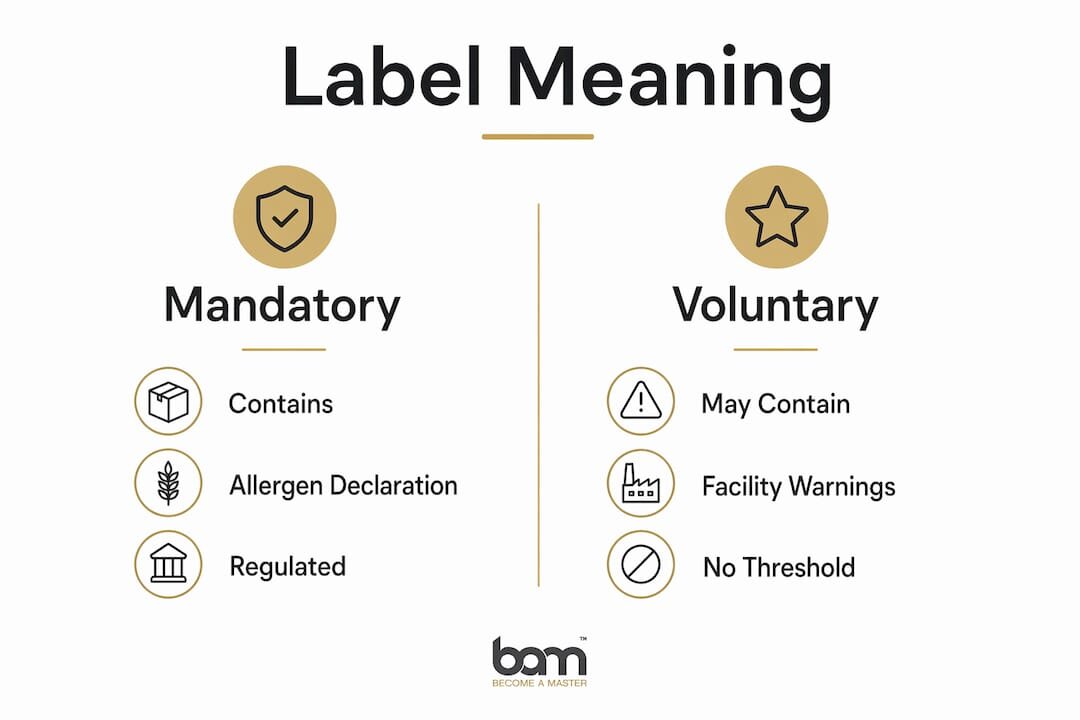
The second category is voluntary. Statements such as “may contain nuts” or “produced in a facility that handles nuts” are precautionary allergen labels, often abbreviated to PAL. Precautionary statements like “may contain” are voluntary and lack standardised thresholds. A manufacturer may include them as a precaution, or may omit them even when a genuine cross-contact risk exists. The absence of a warning does not confirm safety.
This inconsistency creates serious confusion for shoppers. A product without any nut warning could still carry cross-contact risk. A product with a “may contain” statement might have extremely low actual contamination levels. The current system does not give you the information you need to make a precise risk assessment.
Key points to understand about allergen labelling:
The FDA is currently moving towards a science-based allergen threshold framework that would define safe exposure limits and reduce unnecessary precautionary labelling. This shift could eventually bring more clarity. For now, the system remains inconsistent.
Pro Tip: When a product carries no nut warning but you are uncertain about its safety, contact the manufacturer directly and ask whether the product is made on shared equipment or in a shared facility. A reputable brand will answer clearly.
Cross-contact is the transfer of an allergen from one product to another through shared equipment, surfaces, or airborne particles. It differs from cross-contamination in that no spoilage is involved. The allergen simply moves from one batch to another. In chocolate production, this is a persistent challenge because nuts are processed in large volumes and nut residues are difficult to remove completely from machinery.
The main routes of cross-contact in a chocolate facility are:
Manufacturers who take nut-free status seriously use dedicated production lines, rigorous cleaning validation protocols, and supplier audits. Manufacturers using dedicated lines and thorough risk assessments provide higher trust than products labelled “nut-free” without such controls. A “nut-free” claim on packaging is only as reliable as the production system behind it.
Pro Tip: Ask manufacturers whether their nut-free products are made on a dedicated line or simply on a cleaned shared line. Dedicated lines carry significantly lower cross-contact risk.

Choosing genuinely safe nut-free chocolate requires more than reading the front of the pack. The back-of-pack ingredients list and any allergen declarations are your starting point, but they are not the full picture. The table below outlines the key factors to compare when evaluating nut-free chocolate products.
| Factor | What to look for | Why it matters |
|---|---|---|
| Dedicated facility | Produced in a nut-free facility | Eliminates cross-contact at source |
| Allergen declaration | Clear “Contains” statement with no nut entries | Confirms no intentional nut ingredients |
| Precautionary label | Absence of “may contain” advisory | Suggests lower cross-contact risk, though not guaranteed |
| Manufacturer transparency | Published allergen control policy or direct response | Confirms production controls are in place |
| Certification | Third-party allergen-free certification | Independent verification of nut-free status |
For families managing nut allergies, preference for dedicated nut-free chocolate stems from concerns about label ambiguity and the potentially severe consequences of exposure. This is especially true for nut-free chocolate for kids, where parents need certainty rather than probability.
When evaluating specific products, look for brands that publish their allergen management policies online. Contact the customer service team if the information is not publicly listed. A brand that cannot or will not explain its cross-contact controls is not one to trust for high-risk allergen management.
Safe nut-free dessert alternatives extend well beyond plain chocolate bars. Dark chocolate chips without nut inclusions, cocoa powder, and chocolate-flavoured spreads produced in nut-free facilities all work as substitutes in baking. You can find nut-free dessert recipes that use these ingredients without compromising on flavour. Bamchocolate offers a range of baking ingredients and confectionery products suited to allergen-aware home baking, including fillings and accessories designed for safe preparation.
For a broader view of how chocolate fits into a health-conscious diet, the Bamchocolate guide on milk chocolate and health covers ingredient considerations worth knowing.
Nut-free chocolate is only genuinely safe when it is produced in a dedicated facility with verified allergen controls, not simply labelled as such.
| Point | Details |
|---|---|
| Anaphylaxis risk is real | Peanuts are the leading cause of food-induced anaphylaxis; nut-allergic individuals must verify every chocolate product. |
| Labels have two tiers | “Contains” declarations are mandatory; “may contain” statements are voluntary and inconsistent. |
| Cross-contact is the hidden risk | Shared equipment and production lines can transfer nut allergens even when no nuts are listed as ingredients. |
| Dedicated facilities offer most safety | Products made on dedicated nut-free lines carry lower cross-contact risk than those on cleaned shared lines. |
| Manufacturer transparency is essential | Contact brands directly if allergen control information is not publicly listed before purchasing. |
by Andraz
The biggest mistake I see is treating the absence of a “may contain” warning as a green light. People scan the front of the pack, see no nut imagery, and assume the product is safe. That assumption is built on a gap in the labelling system, not on actual safety data.
What I have found genuinely useful is shifting the question from “does this label say nut-free?” to “can this manufacturer prove it?” The brands worth trusting are the ones who can tell you exactly which line the product runs on, what their cleaning validation looks like, and whether their suppliers are audited for allergen control. That level of detail is not common, but it exists. When you find it, it changes how you shop.
The regulatory picture is shifting too. The FDA’s move towards science-based allergen thresholds represents a genuine improvement in how risk will eventually be communicated. But that framework is not in place yet. Until it is, the safest approach remains choosing products from manufacturers who are transparent about their controls, not just their labels.
Chocolate should be enjoyable. For nut-allergic individuals, that enjoyment depends entirely on being able to trust the product. The brands that earn that trust do so through process, not packaging.
— Andraz
Bamchocolate stocks a range of baking ingredients and confectionery products suited to allergen-aware preparation at home. The baking accessories range includes tools and ingredients designed for precise, hygienic use in home kitchens. For those who want a complete starting point, the BAM Basic pastry package brings together core confectionery essentials in one bundle. The BAM Confectionery set Creamy fillings offers nut-free filling options for pastries, cakes, and chocolates. All products are listed with full ingredient information on the Bamchocolate website, making it straightforward to verify suitability before purchase.
Nut-free chocolate is chocolate made without nut ingredients and without cross-contact with nuts during production. Genuinely nut-free products are typically manufactured in dedicated facilities with verified allergen controls.
No. “May contain” statements are voluntary and carry no standardised threshold, meaning the actual risk level is unknown. People with nut allergies should treat these products as potentially unsafe.
Read the full ingredients list and allergen declaration, then contact the manufacturer to ask about their production line setup and allergen control protocols. A dedicated nut-free facility provides the highest level of assurance.
Children with nut allergies face the same anaphylaxis risks as adults but are less able to self-manage an emergency reaction. Nut-free chocolate for kids removes the guesswork and reduces the risk of accidental exposure at home, school, or parties.
The FDA is developing a science-based threshold framework that would standardise when precautionary labels are required. Once implemented, this should reduce label inconsistency, but the framework is not yet in force as of 2026.



 Confectionery tips



 Slovenščina
 Hrvatski
 Deutsch
 Italiano
 Česky
 Polski
 Magyar
 Français
 Slovák
 Nederlands
 Español