 info@bamchocolate.com
 Login


 en

 BAM Cake converter
 Login
Claudia
Avtorica vsebin


 Reading time:
14 minutes

Discover the types of premium cocoa for baking excellence! Explore fine-flavour beans and processed powders to enhance your treats.
TL;DR:
- Premium cocoa is categorized into fine-flavour beans and specialty processed powders, with the former commanding higher prices due to complex sensory profiles. Processing methods such as alkalisation and cacao butter content influence flavor, color, and baking behavior, guiding ingredient choice for recipes. Traceability, harvest details, and supply-chain practices are more important indicators of quality than variety names like Criollo or Forastero.
Premium cocoa splits into two practical categories. The first is fine-flavour beans: rare varieties and single-origin or estate lots defined by complex sensory profiles, genetics, terroir, and post-harvest practice. The second is premium processed powders: natural, alkalised (Dutch), black, and high-fat formulations, each engineered for specific baking outcomes. The International Cocoa Organization (ICCO) classifies fine-flavour cocoa by its complex sensory profile, and estimates it represents roughly 12% of world exports — a small share that commands significant price premiums.
Quick use guide:
The three main varieties encountered on labels and in trade are Criollo, Forastero, and Trinitario. Modern genetic research treats these as geohistorical labels rather than strict botanical categories, but they remain useful shorthand for understanding flavour expectations and price points.
Criollo is historically the most prized. It produces low-bitterness beans with floral, delicate, and sometimes nutty notes. Low yields and susceptibility to disease make it genuinely rare. Expect to pay accordingly, and treat any “Criollo” claim with healthy scepticism unless traceability backs it up.
Forastero is the workhorse. Estimates place it at a large majority of global production, with Criollo accounting for only a few per cent or less. Forastero beans are higher-yielding, disease-resilient, and typically produce stronger, simpler, more bitter flavour profiles. Most bulk cocoa and standard couverture is Forastero-based.
Trinitario is a hybrid of the two. It often carries floral or fruity notes alongside better resilience and yields than Criollo, and appears frequently in premium single-origin lines. It is neither as rare as Criollo nor as ubiquitous as Forastero.
The practical caution: genetic research shows more complex diversity beneath these three labels than marketing suggests. Practitioners who work seriously with premium cocoa prioritise terroir, fermentation protocol, and post-harvest practice over variety name alone. A well-fermented, carefully dried Forastero from a single estate can outperform a poorly handled Criollo in the cup.
The ICCO’s fine-flavour definition frames premium cocoa as a sensory and supply-chain phenomenon, not a purely botanical one. Complex aromatic profiles arise from the interaction of genetics, growing conditions, fermentation, and drying. This means buyers should weight lot notes and tasting descriptors at least as heavily as variety name.
Notable fine-flavour examples:
Fine-flavour beans typically start at a roughly 20% premium over commodity prices and can rise to multiples of that depending on scarcity and traceability. Latin America supplies most fine-flavour exports, with Ecuador, the Dominican Republic, and Peru prominent among them.
Single-estate traceability and consistent fermentation deliver the tasting notes buyers pay for. A named origin with a lot number and harvest year is a stronger quality signal than a variety name alone. Single-origin product launches rose by about 25% in 2022, reflecting growing consumer demand for provenance in the European market.
Pro Tip: When a product claims a fine-flavour origin but carries no lot number, harvest year, or tasting notes, ask the supplier directly before committing to a bulk order. Legitimate fine-flavour suppliers can answer those questions.
Processing choices shape flavour, colour, and how a powder behaves in a recipe. The table below maps the main powder types to their key characteristics.

| Powder type | pH / acidity | Colour | Flavour profile | Leavening interaction |
|---|---|---|---|---|
| Natural (non-alkalised) | Low (acidic) | Mid-brown | Bright, fruity, sharp | Reacts with bicarbonate of soda |
| Dutch/alkalised | Neutral to alkaline | Dark brown | Mild, rounded, earthy | Requires baking powder |
| Black cocoa | Highly alkaline | Near-black | Minimal acidity, intense | Requires baking powder |
| High-fat / couverture mass | Varies | Varies | Rich, creamy mouthfeel | Depends on base type |
Alkalisation lowers acidity, darkens colour, and alters both flavour and leavening behaviour. Highly alkalised powders produce darker, milder, earthier results; natural powders retain brighter, fruity acidity and react differently with raising agents. This is not a quality hierarchy. Alkalisation is a deliberate technical choice: chefs select levels of alkalisation to tune colour and acidity for a specific recipe rather than using “Dutch” as a generic quality label.
Black cocoa is the extreme end of alkalisation. It delivers near-black colour and very low acidity, which is why it suits dramatic layer cakes and dark biscuits where visual impact matters as much as flavour. High-fat powders and couverture masses carry more cocoa butter, which changes mouthfeel and melting behaviour. Higher cocoa butter content yields creamier ganaches and smoother chocolate work, reducing the need for added fats.
Pro Tip: Natural and Dutch cocoa powders are not interchangeable in a recipe without adjustment. Swapping one for the other changes pH, which affects both colour and how your leavening agent performs. Always check which type a recipe specifies.
The right choice depends on whether chocolate flavour is the star or a supporting element.
The practical rule: reserve fine-flavour beans and powders for applications where chocolate is the centrepiece. Use premium processed powders where consistency, colour, and texture matter more than subtle aromatics. Artisan patisserie contexts, such as those seen in Catalan cream and similar desserts.
Artisan patisserie contexts often call for precise cocoa selection to complement rather than dominate other flavours.
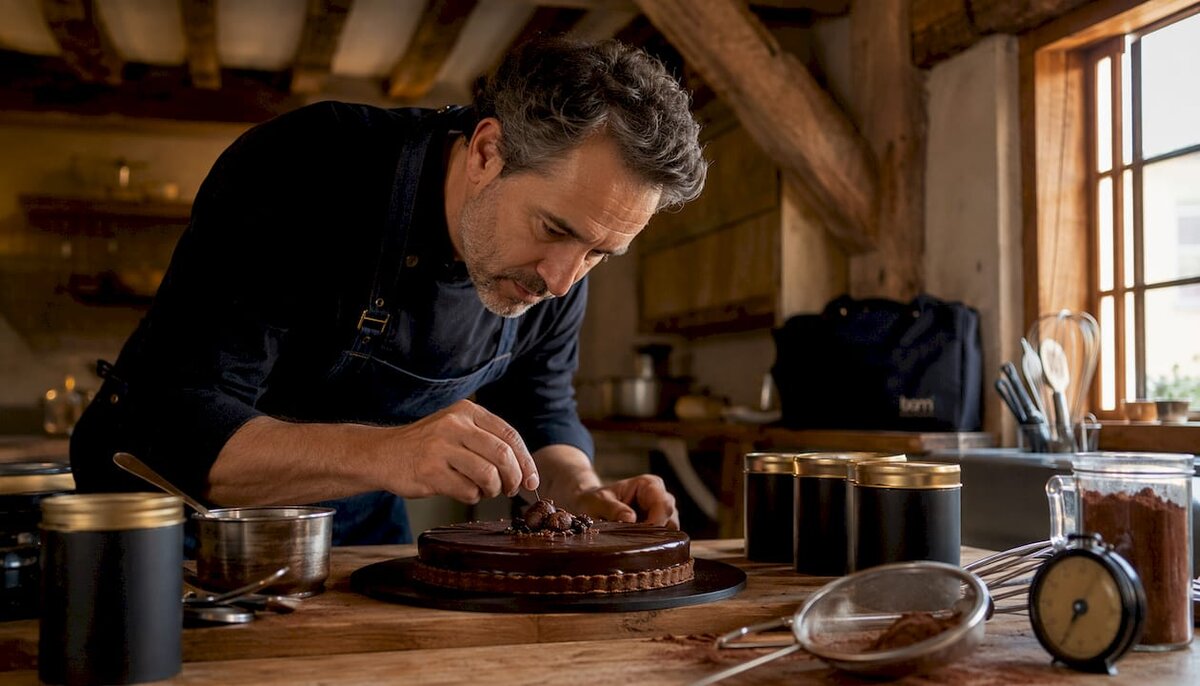
UK buyers have more access to traceable, certified premium cocoa than ever, but label reading still requires care.
Pro Tip: If a price seems too low for a claimed fine-flavour origin, request lot notes from the seller before buying in bulk. Legitimate suppliers provide them without hesitation.
Speciality cocoa is recognised by origin, post-harvest practices, taste profiles, and traceability rather than a single industry definition. That means the buyer’s own due diligence is the last line of quality assurance.
A simple tasting protocol helps when comparing samples or judging whether a product description matches reality.
Sensory vocabulary to use:
For powders, note how the sample behaves in a simple sponge or sauce test. pH behaviour (if the supplier provides it) tells you how the powder will interact with your leavening agents. For more on identifying quality in dark chocolate, the same sensory principles apply.
Storage essentials:
Pack sizes and cost:
Retail sachets and 200–1,000 g packs work well for home bakers. Bulk packs of 5–25 kg suit bakeries and small producers, provided storage conditions and turnover support them. Small high-end retail packs can cost nearly $2 per ounce, while bulk purchasing can reduce costs to roughly $0.65 per ounce in reported examples (figures in USD from US market data; UK pricing varies by supplier and exchange rate). The principle holds across markets: bulk buying lowers per-unit cost substantially, but only when storage and turnover allow quality to be maintained.
Higher cocoa butter content couvertures cost more per kilogram but reduce the need for added fats in ganaches and glazes, which can offset the higher unit price in professional use. Fine-flavour beans and small retail sachets consistently carry a premium over commodity equivalents; the gap widens with traceability and certification.
Fine-flavour cocoa, defined by the ICCO to represent a small share of world exports, commands premiums starting noticeably above commodity prices, and the right powder type (natural, Dutch, or black) determines both flavour and baking behaviour.
| Point | Details |
|---|---|
| Fine-flavour beans for flavour-forward work | Use single-origin couvertures or fine-flavour beans for ganache, artisan bars, and drinking chocolate where cocoa aroma is central. |
| Powder type determines baking outcome | Natural powder suits bright, acidic applications; Dutch/alkalised suits stable colour and mild flavour; black cocoa delivers dramatic colour with minimal acidity. |
| Traceability over variety name | Lot notes, harvest year, and fermentation details are stronger quality signals than Criollo or Trinitario labels alone. |
| Bulk buying lowers cost, but needs storage | Buying in larger quantities reduces per-unit cost significantly; store at 12–20°C in airtight, opaque containers and match quantity to turnover. |
| Bamchocolate for curated options | Bamchocolate stocks premium powders and couvertures with clear origin and lot information, suitable for both home bakers and professionals. |
The conventional wisdom in premium cocoa circles places enormous weight on variety names. Criollo is prized; Forastero is dismissed. That framing is understandable as a starting point, but it misses where quality actually comes from.
Post-harvest practice, specifically fermentation protocol and controlled drying, often contributes more to final flavour than genetics. A Forastero bean from a single estate with a well-managed five-day fermentation and careful sun-drying can produce a more interesting cup than a Criollo from a poorly run operation. The ICCO’s fine-flavour classification implicitly acknowledges this by defining premium cocoa through sensory profile and supply-chain transparency rather than variety alone.
For UK buyers, this has a practical implication. The most useful question to ask a supplier is not “Is this Criollo?” but “Can you tell me the harvest year, the fermentation method, and the lot number?” A supplier who answers those questions confidently is worth trusting. One who deflects to variety names and marketing language is worth scrutinising.
The same logic applies to processed powders. “Dutch” is not a quality grade; it is a processing method. The best Dutch-process powder for your recipe depends on the level of alkalisation, the fat content, and how it behaves in your specific application. Bamchocolate selects products with clear lot notes and origin information precisely because those details let bakers match ingredients to recipe goals rather than guessing from a label.
For bakers new to premium cocoa, the most practical entry point is a mid-size powder pack alongside a small couverture for ganache practice. Bamchocolate stocks a 500 g premium cocoa powder that gives enough volume to test across several recipes, and a 200 g black cocoa powder for those who want to trial the alkalised end of the spectrum without committing to a full kilogram.
For bakers who want to compare natural, Dutch, and black cocoa side by side, the BAM Basic pastry package offers a curated starting point. Those ready to work with couverture for ganache can explore the confectionery set for creamy fillings, which pairs couverture with complementary ingredients. All products carry clear origin and specification information so you can match what you buy to what a recipe actually needs.
Premium cocoa covers fine-flavour beans (Criollo, Trinitario, and named heirlooms such as Nacional and Porcelana) and premium processed powders (natural, Dutch/alkalised, black, and high-fat formulations). The ICCO defines fine-flavour cocoa by complex sensory profile rather than variety name alone.
Yes. Cocoa ranges from commodity bulk grades (predominantly Forastero) to fine-flavour grades defined by the ICCO, which represent roughly 12% of world exports and command premiums starting at around 20% above commodity prices.
Natural (non-alkalised) cocoa powder retains higher levels of flavanols than heavily alkalised versions, as alkalisation reduces phenolic content. For nutritional benefit, look for minimally processed natural cocoa with clear origin information; organic certification indicates farming practices but does not guarantee flavour or nutritional superiority.
It depends on the application. Fine-flavour couvertures suit ganache and flavour-forward work; premium Dutch or black cocoa suits sponges, brownies, and any bake where stable colour and mild acidity are needed. Natural powder is the choice when bright, acidic chocolate notes and bicarbonate of soda leavening are required.
Look for a named origin, harvest year, lot number, and tasting notes from the supplier. Certifications (organic, Fairtrade, Rainforest Alliance) indicate supply-chain standards but do not alone confirm fine-flavour quality. Bamchocolate publishes clear origin and specification information across its cocoa range to support exactly this kind of informed buying.



 Confectionery tips



 Slovenščina
 Hrvatski
 Deutsch
 Italiano
 Česky
 Polski
 Magyar
 Français
 Slovák
 Nederlands
 Español