 info@bamchocolate.com
  Login
Login 

 en
en 
 BAM Cake converter
  Login
Login Claudia
Avtorica vsebin


 Reading time:
9 minutes
Reading time:
9 minutes 
Discover what is sugar-free confectionery and learn its benefits, sweeteners, and legal definitions. Unlock smart choices for your diet!
TL;DR:
- Sugar-free confectionery legally contains less than 0.5g of sugar per serving and uses alternative sweeteners like erythritol, xylitol, stevia, or sucralose. It benefits individuals managing blood sugar, dental health, or following low-carb diets but can still cause digestive discomfort and is not always low in calories. Use these treats thoughtfully, check ingredient labels, and enjoy them as occasional, targeted tools within a balanced diet.
Sugar-free confectionery is one of those categories that sounds straightforward but rarely is. Most people assume it means zero sugar, zero calories, and a free pass to eat as much as they like. None of those assumptions are entirely correct. Understanding what is sugar-free confectionery properly means looking at the legal definitions, the sweeteners involved, and the real health implications. This guide covers all of it: what goes into sugar-free sweets, who benefits from them, what the risks are, and how to use them well in your kitchen and daily diet.
| Point | Details |
|---|---|
| Legal definition matters | Sugar-free products can legally contain up to 0.5g of sugar per serving, not zero. |
| Sweeteners vary widely | Common alternatives include xylitol, erythritol, stevia, and sucralose, each with different effects. |
| Not automatically low-calorie | Sugar-free confectionery can still be calorie-dense depending on fat and sweetener content. |
| Digestive risks are real | Excess sugar alcohols, especially maltitol, can cause bloating and digestive discomfort. |
| Quality ingredients count | Modern sugar-free products increasingly include fibre and clean ingredients beyond simple sugar swaps. |
The term “sugar-free” has a specific regulatory meaning. In most markets, a product labelled sugar-free contains under 0.5g of sugar per serving. That is not the same as containing no sugar at all. It is a threshold, not an absence.
Sugar-free confectionery replaces conventional sucrose with one or more alternative sweeteners. These fall into two broad categories: sugar alcohols and non-nutritive sweeteners.
Sugar alcohols (also called polyols) are the most common bulking agents in sugar-free sweets. They provide sweetness and body to chocolates, gummies, and hard candies without the same blood glucose spike as sugar. Common examples include:
Non-nutritive sweeteners provide intense sweetness at tiny quantities. Stevia comes from a plant leaf and has a slightly bitter aftertaste at high concentrations. Sucralose is artificial and heat-stable, making it useful for baking. Monk fruit extract is natural, very sweet, and increasingly popular in premium products.
It is also worth understanding how sugar-free differs from related terms. “No sugar added” means no extra sugars were introduced during processing, but natural sugars from ingredients like milk or fruit may still be present. “Reduced sugar” simply means less sugar than the standard version. Neither term guarantees a sugar-free product.
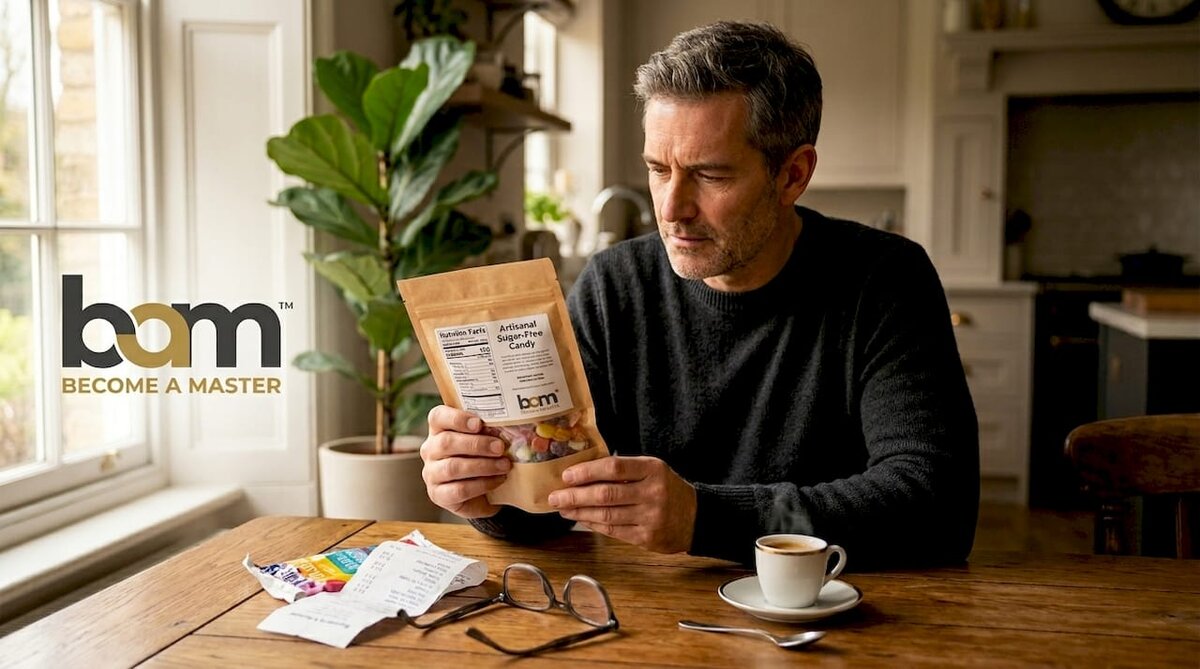
Pro Tip: When reading a label, look beyond the front-of-pack claim. Check the nutrition table for total carbohydrates and the ingredients list for the specific sweeteners used. The type of sweetener matters as much as the sugar content.
Sugar-free confectionery is not a health food in the conventional sense. It is a tool, and like any tool, its value depends on how you use it.
The clearest benefits of sugar-free confectionery apply to specific groups:
Sugar-free is best seen as a strategy tailored to individual needs, such as diabetes management, rather than a universal health improvement.
The risks are real and frequently underestimated. Sugar-free candy is a tool for specific needs, not a blanket healthier option. Several things catch people off guard:
First, sugar-free does not mean calorie-free. Maltitol, for example, delivers roughly 2.1 calories per gram. A large bag of sugar-free chocolates can still represent a significant calorie load.
Second, sugar alcohols affect blood sugar variably. Maltitol in particular has a glycaemic index that is lower than sugar but not negligible. People managing diabetes should not assume all sugar-free products are equally safe.
Third, exceeding your personal tolerance for sugar alcohols causes digestive discomfort. Bloating, gas, and loose stools are common complaints. The threshold varies by individual, but it is easy to cross when snacking freely on sugar-free gummies or chocolates.
Pro Tip: Start with small portions when trying a new sugar-free product, particularly one containing maltitol. Your digestive tolerance is individual, and it is better to test it gradually than to regret a larger serving.
Not all sugar substitutes have the same sweetness profile or health impacts. Understanding the differences helps you choose products that match your goals and your digestive tolerance.
| Sweetener | Calories per gram | Glycaemic index | Digestive tolerance | Common use |
|---|---|---|---|---|
| Maltitol | ~2.1 | ~35 | Moderate (can cause issues) | Chocolate, gummies |
| Erythritol | ~0.2 | ~0 | High (well tolerated) | Baked goods, hard candy |
| Xylitol | ~2.4 | ~7 | Moderate | Chewing gum, mints |
Erythritol stands out as the most digestively friendly of the three. It is absorbed in the small intestine and excreted largely unchanged, which is why it rarely causes the bloating associated with maltitol. Xylitol sits in the middle: better tolerated than maltitol, with the added benefit of dental protection, but still capable of causing issues in larger quantities.
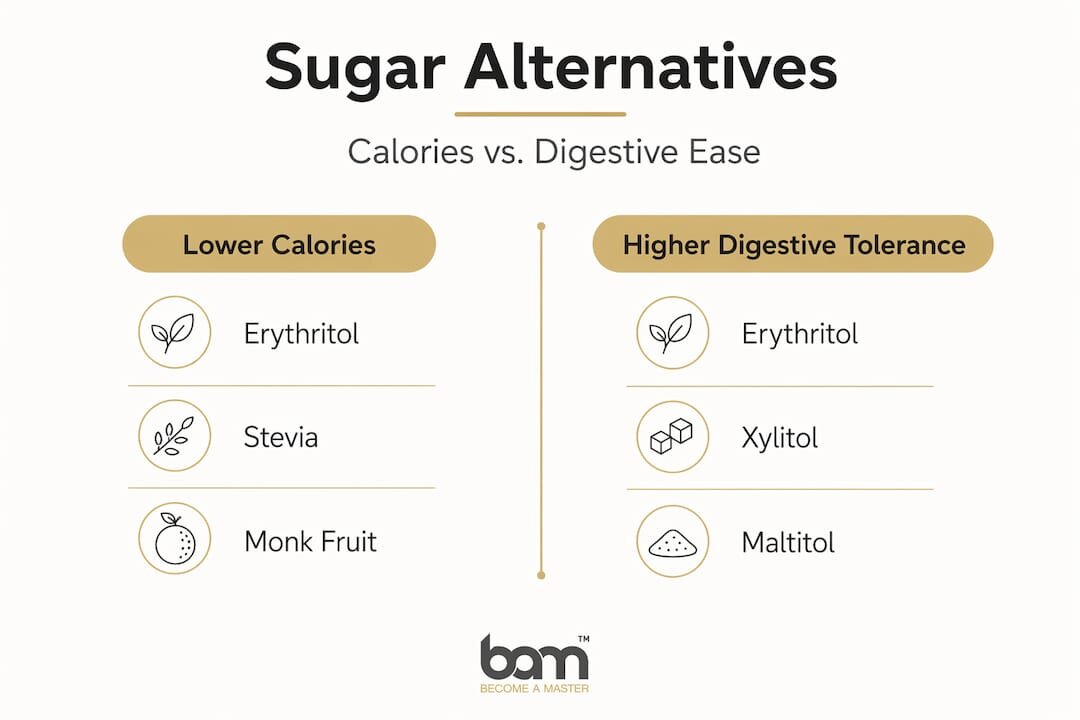
Stevia is derived from the leaves of the Stevia rebaudiana plant. It is intensely sweet, around 200 to 300 times sweeter than sucrose, and contributes no calories. Its slight bitterness at high concentrations is the main challenge for confectionery makers. Blending it with erythritol is a common solution. You can read more about natural sweetener benefits and how they compare to conventional sugar.
Sucralose is heat-stable, which makes it practical for baked confectionery. Monk fruit extract is gaining ground as a premium natural option with a cleaner flavour profile than stevia.
The choice of sweetener directly affects the texture and mouthfeel of the final product. Sugar alcohols provide bulk and a cooling sensation on the palate. Non-nutritive sweeteners alone cannot replicate the body that sugar gives to chocolate or a boiled sweet, which is why most products use a combination.
The sugar-free dessert market has moved well beyond simple sugar swaps. Modern products often include added fibre for satiety and texture, making them more nutritionally considered than earlier generations of sugar-free sweets.
Here is how to integrate sugar-free confectionery thoughtfully:
Pro Tip: When making sugar-free candy at home, use a combination of erythritol and a small amount of stevia. Erythritol provides the bulk and texture; stevia adds sweetness without the cooling aftertaste that erythritol alone can produce at higher concentrations.
For diabetics and those following calorie-conscious diets, sugar-free confectionery works best as an occasional treat within a well-structured eating plan, not as a daily staple consumed without thought.
I have worked with sugar-free ingredients long enough to have a clear opinion: the category is genuinely useful, but it is surrounded by wishful thinking.
The biggest mistake I see people make is treating “sugar-free” as a licence to eat more. They swap regular chocolate for sugar-free chocolate and then eat twice as much, wondering why their digestion is unhappy or their weight is not shifting. The label changes; the behaviour does not.
What has genuinely improved over the past few years is ingredient quality. Early sugar-free products leaned heavily on maltitol because it was cheap and behaved most like sugar. The aftertaste was noticeable and the digestive consequences were unpleasant. Today, better products use erythritol and stevia blends, and the difference in taste and tolerance is significant.
My practical advice: treat sugar-free confectionery as one specific tool in a broader approach to eating well. It is excellent for managing blood sugar, useful for dental health when xylitol is involved, and genuinely helpful for people on low-carb diets. For everyone else, it is a reasonable occasional swap, not a transformation. Read the label, start with small portions, and choose quality over quantity every time.
— Andraz
Bamchocolate stocks a curated selection of ingredients and product bundles suited to anyone making or enjoying sugar-free confectionery at home. Whether you are starting out or looking to expand your repertoire, the basic confectionery bundle covers the core ingredients you need for cleaner, better-tasting sugar-free treats. For more creative projects, the creamy fillings set and the large confectionery bundle offer broader ingredient selections suited to truffles, pralines, and filled chocolates. If you want to go further in the kitchen, the full range of baking accessories supports everything from tempering chocolate to moulding sugar-free sweets with professional results.
Sugar-free confectionery legally contains less than 0.5g of sugar per serving and uses alternative sweeteners such as erythritol, xylitol, stevia, or sucralose in place of conventional sugar.
Most sugar-free sweets are better suited to diabetics than regular confectionery, but not all are equal. Products containing maltitol still have a moderate glycaemic index, so checking the specific sweetener used is important.
Yes. Sugar alcohols such as maltitol can cause bloating, gas, and diarrhoea when consumed in excess. Erythritol is generally better tolerated, but individual thresholds vary and moderation applies to all sugar alcohols.
No. “No sugar added” means no extra sugar was introduced during processing, but natural sugars from ingredients like milk or fruit may still be present. Sugar-free refers to the total sugar content falling below 0.5g per serving.
Not always. Some sugar-free products are calorie-dense due to fat content and the caloric contribution of sugar alcohols like maltitol. Always check the full nutrition label rather than relying on the front-of-pack claim alone.



 Confectionery tips



 Slovenščina
 Hrvatski
 Deutsch
 Italiano
 Česky
Česky
 Polski
 Magyar
 Français
 Slovák
 Nederlands
 Español